FLOAT 100 · Coins · No. 45
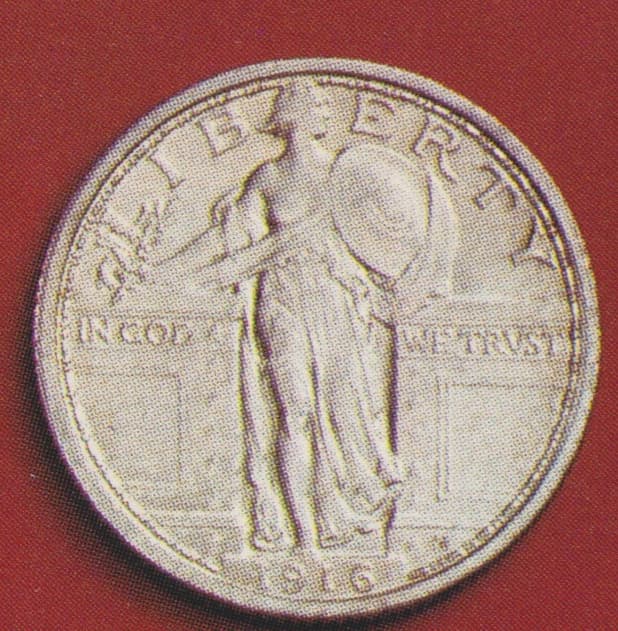
1916 Standing Liberty Quarter
Only 52,000 were struck in the last two weeks of 1916, the sculptor learned about them from a newspaper, the Mint locked them away after he complained, and the bare-breasted Liberty they carried lasted barely a year.
- Year
- 1916
- Maker
- U.S. Mint (Philadelphia), designed by Hermon MacNeil
- By price in coins
- 57 of 100
Create a free account to see every recorded price and every grade.
Create a free account- Denomination
- Quarter dollar (25 cents), silver
- Struck
- Late December 1916, Philadelphia Mint only (no mint mark)
- Released
- January 17, 1917, alongside the first 1917-dated quarters
- Designer
- Hermon Atkins MacNeil, sculptor
- Mintage
- 52,000, the lowest of the Standing Liberty series
- Type
- Type 1: Liberty's right breast uncovered, no stars below the eagle
- This entry
- Mint State with Full Head, meaning a complete strike on Liberty's head
- Finest known
- A PCGS MS67+ Full Head
- Auction record
- $207,400 for a PCGS MS67 Full Head on May 2, 2026
A coin made to meet a deadline that did not exist
Charles E. Barber's matching designs for the dime, quarter and half dollar had been in use since 1892 and were widely disliked. Federal law said a coin design could not be changed more often than once in 25 years. That allowed a change in 1916, but did not require one. When Robert W. Woolley took office as Director of the Mint in April 1915, he believed the law obliged the Mint to replace the designs, which the numismatic historian David Lange calls a misinterpretation of the coinage laws. The Treasury's own announcement on March 3, 1916, repeated it: designs "must be changed by law every 25 years."
Woolley showed sketches from Barber's engraving department to the Commission of Fine Arts on December 3, 1915. The Commission disliked them and chose three outside sculptors to compete: Adolph Weinman, Hermon MacNeil and Albin Polasek. On February 28, 1916, Weinman won the dime and half dollar, and MacNeil was given the quarter, at first only the obverse but in the end both sides.
What followed was a year of delays. MacNeil sent his models as bronze casts on May 18; Woolley approved the quarter on May 23. Pattern strikes in June looked indistinct, so MacNeil revised his obverse with dolphins for the Atlantic and Pacific, which Treasury Secretary William G. McAdoo approved on August 19. Then the Mint, already struggling with the new dime and half dollar, made major changes to MacNeil's design without telling him, dropping the dolphins and moving the eagle.
By the time working dies were ready, 1916 was nearly over. Only 52,000 quarters were struck, in the final two weeks of the year, partly as proof that the Barber design had been replaced in its 25th year. Barber quarters were still being made in quantity: 1916 was the Barber quarter's 25th year and it had a full mintage of 1,788,000.
MacNeil and the Liberty on the gate
Hermon Atkins MacNeil was born in Everett, Massachusetts, on February 27, 1866. He graduated from the Massachusetts Normal Art School in 1886, studied in Paris, helped prepare sketch models for the World's Columbian Exposition, spent 1896 to 1900 in Rome on a scholarship, and made his name with figures of Native Americans such as The Sun Vow. His later work includes Justice, the Guardian of Liberty on the east pediment of the U.S. Supreme Court building. He died on October 2, 1947.
His quarter shows Liberty striding through a gateway in a wall inscribed IN GOD WE TRUST, holding an olive branch and raising a shield. MacNeil described her as "stepping forward in... the defense of peace as her ultimate goal." She faces right, toward the war in Europe. The art historian Cornelius Vermeule compared her to the Athena of the Parthenon pediments. The reverse shows an eagle in flight, with seven stars on one side and six on the other on the 1916 version.
Who posed for Liberty is still disputed. From 1917 the model was said to be Doris Doscher, later a silent-film actress known as "the girl on the quarter." In 1972 newspapers reported that the real model was the Broadway actress Irene MacDowell, whose husband, one of MacNeil's tennis partners, had supposedly disapproved. No document settles it.
MacNeil's Liberty traveled beyond coinage: a version of her, with longer hair, served as Columbia Pictures' first logo from 1924 to 1927.
Locked in the vault
The 1916 quarter was born as the United States edged toward war. Europe had been fighting for more than two years, and MacNeil's guarded, armed Liberty spoke to a country that wanted peace but would defend itself.
Fearing the new coins would be hoarded, especially the low-mintage 1916, the new Mint Director, Friedrich von Engelken, ordered that none be released without his say. MacNeil, who had heard nothing from the Mint since his dolphin design was accepted, read in a newspaper in early January 1917 that his quarters were being struck. On January 6 he sent a $5 money order and received 20 coins. When he saw what had been done to his design, he wrote back so sharply that von Engelken kept the embargo in place, worried the Mint would be ridiculed if the complaints became public.
The quarters, dated both 1916 and 1917, finally went into circulation on January 17, 1917. No public notice announced the new design, so nearly all of the 1916s were spent. Because the 1917 coins were released at the same time and in far larger numbers, people who saved a new quarter usually saved a 1917, which is a large part of why the 1916 is scarce today.
MacNeil was then allowed to redo the design, assisted by the engraver George T. Morgan. His new version gave Liberty a chain-mail shirt and raised the eagle, adding three stars beneath it. Congress passed a law authorizing the change, and it took effect on July 9, 1917.
What makes a Full Head 1916
The 1916 carries the original Type 1 design: Liberty's right breast uncovered on the obverse and no stars below the eagle on the reverse. Every 1916 came from Philadelphia, so there is no mint mark. Type 1 coins were also struck early in 1917 at all three mints, so the date is what sets the 1916 apart.
The legend that Liberty was covered because of public outrage over her bare breast is not supported by the record. Roger W. Burdette's research found no contemporary documentation of a broad public outcry. Senators and congressmen debating the 1917 change talked about coins that would not stack and a design that was not true to the artist. Historians have suggested other factors, from Treasury objections to the wartime mood.
Full Head is a strike designation. Collectors want strong detail in Liberty's head, judged by the three leaves on her head and a complete hairline behind her eye. PCGS notes that 1916 quarters often have softly struck heads, unlike most 1917 Type 1 coins, and that Gem examples with full heads are rarer still; Ron Guth adds that in Gem condition a Full Head is actually the more likely find. A Full Head label does not replace eye appeal, luster and originality.
Most Mint State 1916s grade MS64, followed by MS63. One published estimate puts survivors at about 10,000 in all grades and about 500 in MS60 or better. Sources disagree about proofs: one PCGS note says proofs are extremely rare and that PCGS has graded none, while Wikipedia says the Standing Liberty quarter is the only 20th-century regular-issue U.S. coin for which no proofs were struck.
The record coins
The finest 1916 recorded by PCGS is an MS67+ Full Head. It sold for $89,125 in January 2000, for $149,500 in August 2010 and, three months later in November 2010, for $195,500.
Other MS67 Full Head coins have followed a similar path. The James W. Lull coin brought $143,750 in August 2006 and $146,875 in January 2015, then went to the D.L. Hansen collection. The Malibu Collection coin sold for $115,000 in November 2010, another brought $138,000 in August 2012, and another $135,125 in August 2017.
On May 2, 2026, a PCGS MS67 Full Head sold for $207,400, the current auction record for the date. The record for a 1916 without the Full Head designation is $50,400, set by a PCGS MS67 on August 31, 2025.
Lower Mint State Full Head coins trade regularly. In January 2026 two PCGS MS64 Full Heads each brought $28,060, and on March 10, 2026, a choice MS64 Full Head with delicate iridescent toning sold for $24,000.
The rarest regular quarter of its era
The 1916 has the second-lowest mintage of any regular-issue U.S. quarter of the 20th century; only the 1913-S Barber quarter, at 40,000, is lower. It is the key date of the Standing Liberty series, which ran until 1930. In circulation the date on later coins wore away so fast that in 1925 the Mint recessed it into the design. No quarters were struck in 1931, and in 1932 the Washington quarter replaced MacNeil's design.
The design has outlived its run. In 2015 the Mint announced a gold version of the original 1916 quarter, bare-breasted Liberty and all, for collectors; no more than 100,000 were struck at West Point. In 2026 the gold quarter is being issued again with a 1916 date and a special privy mark as part of the Mint's "Best of the Mint" series for the nation's 250th anniversary.
The numbers
- Mintage
- 52,000 (Philadelphia only)
- Known survivors
- One published estimate: about 10,000 in all grades, about 500 in MS60 or better
- Weight
- 6.30 grams
- Diameter
- 24.30 millimeters
- Composition
- 90% silver, 10% copper
- Edge
- Reeded
- Designer
- Hermon Atkins MacNeil
Timeline
Hermon Atkins MacNeil is born in Everett, Massachusetts.
Charles E. Barber's dime, quarter and half dollar designs are introduced.
Robert W. Woolley becomes Director of the Mint and starts the redesign.
The Commission of Fine Arts rejects the Mint's sketches and picks three outside sculptors.
MacNeil is told he will design the quarter.
The Treasury publicly announces new dime, quarter and half dollar designs.
Woolley formally approves MacNeil's quarter models.
Treasury Secretary McAdoo approves MacNeil's revised obverse with dolphins.
Friedrich von Engelken is sworn in as Mint Director.
The Mint strikes patterns with major changes to MacNeil's design, without consulting him.
The Philadelphia Mint strikes 52,000 quarters in the last two weeks of the year.
MacNeil, having read about the new coins in a newspaper, sends $5 and receives 20 quarters.
The first Standing Liberty quarters, dated 1916 and 1917, are released into circulation.
Chief Engraver Charles E. Barber dies at 77.
A law authorizing MacNeil's redesign, with Liberty in chain mail, takes effect.
The Mint recesses the date to stop it wearing away.
The Washington quarter replaces the Standing Liberty design.
MacNeil dies.
The finest known, a PCGS MS67+ Full Head, sells for $195,500.
The Mint announces a gold collector version of the 1916 quarter; no more than 100,000 are struck at West Point.
A PCGS MS67 Full Head sets the auction record for the date at $207,400.
The world in 1916
Pancho Villa's raiders attack Columbus, New Mexico; President Wilson sends troops into Mexico days later.
President Wilson signs a bill incorporating the Boy Scouts of America.
German agents blow up the Black Tom ammunition depot in Jersey City, New Jersey.
President Wilson signs legislation creating the National Park Service.
Piggly Wiggly, the first true self-service grocery store, opens in Memphis, Tennessee.
Margaret Sanger opens a birth control clinic in Brooklyn, the first of its kind in the U.S.
Woodrow Wilson narrowly wins reelection, and Jeannette Rankin of Montana becomes the first woman elected to the U.S. House.
Price record
| Date | Price | Kind |
|---|---|---|
| Jan 2000 | $89,125 | Sold at auctionPCGS MS67+ Full Head, finest known. |
| Aug 2006 | $143,750 | Sold at auctionPCGS MS67 Full Head, James W. Lull collection. |
| Aug 2006 | $44,850 | Sold at auctionPCGS MS66 Full Head. |
| Aug 2010 | $149,500 | Sold at auctionPCGS MS67+ Full Head, Dr. Brandon Smith collection; finest known. |
| Nov 2010 | $195,500 | Sold at auctionSame PCGS MS67+ Full Head, three months later. |
| Nov 2010 | $115,000 | Sold at auctionPCGS MS67 Full Head, Malibu Collection. |
| Aug 2012 | $138,000 | Sold at auctionPCGS MS67 Full Head, Just Having Fun Collection. |
| Jan 2015 | $146,875 | Sold at auctionPCGS MS67 Full Head, ex Lull, Sweet Bloomfield Collection. |
| Oct 29, 2015 | $39,950 | Sold at auctionPCGS MS66 Full Head. |
| May 2016 | $35,250 | Sold at auctionSame PCGS MS66 Full Head. |
| Aug 2017 | $135,125 | Sold at auctionPCGS MS67 Full Head. |
| Aug 31, 2025 | $50,400 | Sold at auctionPCGS MS67 without Full Head; record for the non-Full Head coin. |
| Jan 2026 | $28,060 | Sold at auctionPCGS MS64 Full Head (one of two that each brought this price in the same sale). |
| Jan 2026 | $34,160 | Sold at auctionNGC MS65 Full Head. |
| Jan 2026 | $39,040 | Sold at auctionNGC MS66 Full Head. |
| Mar 10, 2026 | $24,000 | Sold at auctionMS64 Full Head, iridescent obverse toning. |
| May 2, 2026 | $207,400 | Sold at auctionPCGS MS67 Full Head. Auction record for the date. |
| Jul 2026 | $15,860 | Sold at auctionNGC MS61 Full Head. |
A realized auction price is what a buyer actually paid on the date shown, including the buyer's premium where the sale reported it. It is the strongest kind of reference price, and it is a record of one sale of one object on one day, not a promise of what the next example will bring.
By reference price, 1916 Standing Liberty Quarter is number 57 of 100 in the coins entries of the FLOAT 100. 96 of those 100 rest on a realized sale; the rest carry an asking price or a guide value, and each page says which. Rank within the FLOAT 100 itself (45 here) is editorial: how much an object defines its field, not price alone.
Did you know
- The law only allowed a new quarter design in 1916; Mint officials mistakenly believed it required one, and rushed 52,000 coins out in the last two weeks of the year to prove it.
- MacNeil found out his quarter was being struck by reading a newspaper, then paid $5 for 20 of his own coins.
- The 1916 quarters were not released until January 17, 1917, so the coin's date was already a year old when the public first saw it.
- No document shows a public outcry over Liberty's bare breast; the debate in Congress was about stacking and the artist's intent.
- MacNeil's Liberty, with longer hair, was the first logo of Columbia Pictures from 1924 to 1927.
- Only one 20th-century regular-issue quarter has a lower mintage: the 1913-S Barber, at 40,000.
- MacNeil had first proposed dolphins at Liberty's feet to stand for the Atlantic and Pacific Oceans; the Mint dropped them without telling him.
- A century later the Mint struck the original 1916 design again, this time in gold.
How this page is made
- The figure
- One reference price, shown with its own kind. FLOAT does not average it with anything or adjust it for time.
- Realized or not
- A realized price is a completed sale. An asking price, an estimate and a price-guide value are not sales, and are labeled as such wherever they appear.
- The story
- Researched from published records and checked fact by fact. Updated Oct 1, 2026.
- Archive
- Oct 5, 2026