FLOAT 100 · Coins · No. 46
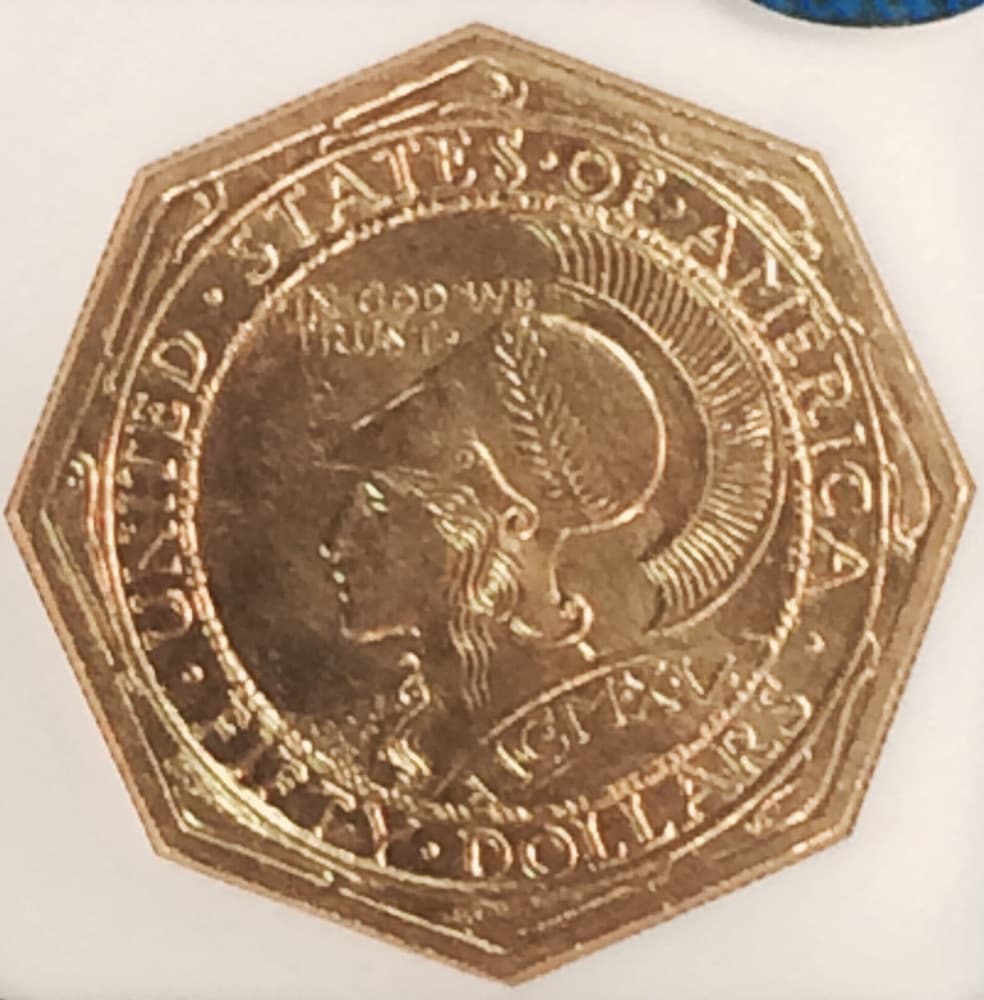
1915-S Panama-Pacific $50 Gold (Octagonal)
San Francisco, ten years after the earthquake, asked the Mint for a fifty-dollar gold coin shaped like a Gold Rush slug, and got the only non-round coin the United States would issue for more than a century.
- Year
- 1915
- Maker
- U.S. Mint (San Francisco)
- By price in coins
- 67 of 100
Create a free account to see every recorded price and every grade.
Create a free account- Struck
- From June 15, 1915, at the San Francisco Mint, on a hydraulic medal press shipped from Philadelphia
- Occasion
- Panama-Pacific International Exposition, San Francisco, February 20 to December 4, 1915
- Designer
- Robert Ingersoll Aitken: Minerva on the obverse, her owl on the reverse, eight dolphins in the border
- Denomination
- $50 in gold, sold at the fair for $100 each
- Struck vs. distributed
- 1,500 struck plus 9 assay pieces; 855 melted; about 645 distributed (sources vary on the exact figure)
- Specifications
- 83.59 grams, 90% gold and 10% copper, reeded edge
- Distinction
- The only non-round legal-tender U.S. coin until the Liberty Bell gold coins released July 16, 2026
- This entry
- The type as graded PCGS MS64, near Gem; most survivors grade around MS63
- Notable sale
- $288,000 for a PCGS MS66+ at auction in Tampa, January 4, 2018
A Gold Rush shape for a rebuilt city
In 1904 San Francisco merchant Rueben Hale proposed a world's fair for his city in 1915, to celebrate the opening of the Panama Canal and the 400th anniversary of Vasco Nunez de Balboa's first European sighting of the Pacific from the Americas. The 1906 earthquake and fire set the plans back only briefly, and in 1911 President William Howard Taft chose San Francisco over New Orleans. The Panama-Pacific International Exposition, built by the Golden Gate at a cost of $50 million, ran from February 20 to December 4, 1915, and drew about 19 million visitors.
The coin's shape reached back further. Before the San Francisco Mint opened in 1854, Augustus Humbert struck octagonal fifty-dollar pieces for the U.S. Assay Office in San Francisco. They were not legal tender, and were officially ingots, but they held their full value in gold, were called 'slugs' or 'quintuple eagles,' and passed at par with federal gold across the Far West. Before 1915 the only $50 piece the Mint itself had made was the experimental 1877 half union pattern.
Congress built that memory into the law. Senate bill 6309, introduced by New Jersey Senator James E. Martine on July 6, 1914, called for a half dollar, a gold dollar, a quarter eagle and two $50 pieces, one round and one octagonal, the octagonal one meant to recall the Gold Rush slugs. A House committee raised the combined authorized mintage of the two $50 coins from 2,000 to 3,000, and President Woodrow Wilson signed the bill on January 16, 1915.
Under the rules of the day the Mint did not sell commemoratives to the public. It sold them at face value to an organization named in the law, which resold them at a premium as a fundraiser. Here that was the Exposition company.
Robert Aitken and the goddess of wisdom
Mint Director George E. Roberts asked the Commission of Fine Arts to recommend sculptors and found Robert Ingersoll Aitken interested in the $50 pieces. Treasury Secretary William G. McAdoo approved Aitken on January 21, 1915, then on February 5 sent terse rejections to all four outside artists on the program. Aitken protested, met with McAdoo in Washington, agreed to changes, and his design was approved on March 6, 1915.
Aitken explained his choice: because the exposition 'stands for all that wisdom and industry have produced,' he used the head of Minerva, goddess of wisdom and skill, who also appears on the seal of California. Her crested helmet is pushed back to signal peace, and the date appears on her shield in Roman numerals, MCMXV, only the second use of Roman numerals on a U.S. coin after the early 1907 double eagles. Aitken dropped his first idea of writing '1915' because, he said, the design would never be used in another year.
The reverse shows Minerva's owl on a pine branch with cones; Kevin Flynn identified it as ponderosa pine. On the octagonal coin the central design is smaller than on the round one, to leave room for a border of dolphins, which Aitken said 'express the uninterrupted water route made possible by the canal.' Each side carries eight of them.
Not everyone was charmed. Some critics joked that the dolphins implied the canal had been built for their convenience, and a 1916 column in the American Journal of Numismatics agreed that 'there is nothing American about the coin except the inscription.' Later judges were kinder: Cornelius Vermeule called the $50 pieces 'a tour de force,' and Jeff Garrett and Ron Guth named them 'one of the most stunning issues ever produced by the U.S. government.'
Striking the biggest coin in America
The bronze casts went to a private firm in New York, the Medallic Art Company, which made the hubs faster than the Mint could; the Panama-Pacific coins are the first American coins known to have been struck from privately made hubs. Dies were then cut at Philadelphia. When the first dies reached San Francisco without an 'S' mintmark, new Mint Director Robert W. Woolley sent them back, worried that people would assume the coins came from Philadelphia. Dies for the $50 pieces left Philadelphia on May 14, 1915.
San Francisco's presses could not handle a coin this large, so a hydraulic medal press was shipped west. On June 15, 1915, Mint Superintendent T. W. H. Shanahan struck the first octagonal piece, for exposition president Charles C. Moore. Nine more were struck by dignitaries including Congressman Julius Kahn. After that, anyone present with $100 could strike his or her own coin, and at least three people did, among them the acting Mint director's wife and the local postmaster.
Each $50 piece holds 2.4286 troy ounces of gold. They were the largest and heaviest coins the United States had issued, a distinction they held until the 2010 silver bullion coins, and they stood for many years as the highest U.S. denomination, matched by the $50 gold bullion coin in 1986 and surpassed by the $100 platinum coin in 1997.
The fair itself was a success, earning enough to build the San Francisco Civic Auditorium with about $1 million left over. The Palace of Fine Arts is the only building still standing on the site.
A $100 souvenir and a brutal melt
The Exposition hired Farran Zerbe, a former American Numismatic Association president and a controversial promoter, to sell the coins at his 'Money of the World' exhibit. He had no coins at all until May, and many fairgoers, surrounded by souvenir medals and replica pioneer gold, doubted his were official. The $50 pieces sold for $100 each. A four-coin set with a choice of $50 cost $100 and a five-coin set $200, and copper frames holding two of each coin were said to cost $400, though one modern researcher suspects those went to dignitaries.
Sales of the big gold coins were slow. The octagonal outsold the round, helped by its Gold Rush shape and, according to Swiatek, because people liked the dolphins. Zerbe kept selling by mail until at least November 1916 and bought an unknown number for his own stock. The rest went back to the Treasury. Of 1,500 octagonal coins, 855 were melted, leaving about 645 distributed, the second-lowest distribution of any U.S. commemorative after the round $50 at about 483. Sources differ on the exact figures.
Nine extra octagonal pieces went to Philadelphia for the 1916 Assay Commission. Commission members traditionally could buy unused test coins at face value and asked to; Woolley refused, and those coins were melted too.
In modern markets the coin has become a trophy. A PCGS MS66+ from the Burgess Lee Berlin collection brought $288,000 at auction in Tampa on January 4, 2018, the same night a round $50 in MS66 brought $204,000. An MS66 realized $180,000 at auction in spring 2022, and an NGC MS65 sold for $168,918.75 at an online auction on December 28, 2025.
Reading an octagonal $50
The coin weighs 83.59 grams and is 90% gold and 10% copper with a reeded edge. Published widths differ: one reference gives 44.9 millimeters across, while a leading grading service lists 46.00 millimeters. The 'S' mintmark is on the reverse beside the rightmost pine cone, directly above the 'O' in 'San Francisco.' The $50 pieces and the half dollar were the first commemoratives to carry 'In God We Trust,' and the Panama-Pacific set was the first commemorative issue struck at a branch mint.
The coins were never meant to circulate, but heavy soft gold marks easily, and most were handled. Ron Guth writes that the vast majority of survivors are Mint State, usually MS63, that Gems are very rare, and that the best examples top out at MS66. MS64, the grade of this entry, sits just below Gem and is where a well-preserved coin becomes hard to find. A few more Gem examples are known of the octagonal than of the round.
Price lists for the type are crowded with sales in the MS61 to MS64 range. Coins approved by an independent sticker service and coins with even, satiny luster draw the most interest.
111 years outside the circle
For more than a century the octagonal $50 stood alone as the only non-round legal-tender coin issued by the United States Mint. That changed with the Mint's Semiquincentennial program: Liberty Bell-shaped gold coins in $250 and $125 denominations went on sale on July 16, 2026.
The coin is listed in Garrett and Guth's '100 Greatest U.S. Coins.' Its pull comes from the stories it carries at once: the Gold Rush slugs it echoes, the canal its dolphins celebrate, a city back on its feet after 1906, and a souvenir that cost twice its face value and was mostly melted.
The numbers
- Mintage
- 1,500 struck plus 9 for assay; 855 melted
- Distributed
- About 645 (sources vary on the exact number)
- Known survivors
- No verified census figure; most survivors are Mint State, typically MS63, and the finest reach MS66
- Weight
- 83.59 grams (2.4286 troy ounces of gold)
- Width
- 44.9 mm across per one reference; 46.00 mm per a grading-service listing
- Composition
- 90% gold, 10% copper
- Edge
- Reeded
- Designer
- Robert Ingersoll Aitken
- Mint
- San Francisco; 'S' mintmark on the reverse
Timeline
Augustus Humbert's octagonal $50 'slugs' for the U.S. Assay Office in San Francisco set the shape the 1915 coin would echo.
San Francisco merchant Rueben Hale proposes a 1915 exposition.
President Taft chooses San Francisco over New Orleans to host the fair.
Congressman Julius Kahn introduces H.R. 16902 for exposition coins.
Senator James E. Martine introduces S. 6309, calling for round and octagonal $50 pieces.
A House committee raises the combined $50 mintage from 2,000 to 3,000.
President Wilson signs the authorizing act.
Treasury Secretary McAdoo approves Robert Aitken for the $50 pieces.
McAdoo rejects the outside artists' first designs.
The Panama-Pacific International Exposition opens.
Aitken's revised $50 designs are approved.
Dies for the $50 pieces are sent from Philadelphia to San Francisco.
The first octagonal $50 is struck on a hydraulic press for exposition president Charles C. Moore.
The exposition closes; mail sales continue.
The Assay Commission meets; the nine extra octagonal assay coins are later melted.
Zerbe is still selling coins for the exposition; unsold pieces are eventually melted, leaving about 645 octagonal coins distributed.
The Mint's $50 gold bullion coin matches the 1915 denomination.
A $100 platinum coin surpasses the $50 as the highest U.S. denomination.
A PCGS MS66+ octagonal brings $288,000 at auction in Tampa.
The Mint releases its Liberty Bell-shaped gold coins, ending the octagonal's run as the only non-round U.S. coin.
The world in 1915
D. W. Griffith's The Birth of a Nation premieres in Los Angeles.
The Panama-Pacific International Exposition opens in San Francisco.
A German U-boat sinks the Lusitania, killing 1,198.
Lassen Peak erupts in Northern California.
The steamer Eastland capsizes in Chicago, killing 844.
The U.S. occupation of Haiti begins.
The millionth Ford car rolls off the line in Detroit.
President Wilson marries Edith B. Galt.
Price record
| Date | Price | Kind |
|---|---|---|
| 1915 | $100 | Asking price, not a saleIssue price at the exposition for one $50 piece, twice face value. |
| Jan 4, 2018 | $288,000 | Sold at auctionPCGS MS66+, Burgess Lee Berlin collection, sold at auction in Tampa. |
| 2022 | $180,000 | Sold at auctionMS66, realized $180,000 at a spring 2022 auction. |
| Dec 28, 2025 | $168,919 | Sold at auctionNGC MS65; realized $168,918.75 at an online auction. |
A realized auction price is what a buyer actually paid on the date shown, including the buyer's premium where the sale reported it. It is the strongest kind of reference price, and it is a record of one sale of one object on one day, not a promise of what the next example will bring.
By reference price, 1915-S Panama-Pacific $50 Gold (Octagonal) is number 67 of 100 in the coins entries of the FLOAT 100. 96 of those 100 rest on a realized sale; the rest carry an asking price or a guide value, and each page says which. Rank within the FLOAT 100 itself (46 here) is editorial: how much an object defines its field, not price alone.
Did you know
- Anyone present at the San Francisco Mint with $100 was allowed to strike his or her own octagonal $50 after the first ten were made.
- The first dies arrived without an 'S' mintmark on purpose, and the Mint director sent them back so San Francisco would get credit.
- Each side's border holds eight dolphins, meant to stand for the unbroken water route the Panama Canal opened.
- The date is in Roman numerals because Aitken knew the design would never need to be changed for another year.
- Members of the 1916 Assay Commission asked to buy the leftover test coins at face value. They were refused, and the coins were melted.
- Contemporary critics joked that the dolphins made it look as if the canal had been dug for them.
How this page is made
- The figure
- One reference price, shown with its own kind. FLOAT does not average it with anything or adjust it for time.
- Realized or not
- A realized price is a completed sale. An asking price, an estimate and a price-guide value are not sales, and are labeled as such wherever they appear.
- The story
- Researched from published records and checked fact by fact. Updated Oct 1, 2026.
- Archive
- Oct 5, 2026