FLOAT 100 · Coins · No. 38
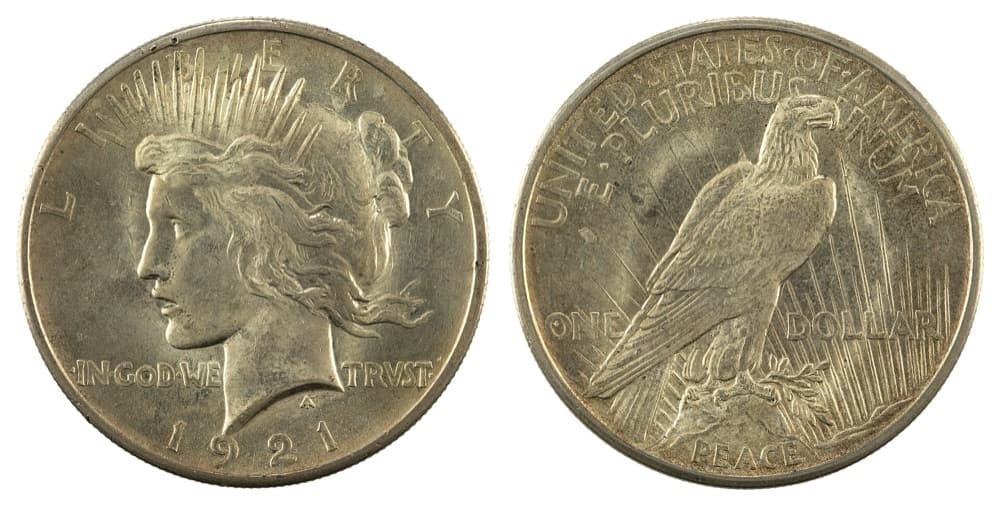
1921 Peace Dollar (High Relief)
Designed in a few weeks by a 34-year-old sculptor who modeled Liberty on his wife, stripped of a broken sword by hand two days before Christmas, and struck in relief so high the dies kept breaking, the 1921 Peace dollar lasted one year before the Mint flattened it.
- Year
- 1921
- Maker
- U.S. Mint (Philadelphia), designed by Anthony de Francisci
- By price in coins
- 99 of 100
Create a free account to see every recorded price and every grade.
Create a free account- Struck
- Last days of December 1921, Philadelphia Mint only (no mintmark)
- Mintage
- 1,006,473
- Designer
- Anthony de Francisci, chosen unanimously in an invited competition; Liberty modeled on his wife, Teresa
- Specifications
- 26.73 grams, 38.1 mm, 90% silver and 10% copper
- Type
- High Relief: a one-year design, replaced by a lower-relief version in 1922
- Released
- January 3, 1922
- Survivors
- About 100,000 in all grades, 40,000 Mint State and 5,000 at MS65 or better, by expert estimate
- This entry
- The type as graded PCGS MS65, the Gem level where specialists call the coin rare
- Top sale
- $132,000 for a PCGS MS67 at auction in August 2018
A coin to celebrate the peace
The Peace dollar began with silver sent to war. During World War I, German propaganda spread rumors in India that Britain could not redeem its paper money there for silver, and a run on silver followed. Britain asked its American ally for help, and the Pittman Act of April 1918 let the United States melt silver dollars and sell the metal. More than 270 million were melted, 47 percent of all Morgan dollars struck to that point. The law also required the Treasury to strike new dollars to replace them, and on May 9, 1921, the Philadelphia Mint resumed striking Morgan dollars.
Collectors had other ideas. A November 1918 article in The Numismatist by Frank Duffield proposed a victory coin "issued in such quantities it will never become rare." In August 1920 a paper by Farran Zerbe was read to the American Numismatic Association convention in Chicago: "we gave our silver dollars to help win the war, we restore them in commemoration of victory and peace." The historian Walter Breen called the campaign that followed apparently the first time a coin collector "ever wielded enough political clout to influence not only the Bureau of the Mint, but Congress as well."
A bill to authorize a peace coin stalled in the House on August 1, 1921, when one representative objected. By November, supporters realized they did not need Congress at all: the Morgan design was more than 25 years old, so under an 1890 law the Treasury Secretary could replace it on his own authority. According to historian Roger Burdette, Mint Director Raymond T. Baker's new enthusiasm came because President Harding was about to formally declare an end to the war with Germany, and the Washington disarmament conference was soon to convene.
The sculptor and his wife
The Commission of Fine Arts ran an invitation-only competition. On November 19, 1921, sculptor James Earle Fraser, designer of the Buffalo nickel, notified the entrants, with designs due December 12. The field included Hermon MacNeil, Victor D. Brenner and Adolph Weinman, all of whom had designed earlier American coins. The winner would get $1,500; everyone else, $100. On December 13 the commission unanimously chose Anthony de Francisci.
At 34, de Francisci was the youngest entrant and among the least experienced. His only Mint work had been turning someone else's drawings into models for the 1920 Maine centennial half dollar, a job of which he later said, "I do not consider it very favorably." With no time to hire a model, he based Liberty on his wife, Teresa, born Teresa Cafarelli in Naples. As a five-year-old immigrant passing the Statue of Liberty, she had struck the statue's pose for her family. "And now seeing myself as Miss Liberty on the new coin," she wrote to her brother Rocco, "it seems like the realization of my fondest childhood dream." De Francisci opened the studio window so the wind would blow her hair as he worked, though he said the finished face had been elongated and was not hers alone.
Liberty wears a radiate crown that, in Breen's words, was "more explicitly intended to recall that on the Statue of Liberty." For the reverse, de Francisci offered two eagles: one aggressively breaking a sword, and one at rest holding an olive branch. The calm eagle won, with the word PEACE. President Harding saw the designs on December 19 and asked for one change: a small feature of Liberty's face that looked to him like a dimple, which he did not consider suggestive of peace.
The broken sword
Baker had asked de Francisci to add the broken sword from his alternate design, placed under the eagle on its mountaintop, alongside the olive branch. The Treasury announced the design on December 19, 1921, and Secretary Andrew Mellon approved it on December 20. Because the Treasury then believed it was illegal for newspapers to print photographs of a U.S. coin, papers ran photos of Baker and de Francisci examining the plaster model, along with written descriptions; a Mint press release described an eagle "perched on a broken sword."
On December 21 the New York Herald attacked: "A sword is broken when its owner has disgraced himself. It is broken when a battle is lost." Letters of protest poured in. De Francisci defended the symbol, but with Baker on a three-day train trip to San Francisco, Acting Mint Director Mary Margaret O'Reilly and Treasury Undersecretary Seymour Parker Gilbert approved removing the sword. A press release late on December 24 announced the change, and the Herald took full credit the next day.
The hub had already been made, so the sword had to be cut out of it. On December 23, with de Francisci watching, Chief Engraver George T. Morgan, the designer of the dollar being replaced, worked on the hub with extremely fine tools under magnification. He extended the olive branch to hide the gap, removed a bit of stem, strengthened the rays and sharpened the eagle's leg. His work was so skillful that it went unnoticed for more than 85 years.
Too beautiful to strike
On December 28, 1921, the Philadelphia superintendent wired Baker that the first Peace dollars had been struck. The Mint reported 1,006,473 pieces for 1921, a rate for the last days of the year that historian Roger Burdette calls "amazing"; he speculates that striking of 1921-dated coins ran into 1922. Q. David Bowers, writing in 1993, put the whole production between December 26 and 31. The fate of the first coin, meant for President Harding, is a mystery; it is not mentioned in his papers or the inventory of his estate.
The coins went into circulation on January 3, 1922, and the 75,000 sent to New York's Federal Reserve Bank were practically gone by the end of the next day. One press account declared Liberty had "lost her Greek profile" for the new "flapper" type. De Francisci had bought 50 coins through Morgan, and used them to pay off bets he had made that he would lose the competition.
The high relief was the problem. Bringing up the design took excessive pressure, and dies broke quickly. Some accounts say the coins stacked poorly because of uneven thickness and raised fins at the rim, though bank cashiers demonstrated for The New York Times that they stacked about as well as Morgans. On January 10, 1922, O'Reilly halted production. After repeated attempts to fix the problem without changing the design failed, de Francisci agreed to lower the relief, and the new low-relief dollars went into production in February 1922. About 32,400 coins struck in January 1922 in a compromise higher relief were believed melted; one circulated example has surfaced.
Unlike every later Peace dollar date, the 1921 never turned up in quantity. Bowers wrote that he had never heard of an original 1,000-coin mint bag coming onto the market and had never even seen an original Mint State roll of 20. The public kept them as novelties, so they turn up in ones, twos and threes in old accumulations. As late as June 1934, The Numismatist reported that collectors could still buy uncirculated 1921 Peace dollars for face value plus first-class postage.
Reading a High Relief
The 1921 is easy to tell from later Peace dollars once you know where to look. Both sides are in higher relief, and the obverse fields are more concave. The rays above Liberty's head are thicker, without the three very short rays seen between the first four long rays on later dates. On the reverse, the leaves and branch are arranged slightly differently, as are the distant mountains at lower right and the count of the rays. The die variety catalog calls the main variety VAM-1; VAM-2, with the letters of PEACE slightly doubled, is a little scarcer. Some coins have the reverse die rotated about 20 degrees counterclockwise, and these are rare.
Strike is everything at the top grades. Bowers estimated that 99 percent or more are lightly struck on the hair at the center of the obverse, often with weakness at the center of the reverse too, and that fewer than 10 in 1,000 are sharply struck. A weak spot often shows a subdued white frost, the original surface of the blank. Most Mint State coins fall in MS60 to MS62. MS63 is easy to find; MS64 is elusive; and MS65, the grade this entry tracks, is rare. David Hall, founder of the grading service that recognized the date as its own type, has called it "one of America's all-time classic coin issues" and added, "In MS-65 it is rare." He has also written that any Peace dollar with rainbow toning is, in his view, artificially toned.
For decades collectors filed the 1921 under the general Peace dollar heading. After the grading service launched in 1986, its founders began listing the 1921 as a separate type coin, and the hobby followed. That status is now firm: it is a 20th-century, one-year type, likened to the 1907 High Relief double eagle.
The proofs and the long afterlife
A few proofs were struck early in the 1921 run, in satin and matte (sandblast) finishes. Sources disagree on how many. Historians Leroy Van Allen and A. George Mallis estimated 24 satin and five matte proofs; the grading service's record lists a satin-finish mintage of eight and estimates five survivors. A satin-finish proof graded PR66 brought $264,000 at auction on February 5, 2025.
The finest business strikes are four PCGS MS67 coins. One sold for $24,150 in June 2002 and then for $132,000 in August 2018, the auction record for the date. Another, from the Dr. and Mrs. Michael DeMicco Collection, brought $70,500 in August 2015; a third, from the Burgess Lee Berlin Collection, brought $111,000 in January 2018. The fourth is in the Bob R. Simpson Collection.
De Francisci's design survived the flattening and was struck through 1928 and again in 1934 and 1935, the last circulating U.S. dollar coin in 90 percent silver. The Mint struck 316,076 Peace dollars dated 1964 at Denver in 1965, all of which were reported melted. In 2021 the Mint struck a new Peace dollar for the design's 100th anniversary, alongside a revived Morgan. For the original, Bowers in 1993 quoted and endorsed an older verdict: "Fully struck 1921 Peace dollars are very rare and always command a premium."
The numbers
- Mintage
- 1,006,473 business strikes; satin and matte proofs in disputed small numbers
- Known survivors
- Expert estimate: 100,000 in all grades, 40,000 MS60 or better, 5,000 MS65 or better. Q. David Bowers (1993): 50,000 to 90,000.
- Weight
- 26.73 grams
- Diameter
- 38.1 mm (1.5 inches)
- Composition
- 90% silver, 10% copper
- Designer
- Anthony de Francisci; Liberty modeled on Teresa de Francisci
- Dies
- 41 obverse dies prepared; reverse count unknown
- Mint
- Philadelphia only; no mintmark
Timeline
The Pittman Act authorizes melting up to 350 million silver dollars and requires their replacement.
Frank Duffield proposes a victory coin in The Numismatist.
Farran Zerbe's paper calling for a peace coin is read at the ANA convention in Chicago.
A House committee hears the peace coin proposal.
The Philadelphia Mint resumes striking Morgan dollars; a peace dollar bill is introduced the same day.
The bill fails when one representative objects to unanimous consent.
James Earle Fraser invites sculptors to the design competition.
The Commission of Fine Arts unanimously selects Anthony de Francisci's design.
The Treasury announces the design; President Harding asks for a dimple to be removed.
The New York Herald attacks the broken sword on the reverse.
George T. Morgan removes the sword from the hub by hand, with de Francisci watching.
A press release announces the broken sword will not appear on the coin.
The first Peace dollars are struck at Philadelphia.
The 1921 Peace dollar is released into circulation.
Production is halted because the high-relief dies break too quickly.
Low-relief Peace dollars enter production at all three mints.
The Numismatist reports uncirculated 1921 Peace dollars still available at face value plus postage.
A PCGS MS67 sells for $24,150.
The same MS67 brings $132,000, the auction record for the date.
A satin-finish 1921 proof, PR66, brings $264,000 at auction.
The world in 1921
Charlie Chaplin's The Kid is released.
Warren G. Harding is sworn in as the 29th president.
The Emergency Quota Act sets national quotas on immigration.
The Tulsa Race Massacre begins as white mobs attack the Greenwood District of Tulsa, Oklahoma.
Harding signs a joint resolution ending America's state of war with Germany, Austria and Hungary.
The first radio broadcast of a baseball game airs from Pittsburgh's Forbes Field.
The Tomb of the Unknowns is dedicated at Arlington National Cemetery.
The U.S., Japan, Britain and France sign the Four Power Treaty on the Pacific.
Price record
| Date | Price | Kind |
|---|---|---|
| Jun 2002 | $24,150 | Sold at auctionPCGS MS67, one of four finest known. |
| Aug 2015 | $70,500 | Sold at auctionPCGS MS67, Dr. and Mrs. Michael DeMicco Collection. |
| Jan 2018 | $111,000 | Sold at auctionPCGS MS67, Burgess Lee Berlin Collection. |
| Aug 22, 2018 | $132,000 | Sold at auctionPCGS MS67, the same coin as the 2002 sale; auction record for the date. |
A realized auction price is what a buyer actually paid on the date shown, including the buyer's premium where the sale reported it. It is the strongest kind of reference price, and it is a record of one sale of one object on one day, not a promise of what the next example will bring.
By reference price, 1921 Peace Dollar (High Relief) is number 99 of 100 in the coins entries of the FLOAT 100. 96 of those 100 rest on a realized sale; the rest carry an asking price or a guide value, and each page says which. Rank within the FLOAT 100 itself (38 here) is editorial: how much an object defines its field, not price alone.
Did you know
- The eagle was meant to stand on a broken sword. Public outrage got it removed, and George T. Morgan cut it out of the hub by hand.
- Morgan's careful erasure went unnoticed for more than 85 years.
- President Harding had a small dimple removed from Liberty's face because it did not seem suggestive of peace.
- De Francisci bet friends he would lose the competition, then paid them off with new Peace dollars.
- A leading Peace dollar historian never heard of an original 1,000-coin bag of 1921 Peace dollars reaching the market.
- In 1934 collectors could still buy uncirculated 1921 Peace dollars for face value plus postage.
- The Treasury at the time held that printing a photograph of a U.S. coin in a newspaper was illegal, so papers showed the plaster model instead.
How this page is made
- The figure
- One reference price, shown with its own kind. FLOAT does not average it with anything or adjust it for time.
- Realized or not
- A realized price is a completed sale. An asking price, an estimate and a price-guide value are not sales, and are labeled as such wherever they appear.
- The story
- Researched from published records and checked fact by fact. Updated Oct 1, 2026.
- Archive
- Oct 5, 2026