FLOAT 100 · Coins · No. 39
1907 High Relief Double Eagle (Wire Rim)
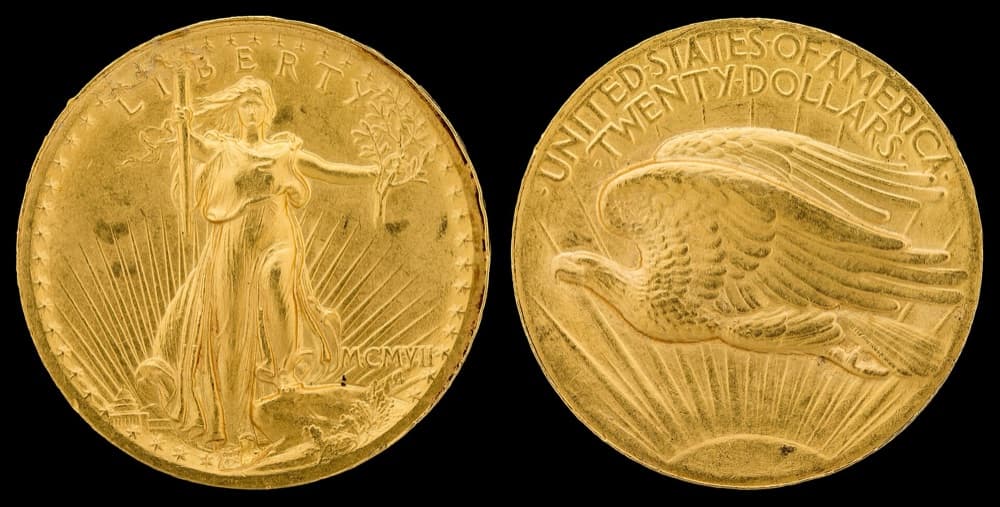
A president who called American coins "atrocious hideousness" and a dying sculptor forced the Mint to strike a $20 piece it said could not be made, and a loose collar on the press left a thin ridge of gold that collectors now pay a premium to own.
- Year
- 1907
- Maker
- U.S. Mint (Philadelphia), designed by Augustus Saint-Gaudens
- By price in coins
- 77 of 100
Create a free account to see every recorded price and every grade.
Create a free account- Struck
- Late 1907, Philadelphia Mint, on a medal press rather than a regular coining press
- Designer
- Augustus Saint-Gaudens, with his assistant Henry Hering; the Mint's chief engraver was Charles E. Barber
- Date
- Roman numerals, MCMVII, a choice President Theodore Roosevelt defended against his own Treasury Secretary
- Strikes per coin
- Three to five blows of the press, by most accounts; ordinary coins took one
- Mintage
- Sources differ: 11,250 (one grading service), 12,367 (the standard reference figure), 12,153 delivered within about 30 days (the Mint Director's memoir)
- Wire Rim share
- At least two-thirds of the High Relief mintage, by two estimates; the Flat Rim is two to three times as rare
- What the Wire Rim is
- A thin raised fin of gold where the coin met a loose collar; the Mint saw it as a striking flaw
- This entry
- $20 gold, High Relief, Wire Rim, graded PCGS MS65
- Finest known
- One example graded MS69 by PCGS and one by NGC (October 2024 counts)
- Ranking
- No. 25 in the 2019 fifth edition of 100 Greatest U.S. Coins by Jeff Garrett and Ron Guth
A president's war on ugly money
On December 27, 1904, President Theodore Roosevelt wrote to his Treasury Secretary, Leslie Mortier Shaw: "I think the state of our coinage is artistically of atrocious hideousness. Would it be possible, without asking permission of Congress, to employ a man like Saint-Gaudens to give us a coinage which would have some beauty?" The sculptor Augustus Saint-Gaudens was a personal friend. Coin designs that had been in use for 25 years could be changed without an act of Congress, so Roosevelt had the Mint engage him to redesign the cent and the four gold coins. No U.S. coin had ever been designed by anyone outside the Mint.
Saint-Gaudens had reason to distrust the Mint. In 1892 his design for the reverse of the World's Columbian Exposition medal, a nude youth carrying wreaths, was attacked as obscene and replaced with one by Chief Engraver Charles E. Barber. Saint-Gaudens swore to have nothing more to do with the Mint and for a decade refused any commission that might involve it. He accepted Roosevelt's request anyway, predicting resistance from Barber, who, he wrote, "has been in that institution since the foundation of the government, and will be found standing in its ruins."
Roosevelt had been studying the gold coins of ancient Greece, and in November 1905 he suggested the new designs be in high relief, with a high rim to protect them. Saint-Gaudens agreed. In January 1906 the Mint Director, George E. Roberts, warned that "the judgement of the authority of all countries is that modern coins must be of low relief," but the President overruled him. Roosevelt also overruled Shaw on the date: the Secretary wanted English numbers, not Roman numerals, but the coin would read MCMVII.
The obverse shows Liberty, who also stands for victory, striding forward with a torch in one hand and an olive branch in the other, the Capitol behind her and 46 stars around her, one for each state in 1907. Saint-Gaudens adapted the figure from his monument to General William Tecumseh Sherman in New York; his ultimate model was the Nike of Samothrace. The reverse shows an eagle in flight over a rising sun. With no room for a third line of text on either side, E PLURIBUS UNUM went on the edge, and IN GOD WE TRUST was left off entirely, at Roosevelt's request.
The coin the Mint said could not be made
Saint-Gaudens was dying of cancer through 1906 and left much of the work to his assistant, Henry Hering. He had the models made in Paris, not at the Mint, to keep the Mint from obstructing them. The first dies, struck on the Mint's medal press at maximum pressure, needed up to nine blows to bring up the design, and roughly two dozen of those pieces, today's Ultra High Relief patterns, were all that came of them. On May 8, 1907, Roosevelt told the sculptor it had "proved hitherto impossible to strike them by one blow." Saint-Gaudens answered, "Evidently it is no trifling matter to make Greek art conform with modern numismatics."
A second set of dies, with the relief somewhat reduced, still needed three blows. Saint-Gaudens died on August 3, 1907, while Hering was working on a third model. Roosevelt ordered the Mint to finish the coin and have it in circulation by September 1; Barber, recalled from vacation, replied that what the President wanted was impossible, and when Hering finally brought new models in late September, Barber rejected them as uncoinable.
The new Mint Director, Frank A. Leach, formerly superintendent of the San Francisco Mint, took up the post that fall; one account says by October 1, another gives November 1, 1907. On November 18 Roosevelt ordered the second set of dies put into use, telling the Mint to "begin the new issue, even if it takes you all day to strike one piece!" Leach wrote in his memoir that the Mint delivered 12,153 of the double eagles to the Treasurer within about 30 days. Barber, sending two finished pieces to the Philadelphia superintendent, wrote that they were "so well made that I fear the President may demand the continuance of this particular coin."
Meanwhile Barber produced his own low-relief version for mass production, with an Arabic date, and 361,667 of those were struck in 1907. Saint-Gaudens's family and Hering denounced the changes. In 1908 an "outraged and furious" Congress, as the historian Walter Breen put it, ordered IN GOD WE TRUST restored. The High Relief, with its Roman date, was released into circulation in 1907 and 1908.
The wire rim, and how to read one
Every High Relief double eagle was struck several times on a hydraulic medal press, typically three to five blows with inspection between impressions. Where the collar holding the blank was not tight enough, the repeated pressure forced gold up into the gap between collar and die, leaving a thin raised ridge around the edge. The Mint called it a "fin." Collectors call it the wire rim. On most examples it runs around the whole coin, on both sides.
It was an accident, not a design. The numismatist David Akers stressed that the Wire Rim and Flat Rim are not two intended varieties but the products of two different collars. A tighter collar introduced around mid-December 1907 largely ended the fin, and coins struck after it have a flat, sometimes beveled, edge. Akers estimated that two-thirds to three-quarters of all High Reliefs are Wire Rims and that the Flat Rim is at least two to three times as rare.
Because each coin took several blows, High Reliefs are almost always fully struck. Akers described most as very frosty, many as satiny with raised die swirls in the fields, and the usual color as light to medium greenish gold, with a few showing a coppery hue. The date is in Roman numerals, MCMVII; the low-relief coins that replaced it carry an Arabic 1907.
Counterfeits exist. A group of fakes known as the Omega counterfeits began circulating at the 1971 American Numismatic Association convention in Washington, D.C., and were studied in 1973 by the authenticator F. Michael "Skip" Fazzari. They show tooling marks on the ray above the first M of the date, in Liberty's hair on the right side of her head and between the M and E of AMERICA, and they carry a tiny omega symbol, the counterfeiter's signature, between the eagle's talon and tail feathers.
Saved from the start
The High Relief is much more common than its mintage, which Akers called the lowest of the Saint-Gaudens series, would suggest. People saved it for its beauty and novelty. Akers noted that most survivors are uncirculated, and that circulated pieces usually got their wear as jewelry or pocket pieces rather than in commerce. Shortly after release the coins sold for about $30, half again their face value; as the Depression took hold, the price fell to just over $20.
Survival estimates differ. The grading service PCGS estimates about 8,000 Wire Rims survive, about 725 of them in grade 65 or better. Other estimates put the total for both rim varieties combined at about 6,000, roughly half the mintage. Akers called the Wire Rim, relative to its rarity, the highest-priced coin in the American series.
Individual coins have long, traceable histories. One example graded MS64 was sold by a dealer, Roman Lester, to a buyer named George Carlin on May 6, 1966, for $825; it came back to market in March 2024 with the original canceled check and brought $31,200. The finest PCGS example, graded MS69, passed from the Ed Trompeter collection to the Phillip H. Morse collection in a private sale in 1999 and sold three times at auction between 2005 and 2008, for $575,000, $546,250 and $517,500.
An MS67 example is thought to have come from Chief Engraver Barber himself, by way of a cased set of seven double eagles and four eagles assembled by Captain Andrew North. In April 1980 that set sold privately, intact, for $1,000,000; the coin later passed to the collector Harry W. Bass Jr. and sold at auction for $57,500 in 2000, $230,000 in 2010 and $282,000 in 2014.
The coin in this entry, PCGS certificate 46940092, graded MS65, sold at auction on June 13, 2023, for $42,000 and again on August 27, 2025, for $75,000.
A design that outlived the coin
Barber's low-relief version carried Saint-Gaudens's design until 1933, when gold coinage ended. Even modified, the Saint-Gaudens double eagle is widely called the most beautiful American coin. Since 1986 the obverse has appeared on American gold bullion coins, with two more stars added for Alaska and Hawaii.
In 2009 the Mint finally struck Saint-Gaudens's original ultra high relief design as a one-ounce coin in .999 gold, with a 50-star obverse, and made 115,178 of them. In November 2025 it announced a 2026 gold reissue dated in Roman numerals with a Liberty Bell privy mark, for the 250th anniversary of American independence.
The numbers
- Mintage
- Sources differ: 12,367 (standard reference), 11,250 (PCGS), 12,153 delivered within about 30 days (Leach); Wire Rims are at least two-thirds
- Known survivors
- About 8,000 Wire Rims (PCGS estimate), 725 in MS65 or better; other estimates put both rim types together at about 6,000
- Weight
- 33.4 grams (sources give 33.40 and 33.431 g); about 0.9675 troy oz of gold
- Diameter
- About 34 mm (sources give 34.00 and 34.1 mm)
- Composition
- 90% gold, 10% copper
- Edge
- Lettered E PLURIBUS UNUM
- Designer
- Augustus Saint-Gaudens, models by Henry Hering
- This coin's grade
- PCGS MS65
Timeline
Saint-Gaudens judges a Mint design competition and finds no entry acceptable.
His Columbian Exposition medal reverse is rejected as obscene and replaced with a Barber design; he vows to avoid the Mint.
Roosevelt writes to Treasury Secretary Shaw about the "atrocious hideousness" of American coinage.
Roosevelt proposes high relief, after the gold coins of ancient Greece.
Shaw lets Saint-Gaudens proceed in high relief despite the Mint Director's warning.
Hering hands Roosevelt coin-sized models; the President orders dies made "just as they are."
Roosevelt tells Saint-Gaudens the first dies cannot strike a coin in one blow.
Augustus Saint-Gaudens dies.
Frank A. Leach takes office as Director of the Mint (one account says October 1).
Roosevelt orders the second, reduced-relief dies into use: the High Relief.
A new collar, introduced around mid-month, largely ends the wire rim; later coins have a flat rim.
Barber's low-relief version, with an Arabic date, is released at month's end.
Congress orders IN GOD WE TRUST added to the double eagle.
An MS64 Wire Rim is sold privately for $825; it resurfaces in 2024 with the canceled check.
The Omega counterfeits begin to circulate at a national coin convention in Washington, D.C.
A cased set of eleven gold coins, including an MS67 High Relief, sells privately for $1,000,000.
The finest PCGS example, MS69, sells at auction for $575,000.
The Mint issues Saint-Gaudens's ultra high relief design in .999 gold.
This PCGS MS65 coin sells at auction for $42,000.
The same coin sells again for $75,000.
The world in 1907
Roosevelt names George Washington Goethals chief engineer of the Panama Canal.
The busiest single day in Ellis Island history, in a year when 1.1 million immigrants arrive.
The liner Lusitania makes her maiden voyage from Liverpool to New York.
The Panic of 1907: a bank run forces New York's Knickerbocker Trust to suspend operations.
The Monongah mine explosion in West Virginia kills 362 workers.
The Great White Fleet leaves Hampton Roads on a 14-month voyage around the world.
The first electric ball drops in Times Square.
Price record
| Date | Price | Kind |
|---|---|---|
| May 6, 1966 | $825 | Private salePCGS MS64 example, sold by a dealer to a collector; offered again in 2024 with the canceled check. |
| Nov 21, 2000 | $57,500 | Sold at auctionPCGS MS67 example, from the Harry W. Bass Jr. collection; earlier in a cased set of eleven gold coins. |
| Nov 2005 | $575,000 | Sold at auctionPCGS MS69, the finest PCGS example; from the Phillip H. Morse collection. |
| Jan 2007 | $546,250 | Sold at auctionThe same PCGS MS69 coin. |
| Mar 2008 | $517,500 | Sold at auctionThe same PCGS MS69 coin. |
| Jan 2010 | $230,000 | Sold at auctionThe ex-Bass PCGS MS67 coin. |
| Aug 7, 2012 | $49,938 | Sold at auctionA PCGS MS65+ example ($49,937.50). |
| Aug 7, 2012 | $34,075 | Sold at auctionA PCGS MS64 example, same sale. |
| May 2013 | $217,375 | Sold at auctionA PCGS MS67 example. |
| Sep 2014 | $282,000 | Sold at auctionThe ex-Bass PCGS MS67 coin, from the Pannonia collection. |
| Aug 15, 2018 | $31,200 | Sold at auctionA PCGS MS64+ example, ex John Whitney Walter collection. |
| Aug 15, 2018 | $25,200 | Sold at auctionA different PCGS MS64+ example, same sale. |
| Nov 14, 2019 | $72,000 | Sold at auctionA PCGS MS66 example. |
| Sep 20, 2020 | $660,000 | Sold at auctionAn MS69 example; the auction record for the Wire Rim per PCGS. |
| Jun 13, 2023 | $42,000 | Sold at auctionThis entry's coin, PCGS MS65, certificate 46940092. |
| Jul 20, 2023 | $39,600 | Sold at auctionA different coin, NGC MS65. |
| Aug 16, 2023 | $288,000 | Sold at auctionA PCGS MS67 example. |
| Mar 26, 2024 | $108,000 | Sold at auctionA PCGS MS66 example. |
| Mar 26, 2024 | $31,200 | Sold at auctionThe PCGS MS64 coin first sold privately in 1966 for $825. |
| Mar 26, 2024 | $26,400 | Sold at auctionA PCGS MS63 example. |
| Mar 28, 2024 | $27,000 | Sold at auctionA different PCGS MS63 example. |
| Aug 27, 2025 | $75,000 | Sold at auctionThis entry's coin again, PCGS MS65, certificate 46940092. |
A realized auction price is what a buyer actually paid on the date shown, including the buyer's premium where the sale reported it. It is the strongest kind of reference price, and it is a record of one sale of one object on one day, not a promise of what the next example will bring.
By reference price, 1907 High Relief Double Eagle (Wire Rim) is number 77 of 100 in the coins entries of the FLOAT 100. 96 of those 100 rest on a realized sale; the rest carry an asking price or a guide value, and each page says which. Rank within the FLOAT 100 itself (39 here) is editorial: how much an object defines its field, not price alone.
Did you know
- Treasury Secretary Shaw objected to the Roman-numeral date, saying he would dismiss "the first one who puts a V on a public building where a U is intended." Roosevelt overruled him.
- Roosevelt left IN GOD WE TRUST off the coin on purpose, believing the motto debased God's name on money that might be spent on crime.
- The wire rim the collectors prize was, to the Mint, a defect, and it fixed the collar within weeks.
- Saint-Gaudens had the coin models made in Paris rather than at the Mint, to avoid obstruction from the Mint.
- On receiving the models, Roosevelt wrote: "I suppose I shall be impeached for it by Congress, but I shall regard that as a very cheap payment!"
- One example sold for $825 in 1966 came back to market 58 years later with its original canceled check and sold for $31,200.
How this page is made
- The figure
- One reference price, shown with its own kind. FLOAT does not average it with anything or adjust it for time.
- Realized or not
- A realized price is a completed sale. An asking price, an estimate and a price-guide value are not sales, and are labeled as such wherever they appear.
- The story
- Researched from published records and checked fact by fact. Updated Oct 1, 2026.
- Archive
- Oct 5, 2026