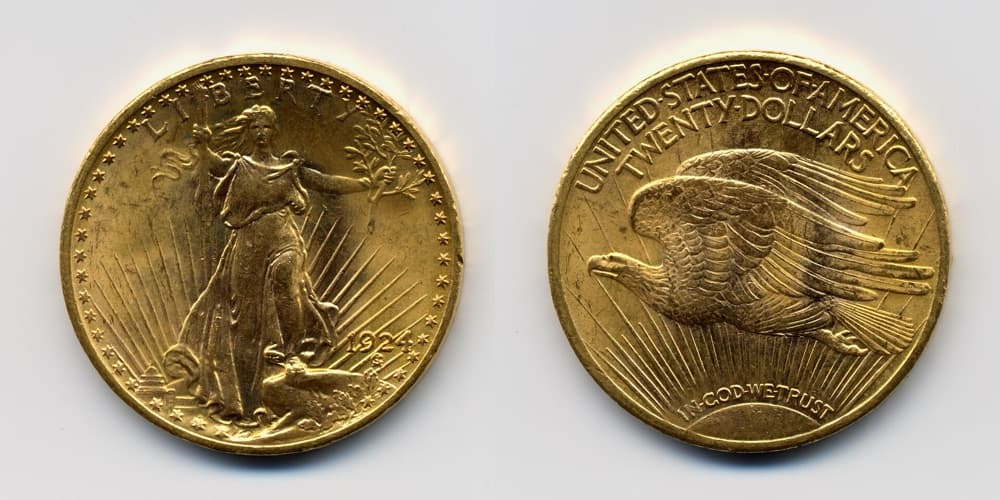
FLOAT 100 · Coins · No. 41
1924 Saint-Gaudens Double Eagle
Collectors once thought the 1924 double eagle was rare, until dealers opened European bank vaults after World War II and found the coins waiting in large quantities.
- Year
- 1924
- Maker
- U.S. Mint (Philadelphia)
- By price in coins
- 97 of 100
Create a free account to see every recorded price and every grade.
Create a free account- Struck
- 1924, Philadelphia Mint (no mintmark)
- Mintage
- 4,323,500, plus 3,049,500 at Denver and 2,927,500 at San Francisco
- Design
- Augustus Saint-Gaudens's striding Liberty and flying eagle, in the lower relief Charles E. Barber adapted in 1907
- Face value
- $20 in gold, a coin used mainly for international payments and bank reserves by the 1920s
- What happened to them
- Most coins left at home were recalled and melted after 1933; hundreds of thousands paid out abroad escaped
- Today
- One of the most common dates in the series, and a popular choice for a type coin
- This entry
- Graded NGC MS66+
- Condition rarity
- PCGS has certified over 360,000; about 3% grade MS66 or finer
- Finest
- A single PCGS MS68+ heads the grading service's condition census
A sculptor's design, a Mint engraver's coin
The Saint-Gaudens double eagle began with President Theodore Roosevelt's 1904 complaint that American coins were of "atrocious hideousness." He had the Mint hire the sculptor Augustus Saint-Gaudens, whose design showed Liberty striding forward with a torch and an olive branch, the Capitol behind her, and on the reverse an eagle flying over a rising sun. The first versions, in deep relief, needed several blows of a press to strike. Saint-Gaudens died in August 1907, and the Mint's chief engraver, Charles E. Barber, lowered the relief so the coin could be struck in a single blow.
The design changed twice more before 1924. In 1908 Congress ordered IN GOD WE TRUST added, after Roosevelt had deliberately left it off. In 1912 two stars were added to the obverse, placed on the rocky outcrop at lower right, for New Mexico and Arizona, bringing the count to 48. A 1924 coin from Philadelphia carries that final form: Arabic date, motto, 48 stars, and E PLURIBUS UNUM lettered on the edge.
Despite Barber's changes, many consider the Saint-Gaudens the most beautiful American coin, a view R.S. Yeoman recorded in A Guide Book of United States Coins.
Gold that rarely circulated
Double eagle production stopped in 1916, when World War I pushed bullion prices up. Banks refused to pay gold coins out at face value and they vanished from circulation. After the war, international demand returned: many Europeans distrusted their own currencies and wanted double eagles to hold. When coinage resumed in 1920 the coin was struck in large numbers, but by now it was almost entirely a coin of international trade, or was held by banks to back gold certificates. It rarely circulated inside the United States.
The 1924 was struck in quantity at all three mints: 4,323,500 at Philadelphia, 3,049,500 at Denver and 2,927,500 at San Francisco. Hundreds of thousands of the Philadelphia coins were paid out internationally.
On March 6, 1933, newly inaugurated President Franklin Roosevelt ordered the Treasury to stop paying out gold, and on December 28, 1933, Americans were ordered to turn in their gold coins, with limited exceptions. Millions of gold coins were melted down by the Treasury in the following years. Coins sitting in American bank vaults went to the furnace; coins in vaults overseas did not.
Rare, then found
For a time the 1924 looked scarce. When the Mint published a list in 1932 of coins available at face value plus postage, the 1924 double eagle was not on it, and it came to be thought rare. Few collectors cared about double eagles by date and mint until the middle or late 1940s.
Starting around the end of World War II, a small number of American dealers began traveling to Europe to see what gold coins were held in bank vaults. They found millions of U.S. gold coins, exported long before the 1933 recall, including many good dates and large numbers of uncirculated pieces. Millions of double eagles were brought back once it was legal to do so. Large quantities of 1924 double eagles were among them, and the date became one of the most common in the series.
The same hoards transformed its sister coins differently. The 1924-S, with a mintage of 2,927,500, was believed in the late 1940s to exist in only three examples; European hoards brought hundreds to light, though very few in top condition. The 1925-S, of which 3,776,500 were struck, mostly stayed in American vaults and was melted, and fewer than a thousand survive.
Common date, uncommon coin
In the coin trade, the 1924 is often called "generic gold": in lower uncirculated grades it trades at the gold price plus a modest premium, along with the 1925, 1926, 1927 and 1928 Philadelphia issues that follow it. The numismatic writer Charles Morgan has objected to the term, arguing that even so-called generics become rare at a high enough grade.
The numbers support him. PCGS has certified more than 360,000 1924 double eagles, and only about 3 percent of them have graded MS66 or finer. The grading service estimates that about 1.9 million survive in all grades and about 210,000 in MS65 or better, which makes the 1924 the most available coin of its type in high grade, yet the top of its census is thin: one coin at PCGS MS68+ and a group at MS67+.
To identify one, look above the date on the obverse, between the second and third digits, where Denver and San Francisco coins carry a D or S mintmark. A Philadelphia 1924 has none. The date is in Arabic numerals, the coin carries the motto IN GOD WE TRUST, and there are 48 stars. The coin weighs about 33.4 grams, contains about 0.9675 troy ounce of gold and measures about 34 millimeters across.
The coin in this entry is an NGC MS66+, a grade its last auction catalog described as better than the usual premium gem, with yellow-orange frosted surfaces. It sold at a January 2022 convention auction in Orlando, after an earlier appearance at a June 2011 sale in Long Beach, California.
The face of American gold
The Saint-Gaudens double eagle was struck until 1933, and its rarest dates come from those last years, when most of each mintage stayed home and was melted. Common dates like the 1924 are the reverse of that story: the coins that were shipped abroad are the ones that survived.
Since 1986 Saint-Gaudens's obverse has appeared on American gold bullion coins, with two more stars for Alaska and Hawaii. The 1924 remains a standard choice for collectors who want a single example of the original design.
The numbers
- Mintage
- 4,323,500 (Philadelphia)
- Known survivors
- About 1.9 million in all grades, 210,000 in MS65 or better (PCGS estimate); over 360,000 certified by PCGS
- Weight
- About 33.4 grams (sources give 33.40, 33.431 and 33.44 g)
- Diameter
- About 34 mm (sources give 34.00 and 34.1 mm)
- Composition
- 90% gold, 10% copper; 0.9675 troy oz of gold
- Edge
- Lettered E PLURIBUS UNUM
- Designer
- Augustus Saint-Gaudens; relief lowered by Charles E. Barber
- This coin's grade
- NGC MS66+
Timeline
Theodore Roosevelt asks whether Saint-Gaudens could give the country "a coinage which would have some beauty."
The Saint-Gaudens double eagle enters production; Barber lowers the relief for mass striking.
Congress orders IN GOD WE TRUST added.
Two stars are added for New Mexico and Arizona, making 48.
Double eagle production stops as World War I drives bullion prices up.
Production resumes in large numbers, mainly for international trade and bank reserves.
Philadelphia strikes 4,323,500 double eagles, many paid out abroad.
The 1924 is missing from the Mint's list of coins available at face value, and comes to be thought rare.
Franklin Roosevelt orders the Treasury to stop paying out gold.
Americans are ordered to turn in gold coins; millions are later melted.
Around the end of World War II, American dealers begin finding U.S. gold coins in European bank vaults.
Saint-Gaudens's obverse returns on American gold bullion coins.
The PCGS MS68 coin, now graded MS68+, sells at auction for $63,250.
This NGC MS66+ coin is offered at a sale in Long Beach, California.
This NGC MS66+ coin sells at a convention auction in Orlando.
A PCGS MS67+ sets the issue's auction record at $90,000.
The world in 1924
George Gershwin's Rhapsody in Blue is first performed in New York.
International Business Machines (IBM) is founded in New York State.
Calvin Coolidge becomes the first president to deliver a radio broadcast from the White House.
J. Edgar Hoover is appointed head of the federal Bureau of Investigation.
Coolidge signs the Indian Citizenship Act, granting citizenship to Native Americans born in the United States.
Russell L. Maughan flies from New York to San Francisco between dawn and dusk.
The first Macy's Thanksgiving Day Parade is held in New York City.
Price record
| Date | Price | Kind |
|---|---|---|
| Jan 5, 2006 | $63,250 | Sold at auctionPCGS MS68, later regraded MS68+; the finest in the PCGS census. |
| Jan 12, 2020 | $28,800 | Sold at auctionPCGS MS67+, from the Rolla Fox collection of Saint-Gaudens gold. |
| May 5, 2022 | $45,600 | Sold at auctionPCGS MS67+, from the Hanalei Bay Saint collection. |
| Aug 22, 2022 | $90,000 | Sold at auctionPCGS MS67+, from the Bob R. Simpson collection; the issue's auction record per PCGS. |
| Oct 30, 2022 | $79,875 | Sold at auctionPCGS MS67+. |
| Jan 21, 2024 | $75,938 | Sold at auctionPCGS MS67+. |
A realized auction price is what a buyer actually paid on the date shown, including the buyer's premium where the sale reported it. It is the strongest kind of reference price, and it is a record of one sale of one object on one day, not a promise of what the next example will bring.
By reference price, 1924 Saint-Gaudens Double Eagle is number 97 of 100 in the coins entries of the FLOAT 100. 96 of those 100 rest on a realized sale; the rest carry an asking price or a guide value, and each page says which. Rank within the FLOAT 100 itself (41 here) is editorial: how much an object defines its field, not price alone.
Did you know
- The 1924 double eagle was once considered rare because it was missing from a 1932 Mint list of coins available at face value.
- After 1920 the double eagle almost never circulated in the United States; it was a coin for international settlements and bank reserves.
- Coins shipped overseas before 1933 escaped the gold recall, which is why a date with millions struck is common today while some lower-mintage dates kept at home are rare.
- The two stars added in 1912 for New Mexico and Arizona were squeezed onto the rocks at lower right rather than spaced among the others.
- Only about 3 percent of the more than 360,000 1924 double eagles graded by PCGS reach MS66 or finer.
How this page is made
- The figure
- One reference price, shown with its own kind. FLOAT does not average it with anything or adjust it for time.
- Realized or not
- A realized price is a completed sale. An asking price, an estimate and a price-guide value are not sales, and are labeled as such wherever they appear.
- The story
- Researched from published records and checked fact by fact. Updated Oct 1, 2026.
- Archive
- Oct 5, 2026