FLOAT 100 · Coins · No. 40
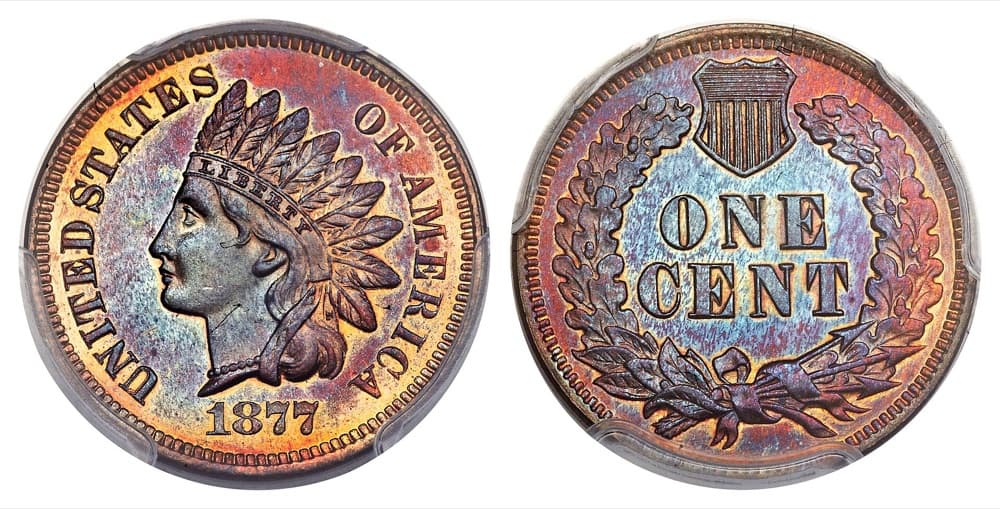
1877 Indian Head Cent
In a depression year the Mint paid out more than 9.8 million old pennies and struck barely 852,500 new ones, and that one-cent coin became the piece every Indian Head collection is built around.
- Year
- 1877
- Maker
- U.S. Mint (Philadelphia)
- By price in coins
- 68 of 100
Create a free account to see every recorded price and every grade.
Create a free account- Struck
- 1877, Philadelphia Mint (no mintmark)
- Designer
- James Barton Longacre, Chief Engraver of the U.S. Mint
- Mintage
- 852,500 business strikes, the lowest small-cent production since the 1856 Flying Eagle cent; roughly 1,250 to 1,500 proofs, by one estimate
- Why so few
- The Panic of 1873 depression and a flood of redeemed cents the Mint paid back out instead of striking new ones
- Series
- Indian Head cent, 1859-1909; one of only two issues with a mintage under one million
- Metal
- Bronze: 95% copper, 5% tin and zinc
- This entry
- Graded PCGS MS66 Red, the full original copper color
- Finest certified
- One PCGS MS66+ Red, the "Golden Princess"; no MS67 at either major grading service
- Record
- $149,500 for a PCGS MS66 Red, reached in 2007 and again in 2009
A penny for a nation in debt
The Indian Head cent was introduced in 1859, designed by James Barton Longacre, Chief Engraver of the Mint. Despite its name, it does not depict a Native American: it shows Liberty wearing a feathered headdress. Longacre said the face was based on a statue of the Crouching Venus on loan to Philadelphia, and he had used a similar head on the gold dollar and three-dollar piece. A popular legend held that his daughter Sarah had posed in the headdress of a Native American visitor to the Mint; she was in fact 30 and married in 1858, and the Mint Director denied in writing that the coin was based on "any human features in the Longacre family."
The first cents were copper-nickel. During the Civil War, cents were hoarded and merchants issued bronze tokens that the public readily accepted, so in 1864 Congress authorized a thinner bronze cent. That is the coin struck in 1877: about 3.11 grams of 95 percent copper with the balance tin and zinc, 19 millimeters across.
In 1860 the reverse changed from a laurel wreath to the oak wreath and shield seen on the 1877 coin. The design lasted until 1909, when Victor David Brenner's Lincoln cent replaced it.
Why the Mint barely made any
The Panic of 1873 began a depression that lasted until 1877. Banks failed, railroad building slowed and demand for small change fell. At the same time, an act of March 3, 1871, had let the public turn minor coins in to the government in lots of $20 or more. More than thirty million copper-nickel cents were redeemed and melted, and fifty-five million bronze cents were sold back to the Treasury. From 1874 the Mint stopped melting the bronze ones and began paying them back out in response to commercial requests for cents.
With old cents available to meet what little demand there was, the Mint had little reason to strike new ones. Of the almost 10 million cents turned in to the Mint in 1877, more than 9.8 million were paid back out. The supplemental mintage of new cents for the year was stated at 852,500, the lowest small-cent production since the 1856 Flying Eagle cent. Silver coins were also returning to circulation for the first time since the Civil War, further reducing the need for cents.
Some specialists think even 852,500 is too high. The Indian cent authority Rick Snow and others note that all known genuine 1877 cents were struck from a single reverse die, of a type last used five years earlier. A die in that era typically lasted for a production run in the low six figures, so if that one die had an ordinary life, the true mintage would be below the 309,000 of the 1909-S, which is generally called the lowest-mintage issue of the series.
Reading an 1877
Snow attributes two die pairs to the 1877 business strikes: one with the digits of the date set closer together, one with wider spacing. Both developed obverse die cracks in use. The Snow-2 variety shows an unbroken hub on the D of UNITED and a die dot near Liberty's neck.
The issue has a known weakness: the lower right corner of the N in ONE on the reverse is often soft. A sharply struck 1877 with a solid outline on that letter is exceptional.
Because nobody set the coins aside at the time, nearly all 1877 cents circulated heavily. Population figures cited in a 2026 profile show NGC had graded 4,422 circulated examples and 381 Mint State, only 16 of them Red, and PCGS 6,581 circulated and 1,206 Mint State, 91 of them Red. PCGS estimates about 150 survive in full Red at any grade and about 50 in Red at 65 or better.
Copper color matters enormously in grading cents. Brown and Red-Brown coins, which have toned, are far more available than Red ones, which keep their original mint orange. The finest Red coins grade MS66; a single PCGS MS66+ Red, nicknamed the "Golden Princess," surfaced at auction in January 1999 and was bought by the collector Stewart Blay, who later had it certified.
The finest few
An August 2007 catalog noted that PCGS had certified only six 1877 cents as MS66 Red at that time, and that NGC had certified none above MS65 with full Red color. One of the six, from the Santa Fe Collection, sold that August at a convention auction in Milwaukee. Its catalog called it tied for finest known, with vibrant copper-orange surfaces and a solid N in ONE, and it brought $149,500, a figure PCGS lists as the auction record for the issue.
Another MS66 Red, from the Gorrell and Joseph C. Thomas collections, matched that $149,500 in April 2009. A third, later in the High Desert collection on the PCGS Set Registry, had sold for $115,000 in August 2006. One industry account says MS66 Red examples have brought between $100,000 and $149,000, with the strongest prices from 2007 to 2009, and that a PCGS MS66 Red with a CAC sticker sold for $114,000 in 2019.
Not every record fits that pattern. The PCGS condition census also lists an MS66 Red that sold for $42,300 in August 2017 and $40,800 in January 2018, and a coin from the "Providence 1951" collection that brought $99,875 in February 2015, listed once as MS66 Red and once as MS65+ Red.
The key to the set
Indian Head cents were collected even while they were still being made, and inexpensive coin albums in the 1930s, when the cents were still common in pocket change, turned the series into a classic set to fill by date. Most dates remain inexpensive.
The 1909-S has a lower stated mintage, but collectors have long recognized the 1877 as the key date of the series. As one 2026 profile put it, the coin "reflects a nation in financial distress and a Mint adapting to economic pressure."
The numbers
- Mintage
- 852,500 business strikes (some specialists think fewer); proofs estimated at 1,250 to 1,500
- Known survivors
- About 150 in full Red, about 50 Red at 65 or better (PCGS estimate); PCGS has graded 6,581 circulated and 1,206 Mint State, NGC 4,422 and 381
- Weight
- 3.11 grams
- Diameter
- 19 mm (19.05 mm in one source)
- Composition
- 95% copper, 5% tin and zinc
- Edge
- Plain
- Designer
- James Barton Longacre
- This coin's grade
- PCGS MS66 Red
Timeline
Mint Director James Ross Snowden approves Longacre's Indian Head design for 1859.
The Indian Head cent enters production, in copper-nickel.
The oak wreath and shield reverse replaces the laurel wreath.
Lincoln signs the Coinage Act of 1864, authorizing a bronze cent.
Congress allows minor coins to be redeemed in lots of $20 or more.
The Panic of 1873 begins a depression that lasts until 1877.
The Mint begins paying redeemed bronze cents back into circulation instead of melting them.
The Mint pays out more than 9.8 million old cents and strikes 852,500 new ones.
The Lincoln cent replaces the Indian Head design; the 1909-S records 309,000.
The finest known 1877, later graded PCGS MS66+ Red, surfaces at auction and is bought by Stewart Blay.
A PCGS MS66 Red sells for $115,000.
The Santa Fe Collection MS66 Red sells in Milwaukee for $149,500, the issue's auction record.
A second MS66 Red matches $149,500.
The "Providence 1951" coin brings $99,875.
A PCGS MS66 Red with a CAC sticker sells for $114,000.
The world in 1877
The Compromise of 1877 settles the disputed 1876 election in favor of Rutherford B. Hayes.
Crazy Horse surrenders to U.S. troops in Nebraska.
The first Westminster Kennel Club Dog Show opens in New York.
Henry Ossian Flipper becomes the first African American to graduate from West Point.
The Great Railroad Strike of 1877 begins with riots in Baltimore and spreads west.
Thomas Edison announces the phonograph.
The Washington Post publishes its first issue.
Price record
| Date | Price | Kind |
|---|---|---|
| Aug 2006 | $115,000 | Sold at auctionPCGS MS66 Red, later in the High Desert collection. |
| Aug 9, 2007 | $149,500 | Sold at auctionPCGS MS66 Red, the Santa Fe Collection coin, sold in Milwaukee. Auction record for the issue per PCGS. |
| Apr 2009 | $149,500 | Sold at auctionPCGS MS66 Red, ex Gorrell and Joseph C. Thomas collections. |
| Feb 2015 | $99,875 | Sold at auction"Providence 1951" coin; the PCGS census lists it as both MS66 Red and MS65+ Red. |
| Aug 2017 | $42,300 | Sold at auctionListed in the PCGS census as MS66 Red; far below other MS66 Red results. |
| Jan 2018 | $40,800 | Sold at auctionThe same coin as August 2017. |
| Aug 2019 | $114,000 | Sold at auctionPCGS MS66 Red with a CAC sticker. |
A realized auction price is what a buyer actually paid on the date shown, including the buyer's premium where the sale reported it. It is the strongest kind of reference price, and it is a record of one sale of one object on one day, not a promise of what the next example will bring.
By reference price, 1877 Indian Head Cent is number 68 of 100 in the coins entries of the FLOAT 100. 96 of those 100 rest on a realized sale; the rest carry an asking price or a guide value, and each page says which. Rank within the FLOAT 100 itself (40 here) is editorial: how much an object defines its field, not price alone.
Did you know
- The Mint paid more than 9.8 million old cents back into circulation in 1877, more than eleven times the number of new ones it made.
- Every known genuine 1877 cent was struck from a single reverse die, which is why some specialists doubt the official mintage.
- The "Indian" is Liberty in a headdress; Longacre said her face came from a statue of Venus, and the Mint Director denied in writing that it was his daughter.
- The 1909-S has a lower stated mintage, yet the 1877 is the series' key date.
- The finest known 1877 is nicknamed the "Golden Princess."
- During the Civil War, so many cents were hoarded that one New York City floor collapsed under the load.
How this page is made
- The figure
- One reference price, shown with its own kind. FLOAT does not average it with anything or adjust it for time.
- Realized or not
- A realized price is a completed sale. An asking price, an estimate and a price-guide value are not sales, and are labeled as such wherever they appear.
- The story
- Researched from published records and checked fact by fact. Updated Oct 1, 2026.
- Archive
- Oct 5, 2026