FLOAT 100 · Coins · No. 1
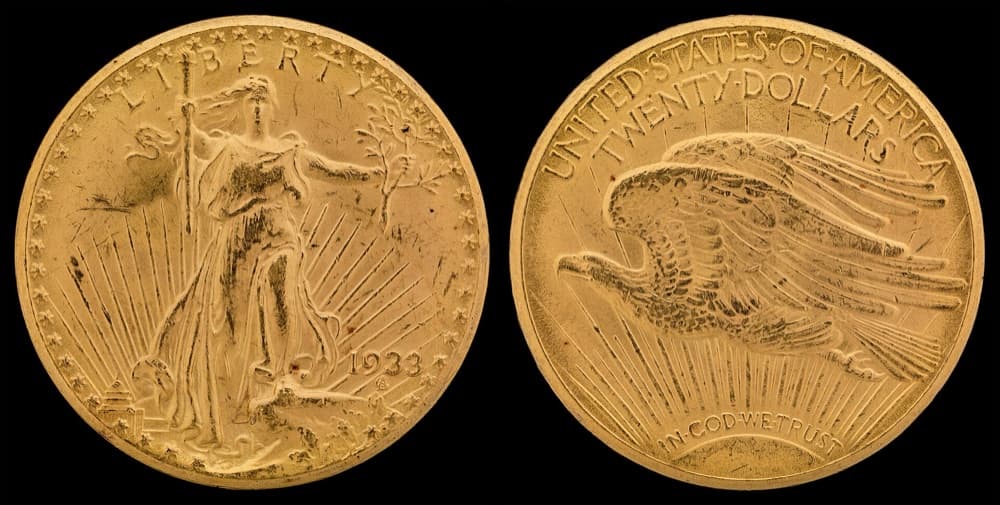
1933 Saint-Gaudens Double Eagle
The United States struck 445,500 of these gold coins, ordered almost every one melted, and then spent seven decades chasing the handful that slipped out of the Philadelphia Mint.
- Year
- 1933
- Maker
- U.S. Mint (Philadelphia)
- By price in coins
- 2 of 100
Create a free account to see every recorded price and every grade.
Create a free account- Struck
- March 15 to May 19, 1933, U.S. Mint, Philadelphia (no mintmark)
- Mintage
- 445,500, none officially released
- Designer
- Augustus Saint-Gaudens, commissioned by President Theodore Roosevelt; design introduced 1907
- Specs
- $20 gold, 90% gold and 10% copper, about 33.4 grams, 34.1 mm across
- Surviving examples
- At least 14 accounted for as of 2026: 11 held by the U.S. Mint, 2 in the Smithsonian, 1 in private hands. Older counts give 13
- Legal status
- One example, the King Farouk coin, was monetized in 2002 and is the only 1933 double eagle a private person may lawfully own
- Private example's grade
- PCGS MS65
- Record
- $18,872,250 at auction in New York, June 8, 2021, the most ever paid for a coin
- Owners of the private coin
- King Farouk of Egypt (1944), dealer Stephen Fenton (1990s), Stuart Weitzman (2002 to 2021), anonymous buyer (2021)
The most beautiful coin, struck for nothing
In January 1905 President Theodore Roosevelt asked Augustus Saint-Gaudens, the country's leading sculptor and the designer of Roosevelt's 1905 inaugural medal, to remake the nation's gold coinage. "I have long wished to do what little I could to improve the shameful condition of our money, but now that I have the opportunity I approach it with fear and trembling," Saint-Gaudens wrote that year. He was already terminally ill with cancer, and died in August 1907, the year his $20 double eagle went into production.
The design shows Liberty striding forward with a torch raised in one hand and an olive branch in the other, her hair streaming behind her, with the Capitol in the distance; on the reverse an eagle flies above a rising sun. Saint-Gaudens's model was Harriette Eugenia Anderson, originally from South Carolina, whom he called "certainly the handsomest model I have ever seen of either sex." Roosevelt later pronounced it "the best coin that has been struck for 2,000 years."
The Philadelphia Mint struck 445,500 double eagles dated 1933 in three runs between March 15 and May 19, 1933. By then the country was in the depth of the Great Depression, and the coins were never issued. On March 6 Franklin Roosevelt barred gold payments, hoarding and export, and on April 5 Executive Order 6102 required Americans to turn in their gold coin and bullion by May 1. Collectors were exempted, a loophole that would feed decades of litigation.
The melt, and the coins that got away
The Gold Reserve Act of 1934 ended the circulation and private ownership of U.S. gold coins. On August 4, 1934, Mint Director Nellie Tayloe Ross ordered the Mint to "begin the process of melting down all of the gold coins on hand." The 1933 double eagles were turned into bullion bound for Fort Knox, and the Smithsonian calls the 1933 issue the end of the era in which Congress authorized circulating gold coinage.
Two coins were saved on purpose. The Mint kept a pair as coins of record and transferred them to the Smithsonian's National Numismatic Collection in 1934; one is on display today at the National Museum of American History.
Others left without permission. The Secret Service came to suspect George McCann, the Philadelphia Mint's cashier, of passing coins to Israel Switt, a Philadelphia jeweler and coin dealer. McCann was later imprisoned for a separate embezzlement. When a 1933 double eagle surfaced in a 1944 sale, investigators began tracing them, and Switt admitted selling nine of the coins the government recovered. Those recovered coins were melted in 1956.
A king's coin and a hotel sting
In February 1944 one coin was sold for $1,575 to a buyer acting for King Farouk of Egypt, a voracious collector. The Treasury issued a license to export it, and the coin went to Cairo. The sale alerted the Secret Service that 1933 double eagles had left the Mint. After Farouk was overthrown in 1952, his collections were offered at auction in Cairo in 1954. The United States asked for the coin back; the Egyptian government withdrew it from the sale, and it then disappeared for four decades.
In 1996 a 1933 double eagle, in all likelihood Farouk's, surfaced in the hands of the British dealer Stephen Fenton. Secret Service agents arrested Fenton during a sting at the Waldorf-Astoria hotel in New York. Accounts differ on the date of the arrest: some give February 8, 1996, others June 1996. After years of legal wrangling, the case was settled in 2001 with an agreement to sell the coin and split the proceeds between Fenton and the government. The coin was moved to Fort Knox to await sale.
On July 30, 2002, it sold at auction in New York. The winning bid was $6.6 million; with a 15 percent buyer's premium and $20 added so the Treasury could formally issue the coin at face value, the total came to $7,590,020. The buyer stayed anonymous for nearly two decades. He was the shoe designer Stuart Weitzman, who consigned it to auction in New York on June 8, 2021, together with the British Guiana one-cent magenta and an Inverted Jenny plate block. Bidding lasted about five minutes and the coin, graded PCGS MS65, sold to a telephone bidder for a hammer price of $16.75 million, or $18,872,250 with premium, against an estimate of $10 million to $15 million. The buyer was not identified.
Ten coins in a department-store bag
In 2003 Joan Langbord, Israel Switt's daughter, had safe deposit box No. 442 at a Philadelphia bank drilled open. At the bottom, wrapped in tissue and plastic inside a gray John Wanamaker department store bag, were ten 1933 double eagles. On September 15, 2004, the family's lawyer met with Mint attorneys, and a week later her son Roy Langbord handed the coins over for authentication.
The Mint confirmed the coins were genuine and kept them. It announced in August 2005 that it had recovered ten 1933 double eagles, and later showed all ten at an exhibition in Denver. The family sued for their return. A jury in Philadelphia found for the government on July 20, 2011. In 2015 a panel of the Third Circuit Court of Appeals sided with the family, but the full court reversed that ruling in 2016 and the coins stayed with the government as government property. On April 17, 2017, the U.S. Supreme Court declined to hear the case.
An eleventh coin later came in from the cold. After the 2011 trial, a private citizen who had bought a 1933 double eagle on the open market, not knowing it could not lawfully be owned, surrendered it unconditionally; the Mint disclosed it in 2018. On August 28, 2026, the Mint put all eleven of its 1933 double eagles on public display together for the first time, at the American Numismatic Association's World's Fair of Money in Pittsburgh. The privately owned coin was not part of that display.
Why it matters
No other coin combines the same elements: a design widely called the most beautiful in American coinage, an issue that was struck and then destroyed by government order, a theft from inside the Mint, an Egyptian king, a federal sting and a ruling by the country's highest court that settled who owns ten of them.
The legal line is unusually sharp. The two Smithsonian coins and the Mint's eleven belong to the government. A single example, the Farouk coin, has been formally issued by the Treasury and may be owned privately; it was the centerpiece of both the 2002 and 2021 sales.
Its 2021 price was nearly two and a half times what the same coin brought in 2002, and set the world auction record for any coin.
Timeline
President Theodore Roosevelt commissions Augustus Saint-Gaudens to redesign U.S. gold coinage.
The Saint-Gaudens double eagle enters production; the sculptor dies in August.
The Philadelphia Mint begins striking 1933 double eagles; runs continue to May 19, for a total of 445,500.
Executive Order 6102 orders Americans to surrender gold coin and bullion by May 1.
Mint Director Nellie Tayloe Ross orders all gold coins on hand melted; two 1933 double eagles go to the Smithsonian.
A 1933 double eagle is sold for $1,575 for King Farouk of Egypt and exported under a Treasury license; the Secret Service opens an investigation.
The Farouk coin is withdrawn from the auction of his collections in Cairo after a U.S. request, then vanishes.
Nine 1933 double eagles recovered by the government are melted.
British dealer Stephen Fenton is arrested at the Waldorf-Astoria in New York with a 1933 double eagle, very likely Farouk's.
A settlement allows the coin to be sold, with proceeds split between Fenton and the government.
Sold at auction in New York for $7,590,020, including $20 to monetize it; buyer anonymous.
Israel Switt's heirs hand ten 1933 double eagles to the Mint for authentication; the Mint keeps them.
The Mint announces it has recovered ten 1933 double eagles.
A federal jury in Philadelphia rules the ten coins are government property.
The full Third Circuit Court of Appeals reverses a 2015 panel ruling and affirms government ownership.
The U.S. Supreme Court declines to hear the Langbord family's appeal.
The Mint discloses an eleventh coin, surrendered by a private owner.
Stuart Weitzman's coin sells at auction in New York for $18,872,250, a world record for a coin.
All eleven Mint-held 1933 double eagles go on display together for the first time, in Pittsburgh.
The world in 1933
Adolf Hitler is appointed chancellor of Germany.
King Kong premieres in New York.
Franklin D. Roosevelt is sworn in; Frances Perkins becomes the first woman in a U.S. Cabinet.
Roosevelt declares a national bank holiday, closing every bank in the country until March 13.
Executive Order 6102 makes it unlawful for Americans to hold substantial amounts of monetary gold.
The Century of Progress world's fair opens in Chicago.
Major League Baseball plays its first All-Star Game, at Comiskey Park in Chicago.
The Twenty-first Amendment is ratified, ending Prohibition.
Price record
| Date | Price | Kind |
|---|---|---|
| Feb 1944 | $1,575 | Private saleSold to a buyer acting for King Farouk of Egypt. |
| Jul 30, 2002 | $7,590,020 | Sold at auctionSold at auction in New York: $6.6 million bid plus 15% premium plus $20 to monetize the coin. Buyer later revealed as Stuart Weitzman. |
| Jun 8, 2021 | $10,000,000 | Estimate, not a salePresale estimate of $10 million to $15 million (low end shown). |
| Jun 8, 2021 | $18,872,250 | Sold at auctionSold at auction in New York, PCGS MS65; hammer $16.75 million. World record for any coin. Buyer anonymous. |
A realized auction price is what a buyer actually paid on the date shown, including the buyer's premium where the sale reported it. It is the strongest kind of reference price, and it is a record of one sale of one object on one day, not a promise of what the next example will bring.
By reference price, 1933 Saint-Gaudens Double Eagle is number 2 of 100 in the coins entries of the FLOAT 100. 96 of those 100 rest on a realized sale; the rest carry an asking price or a guide value, and each page says which. Rank within the FLOAT 100 itself (1 here) is editorial: how much an object defines its field, not price alone.
Did you know
- To make the 2002 sale legal, $20, the coin's face value, was added to the price so the Treasury could formally issue it.
- A 1933 double eagle was sold for King Farouk of Egypt in 1944 for $1,575, and the U.S. Treasury issued a license to export it.
- The ten Langbord coins were found wrapped in tissue in a gray John Wanamaker shopping bag at the bottom of safe deposit box No. 442.
- Theodore Roosevelt called the design "the best coin that has been struck for 2,000 years."
- Saint-Gaudens's Liberty was modeled on Harriette Eugenia Anderson of South Carolina.
- The Langbord family sought the coins' return or $40 million in compensation.
- Eleven of the coins were displayed together for the first time on August 28, 2026, in Pittsburgh.
How this page is made
- The figure
- One reference price, shown with its own kind. FLOAT does not average it with anything or adjust it for time.
- Realized or not
- A realized price is a completed sale. An asking price, an estimate and a price-guide value are not sales, and are labeled as such wherever they appear.
- The story
- Researched from published records and checked fact by fact. Updated Oct 1, 2026.
- Archive
- Oct 5, 2026