FLOAT 100 · Coins · No. 68
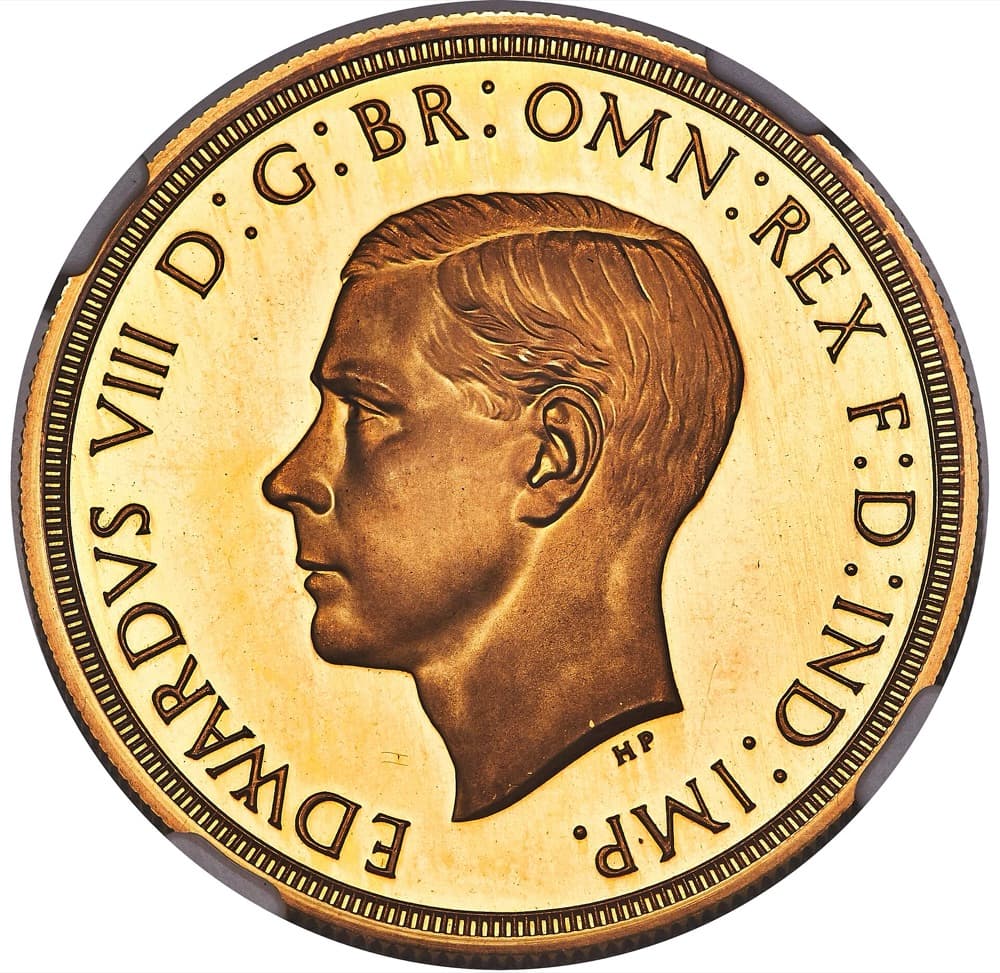
1937 Edward VIII Gold Pattern Five Sovereign
Edward VIII gave up his throne before his coins could be issued, and even he was refused a set afterward, so the few gold five-pound patterns that survive have become the most expensive British coins ever sold.
- Year
- 1937
- Maker
- Royal Mint (Great Britain), Edward VIII
- By price in coins
- 17 of 100
Create a free account to see every recorded price and every grade.
Create a free account- Dated
- 1937, prepared in 1936 for a coronation that never happened
- Maker
- Royal Mint, London
- Designers
- Obverse by Thomas Humphrey Paget; reverse after Benedetto Pistrucci's St. George and the dragon
- Status
- Pattern only; Edward VIII's coinage was never issued
- Known in private hands
- Two: this coin and the example in the Tyrant Collection
- This coin
- NGC Proof 67 Ultra Cameo, ex Paramount Collection
- Specs
- 22-carat (.9167) gold, 39.87 g, 37 mm, reeded edge
- Sale, March 2021
- $2,280,000 at auction in Dallas, a record for any British coin
- Sale, October 2021
- €2.11 million (about $2.45 million) at auction in Monaco, breaking its own record
Coins for a coronation
King George V died on January 20, 1936, and his eldest son became King Edward VIII. The Royal Mint set to work on a new coinage at once. Its reports for 1935-1936 record that more than 200 dies for coins, medals and seals were prepared, a clear sign the Mint meant to strike a full circulating series. Striking was scheduled to begin on January 1, 1937, so the coins carry that date.
Custom also called for specimen coronation sets for collectors and important persons. A newspaper report of July 1936 described a coronation set of gold coins of four pieces, five pounds, two pounds, one pound and a half sovereign, although no Edward VIII half sovereign is known to have been struck. The five-pound piece, the largest denomination in the king's name, sat at the head of that set.
None of it was ever issued. Edward signed the instrument of abdication on December 10, 1936, after a reign of 326 days, in order to marry Wallis Simpson, a divorced American. The dies were destroyed, and what survives of his coinage is a small group of patterns, proposed designs struck before the plan was abandoned.
A king who wanted to face the other way
Since the Restoration of Charles II in 1660, British monarchs had alternated the direction of their portraits with each new reign. George V faced left, so Edward VIII should have faced right. Edward wanted to face left, as his father had, and after long correspondence with the Chancellor of the Exchequer, Neville Chamberlain, he got his way.
The portrait was the work of Thomas Humphrey Paget, who modeled an uncrowned bust of the king facing left, with the legend EDWARDVS VIII D: G: BR: OMN: REX F: D: IND: IMP. For the reverse of the gold pieces the Mint kept Benedetto Pistrucci's St. George on horseback slaying the dragon, a design first used on the sovereign of 1817.
Edward's taste for breaking with convention was well known. His dress and manner were considered simple and frank, which delighted the public and dismayed those who expected a more kingly style. The left-facing coin portrait was one more break with tradition, and after the abdication Paget's left-facing bust of George VI was used on the 1937 coronation five-pound piece, which still carried Pistrucci's reverse.
The year of three kings
Britain had three kings in 1936. George V died in January; Edward VIII reigned through the year; and on December 11 his brother Prince Albert, Duke of York, became King George VI. That evening the former king broadcast to the nation to explain his decision.
It was a year of contrasts. The Supermarine Spitfire made its first test flight in March, the liner Queen Mary sailed from Southampton on her maiden voyage to New York in May, and the BBC began the world's first regular television service in London on November 2. Hardship was never far away: in October some 207 men marched from Jarrow to London to protest unemployment and poverty, and the Battle of Cable Street pitted anti-fascist demonstrators against Oswald Mosley's British Union of Fascists. At the end of November the Crystal Palace burned down.
The coin even a king couldn't have
After the abdication, the patterns were kept close. When the Royal Mint took an inventory in September 1950, it reported only three complete sets. The researcher Joseph Giordano recorded about six sets known to him in 2009, most long since broken up, and today only two complete sets are believed to remain, one in the Royal Mint Museum and one in the private Tyrant Collection. Accounts differ on how many gold sets were made; one widely cited figure is six four-piece sets.
Edward himself, by then the Duke of Windsor, asked his brother George VI for a set of the coins prepared for him. A surviving letter shows he was refused.
Only two of the five-pound pieces are known in private hands. This one, graded Proof 67 Ultra Cameo by NGC, two points higher than the Tyrant Collection coin, was the star of the Paramount Collection. When it was offered in Dallas, the seller said no Edward VIII five pounds had come to auction in at least 20 years. On March 26, 2021, against an estimate of $1 million, it sold for $2,280,000, the highest price ever paid for a British coin. The previous record was an 1831 William IV proof five pounds that had hammered at 820,000 euros in Monaco in October 2020.
Seven months later the same coin was back on the block, in Monaco on October 20-21, 2021. It realized €2.11 million, about $2.45 million, breaking its own record for any British coin sold at auction.
How to know it, and its siblings
The five-pound pattern is struck in 22-carat gold (.9167 fine), weighs 39.87 grams and measures 37 millimeters, with a reeded edge. The obverse shows Paget's uncrowned, left-facing bust of Edward VIII; the reverse shows St. George slaying the dragon, with the date 1937 and the engraver's initials in the exergue. It is catalogued as S-4063 and Fr-406.
The other Edward VIII patterns have set their own marks. The pattern sovereign hammered at £430,000 (about $729,000) in May 2014 and was brokered by the Royal Mint for £1,000,000 ($1.3 million) in January 2020. A pattern crown hammered at $300,000 in January 2020; a pattern penny hammered at £111,000 (about $138,500) in September 2019; and a pattern threepence brought $63,000 all-in in January 2021. A two-pound piece sold in London in November 2001 for £58,000 (about $85,000).
This coin's mirrored fields and frosted portrait give it the deep contrast that the Ultra Cameo designation describes, and it was catalogued in 2021 as very likely the finest in existence.
The numbers
- Mintage
- Patterns only; never issued. Reports range from three complete sets (1950 inventory) to about six sets
- Known in private hands
- Two five-pound pieces
- Weight
- 39.87 grams
- Diameter
- 37 mm
- Composition
- 22-carat gold (.9167)
- Edge
- Reeded
- Designers
- Thomas Humphrey Paget (obverse); Benedetto Pistrucci (reverse)
- References
- S-4063, Fr-406, W&R-432
- This coin's grade
- NGC Proof 67 Ultra Cameo
Timeline
George V dies; Edward VIII becomes king and the Royal Mint begins preparing his coinage.
A newspaper reports plans for a four-piece gold coronation set.
Edward VIII signs the instrument of abdication; the coinage is canceled and the dies destroyed.
George VI becomes king; Edward broadcasts to the nation.
The date on which striking of Edward VIII's coinage had been scheduled to begin.
A Royal Mint inventory reports only three complete Edward VIII pattern sets.
Joseph Giordano records about six sets known to him, most broken up.
A William IV proof five pounds hammers at 820,000 euros in Monaco, the record this coin would beat.
This coin, NGC PF67 Ultra Cameo, sells at auction in Dallas for $2,280,000, a record for any British coin.
Offered again in Monaco, it realizes €2.11 million (about $2.45 million), a new record.
The world in 1936
John Maynard Keynes publishes The General Theory of Employment, Interest and Money.
The Supermarine Spitfire makes its first test flight.
The RMS Queen Mary leaves Southampton on her maiden voyage to New York.
The Battle of Cable Street is fought in London's East End.
The Jarrow March sets out for London.
The BBC launches the world's first regular television service.
The Crystal Palace in south London is destroyed by fire.
Price record
| Date | Price | Kind |
|---|---|---|
| Mar 26, 2021 | $2,280,000 | Sold at auctionThis coin, NGC PF67 Ultra Cameo, ex Paramount Collection; in Dallas, against a $1 million estimate. Record for any British coin. |
| Oct 2021 | $2,450,000 | Sold at auctionThis coin again, in Monaco, October 20-21; €2.11 million, reported as about $2.45 million. New record for any British coin. |
A realized auction price is what a buyer actually paid on the date shown, including the buyer's premium where the sale reported it. It is the strongest kind of reference price, and it is a record of one sale of one object on one day, not a promise of what the next example will bring.
By reference price, 1937 Edward VIII Gold Pattern Five Sovereign is number 17 of 100 in the coins entries of the FLOAT 100. 96 of those 100 rest on a realized sale; the rest carry an asking price or a guide value, and each page says which. Rank within the FLOAT 100 itself (68 here) is editorial: how much an object defines its field, not price alone.
Did you know
- Edward VIII insisted on facing left on his coins, breaking a tradition of alternating directions that dated back to 1660.
- After abdicating, Edward asked his brother for a set of his own pattern coins and was refused.
- More than 200 dies were prepared for Edward VIII's coins, medals and seals, and they were destroyed after the abdication.
- The same coin set the record for a British coin twice in seven months, in Dallas and then in Monaco.
- Coins in Edward VIII's name were issued in a few places: Fiji, British West Africa, East Africa and New Guinea issued coins in his name in 1936.
- Only two complete sets of Edward VIII patterns are believed to remain, one of them in the Royal Mint Museum.
How this page is made
- The figure
- One reference price, shown with its own kind. FLOAT does not average it with anything or adjust it for time.
- Realized or not
- A realized price is a completed sale. An asking price, an estimate and a price-guide value are not sales, and are labeled as such wherever they appear.
- The story
- Researched from published records and checked fact by fact. Updated Oct 3, 2026.
- Archive
- Oct 5, 2026