FLOAT 100 · Coins · No. 69
Croesus Gold Stater (Lydia)
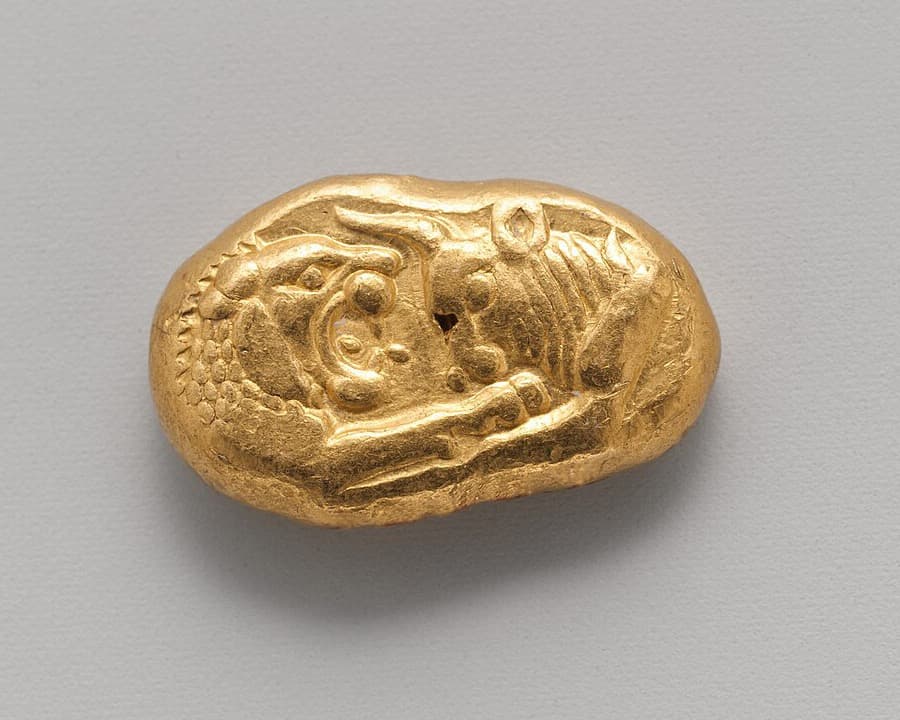
Before Croesus, coins were made of a natural gold-silver alloy no one could value with certainty; the king whose name still means 'rich' replaced them with coins of pure gold, and this small, lumpy stater is one of the first.
- Year
- c.561-546 BC
- Maker
- Kingdom of Lydia, King Croesus
- By price in coins
- 74 of 100
Create a free account to see every recorded price and every grade.
Create a free account- Issuer
- King Croesus of Lydia
- Struck
- Sardis, about 561-550 BC
- Design
- Foreparts of a lion and a bull facing each other; reverse two incuse square punches
- Standard
- The early 'heavy' standard of about 10.7 grams, later lightened to about 8.1 grams
- Why it matters
- Croesus is credited with the first true gold coins of standardized purity and the first bimetallic coinage
- This coin
- NGC Ancients MS★, Strike 5/5, Surface 5/5; 10.79 grams; ex Bob Klein History of Money Collection
- Sales of this coin
- $144,000 in August 2018; $96,000 in January 2024 at auction in New York
From electrum to gold
Coins were born in western Asia Minor, and for their first decades they were made of electrum, a naturally occurring mix of gold and silver. In Lydia, its capital Sardis and the surrounding region, electrum coins had been in use for about 80 years before Croesus took the throne. The trouble was that electrum varied: one estimate puts it at about 54 percent gold and 44 percent silver, but no two lumps were quite the same, so the real value of any coin was hard to know.
Croesus changed that. Around 561 BC, early in his reign, he introduced separate coins of refined gold and refined silver, first alongside the electrum coins and then in place of them. Gold and silver were refined from raw electrum in workshops at Sardis. Because each coin's worth now rested on a known metal and a fixed weight, it could be trusted on sight. Croesus is credited with issuing the first true gold coins of standardized purity for general circulation, and with the world's first bimetallic monetary system.
The new gold staters were struck at about 10.7 grams, the same weight as the new silver stater. Since gold is far more valuable, the gold coin was smaller and worth much more. The denominations ran from a full stater down to 1/96 of a stater. Soon afterward the gold stater was lightened to about 8.1 grams, a weight at which one gold stater equaled exactly ten silver staters. The coin here belongs to the earlier, heavier series.
As rich as Croesus
Croesus was the son of Alyattes, and his family's wealth came in part from the gold-bearing Pactolus river near Sardis. He extended Lydian rule over the Greek cities of the coast until he had subjugated all of mainland Ionia, Aeolis and Doris, annexed Ephesus, and held most of the land west of the Halys River. At Ephesus he paid for many of the marble columns of the rebuilt Temple of Artemis.
His name became shorthand for wealth in both Greek and Persian tradition. Herodotus tells of the Athenian lawgiver Solon visiting Croesus and refusing to call him the happiest of men, on the grounds that no one's happiness can be judged until he is dead. Croesus sent lavish gifts to the oracle at Delphi, among them a lion of gold weighing ten talents.
The lion on his coins had already been used by his father. One theory holds that the design is dynastic, with the lion standing for Alyattes and the bull for his son; another reads the lion as strength and power and the bull as fertility.
The fall of Sardis
Croesus ruled in a century of upheaval. In 550 BC Cyrus II of Persia overthrew the king of the Medes and founded the Persian Empire on Lydia's eastern border. Confucius was born in 551 BC; in the Greek world, Solon's reforms of 594 BC still shaped Athens, and Pythagoras was born around 570 BC.
Before marching against Cyrus, Croesus consulted Delphi and was told that if he attacked he would destroy a great empire. He did, and the empire he destroyed was his own. Cyrus defeated him at the Battle of Thymbra around 547-546 BC and took Sardis, ending Lydian independence. What happened to Croesus afterward is uncertain; ancient accounts disagree on whether he was put to death or became an adviser to Cyrus.
His coinage outlived his kingdom. The Persians kept the bimetallic system and went on striking gold and silver coins of the same type at Sardis until around 520 BC, with stiffer, less natural animals. Under Darius I these were replaced by the gold daric, whose weight followed the Croeseid standard. Because Persian issues copy the type, scholars once argued that all Croeseids were Persian, but excavations at Sardis have shown that the first ones were struck before the Persian conquest.
This coin
This stater weighs 10.79 grams and is graded by NGC Ancients as Mint State with a star for exceptional eye appeal, with the top scores of 5 out of 5 for both strike and surface. It is struck on an oval flan, with sharp detail on both animals, deep incuse punches and strong luster. When first offered it was described as among the finest examples known.
It sold at auction on August 17, 2018, for $144,000. It later formed part of the Bob Klein History of Money Collection, and was offered again at auction in New York on January 8, 2024, with an estimate of $100,000 to $150,000. It realized $96,000.
The two catalog descriptions disagree on the coin's diameter, giving 19 millimeters in 2018 and 17 millimeters in 2024; both give the same 10.79-gram weight, grade and references.
How to recognize a Croeseid
The obverse shows the foreparts of a lion facing right and a bull facing left, each with a foreleg outstretched, set nose to nose. The reverse has no design at all, only two incuse square punches of unequal size side by side.
Weight separates the two gold series: heavy staters run about 10.7 grams and light staters about 8.1 grams. Later Persian copies show the same animals in a more rigid style. Standard references for this coin include BMC Lydia 30, Boston MFA 2068 and Gulbenkian 756.
The numbers
- Mintage
- Not recorded
- Known survivors
- Not established; described as very rare
- Weight
- Heavy standard about 10.7 grams; this coin 10.79 grams
- Diameter
- 17 mm (2024 catalog) or 19 mm (2018 catalog)
- Composition
- Refined gold
- Mint
- Sardis, Lydia
- Designer
- Unknown; royal workshop of Croesus
- This coin's grade
- NGC Ancients MS★, Strike 5/5, Surface 5/5
Timeline
Croesus's reign begins by one reckoning; other sources date his accession to about 561 BC.
Croesus introduces separate gold and silver coins, beginning to replace electrum.
Heavy-standard gold staters of about 10.7 grams are struck at Sardis.
This stater is struck, in the heavy series of about 561-550 BC.
Cyrus II overthrows the Median king and founds the Persian Empire.
Cyrus defeats Croesus at Thymbra and takes Sardis.
Persian-era Croeseids are still being struck at Sardis.
Under Darius I, the Croeseid gives way to the gold daric.
This coin, NGC MS★ 5/5-5/5, sells at auction for $144,000.
Offered from the Bob Klein History of Money Collection, it sells at auction in New York for $96,000.
The world in 594
Solon enacts his reforms in Athens.
A solar eclipse occurs, reportedly as predicted by Thales.
Pythagoras is born.
Confucius is born.
Cyrus II founds the Persian Empire.
Babylon falls to Cyrus the Great.
Price record
| Date | Price | Kind |
|---|---|---|
| Aug 17, 2018 | $144,000 | Sold at auctionThis coin, NGC MS★ 5/5-5/5, 10.79 g. |
| Jan 8, 2024 | $96,000 | Sold at auctionThis coin, ex Bob Klein History of Money Collection; at auction in New York, estimate $100,000-$150,000. |
A realized auction price is what a buyer actually paid on the date shown, including the buyer's premium where the sale reported it. It is the strongest kind of reference price, and it is a record of one sale of one object on one day, not a promise of what the next example will bring.
By reference price, Croesus Gold Stater (Lydia) is number 74 of 100 in the coins entries of the FLOAT 100. 96 of those 100 rest on a realized sale; the rest carry an asking price or a guide value, and each page says which. Rank within the FLOAT 100 itself (69 here) is editorial: how much an object defines its field, not price alone.
Did you know
- Before Croesus, coins were made of electrum, a natural gold-silver alloy whose makeup varied from coin to coin.
- The heavy gold stater weighed the same as the silver stater, so the gold coin was simply smaller.
- Croesus's denominations went down to 1/96 of a stater.
- The oracle at Delphi told Croesus he would destroy a great empire if he attacked Persia; the empire was his own.
- The Persians who conquered Lydia kept striking Croesus's lion-and-bull coins for years afterward.
- This coin sold for $144,000 in 2018 and $96,000 in 2024.
How this page is made
- The figure
- One reference price, shown with its own kind. FLOAT does not average it with anything or adjust it for time.
- Realized or not
- A realized price is a completed sale. An asking price, an estimate and a price-guide value are not sales, and are labeled as such wherever they appear.
- The story
- Researched from published records and checked fact by fact. Updated Oct 3, 2026.
- Archive
- Oct 5, 2026