FLOAT 100 · Coins · No. 50
Athens Decadrachm (Owl)
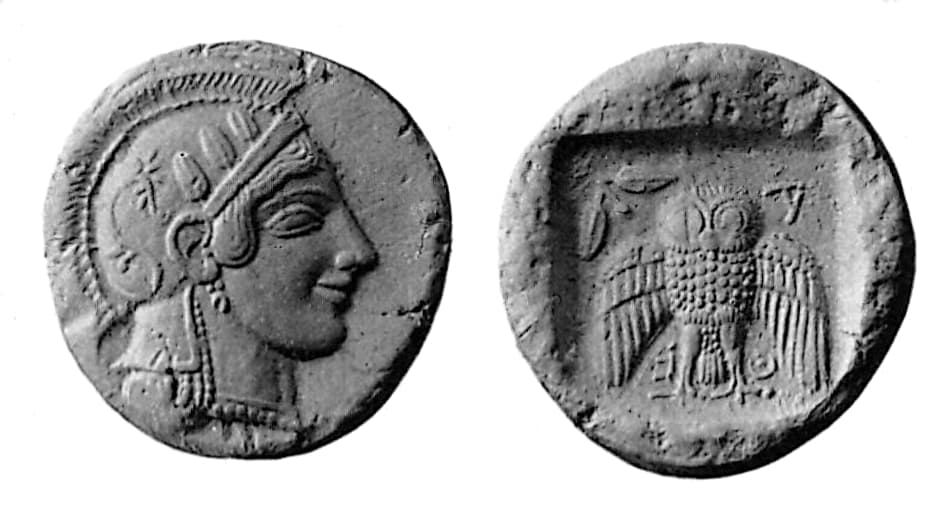
Athens made the most famous small change of the ancient world, its silver owls, and then for a few years in the 460s BC struck a giant version worth ten drachms, with the owl turned to stare straight out of the coin; only about forty survive.
- Year
- c.467-465 BC
- Maker
- Athens (Attica), ancient Greece
- By price in coins
- 45 of 100
Create a free account to see every recorded price and every grade.
Create a free account- Struck
- Athens, about 469/5 to 460 BC; also dated about 467 to 465 BC
- Denomination
- Decadrachm (dekadrachm), ten drachms, the largest Athenian silver coin
- Obverse
- Helmeted head of Athena right, her crested helmet decorated with three olive leaves
- Reverse
- Owl standing facing with wings spread, olive sprig and crescent, the letters A-Θ-E, in an incuse square
- Weight
- About 42.5 g; recorded examples weigh 42.69 g and 41.98 g
- Known examples
- 40 in the standard catalog of the type; one 2011 auction description says about 48
- Where they are
- Of the 40 cataloged: 18 in museums, 19 in private hands, 3 unlocated
- First modern find
- 1817, reportedly at Megara; now in the national coin cabinet in Paris
- Highest price found
- 850,000 Swiss francs, reported as $852,643, at a European auction in 2010
The owl that turned to face you
Athens built its coinage on silver from the mines at Laurion. Its four-drachm piece, the tetradrachm, showed the goddess Athena on one side and her owl on the other, and the coins became so common and so trusted that collectors today simply call them owls. They were minted to a tight standard of weight and purity, which helped make them the leading trade coin of their era.
The decadrachm is the same idea at heroic scale. Worth ten drachms and weighing about 42.5 grams, it was so large that it pushed the limits of striking coins by hand. Its obverse keeps the familiar profile of Athena in a crested helmet. Its reverse breaks the pattern: instead of the usual owl in profile, the bird stands facing the viewer with its wings spread wide. It is the only Athenian coin with that design.
Scholars have read that change as a show of strength. One auction catalog describes the spread-winged owl as a clear representation of Athens's growing military power at the moment the coins were made.
Dating a coin by its silver
For a long time the decadrachm was tied to a story told by Herodotus. He wrote that Athens had planned to share a surplus from the Laurion mines among its citizens, ten drachms each, until Themistocles persuaded them to build a navy instead, the fleet that defeated the Persians at Salamis in 480 BC. Since a decadrachm is exactly ten drachms, early writers assumed the coins were made for that payout, in the 480s.
Hoards proved otherwise. Finds of buried coins showed the decadrachms came later. The discovery of the Asyut Hoard in 1968 or 1969 and the Elmalı Hoard in 1984, which alone held 13 decadrachms, confirmed a date in the mid-460s BC.
That points to a different source of silver. In 469 or 466 BC, the date is disputed, the Athenian general Cimon led the Delian League to a crushing victory over the Persians at the Eurymedon River in what is now southern Turkey, and the plunder was enormous. Soon after, the island of Thasos tried to leave the League over a dispute about mines, and Athens besieged it from 465 to 463 BC and imposed heavy reparations. The near-consensus view is that the decadrachms were struck from the silver of those victories.
Their purpose is still debated. One scholar argued that the size of the issue points to an economic rather than ceremonial use; an older view held that such coins were made for show. Imitations struck elsewhere, including a tetradrachm from Askalon on the coast of what is now Israel, suggest the big owls did circulate.
From Megara to the auction room
The first decadrachm known in modern times was found in 1817, reportedly at Megara, about 26 miles west of Athens. It was acquired by Percy Smythe, Viscount Strangford, then British ambassador to the Ottoman Empire. He passed it to the Duke of Luynes, who gave it to the coin cabinet of France's national library, where it remains.
Finds came slowly. A 1924 study identified eight more, and a 1970 study added three. Hoards dug up over the following decades raised the total to 40, the number cataloged in Wilhelm Fischer-Bossert's study of the type, The Athenian Decadrachm (one source dates it 2005, another 2008). A 2011 auction description put the figure at about 48, so the count depends on the source and the date.
Individual coins carry their own stories. The example sold in January 2011 came from the family of a petroleum engineer who had worked in the Middle East; it was reportedly found around 1952 during excavations by his construction crew. Graded VF and lightly toned, it weighed 42.69 grams and sold for a hammer price of $375,000 against a $200,000 estimate.
Prices for these coins run from the tens of thousands to the high six figures. A finely preserved example sold for $525,000 in January 2019. In 2010 one brought 850,000 Swiss francs, reported as $852,643, at a European auction. Even damaged examples find buyers: one with a major flaw in the metal sold for $60,000 in January 2010, and the only known fragment, half a coin broken long ago, sold for $23,000 the same month.
How to recognize one, and the fakes
A genuine decadrachm shows Athena's head right in very high relief, wearing an earring, a necklace and a crested Attic helmet with three olive leaves over the visor. The reverse shows the facing owl with wings spread, an olive sprig and crescent at upper left, and the letters A-Θ-E, short for the Athenians, all inside an incuse square. Specialists identify individual coins by their dies.
Because the coin is so famous, fakes have followed it for two centuries. Lord Strangford himself reportedly owned a second decadrachm that turned out to be forged. Within five years of the first find, a forger named Becker cut dies from a published illustration and struck copies in bronze, which are easy to spot. A more deceptive forgery appeared after World War I and fooled many professionals until its telltale details were published.
There are also honest copies. Starting in 1859 the British Museum had Robert Ready make electrotype copies of coins in its collection, and in the early 1920s a collector could buy a copy of the museum's decadrachm for two shillings and sixpence. The copies were good enough that some were later passed off as real, and the museum stopped selling them.
The greatest coin in the world
The decadrachm sits near the top of every list of great ancient coins; a widely used ranking of the 100 greatest ancient coins places it second. A veteran dealer once told a younger colleague, holding up a single silver coin on a velvet tray, "This, my good friend, is the greatest coin in the world." It was an Athenian decadrachm.
Part of its appeal is what it stands for. It was struck as Athens was tightening its grip on the Delian League, not long before the League's treasury was moved from Delos to Athens. The owl that stares out of the coin is the bird of Athena, and of Athens at its most confident.
The numbers
- Mintage
- Not recorded
- Known survivors
- 40 (Fischer-Bossert catalog); about 48 (2011 auction description)
- Weight
- About 42.5 g; examples recorded at 42.69 g and 41.98 g
- Diameter
- 31 mm (the 2011 example)
- Composition
- Silver, struck on the Attic standard, on which one drachm weighed about 4.3 g
- Designer
- Not recorded; no engraver is named
- Standard reference
- Fischer-Bossert, The Athenian Decadrachm
Timeline
The fleet built on Themistocles's advice defeats the Persians at Salamis; early scholars wrongly linked the decadrachm to this era.
The Delian League is founded under Athenian leadership to keep fighting Persia.
Cimon defeats the Persians at the Eurymedon River, capturing huge booty.
Athens suppresses the revolt of Thasos and imposes reparations.
Athens strikes its decadrachms, the only Athenian coins with a facing owl.
The first decadrachm known in modern times is found, reportedly at Megara, and later given to France's national coin cabinet.
A study by Charles Seltman identifies eight more examples.
A decadrachm is reportedly found during construction excavations; it stays in one family until 2011.
The Asyut Hoard is discovered, helping fix the coins' date.
A study by Chester C. Starr describes three more decadrachms.
The Elmalı Hoard is found with 13 decadrachms.
Wilhelm Fischer-Bossert publishes The Athenian Decadrachm, cataloging 40 known examples (sources give 2005 and 2008).
A damaged example sells for $60,000 and the only known half-coin fragment for $23,000.
An example sells in Europe for 850,000 Swiss francs, reported as $852,643.
The 42.69 g example found around 1952 sells for a $375,000 hammer price.
A finely preserved example sells for $525,000.
The world in 468
Sophocles wins his first prize at the Dionysia festival in Athens, beating Aeschylus.
The Battle of the Eurymedon River ends a planned Persian offensive against the Greeks.
The Persian king Xerxes is assassinated by the commander of his bodyguard.
Thasos revolts against the Delian League in a dispute over mines.
An earthquake destroys much of Sparta.
Cimon is ostracized and exiled from Athens for ten years.
Pericles moves the Delian League's treasury from Delos to Athens.
Price record
| Date | Price | Kind |
|---|---|---|
| 2010 | $852,643 | Sold at auctionEuropean auction, 850,000 Swiss francs against an estimate of 750,000 francs. |
| Jan 2010 | $60,000 | Sold at auctionExample with a major planchet defect on the reverse. |
| Jan 4, 2011 | $375,000 | Sold at auction42.69 g, 31 mm, VF, lightly toned; found c. 1952. Hammer price, excluding buyer's fee; estimate $200,000. |
| Jan 4, 2011 | $200,000 | Estimate, not a salePre-sale estimate for the 42.69 g example. |
| Jan 2019 | $525,000 | Sold at auctionExample of outstanding quality. |
A realized auction price is what a buyer actually paid on the date shown, including the buyer's premium where the sale reported it. It is the strongest kind of reference price, and it is a record of one sale of one object on one day, not a promise of what the next example will bring.
By reference price, Athens Decadrachm (Owl) is number 45 of 100 in the coins entries of the FLOAT 100. 96 of those 100 rest on a realized sale; the rest carry an asking price or a guide value, and each page says which. Rank within the FLOAT 100 itself (50 here) is editorial: how much an object defines its field, not price alone.
Did you know
- The decadrachm is the only Athenian coin whose owl faces the viewer with wings spread.
- Herodotus's story of a ten-drachm payout to every citizen led early scholars to date the coins nearly two decades too early.
- One hoard, found in 1984, held 13 decadrachms.
- The only known fragment is half a coin; the other half has never been found.
- In the early 1920s you could buy an official museum copy of a decadrachm for two shillings and sixpence.
- A forger named Becker copied the first known decadrachm within five years of its discovery, working from a published drawing.
How this page is made
- The figure
- One reference price, shown with its own kind. FLOAT does not average it with anything or adjust it for time.
- Realized or not
- A realized price is a completed sale. An asking price, an estimate and a price-guide value are not sales, and are labeled as such wherever they appear.
- The story
- Researched from published records and checked fact by fact. Updated Oct 1, 2026.
- Archive
- Oct 5, 2026