FLOAT 100 · Coins · No. 49
EID MAR Denarius of Brutus
Two years after he helped stab Julius Caesar, Brutus put his own face on a coin and the murder weapons on the back, a boast so famous that a Roman historian wrote about it and the victors tried to melt every one.
- Year
- 43-42 BC
- Maker
- Roman Republic (Brutus, military mint)
- By price in coins
- 33 of 100
Create a free account to see every recorded price and every grade.
Create a free account- Struck
- 43 to 42 BC, by a military mint traveling with Brutus; one auction catalog dates this issue to late summer and autumn 42 BC in northern Greece
- Issued by
- Marcus Junius Brutus, with the magistrate Lucius Plaetorius Cestianus, whose name appears on the obverse
- Obverse
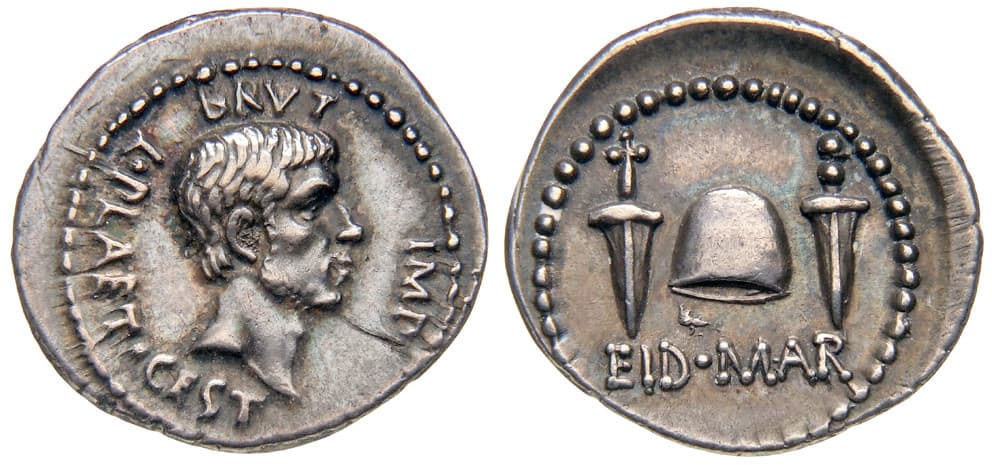
- Bare head of Brutus right with a slight beard; legend BRVT IMP L PLAET CEST
- Reverse
- A pileus (liberty cap) between two daggers, with EID MAR, short for Eidibus Martiis, "on the Ides of March"
- Metal
- Silver denarius; a handful were struck in gold
- Size
- Roughly the size of a US nickel; the record-setting example measures 19 mm and weighs 3.72 g
- Surviving examples
- Silver: estimates range from about 80 to about 100. Gold: three known
- Standard reference
- Crawford 508/3
- Record for the silver type
- $720,000 at auction, May 3, 2023, for an example graded NGC XF, Strike 5/5, Surface 4/5, Fine Style
A coin that celebrates a murder
On the Ides of March, March 15, 44 BC, a group of senators led by Marcus Junius Brutus and Gaius Cassius Longinus surrounded Julius Caesar at a session of the Senate and stabbed him to death. The conspirators expected to be hailed as liberators. Instead, the Roman crowd turned against them, and in April Brutus and Cassius left Rome.
They regrouped in the Greek east to fight Caesar's heirs, Mark Antony and Octavian. To pay a growing army, Brutus struck coins at a mint that moved with his troops. The last and most famous of his types carries his own bare-headed portrait on the front and, on the back, a pileus, the felt cap given to freed slaves, flanked by two daggers. Beneath them are the letters EID MAR, short for Eidibus Martiis, "on the Ides of March."
The message was not subtle. The cap stood for liberty, the daggers for the weapons that killed Caesar, and the date for the day the deed was done. Read together, the reverse claims that the Republic had been freed from a tyrant. The production was overseen by Lucius Plaetorius Cestianus, whose name, abbreviated L PLAET CEST, runs around Brutus's portrait.
It is one of very few specific coin designs described by an ancient author. The historian Cassius Dio wrote that Brutus "stamped upon the coins which were being minted his own likeness and a cap and two daggers, indicating by this and by the inscription that he and Cassius had liberated the fatherland."
Brutus, the tyrannicide with his own portrait
Brutus was born late in 85 BC to Marcus Junius Brutus the Elder and Servilia, who later became Caesar's mistress. His family told stories of tyrant killers: his ancestor Lucius Junius Brutus was credited with expelling Rome's last king, and another forebear, Gaius Servilius Ahala, with killing a would-be tyrant, Spurius Maelius.
He knew coinage from the inside. In 54 BC he served as one of Rome's annual moneyers and designed a denarius showing those two ancestors, a coin that advertised his family's opposition to one-man rule. When civil war broke out in 49 BC he sided with Pompey, was pardoned by Caesar after Pompey's defeat, and rose in Caesar's favor before joining the plot against him.
That history is what makes the EID MAR coin so pointed. Placing a living man's portrait on Roman coins was one of the things that had alarmed Caesar's opponents, who feared he meant to make himself king. Brutus, the self-styled defender of the Republic, did the same thing while celebrating Caesar's death on the reverse.
His cause ended in northern Greece. Antony and Octavian defeated the armies of Brutus and Cassius in two battles at Philippi, on October 3 and October 23, 42 BC. Cassius took his own life after the first; Brutus took his after the second. Ancient accounts disagree on what happened to his body.
How to read and identify one
The obverse shows Brutus's head facing right with a light beard. The legend reads BRVT IMP, for Brutus Imperator, a title his soldiers gave him after a campaign in Thrace, and L PLAET CEST for the magistrate. The reverse shows the cap of liberty between two daggers with EID MAR below. The two daggers are usually read as standing for Brutus and Cassius. One writer points out that their hilts differ, one with a cross-shaped pommel and one rounded, and finds it tempting to imagine they show the actual weapons used.
The coins were struck by hand from engraved dies. A 1989 study of the type by the numismatist Cahn worked from 58 examples and found that they were struck from 8 obverse dies and 26 reverse dies; reverse dies wore out faster because they took the hammer blow. A later survey added about 30 more coins.
How many survive depends on whom you ask. Recent published estimates range from about 80 to about 100 silver examples. The scarcity is usually explained by a recall: after Philippi, the victorious Antony and Octavian are said to have called the coins in and melted them down.
A gold version, the aureus, is far rarer, with only three examples known. One of them was pierced in Roman times, probably to be worn as jewelry. Because of the type's fame, buyers today look for certification by a third-party grading service, and the best silver examples are graded for strike, surface and style as well as wear.
A century of owners for the record coin
The silver example that set the record for the type has a paper trail running back almost a hundred years. It was sold from the W. H. Woodward collection in July 1930, from the Hall Park McCullough collection in November 1967, and again in November 1973. It became the plate coin, illustrated as 10b, in Cahn's study of the type.
The collector Nelson Bunker Hunt acquired it privately from the Sy Weintraub collection, and it was offered in the first part of the Hunt sale on June 19, 1990. It later passed through a sale in May 2000, the Peter Weller collection that summer, and an auction in Switzerland in May 2005.
In September 2011 it sold at auction in Long Beach, California, as part of the Rubicon collection for $546,250, at the time a record for any silver Roman coin. Writers on the type noted that it outsold a less worn example because its metal was sounder and less porous.
On May 3, 2023, graded NGC XF with a strike of 5/5 and a surface of 4/5, and the only certified example to receive a Fine Style designation, it sold at auction for $720,000, a new record for the silver type. A grading company official said demand was being driven by new buyers attracted by third-party certification.
The gold coin that went home to Greece
On October 29, 2020, one of the three known gold EID MAR coins sold at auction in London for £3,240,000, reported as about $4.19 million, and was described as the most expensive ancient coin ever sold at auction. It had never been published before and was the best preserved of the three.
The provenance offered with it, tracing the coin to an eighteenth-century Swiss collection, turned out to be false. According to the Manhattan District Attorney's office, the coin first appeared on the market in 2016, offered in Munich with no provenance, before being taken to London and sold to a US buyer. One report says it had also been shown at a New York coin convention in 2015; the two accounts differ on where it first surfaced.
Investigators from US Homeland Security Investigations, working with foreign agencies, concluded that the coin had been looted from Greece. The buyer handed it over, the London auction firm's owner was arrested and charged with grand larceny, and in February 2023 the coin was seized. On March 21, 2023, it was returned to Greece at a ceremony at the Greek Consulate in New York along with 28 other antiquities. The auction firm closed in May 2024.
Why it matters
The EID MAR denarius is often called the most historically important ancient coin. Numismatists voted it number one among the 100 greatest ancient coins, and it appears in the standard handbook of Roman coins and in countless books and television programs about Caesar.
Its appeal is that it connects a small silver object to a single, famous day. Few coins name an event; this one names a murder and shows the weapons. Collectors also prize the irony that the man who killed Caesar partly over royal pretensions put his own face on the money.
Prices show how steady that demand has been. Silver examples have sold for more than half a million dollars in Los Angeles in 2014, twice in 2023, and in Switzerland in 2026, where one example brought a hammer price of 420,000 Swiss francs, reported as $533,039, before fees.
The numbers
- Mintage
- Not recorded. Known examples come from 8 obverse and 26 reverse dies (Cahn, 1989)
- Known survivors
- Silver: about 80 to about 100 by recent estimates (58 studied by Cahn in 1989, about 30 added since). Gold: 3
- Weight
- 3.72 g (the record example)
- Diameter
- 19 mm (the record example), about the size of a US nickel
- Composition
- Silver; a separate gold aureus version exists
- Issuer and moneyer
- Marcus Junius Brutus, with Lucius Plaetorius Cestianus; engraver not recorded
- Mint
- Military mint moving with Brutus's army in northern Greece
- References
- Crawford 508/3; Sydenham 1301
Timeline
Marcus Junius Brutus is born, late in the year, to Marcus Junius Brutus the Elder and Servilia.
Brutus serves as a Roman moneyer and issues denarii honoring his tyrant-fighting ancestors.
Caesar crosses the Rubicon and civil war begins; Brutus sides with Pompey.
Caesar is assassinated at a session of the Senate by conspirators led by Brutus and Cassius.
Brutus and Cassius leave Rome as public anger turns against them.
A military mint traveling with Brutus strikes his coinage; the EID MAR type is his last.
First battle of Philippi; Cassius takes his own life.
Second battle of Philippi; Brutus is defeated and takes his own life. The coins are later said to have been recalled and melted.
The future record coin is sold from the W. H. Woodward collection.
The numismatist Cahn publishes his study of the type, based on 58 coins from 8 obverse and 26 reverse dies.
The record coin is offered in the first part of the Nelson Bunker Hunt collection sale.
The record coin sells for $546,250 in Long Beach, California, a record at the time for a silver Roman coin.
Another silver example sells for $517,000 at auction in Los Angeles.
A gold EID MAR aureus sells in London for £3,240,000, reported as about $4.19 million.
The gold aureus, found to have been looted, is repatriated to Greece in New York.
The record silver coin, now graded NGC XF Fine Style, sells for $720,000.
A silver example sells in Scandinavia for 4.25 million Danish kroner ($616,747), a record for any coin sold at auction there, after failing to sell on March 15.
A silver example brings a hammer price of 420,000 Swiss francs ($533,039) at auction in Switzerland.
The world in Marc
The poet Ovid is born in Sulmo, east of Rome.
Senate forces, with Octavian, defeat Mark Antony at the Battle of Mutina.
The Second Triumvirate of Octavian, Antony and Lepidus is formally created by law, followed by proscription lists of their enemies.
Cicero, the Republic's great orator, is caught and killed at Formiae.
The future emperor Tiberius is born in Rome.
The two battles of Philippi end the armed resistance of Caesar's assassins.
Price record
| Date | Price | Kind |
|---|---|---|
| Sep 7, 2011 | $546,250 | Sold at auctionThe Rubicon collection example, Cahn plate coin 10b (the later record coin). Sold at auction in Long Beach, California; then a record for a silver Roman coin. |
| Jun 4, 2014 | $517,000 | Sold at auctionSilver denarius, described as one of the finest known. Sold at auction in Los Angeles ($440,000 hammer plus a 17.5% premium). |
| May 3, 2023 | $720,000 | Sold at auctionThe same coin as the 2011 sale, graded NGC XF, Strike 5/5, Surface 4/5, Fine Style. Record for the silver type; includes buyer's premium. |
| Jun 15, 2023 | $616,747 | Sold at auctionSilver denarius with provenance to 1959. Sold at auction in Scandinavia for 4.25 million Danish kroner including buyer's fee and VAT. |
| May 30, 2026 | $533,039 | Sold at auctionSilver denarius described as Extremely Fine, struck slightly off center. Hammer price of 420,000 Swiss francs at auction in Switzerland, before the 22.5% buyer's fee. |
A realized auction price is what a buyer actually paid on the date shown, including the buyer's premium where the sale reported it. It is the strongest kind of reference price, and it is a record of one sale of one object on one day, not a promise of what the next example will bring.
By reference price, EID MAR Denarius of Brutus is number 33 of 100 in the coins entries of the FLOAT 100. 96 of those 100 rest on a realized sale; the rest carry an asking price or a guide value, and each page says which. Rank within the FLOAT 100 itself (49 here) is editorial: how much an object defines its field, not price alone.
Did you know
- It is one of the very few coin designs described by a classical author: Cassius Dio wrote about the cap and two daggers.
- The pileus on the reverse was the felt cap given to Roman slaves when they were freed.
- Appian wrote that as the assassins left the Senate, one of them carried a cap on the end of a spear as a symbol of freedom.
- Brutus had been a Roman moneyer himself ten years earlier, in 54 BC, designing coins that honored his tyrant-killing ancestors.
- The record silver example sold for $546,250 in 2011 and $720,000 in 2023, and its documented ownership goes back to 1930.
- One of the three gold examples has a hole made in Roman times, probably so it could be worn.
- A gold example that sold for about $4.19 million in 2020 was seized in 2023 and returned to Greece after investigators found it had been looted.
How this page is made
- The figure
- One reference price, shown with its own kind. FLOAT does not average it with anything or adjust it for time.
- Realized or not
- A realized price is a completed sale. An asking price, an estimate and a price-guide value are not sales, and are labeled as such wherever they appear.
- The story
- Researched from published records and checked fact by fact. Updated Oct 1, 2026.
- Archive
- Oct 5, 2026