FLOAT 100 · Stamps · No. 87
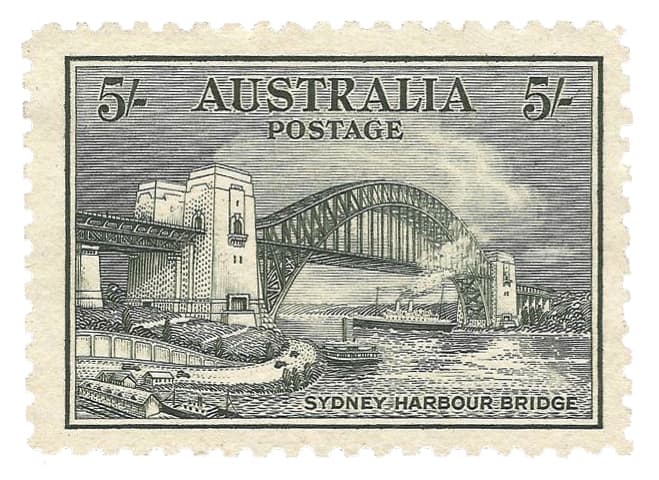
Australia 1932 5/- Sydney Harbour Bridge
In the depths of the Great Depression, Australia put its new Sydney Harbour Bridge on a five-shilling stamp that almost nobody could afford to post, let alone save, and that is exactly why collectors chase it today.
- Year
- 1932
- Maker
- Commonwealth of Australia
- By price in stamps
- 95 of 100
- What it is
- The 5/- (five shilling) top value of Australia's 1932 Sydney Harbour Bridge commemorative issue
- Issued
- March 14, 1932, five days before the bridge opened (one source gives March 19, the opening day)
- Color
- Blue-green, also described as dark green
- Design
- The bridge seen from the south-east, with the liner R.M.S. Orford passing beneath for scale
- Makers
- Designed by R. A. Harrison, engraved by Frank D. Manley, printed by John Ash in Melbourne
- Printing
- Recess (engraved), perforated 11, no watermark
- Quantity
- Usually given as 72,800 (one dealer gives 72,500), against 9,749,680 of the 2d recess value
- Hardest form
- Unused, never-hinged copies with good centering; postally used copies are also far scarcer than cancelled-to-order ones
A bridge worth a stamp
The Sydney Harbour Bridge was the largest public work of its time in Australia. The contract went to the British firm Dorman Long & Co of Middlesbrough on March 24, 1924, for £4,217,721. About 52,800 tonnes of steel went into it, held together by roughly six million hand-driven rivets, and the last rivet was driven on January 21, 1932. The total cost reached £6.25 million, a debt that was not fully repaid until 1988.
To mark the opening, the Commonwealth issued three stamps showing the bridge: a 2d in carmine-red, a 3d in blue and a 5/- in green. All three were recess printed. A 2d printed by letterpress followed, and the 2d and 3d were also overprinted 'O S' for official use. The 5/- was never overprinted.
The stamps went on sale on March 14, 1932, ahead of the opening on March 19. One collector's account gives March 19 as the issue date; most catalogues and the bridge's own history give March 14.
Harrison, Manley and Ash
The design is credited to R. A. Harrison. It shows the bridge from the south-east, with the ocean liner R.M.S. Orford steaming underneath, so that the size of the arch is obvious at a glance. The die was engraved by Frank D. Manley.
The stamps were printed in Melbourne by John Ash, whose name appears as an imprint in the center of the bottom sheet margin on every 1932 bridge value except the postal forgery. Strips with the Ash imprint are a collected variety of their own.
The 5/- was printed by recess on unwatermarked paper and perforated 11. One specialist account notes that the 5/- exists only on horizontal-mesh paper, while the lower values are found on both mesh directions. A retouch to the shading over the center of the bridge is a recorded variety.
Opening day, in hard times
Australia in 1932 was in the worst of the Depression. Unemployment reached a record of about 32 percent. In that setting, a five-shilling stamp was a large sum. Postally used copies often carry parcel-office cancels, and very few people bought one to keep.
The opening on March 19, 1932, became famous for something no one had planned. Premier Jack Lang was about to cut the ribbon when Francis de Groot, a member of the paramilitary New Guard, rode forward on a borrowed horse in military uniform and slashed at it with his sword, declaring the bridge open 'in the name of the decent and respectable people of New South Wales.' He was pulled from the horse and arrested, the ribbon was retied, and Lang opened the bridge.
Estimates of the crowd that day run from 300,000 to one million people, at a time when Sydney had about 1,256,000 residents. Less than two months later, on May 13, the governor dismissed Lang from office.
Used, cancelled-to-order and mint
Because the 5/- was expensive, most surviving copies are used, and most of those are not postally used at all. The Post Office cancelled sheets to order, typically with a corner 'G.P.O. MELBOURNE' cancel, and put them in specimen packs that collectors describe as having been given away for about 15 years. Those cancelled-to-order copies often still have gum on the back.
Collectors argue that the commonly quoted figure of 72,800 counts only stamps sold over the counter, and that the cancelled-to-order copies were extra. If so, total production was higher than the headline number. The share that was cancelled to order is not known.
Copies that actually carried mail are much harder to find. They often bear heavy oval rubber parcel-office cancels, and many are creased or scuffed. One Australian catalogue prices postally used copies 80 percent above cancelled-to-order ones. At the top of the market are unused, never-hinged copies with good centering and perforations, which dealers call extremely rare. A British catalogue values an unused copy at £425.
How to know the real thing
A genuine 5/- is recess printed (engraved) and perforated 11 on paper with no watermark. The bridge is seen from the eastern side, with the R.M.S. Orford under the arch. A complete sheet of the 5/- has 20 stamps, five across by four down.
The postal forgery of the series, typographed rather than engraved, was made of the 2d to cheat the Post Office rather than collectors. For the 5/-, collectors warn instead about regummed and reperforated copies, and about fake first day covers and fake cancels on covers carrying the full set.
Condition drives price. Centering, perforations and gum separate an ordinary mint copy from a premium one, and a cleanly cancelled postally used copy is worth more than a corner-cancelled specimen-pack stamp.
Australia's iconic key stamp
Collectors call the 5/- bridge the 1930 Penny of Australian philately, comparing it to the famous rare coin of the same Depression years. It is not rare in the strict sense, but strong demand for well-centered, unused copies keeps it the key value of the bridge set.
The bridge itself has appeared on many later stamps and postmarks, but the 1932 engraving, with the Orford under the arch, remains the image collectors mean when they talk about the Harbour Bridge stamp.
The numbers
- Issue date
- March 14, 1932
- Quantity
- 72,800 sold (commonly cited; excludes an unknown number cancelled to order)
- Printing
- Recess (engraved) by John Ash, Melbourne
- Perforation
- 11
- Watermark
- None
- Paper
- Horizontal mesh only (per one specialist account)
- Design size
- 31 x 22 mm
- Sheet
- 20 stamps (5 x 4)
Timeline
Dorman Long & Co wins the contract to build the bridge.
The last rivet in the bridge is driven.
The 2d, 3d and 5/- bridge stamps go on sale.
The bridge opens; Francis de Groot cuts the ribbon before Premier Lang can.
About 72,800 of the 5/- are sold; cancelled-to-order copies go into specimen packs.
Jack Lang is dismissed as premier of New South Wales.
The bridge's construction debt is finally repaid.
The world in 1932
Joseph Lyons becomes prime minister of Australia, succeeding James Scullin.
Phar Lap wins the Agua Caliente Handicap in Mexico; he dies about two weeks later.
The Australian Broadcasting Commission is established.
Labor suffers heavy losses at the New South Wales state election.
The 'Emu War' begins in Western Australia; it ends unsuccessfully on December 10.
Australian unemployment reaches a record of about 32 percent.
Price record
A realized auction price is what a buyer actually paid on the date shown, including the buyer's premium where the sale reported it. It is the strongest kind of reference price, and it is a record of one sale of one object on one day, not a promise of what the next example will bring.
By reference price, Australia 1932 5/- Sydney Harbour Bridge is number 95 of 100 in the stamps entries of the FLOAT 100. 82 of those 100 rest on a realized sale; the rest carry an asking price or a guide value, and each page says which. Rank within the FLOAT 100 itself (87 here) is editorial: how much an object defines its field, not price alone.
Did you know
- Only about 72,800 of the 5/- were sold, against 9,749,680 of the 2d.
- Thousands of 5/- stamps were cancelled to order and handed out in specimen packs, so a genuinely postally used copy is much scarcer than a cancelled one.
- The ship under the bridge on the stamp is the liner R.M.S. Orford.
- The man who cut the opening ribbon, Francis de Groot, was fined £5 for offensive behavior, later won £69 in damages for wrongful arrest and got his sword back.
- The only forgery of the series was made to cheat the Post Office, not collectors, and today it is worth far more than the genuine stamp it copied.
How this page is made
- The figure
- One reference price, shown with its own kind. FLOAT does not average it with anything or adjust it for time.
- Realized or not
- A realized price is a completed sale. An asking price, an estimate and a price-guide value are not sales, and are labeled as such wherever they appear.
- The story
- Researched from published records and checked fact by fact. Updated Oct 3, 2026.
- Archive
- Oct 5, 2026