FLOAT 100 · Stamps · No. 86
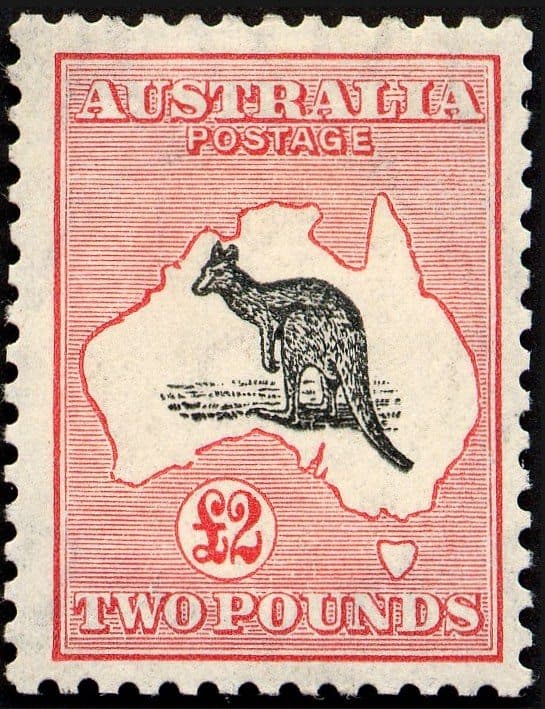
Australia 1913 'Kangaroo and Map' GBP 2
Australia's first national stamps left the king off and put a kangaroo on a map instead; critics called the design childish and the next government tried to kill it, but the top value, the £2 of 1913, became the crown of the series.
- Year
- 1913
- Maker
- Commonwealth of Australia
- By price in stamps
- 77 of 100
Create a free account to see every recorded price and every grade.
Create a free account- What it is
- Australia's 1913 £2 Kangaroo and Map, black and rose, first watermark (SG 16), mint
- Issued
- April 8, 1913
- Series
- Australia's first national definitives: 15 values from ½d to £2, the first on January 2, 1913
- Designer
- William Blamire Young, working to Postmaster-General Charles Frazer's brief
- Engraver and printer
- Samuel Reading engraved the die; J.B. Cooke printed the stamps in Melbourne
- Watermark
- Wide crown over wide A, the first Commonwealth watermark, used only in 1913
- Perforation
- Listed as 12 (or 11½ x 12); measures about 11.7 x 11.8
- Quantity
- One catalog lists 240,000 for the first-watermark £2
A nation's first stamps
Australia federated in 1901. In January 1911 Postmaster-General Josiah Thomas announced a competition for a national design, with prizes of £100 and £50. It drew more than a thousand entries. The winning design showed King George V surrounded by the six state crests, with a kangaroo and an emu.
Charles Frazer, who replaced Thomas as Postmaster-General in October 1911, was appalled and called the royal portrait 'execrable.' He believed Australia's stamps should advertise Australia, not Britain. Republicans in the Fisher Labor government also opposed putting the monarch on the stamps. Frazer liked two competition entries, one with a kangaroo and one with a map, and asked for 'a picturesque stamp' with the outline of Australia as a feature.
Blamire Young, Reading and Cooke
The Victorian Artists' Society recommended William Blamire Young, an English-born watercolorist living in Australia. His first ten essays were judged unsuitable. Frazer then asked him to combine ideas from his own submissions with elements of the competition entries, and the result was a kangaroo standing inside an outline map of the continent. The design was approved and unveiled on April 2, 1912.
Samuel Reading, an engraver in Melbourne, cut the die, and J.B. Cooke printed the stamps. A single die served for every Kangaroo and Map stamp; the value was changed by inserting different value plugs. The printing plates carried two monograms in the bottom margin, 'CA' for Commonwealth of Australia and 'JBC' for the printer, each appearing under only one stamp per pane.
The first value, the 1d red, went on sale in Sydney on January 2, 1913, and the other 14 values, up to the £2, followed over the next three months. The £2, printed in black and rose, was issued on April 8, 1913.
Mocked, replaced and reprieved
The press savaged the design. The two-pronged tuft of grass at the kangaroo's feet was likened to a rabbit's head popping out of a burrow, and critics called the stamp childish, crude, ugly and brainless. One complained that it showed Australia as an empty land with nothing but kangaroos. The British government protested through the Governor-General about the missing king. Frazer defended it as neat, simple and artistic and predicted people would come to love it. He told Parliament the map showed a 'White Australia,' a reference to the immigration policy of the day.
Labor lost office in June 1913, and one of the first acts of Joseph Cook's government was to order stamps bearing George V's profile. They appeared in December 1913. Frazer died of pneumonia on November 25, 1913, less than a year after his stamps went on sale.
The kangaroo survived anyway. The new Postmaster-General, Agar Wynne, decided existing stocks should be used rather than destroyed, and when Labor returned in September 1914 the phase-out stopped and the Post Office supplied both designs. The Kangaroo and Map design was printed for 35 years, through five watermarks, and stayed valid for 38 years; the last value in use was withdrawn in 1948.
Why the first watermark £2 matters
Kangaroos are classified by watermark. The first, used only in 1913, shows a wide crown over a wide letter A. Later printings used a wide crown with a narrow A in 1915, a narrow crown with a narrow A from 1915 to 1924, small crown and A multiples in 1929-30, and small crown and 'C of A' multiples from 1931. The £2 was the highest value, and £2 was a lot of money at the time, so there are not many of them around.
One catalog lists 240,000 of the 1913 £2. A version overprinted SPECIMEN also exists.
The most valuable versions are singles with a monogram in the margin below. Only three are known of each monogram on the first watermark £2, and one of the 'JBC' copies is in the Royal Collection. A 'JBC' monogram single set a record of $138,000 at auction in February 2007, and in June 2020 a 'CA' monogram copy was offered with an estimate of 120,000 Australian dollars. These are distinct varieties and command far more than an ordinary mint copy.
The symbol that stuck
Frazer's design outlasted the government that tried to replace it by decades. The series, with its 16 values, five watermarks and many proofs, errors and varieties, is a field of study in itself. For many collectors the first watermark £2 is the stamp that completes it.
The numbers
- Issue date
- April 8, 1913
- Catalog number
- SG 16
- Color
- Black and rose
- Watermark
- Wide crown over wide A (first Commonwealth watermark)
- Perforation
- 12 or 11½ x 12 as listed; about 11.7 x 11.8 measured
- Printing
- Printed by J.B. Cooke, Melbourne, from a die engraved by Samuel Reading
- Quantity
- 240,000 (as listed by one catalog)
- Monogram singles
- Three known each of 'CA' and 'JBC' on the first watermark £2
Timeline
The Australian colonies federate as the Commonwealth of Australia.
Postmaster-General Josiah Thomas announces a national stamp design competition.
Charles Frazer becomes Postmaster-General and rejects the winning royal design.
Blamire Young's Kangaroo and Map design is approved and unveiled.
The first Kangaroo and Map stamp, the 1d, goes on sale in Sydney.
The £2 black and rose is issued, completing the 15-value set.
Labor loses office; Joseph Cook's government orders stamps with George V's head.
Charles Frazer dies of pneumonia.
The first King George V stamps go on sale.
Labor returns to power and the Kangaroo phase-out stops.
A second watermark, wide crown with narrow A, replaces the first.
The last Kangaroo and Map value is withdrawn.
A first-watermark £2 with the 'JBC' monogram sells for $138,000 at auction.
A 'CA' monogram £2 is offered with an estimate of A$120,000.
The world in 1913
Australia's new federal capital is officially named Canberra.
The Woolworth Building opens in New York as the world's tallest building.
Stravinsky's 'The Rite of Spring' premieres in Paris amid a riot.
Suffragette Emily Davison runs in front of the king's horse at the Derby; she dies four days later.
Bulgaria attacks Serbia and Greece, starting the Second Balkan War.
Ford introduces the moving assembly line.
Woodrow Wilson signs the act creating the Federal Reserve.
Price record
A realized auction price is what a buyer actually paid on the date shown, including the buyer's premium where the sale reported it. It is the strongest kind of reference price, and it is a record of one sale of one object on one day, not a promise of what the next example will bring.
By reference price, Australia 1913 'Kangaroo and Map' GBP 2 is number 77 of 100 in the stamps entries of the FLOAT 100. 82 of those 100 rest on a realized sale; the rest carry an asking price or a guide value, and each page says which. Rank within the FLOAT 100 itself (86 here) is editorial: how much an object defines its field, not price alone.
Did you know
- The original competition winner showed King George V; the postmaster-general called the portrait 'execrable' and threw it out.
- Critics said the tuft of grass at the kangaroo's feet looked like a rabbit popping out of its burrow.
- Every Kangaroo and Map value was printed from one die, with the value swapped in on plugs.
- The government that took office in 1913 tried to replace the kangaroo, but chose to use up the stock rather than destroy it, and the design lasted until 1948.
- Charles Frazer died less than a year after his stamps were issued.
- One of the three known 'JBC' monogram £2 stamps is in the Royal Collection.
How this page is made
- The figure
- One reference price, shown with its own kind. FLOAT does not average it with anything or adjust it for time.
- Realized or not
- A realized price is a completed sale. An asking price, an estimate and a price-guide value are not sales, and are labeled as such wherever they appear.
- The story
- Researched from published records and checked fact by fact. Updated Oct 3, 2026.
- Archive
- Oct 5, 2026