FLOAT 100 · Stamps · No. 15
Basel Dove (Basler Taube)
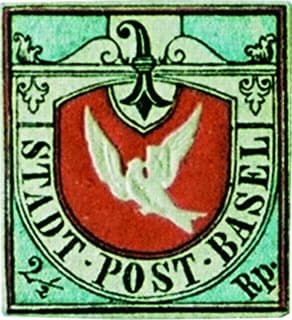
An architect who designed Basel's mailboxes also drew its only stamp: a white dove pressed up out of the paper, carrying a letter, in the world's first three-color postage stamp.
- Year
- 1845
- Maker
- Canton of Basel, Switzerland
- By price in stamps
- 70 of 100
Create a free account to see every recorded price and every grade.
Create a free account- Issued
- July 1, 1845, by the city post of the canton of Basel, Switzerland
- Value
- 2½ rappen, the local rate for a letter carried within the city
- Designer
- Melchior Berri, Basel architect
- Design
- A white embossed dove carrying a letter in its beak, inscribed STADT POST BASEL, with the Basel crozier at top
- Colors
- Black, crimson and blue: the first stamp in the world printed in three colors
- Printer
- H.B. Krebs of Frankfurt, in sheets of 40 (5 rows of 8)
- Quantity
- 41,480 printed by the most recent research; one German source gives 41,400 and a 1930s article claimed 20,880
- Unique status
- Basel's only stamp; Zurich and Geneva were the only other Swiss cantons to issue their own
- Record on cover
- About $108,000 (CHF 103,700 with premium) at auction in Switzerland, November 26, 2014
A city post and sixteen letterboxes
Before 1849 Switzerland had no national post. Each canton ran its own postal service and set its own rates. Only three cantons ever issued their own stamps: Zurich and Geneva in 1843, and Basel two years later.
Basel's stamp grew out of its mailboxes. In 1843, Johannes Bernoulli, the city's postmaster general, proposed to the State Council that Basel's six letterboxes be increased to sixteen, and that the city take the opportunity to issue a stamp. The council approved in January 1844, but the stamp did not appear until July 1, 1845.
The rate was 2½ rappen for a letter of up to one lot, about 15 grams, carried within the city of Basel; mail posted outside the city limits paid a cantonal rate of 5 rappen. At the time Basel counted in batzen, each worth 10 rappen, and the stamps were sold to the public in half-sheets of 20 for 5 batzen.
Melchior Berri, architect of the dove
The stamp was designed by Melchior Berri, born in Basel on October 20, 1801, the son of a pastor. He studied architecture in Karlsruhe, from 1819 under Friedrich Weinbrenner, and then at the École des Beaux-Arts in Paris, traveled in Italy, and in 1828 opened a construction business and a school of building and drawing in Basel. His best-known surviving building is the Basel museum of natural history and ethnography, built 1842 to 1849. He sat on Basel's Grand Council and in 1841 became president of the Swiss Association of Engineers and Architects.
Berri also designed the city's decorative letterboxes, between 1843 and 1844, when Basel reorganized how its mail was collected. They carry the same dove motif. Six are still in use, including one at the Spalentor, the old Spalen Gate, and others at St. Alban-Vorstadt, Münsterplatz, Schneidergasse and Lindenberg, plus one at the old council chambers in Riehen, just outside the city.
The stamp and the mailboxes belong together: one account says Bernoulli liked Berri's boxes so much that he asked for ten more, and a stamp to go with them. Berri died in Basel on May 12, 1854.
Three colors and a raised bird
What makes the Basel Dove remarkable is how it was printed. The design was printed in black, crimson and blue, making it the first multicolored stamp in the world, and the dove itself was embossed: pressed up out of the paper so that it stands slightly in relief, white against a red field. Above the dove sits a bishop's crozier, from the Basel coat of arms; Basel was once the seat of a bishop. Around it runs the inscription STADT POST BASEL, "City Post Basel."
The stamps were made by H.B. Krebs of Frankfurt on thick, yellowish-white wove paper, in sheets of 40 stamps arranged in five rows of eight. They were issued imperforate, so each one had to be cut from the sheet with scissors. German Wikipedia describes the printing method as letterpress; the Helvetia Philatelic Society describes the stamps as engraved and printed.
How many were made was unclear for a long time. An article in the Swiss philatelic press in the early 1930s put the total issued at 20,880. Later research in the archives of the Basel postal administration and in Berri's own papers suggests 41,480 were printed, the figure most sources now use.
Collectors look for more than the basic stamp. A marginal copy with a striking plate flaw, a dot under the "AS" of "BASEL," sold at auction in Zurich in November 2015 for 32,000 Swiss francs from a 7,500-franc start. Many surviving covers are addressed to Carl Ryhiner, a Basel merchant and silk-ribbon manufacturer.
Unpopular then, coveted now
The public did not take to it. Like the other cantonal stamps, the Basel Dove failed to catch on. Sources disagree on when it was retired. The Helvetia Philatelic Society says it was withdrawn in December 1848, with remainders used up through April 1850 and examples known used late into 1850; English and German Wikipedia say it remained valid for postage until September 30, 1854, and a 2015 report describes it as current for nearly ten years. Covers exist that combine the dove with the federal Rayon I stamp issued in March 1851.
Switzerland's national postal service took over in 1849; sources give January 1 and June as the start. Zurich and Geneva kept printing transitional stamps until the first federal stamps arrived in May 1850. Basel never issued another stamp of its own.
Its value today rests on its rarity and its fame. German Wikipedia ranks it with the Double Geneva and the Zurich 4 and 6 among the most popular stamps with Swiss collectors. On November 26, 2014, at auction in Wil, Switzerland, a cover addressed in calligraphy to Carl Ryhiner, bearing a first-printing stamp tied by a red datestamp of June 26, 1847, sold for 103,700 Swiss francs, about $108,000, against an estimate of 20,000 to 25,000 francs: a world record for a Basel Dove on cover. A used pair at the same sale did even better, about $114,000.
In 2015, the stamp's 170th anniversary year, one Zurich saleroom offering many Basel Doves was so crowded that extra chairs had to be squeezed in between the tables.
The numbers
- Issue date
- July 1, 1845
- Valid until
- September 30, 1854 per Wikipedia; withdrawn December 1848 per the Helvetia Philatelic Society
- Quantity printed
- 41,480 (archive research); 41,400 per German Wikipedia; 20,880 per a 1930s article
- Sheet
- 40 stamps (5 rows of 8), sold in half-sheets of 20
- Paper
- Thick yellowish-white wove
- Perforation
- Imperforate
- Printing
- Black, crimson and blue, with embossed dove
Timeline
Zurich and Geneva issue Switzerland's first cantonal stamps; Basel postmaster Johannes Bernoulli proposes more letterboxes and a city stamp.
Melchior Berri designs Basel's dove letterboxes, finished by 1844.
Basel's State Council approves Bernoulli's proposal.
The Basel Dove is issued: 2½ rappen, black, crimson and blue, with an embossed dove.
Postmark date on the record-setting Ryhiner cover.
Withdrawn from sale, according to the Helvetia Philatelic Society.
The Swiss federal postal service begins operating.
The first federal Swiss stamps appear.
The federal Rayon I is issued; covers exist combining it with the Basel Dove.
Melchior Berri dies in Basel.
End of postal validity, according to English and German Wikipedia.
A cover sells at auction in Wil, Switzerland, for CHF 103,700 (about $108,000), a record for a Basel Dove on cover; a used pair brings about $114,000.
In the stamp's 170th anniversary year, a marginal copy with a plate flaw sells at auction in Zurich for CHF 32,000.
The world in 1845
Edgar Allan Poe's "The Raven" is published for the first time.
Frederick Douglass publishes his Narrative of the Life of Frederick Douglass, an American Slave.
Sir John Franklin's expedition sails from the Thames in search of the Northwest Passage; it will never return.
Brunel's iron steamship Great Britain sets out on the first Atlantic crossing by a screw-propelled ship.
Scientific American begins publication.
Potato blight breaks out in Ireland, beginning the Great Famine.
Wagner's opera Tannhäuser premieres in Dresden.
Texas is admitted as the 28th U.S. state.
Price record
| Date | Price | Kind |
|---|---|---|
| Nov 26, 2014 | $108,000 | Sold at auctionCover to Carl Ryhiner, sold at auction in Wil, Switzerland, for CHF 103,700 including 22% buyer's premium, about $108,000 at the exchange rate of the time. Estimate CHF 20,000-25,000. World record for a Basel Dove on cover. |
| Nov 2015 | $31,689 | Sold at auctionAt auction in Zurich: CHF 32,000 (hammer price), shown in USD at the Federal Reserve monthly average (1 CHF = 0.9903 USD). |
A realized auction price is what a buyer actually paid on the date shown, including the buyer's premium where the sale reported it. It is the strongest kind of reference price, and it is a record of one sale of one object on one day, not a promise of what the next example will bring.
By reference price, Basel Dove (Basler Taube) is number 70 of 100 in the stamps entries of the FLOAT 100. 82 of those 100 rest on a realized sale; the rest carry an asking price or a guide value, and each page says which. Rank within the FLOAT 100 itself (15 here) is editorial: how much an object defines its field, not price alone.
Did you know
- It was the first postage stamp printed in three colors anywhere in the world.
- The dove is embossed, so it rises slightly from the paper.
- The same architect designed Basel's mailboxes, and six of his dove letterboxes are still in use.
- It was the only stamp Basel ever issued.
- Its original name, in Basel German, is the "Basler Dybli."
- The record 2014 cover was estimated at CHF 20,000 to 25,000 and, with the buyer's premium, sold for more than four times the top estimate.
How this page is made
- The figure
- One reference price, shown with its own kind. FLOAT does not average it with anything or adjust it for time.
- Realized or not
- A realized price is a completed sale. An asking price, an estimate and a price-guide value are not sales, and are labeled as such wherever they appear.
- The story
- Researched from published records and checked fact by fact. Updated Oct 1, 2026.
- Archive
- Oct 5, 2026