FLOAT 100 · Stamps · No. 14
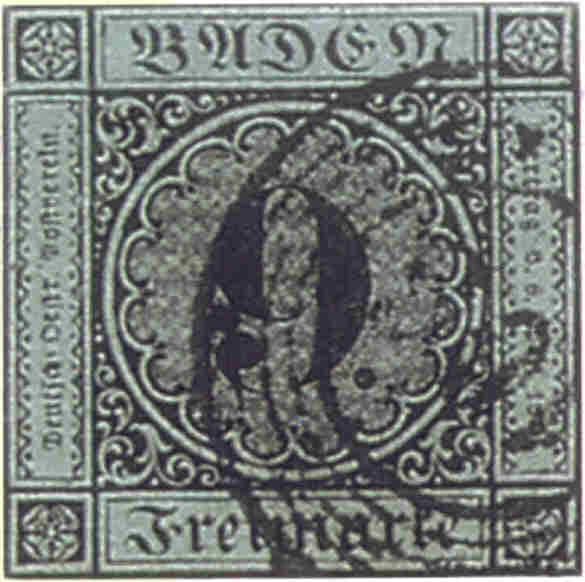
Baden 9 Kreuzer Error (green colour error)
Somewhere in Baden's government print shop in 1851, blue-green paper meant for the 6-kreuzer stamp apparently went under the 9-kreuzer plate, and Germany got its most famous stamp: four known copies, two of them on letters, one survivor of the bombing of Berlin.
- Year
- 1851
- Maker
- Grand Duchy of Baden (German state)
- By price in stamps
- 21 of 100
Create a free account to see every recorded price and every grade.
Create a free account- Issued
- May 1, 1851, the day the Grand Duchy of Baden issued its first stamps and joined the German-Austrian Postal Union
- The error
- The 9-kreuzer value printed in black on the blue-green paper of the 6 kreuzer instead of the intended rose paper
- How many known
- Four: three used (two on letters, one on piece) and one unused
- Discovered
- 1894, more than four decades after issue
- The famous cover
- Mailed from Ettenheim to Karlsruhe, postmarked August 25, 1851; ex Ferrary, Caspary, Boker and Haub
- In a museum
- The Orschweier cover of July 20, 1851, in Berlin's Museum for Communication
- Unused copy
- Unique, with nearly full original gum; its paper was lightened by fire during the bombing of Berlin in World War II
- Record
- About $1.73 million (EUR 1,524,601.50 with premium) for the Ettenheim cover at auction in Germany, June 8, 2019, a German philatelic record
A state's first stamps, made on a budget
Baden, one of the old German states that joined to form modern Germany in 1871, ran its own post. From 1718 to 1811 the princely house of Thurn und Taxis operated the mail there; in 1811 the postal administration passed to Baden itself. On May 1, 1851, Baden joined the German-Austrian Postal Union and, the same day, issued its first stamps: 1, 3, 6 and 9 kreuzer, enough to cover the main rates by distance and weight.
The designs were simple numerals modeled on Bavaria's stamps, with the words "Baden" and "Freimarke" and a line recording the postal union treaty of April 6, 1850. According to the 2008 auction catalog for the unused error, Baden was anxious to save money: it used local printers and local paper, went to Frankfurt only for an engraver to make a master die whose figure of value could be changed, and printed every value in black ink. Color came from the paper instead: buff for the 1 kreuzer, orange-yellow for the 3, blue-green for the 6 and pale rose for the 9.
The quantities were large. The same catalog reports that well over 400,000 of the 9 kreuzer and over 700,000 of the 6 kreuzer were printed, in sheets of 90 according to the handbook author Grobe.
A 9 on paper meant for a 6
No multiples of the error exist, so no one can see how it sat on the sheet, and its cause is still argued. The common story is that a printer reading a "6" where there was a "9" fed blue-green paper meant for the 6 kreuzer under the 9-kreuzer plate. If so, the 2008 catalog reasons, at least four such sheets were printed and sold as 6-kreuzer stock, which would explain why used examples turned up at different post offices: Achern, Ettenheim and Orschweier, and in one disputed case Karlsruhe.
The alternative is a wrong cliché, one 9-kreuzer printing unit mistakenly locked into the 6-kreuzer plate. The catalog argues against a cliché that stayed in the plate for the whole printing: over 8,000 errors would then have been made, and more would have survived. But a curious piece points the other way. In the 1930s the Baden specialist Siegfried Simon found a 6-kreuzer stamp on a cover from Karlsruhe with a full impression of the 9-kreuzer value printed on its back, which fits a cliché error caught early in the printing. That "Simon" stamp was offered at auction in 1993 with a starting price of 500,000 deutsche marks. The catalog calls the question still open.
Wikipedia dismisses another explanation, an accidentally inverted plate, on the grounds that the stamp was printed in a single run, and sides with the wrong-paper view: the printer must have used the 9-kreuzer plate for the green paper, reading a "6" where there was a "9."
Found decades late
Nobody noticed the error for decades. In 1894 a collector in Germany found a 9 kreuzer on blue-green paper. His local dealer thought it must be a forgery, since no catalog mentioned such a thing, so he sent it, by then cut down to a piece, to the dealer and expert Carl Lindenberg. Shortly afterward, at a meeting of the Berlin philatelic club, Baron von Türckheim showed a similar error on a letter addressed to his father. He owned two such letters.
The first cover, postmarked at Orschweier (today part of Mahlberg) on July 20, 1851, was sold by Türckheim to the German Reichspostmuseum. It is now one of the key pieces on display at the Museum for Communication in Berlin, so it is the one copy anyone can go and see.
The piece canceled at Achern was sold at auction in 1908 and again in 1919, when it went to the Paris dealer Théodore Champion. The 2008 catalog says it is believed to be in the United States; a Wikipedia article on Baden's stamps says it was last seen in 1919.
No unused copy was known until 1919, when one appeared as lot 783 in a Berlin auction. It went to the collector Carl Julius Trübsbach of Chemnitz.
The Ettenheim cover and the unused survivor
Türckheim's second letter, postmarked at Ettenheim on August 25, 1851, and addressed to Karlsruhe, was sold at auction in 1894 and later entered the collection of Philipp von Ferrary. After Ferrary's collection was sold off in the 1920s, it passed to Alfred Maier and then, through a dealer, to the collector Alfred Caspary. When Caspary's collection was sold in 1956, Herbert Bloch bought the cover for John R. Boker Jr., who formed a celebrated collection of the German States. The 2008 catalog says Boker paid $20,000.
At the 1985 sale of Boker's collection in Germany, the cover brought 2,645,000 deutsche marks, reported as $833,595. The 2008 catalog calls it the highest price up to that time for a European stamp; Wikipedia goes further and calls it the highest price then paid for any single stamp.
It sold again on June 8, 2019, at auction in Germany, from the collection of the German-born businessman Erivan Haub. Opening at 800,000 euros, it was hammered at 1.26 million euros, about $1.41 million, and cost the buyer 1,524,601.50 euros, about $1.73 million, with premium. The auctioneer marked the result "New German Record."
The unused copy had its own ordeal. It stayed in Trübsbach's collection through World War II, and when Berlin was bombed it survived in a fireproof safe. The heat darkened its gum and lightened the color of its paper, so at first glance it looks paler than the used errors, which has led some to doubt it. Its defenders point to a pinhead-sized spot on the back where the gum is missing and the vivid blue-green of the paper shows through. Sold privately after the war to a German dealer, it was offered at auction in November 1991, when it brought 690,000 Swiss francs; sold at the Pacific 97 exhibition auction in 1997 for $603,750; and sold again at auction in Geneva on April 4, 2008, for 1,314,500 euros against an estimate of 1 million to 1.5 million euros.
Germany's greatest stamp
Collectors rank the Baden error among the great rarities of world philately; the 2008 catalog called it one of the top rarities of the German States, of Europe and of classic philately. Its appeal is part arithmetic and part story: a mass-produced stamp of which hundreds of thousands were printed, an unknown number of mistaken stamps, and only four copies found, each with a traceable history.
It also shows how errors hide. Because the 6 kreuzer was legitimately printed on the same blue-green paper, an error copy looked at a glance like an ordinary 6-kreuzer stamp. Only the numeral gives it away, which helps explain why it went unnoticed for more than four decades.
The numbers
- Issue date
- May 1, 1851
- Printing
- Black ink on colored paper; the error is on the blue-green paper of the 6 kreuzer instead of the rose of the 9 kreuzer
- Quantity printed
- Over 400,000 of the normal 9 kreuzer; errors unknown, possibly a few sheets
- Known
- 4 (two covers, one piece, one unused)
- Paper
- Thin, smooth paper, unlike the rougher, thicker paper of the second issue
Timeline
The German-Austrian Postal Union treaty is signed; Baden's first stamps will carry its date.
Baden joins the postal union and issues its first stamps, 1, 3, 6 and 9 kreuzer, printed in black on colored paper.
An error copy on cover is postmarked at Orschweier; this letter is now in Berlin's Museum for Communication.
The Ettenheim cover is postmarked and sent to Karlsruhe.
A collector finds the first recognized error; Baron von Türckheim then shows a cover at the Berlin philatelic club.
The Achern piece is sold at auction.
The Achern piece sells again, to Paris dealer Théodore Champion; the only unused copy surfaces in Berlin and goes to Carl Julius Trübsbach.
John R. Boker Jr. buys the Ettenheim cover at the sale of Caspary's collection.
The Ettenheim cover sells for 2,645,000 deutsche marks (reported as $833,595) at the sale of Boker's collection.
The unused copy sells at auction in Geneva for 690,000 Swiss francs.
The "Simon" stamp, a 6 kreuzer with a 9-kreuzer impression on its back, is offered with a 500,000-mark starting price.
The unused copy sells for $603,750.
The unused copy sells at auction in Geneva for 1,314,500 euros.
The Ettenheim cover sells at auction in Germany for 1,524,601.50 euros with premium, about $1.73 million, a German record.
The world in 1851
Verdi's Rigoletto premieres in Venice.
The Great Exhibition opens at the Crystal Palace in London, the same day Baden's first stamps go on sale.
Adolf Anderssen and Lionel Kieseritzky play the "Immortal Game" of chess in London.
Isaac Singer receives a U.S. patent for his improved sewing machine.
The yacht America wins the race that becomes the America's Cup.
The New York Times is founded.
Herman Melville's Moby-Dick is published in the United States.
Louis-Napoleon Bonaparte stages a coup in France, a year before declaring himself emperor.
Price record
| Date | Price | Kind |
|---|---|---|
| 1956 | $20,000 | Sold at auctionEttenheim cover, bought for John R. Boker Jr. at the sale of Alfred Caspary's collection. Figure from the 2008 auction catalog; another source lists $27,143. |
| 1985 | $833,595 | Sold at auctionEttenheim cover, sale of the Boker collection in Germany: 2,645,000 deutsche marks. |
| Nov 1991 | $480,903 | Sold at auctionAt auction in Geneva: CHF 690,000 (including buyer's premium), shown in USD at the Federal Reserve monthly average (1 CHF = 0.6970 USD). |
| 1997 | $603,750 | Sold at auctionThe unique unused copy, sold at the Pacific 97 exhibition auction. |
| Apr 4, 2008 | $2,068,366 | Sold at auctionAt auction in Geneva: EUR 1,314,500 (including buyer's premium), shown in USD at the Federal Reserve rate on the sale date (1 EUR = 1.5735 USD). |
| Jun 8, 2019 | $1,730,000 | Sold at auctionEttenheim cover from the Erivan Haub collection, at auction in Germany. Hammer EUR 1.26 million (about $1.41 million); EUR 1,524,601.50 with premium (about $1.73 million). German philatelic record. |
A realized auction price is what a buyer actually paid on the date shown, including the buyer's premium where the sale reported it. It is the strongest kind of reference price, and it is a record of one sale of one object on one day, not a promise of what the next example will bring.
By reference price, Baden 9 Kreuzer Error (green colour error) is number 21 of 100 in the stamps entries of the FLOAT 100. 82 of those 100 rest on a realized sale; the rest carry an asking price or a guide value, and each page says which. Rank within the FLOAT 100 itself (14 here) is editorial: how much an object defines its field, not price alone.
Did you know
- Baden saved money by printing every value of its first stamps in black and letting the paper color tell them apart, which is exactly how the error happened.
- The first error found was thought to be a forgery by the finder's own dealer, because no catalog listed it.
- Baron von Türckheim owned two of the four known copies, both on letters addressed to his father.
- The only unused copy survived the bombing of Berlin in a fireproof safe, but the heat changed the color of its paper.
- A tiny bare spot on the back of the unused copy, where the gum is missing, shows the original blue-green of the paper.
- John R. Boker Jr. bought the Ettenheim cover for about $20,000 in 1956 and sold it for 2,645,000 marks in 1985.
How this page is made
- The figure
- One reference price, shown with its own kind. FLOAT does not average it with anything or adjust it for time.
- Realized or not
- A realized price is a completed sale. An asking price, an estimate and a price-guide value are not sales, and are labeled as such wherever they appear.
- The story
- Researched from published records and checked fact by fact. Updated Oct 1, 2026.
- Archive
- Oct 5, 2026