FLOAT 100 · Stamps · No. 64
Bavaria 'Schwarzer Einser' (1 Kreuzer Black)
Germany's first stamp was printed in black, which turned out to be a mistake because the postmarks were black too; more than 800,000 were made, yet the only complete letter mailed on its first day, a salesman's note announcing a visit, sold for 440,000 euros in 2024.
- Year
- 1849
- Maker
- Kingdom of Bavaria
- By price in stamps
- 25 of 100
Create a free account to see every recorded price and every grade.
Create a free account- What it is
- The 1 kreuzer black of the Kingdom of Bavaria, the first postage stamp issued anywhere in what is now Germany
- Issued
- November 1, 1849, alongside a blue 3 kreuzer and a brown 6 kreuzer
- Design
- A large numeral 1 on a patterned background, designed by Johann Peter Haseney
- Printed
- 832,500 copies by letterpress on handmade paper, imperforate, at Johann Georg Weiss's university printing house in Munich
- Withdrawn
- From post office sale in October 1851; valid for postage until August 31, 1864
- Rate
- One kreuzer paid for a local letter or printed matter such as price lists and brochures
- Most famous example
- The only known complete first-day cover, mailed November 1, 1849, from Wegscheid to Hengersberg
- Record
- 440,000 euros ($492,660) for that cover at auction in Wiesbaden, September 27, 2024
Nine years after the Penny Black
Britain introduced the postage stamp in 1840. In Bavaria the first proposal to follow suit came in February 1845 from the chief post office in Munich. It took more than four years before stamps went on sale, introduced at the behest of King Maximilian II. Before officials settled on a simple numeral design, they also considered an essay showing a large numeral 3 in front of a leaf, which survives in several two-color printings.
On November 1, 1849, Bavaria issued three stamps at once: a 1 kreuzer in black, a 3 kreuzer in blue and a 6 kreuzer in brown. The 1 kreuzer, the lowest value, paid for a local letter or for printed matter. Because of its color and its large numeral, collectors have always called it the Schwarzer Einser, the "Black One."
November 1 is All Saints' Day, a public holiday, and experts long assumed that only large post offices were open. That is one reason very few stamps used on the first day have been found, identified by the date of the postmark or of the letter.
Hidden names in the numeral
The design is credited to Johann Peter Haseney. Sources differ on the engraver of the steel die: German sources name Max Josef Seitz, while the English Wikipedia gives F. J. Seitz. A craftsman named Gustav Lorenz made 400 clichés, enough for two full printing plates of 180 plus 40 spares. The stamps were printed by letterpress at the university printing house of Johann Georg Weiss in Munich.
As a guard against forgery, the makers hid their names in the busy pattern behind the big numeral. With magnification and the stamp turned the right way, the initials PH for Peter Haseney can be found on the upstroke to the left of the 1, and the printer's name, WEISS, in script, near the foot on the right.
The first plate used clichés of soft type metal, an alloy of lead, tin and antimony, which wore quickly and gave a blurred, coarse impression. It printed double sheets of 180 stamps. A second plate, from brass clichés struck at the Munich Mint, printed single sheets of 90 and gave a much sharper image; stamps from it began to appear in May 1850. German sources give the printings as 472,500 from the first plate and 360,000 from the second. The easiest way to tell the plates apart is the left foot of the big 1, which is damaged on the first plate and intact on the second.
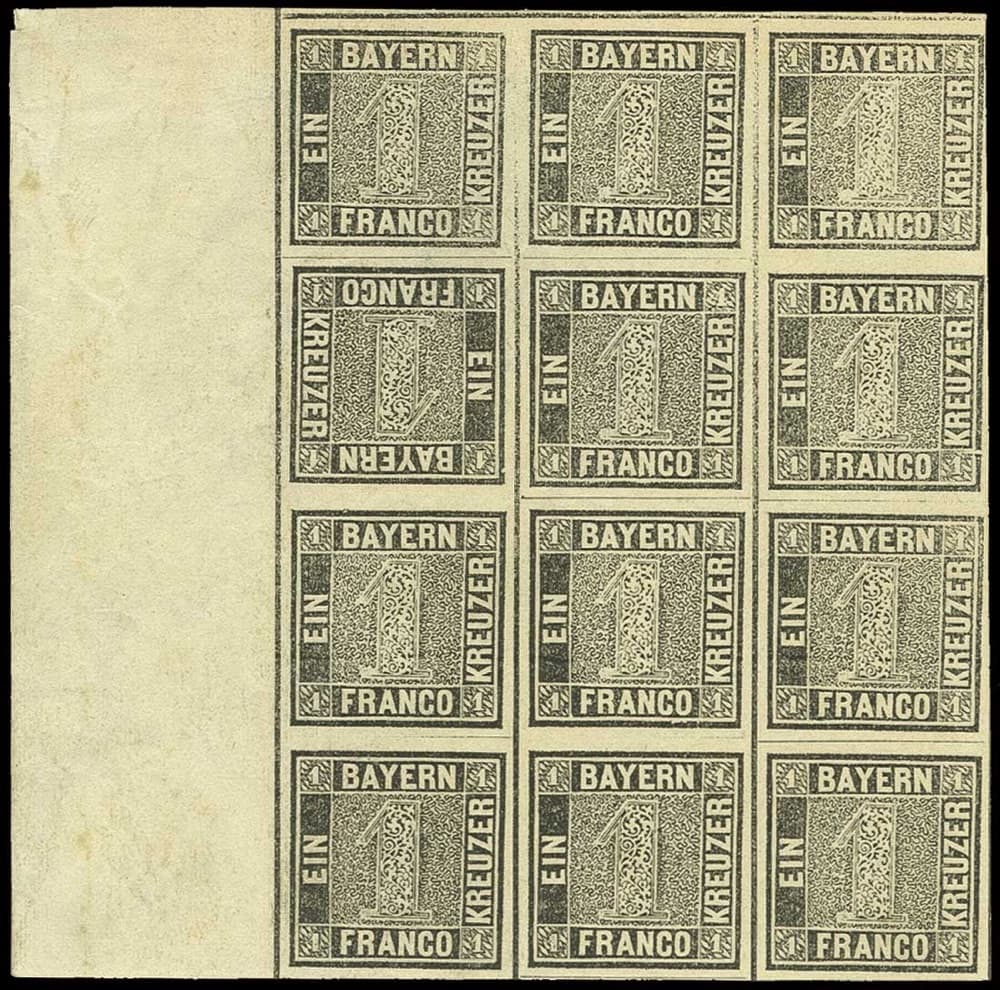
On one plate a cliché was set upside down, producing tete-beche pairs. Only three single stamps showing the error are known apart from the blocks and sheets that contain it.
A black stamp under a black postmark
The black design soon proved impractical. Postmarks were struck in black ink, so on a black stamp a cancellation was hard to see and easy to disguise. Bavaria replaced the stamp with a rose-colored 1 kreuzer redrawn to match the 3 and 6 kreuzer, withdrew the Black One from sale in October 1851, and kept it valid for postage until August 31, 1864.
Later values in the same series followed: a green 9 kreuzer, a red 12 kreuzer and an orange 18 kreuzer. When the German-Austrian Postal Union agreed that the same values should share the same colors, Bavaria changed its colors again, and the 1 kreuzer was printed in yellow.
Compared with other early German stamps, a relatively large number of Black Ones survive. Collectors' prices for ordinary singles are in the low thousands. Around 1900 the stamp was worth only 3 marks; a 1912 catalogue listed it at 38 marks, and around 1920 one brought 2,000 marks at auction in Berlin. A single in very fine condition sold at auction in Germany in May 2015 for 40,000 euros, about $44,957.
The letter from Wegscheid
The most important Black One is not a single stamp but a letter. On November 1, 1849, the post office in Wegscheid, near the Austrian border in Lower Bavaria, was open, and it accepted and postmarked a piece of printed matter franked with a Black One. In it, a sales representative of a wholesale firm named Kohn announced his coming visit to "Herrn J. Saleck" in Hengersberg.
The addressee's name was really Josef Salegg. In the 19th century he owned a store on the market square in Hengersberg and traded with every German state of the day. He kept his letters in a chest, and sometime in the 1920s the correspondence was sold and reached collectors. Nothing is known of the letter's path after that until the father of its 2009 owner, who had bought it years earlier with a collection from a woman, recognized in the 1980s what it was.
The expert Johann Ulrich Schmitt identified it as the first and so far only known complete first-day cover of the first German stamp, calling it a unique item of the greatest rarity. Its owner showed it to the public in 2009 for the stamp's 160th anniversary.
On September 27, 2024, the cover was offered at auction in Wiesbaden with a starting price of 250,000 euros. About 50 collectors bid in the room and hundreds more online and by telephone. It sold for 440,000 euros, about $492,660, to a buyer who asked to remain anonymous. The auctioneers called it the most important document in German philately.
Blocks, sheets and famous covers
Several other Black One pieces are famous in their own right. The "Eichstatt letter," found in 1958 among old records of the town of Eichstatt, carries the only known block of six. Since March 1999 it has been on view in the treasury of the Museum for Communication in Berlin, and Germany pictured it on a stamp on May 7, 2009.
A cover from Neustadt an der Aisch with two strips of three sold in Bavaria on November 22, 2008, for 55,000 euros plus premium. Two letters from Lauf an der Pegnitz each carry six separate Black Ones; one sold in the 1960s for 100,000 marks and the other around 1988 for 185,000 marks.
A block of twelve containing the upside-down cliché, once in the collections of Philipp von Ferrary until 1923 and of the Dale-Lichtenstein family until 1992, sold at auction in Germany in March 2009 for 320,000 euros. A complete sheet of 90 brought 300,000 euros in Wiesbaden on March 27, 2010, and a double sheet of 180 sold in 1992 for $687,000.
A name every German knows
The stamp has been honored repeatedly. A German stamp of 1949 marked its centenary, and in 2009 Germany issued a semi-postal for Stamp Day showing the Eichstatt letter.
It is also forgery-prone. Skilled forgers copied even the hidden initials and the WEISS signature, and the copies made by Jean de Sperati (1884-1957) are themselves sought by specialists. German sources recommend expert examination for any example.
Its name reaches far beyond collectors. A contestant on the German edition of "Who Wants to Be a Millionaire?" won one million euros with the answer "Schwarzer Einser," and an episode of the long-running crime series "Tatort" is titled after it.
The numbers
- Issue date
- November 1, 1849
- Quantity printed
- 832,500 (472,500 from plate 1, 360,000 from plate 2, per German sources)
- Printing
- Letterpress, Johann Georg Weiss, Munich
- Sheets
- Plate 1: double sheets of 180; plate 2: sheets of 90
- Paper
- Handmade paper, without the silk thread used on the 3 and 6 kreuzer
- Perforation
- Imperforate
- Designer
- Johann Peter Haseney
- Engraver
- Max Josef Seitz (German sources); F. J. Seitz (English Wikipedia)
- Validity
- Sold until October 1851; valid to August 31, 1864
- Known complete first-day covers
- 1
Timeline
Britain issues the Penny Black, the world's first postage stamp.
Munich's chief post office first proposes stamps for Bavaria.
Bavaria issues the 1, 3 and 6 kreuzer stamps. A letter mailed from Wegscheid to Hengersberg that day becomes the only known complete first-day cover.
Stamps from the sharper second plate begin to appear.
The Black One is withdrawn from sale and replaced by a rose 1 kreuzer.
The Black One ceases to be valid for postage.
Around this time a Black One brings 2,000 marks at auction in Berlin.
The Eichstatt letter, with the only known block of six, is found in Eichstatt's town records.
A double sheet of 180 sells for $687,000.
The Eichstatt letter goes on display at the Museum for Communication in Berlin.
The Wegscheid first-day cover is shown publicly for the stamp's 160th anniversary.
The Ferrary block of twelve with a tete-beche cliché sells for 320,000 euros.
Germany issues a Stamp Day semi-postal showing the Eichstatt letter.
A complete sheet of 90 sells in Wiesbaden for 300,000 euros.
The Wegscheid first-day cover sells at auction in Wiesbaden for 440,000 euros.
The world in 1849
France issues its first postage stamps, the Ceres series.
Elizabeth Blackwell becomes the first woman to receive a medical degree in the United States.
The short-lived Roman Republic is proclaimed.
Britain annexes the Punjab at the end of the Second Anglo-Sikh War.
Denmark becomes a constitutional monarchy.
Hippolyte Fizeau measures the speed of light in air.
The Hungarian army surrenders to Russian troops at Vilagos, ending the Hungarian Revolution.
Price record
| Date | Price | Kind |
|---|---|---|
| May 2015 | $44,957 | Sold at auctionA single stamp in very fine condition, sold at auction in Germany for 40,000 euros (reported as $44,957). |
| Sep 27, 2024 | $492,660 | Sold at auctionThe only known complete first-day cover, sold at auction in Wiesbaden for 440,000 euros (reported as $492,660) against a starting price of 250,000 euros. |
A realized auction price is what a buyer actually paid on the date shown, including the buyer's premium where the sale reported it. It is the strongest kind of reference price, and it is a record of one sale of one object on one day, not a promise of what the next example will bring.
By reference price, Bavaria 'Schwarzer Einser' (1 Kreuzer Black) is number 25 of 100 in the stamps entries of the FLOAT 100. 82 of those 100 rest on a realized sale; the rest carry an asking price or a guide value, and each page says which. Rank within the FLOAT 100 itself (64 here) is editorial: how much an object defines its field, not price alone.
Did you know
- The stamp's designer and printer hid their names in the pattern behind the big 1: the initials PH and the word WEISS in script.
- It was printed in black and canceled in black, which is why Bavaria replaced it within two years.
- The first stamps went on sale on All Saints' Day, a holiday, which is one reason first-day uses are so rare.
- The record-setting first-day cover is a salesman's notice that he was coming to visit a store in Hengersberg.
- Around 1900 a Black One was worth 3 marks.
- A German game-show contestant won a million euros by answering "Schwarzer Einser."
How this page is made
- The figure
- One reference price, shown with its own kind. FLOAT does not average it with anything or adjust it for time.
- Realized or not
- A realized price is a completed sale. An asking price, an estimate and a price-guide value are not sales, and are labeled as such wherever they appear.
- The story
- Researched from published records and checked fact by fact. Updated Oct 3, 2026.
- Archive
- Oct 5, 2026