FLOAT 100 · Stamps · No. 65
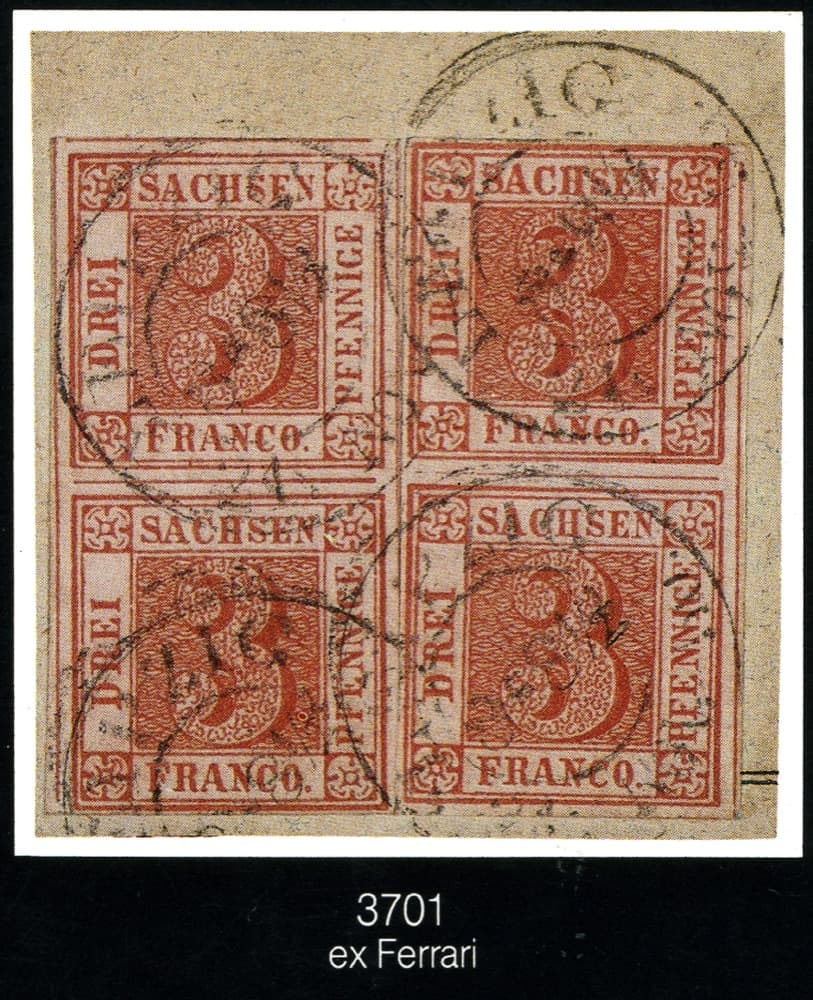
Saxony 'Sachsendreier' (3 Pfennige Red)
Saxony's first stamp was a rushed stopgap for sealing newspaper wrappers, so most copies were torn when readers opened their papers; the only complete sheet survived because someone pasted it to a wall.
- Year
- 1850
- Maker
- Kingdom of Saxony
- By price in stamps
- 75 of 100
Create a free account to see every recorded price and every grade.
Create a free account- What it is
- The 3 pfennig red of the Kingdom of Saxony, its first postage stamp and the second German state's stamp after Bavaria
- Issued
- June 29, 1850; on sale to the public and valid from July 1, 1850
- Purpose
- Paying postage on printed matter, especially newspapers sent in wrappers
- Printed
- 500,000 by letterpress at J. B. Hirschfeld in Leipzig, in eight printings of sheets of 20
- Sold
- 463,118; the remaining 36,882 were burned in Leipzig on December 10, 1851
- Survivors
- An estimated 3,000 to 4,000, about 10 percent of them unused
- Valid until
- December 31, 1867
- Famous pieces
- The only complete sheet of 20, once owned by Philipp von Ferrary and Maurice Burrus; a block of six in the Museum for Communication in Berlin
A stamp made in a hurry
Rising mail volumes led the German states and Austria to form the German-Austrian Postal Union, whose rules took effect on July 1, 1850. To comply, the royal Saxon post decided to introduce postage stamps. On March 15, 1850, the chief postal directorate in Leipzig wrote to the Bavarian postal administration, which had issued Germany's first stamps the previous November, asking for its regulations on stamps. Bavaria replied on March 29 and enclosed two of its stamps, a 3 and a 6 kreuzer.
Saxony had little time. On June 27, 1850, the Leipzig directorate sent the finance ministry a sheet of 20 of the new "provisional" stamps intended for wrapped printed matter. Because the stamp was seen as a stopgap from the start, little care went into its design. It went on sale on July 1, 1850, making Saxony the second German postal territory, after Bavaria, to use stamps.
The Leipzig printing firm J. B. Hirschfeld designed and produced the stamp. The design, built around a large numeral 3, is credited to a designer named Scheele. It was printed by letterpress, imperforate, without watermark, in a red often described as brick red, which varies in shade from printing to printing.
Twenty stamps to a sheet
A total of 500,000 stamps were printed in eight printings, making 25,000 sheets of 20 stamps, five across and four down. Six different settings were used. Strictly speaking they were not plates: the stamps were printed from individual blocks clamped together in a frame, so each setting can be divided into types, and the size of the printed image varies by up to 1.5 millimeters.
The post office sold 463,118 stamps. The remaining 36,882 were sent back to Leipzig and officially burned on December 10, 1851. By then Saxony had replaced the stopgap with regular stamps showing the coat of arms, issued August 1, 1851; from that date the 3 pfennig could also be used on letters. It stayed valid until the end of 1867.
Why so few survive intact
Three pfennig was the newspaper rate, and the stamp's main use was on newspapers mailed in paper wrappers. Senders commonly stuck the stamp half on the wrapper and half on the newspaper, so the paper could not slip out. This was officially forbidden, because postal clerks needed to be able to check that a wrapper held only printed matter, but it was common practice. When readers tore off the wrapper, the stamp usually tore too.
As a result, undamaged used copies are hard to find. Of an estimated 3,000 to 4,000 survivors, most were canceled with a pen stroke, the originally prescribed method, or with a postmark, and only about 10 percent are unused. Many forgeries exist, including work by Jean de Sperati and Francois Fournier.
Collectors' prices for sound copies have been roughly the same for unused and used examples. At a U.S. auction in January 2009, three used and unused singles brought $2,200, $3,250 and $3,750; the highest was a used copy canceled at Potschappel on July 31, 1850, only a month after issue. Complete newspaper wrappers or letters with the stamp bring much more.
The sheet on the wall
Only one complete sheet of 20 is known. Accounts differ about exactly where it had been pasted, but all agree it was stuck to a wall. Taking it down damaged it badly, and it has been restored several times.
The sheet first went to the Vienna dealer Sigmund Friedl for 400 gold marks. By 1875 Philipp von Ferrary had bought it for 2,000 gold marks, and when his collection was sold off it went in 1922 to the collector Maurice Burrus for 55,000 gold francs. Walter Kruschel acquired it in 1959 when the Burrus collection was dispersed, and E. Anderegg bought it in 1964 for 215,000 deutsche marks. In 1966 it reached 620,000 marks. Its owner Ulrich D. Schulze, who had inherited it from his father, sold it at auction in Wiesbaden at the beginning of 1999 for 920,000 marks. The English Wikipedia says instead that it last changed hands in 1994.
A second sheet was cut up in the 1890s. A block of six from it is in the Museum for Communication in Berlin, and a block of four from its lower right corner was in the collection of the American collector John R. Boker Jr. A 2014 auction catalogue compiled a record of more than 90 known multiples, the blocks and strips that collectors track like individual works of art.
Strips, blocks and records
Because so few copies survived in connected units, multiples are the great prizes. A strip of three sold for $30,300 in October 2015, a horizontal strip of four with cancels brought $109,423 in June 2019, and a block in fine condition sold for $218,846 in April 2021, the last two at auction in Germany.
German catalogues price single stamps between 4,000 and 18,000 euros depending on shade, figures that German sources say do not match real market prices; sound copies sold for around 3,500 euros in 2008.
A national favorite
The Sachsendreier is one of the best-known stamps in Germany. Late in the 19th century a private postal company in Dresden issued its own stamps closely modeled on it. West Germany's Bundespost pictured it on a stamp in October 1978; in April 1999 Germany's Stamp Day issue for 150 years of German stamps showed it beside Bavaria's Black One; and another Stamp Day semi-postal showing it followed in September 2025.
The numbers
- Issue date
- June 29, 1850 (valid from July 1, 1850)
- Quantity printed
- 500,000 in eight printings (25,000 sheets)
- Quantity sold
- 463,118; 36,882 burned December 10, 1851
- Sheet
- 20 stamps, 5 by 4; six settings of individual printing blocks
- Printing
- Letterpress, J. B. Hirschfeld, Leipzig
- Paper and perforation
- No watermark, imperforate
- Color
- Red, in several shades, often brick red
- Estimated survivors
- 3,000 to 4,000, about 10 percent unused
- Complete sheets known
- 1 (restored)
Timeline
Leipzig's chief postal directorate asks Bavaria for its stamp regulations.
Bavaria replies and encloses a 3 and a 6 kreuzer stamp.
A sheet of 20 provisional stamps is sent to Saxony's finance ministry.
The 3 pfennig red is issued.
The stamp goes on sale as the German-Austrian Postal Union's rules take effect.
Saxony issues regular coat-of-arms stamps; the 3 pfennig may now be used on letters too.
The 36,882 unsold stamps are burned in Leipzig.
The 3 pfennig ceases to be valid.
By this year Philipp von Ferrary owns the only complete sheet, bought for 2,000 gold marks.
Maurice Burrus buys the sheet for 55,000 gold francs.
Walter Kruschel acquires the sheet from the Burrus collection.
E. Anderegg buys the sheet for 215,000 marks.
West Germany pictures the stamp on a new issue.
The sheet sells at auction in Wiesbaden for 920,000 marks.
Three singles sell at auction in the United States for $2,200 to $3,750.
A horizontal strip of four sells for $109,423.
Germany issues a Stamp Day semi-postal showing the Sachsendreier.
The world in 1850
Henry Clay introduces the Compromise of 1850 in the U.S. Congress.
Nathaniel Hawthorne's "The Scarlet Letter" is published.
President Zachary Taylor dies; Millard Fillmore succeeds him.
Vega becomes the first star to be photographed.
California is admitted as the 31st U.S. state.
The University of Sydney is founded.
Prussia and Austria sign the Punctation of Olmutz.
Price record
| Date | Price | Kind |
|---|---|---|
| Jan 2009 | $2,200 | Sold at auctionSingle, brick red, plate III position 16, unused, full margins. Sold at auction in the United States. |
| Jan 2009 | $3,250 | Sold at auctionSingle, brick red, Leipzig cancel, margins all around. Sold at auction in the United States. |
| Jan 2009 | $3,750 | Sold at auctionSingle, brick red, plate II type 7, Potschappel July 31, 1850 cancel, full margins. Sold at auction in the United States. |
A realized auction price is what a buyer actually paid on the date shown, including the buyer's premium where the sale reported it. It is the strongest kind of reference price, and it is a record of one sale of one object on one day, not a promise of what the next example will bring.
By reference price, Saxony 'Sachsendreier' (3 Pfennige Red) is number 75 of 100 in the stamps entries of the FLOAT 100. 82 of those 100 rest on a realized sale; the rest carry an asking price or a guide value, and each page says which. Rank within the FLOAT 100 itself (65 here) is editorial: how much an object defines its field, not price alone.
Did you know
- Senders stuck the stamp half on the newspaper and half on the wrapper so the paper could not slip out, which was officially forbidden.
- Saxony asked Bavaria how to issue stamps, and Bavaria mailed back two of its own as samples.
- The only complete sheet survived because it had been pasted to a wall.
- More than 36,000 unsold stamps were deliberately burned in Leipzig in December 1851.
- Collectors track more than 90 known blocks and strips of the stamp individually.
- Late in the 1800s a private Dresden mail company issued stamps closely copying its design.
How this page is made
- The figure
- One reference price, shown with its own kind. FLOAT does not average it with anything or adjust it for time.
- Realized or not
- A realized price is a completed sale. An asking price, an estimate and a price-guide value are not sales, and are labeled as such wherever they appear.
- The story
- Researched from published records and checked fact by fact. Updated Oct 3, 2026.
- Archive
- Oct 5, 2026