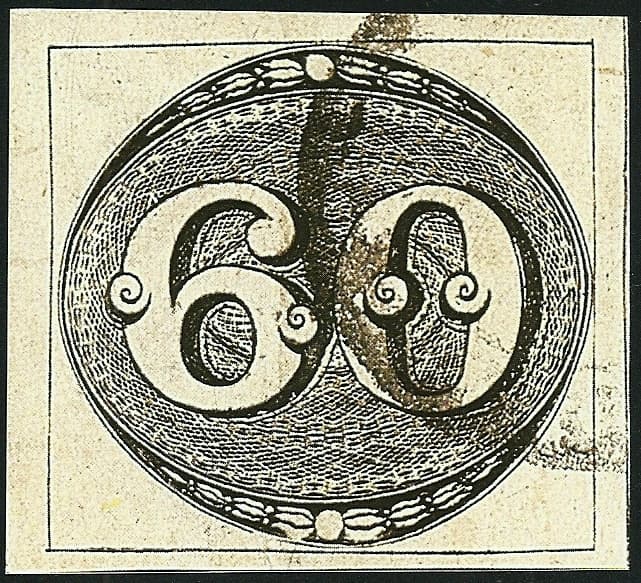
FLOAT 100 · Stamps · No. 22
Brazil 'Bull's Eye' (Olho de Boi)
Brazil wanted stamps but would not let postmen cancel the emperor's face, so in 1843 it printed bare numbers on a confiscated press, and a single intact sheet of sixty of them later sold for $648,720.
- Year
- 1843
- Maker
- Empire of Brazil
- By price in stamps
- 20 of 100
Create a free account to see every recorded price and every grade.
Create a free account- Issued
- August 1, 1843, Rio de Janeiro, Empire of Brazil
- Values
- 30, 60 and 90 réis; this entry is the 60 réis (Scott Brazil 2)
- Nickname
- Bull's Eyes (olhos-de-boi), for the ornate numerals inside oval frames
- Place in history
- Second country, after Great Britain, to issue postage stamps valid nationwide
- Printed by
- The Brazilian Mint in Rio de Janeiro, on an engraving press seized by customs in 1841
- Printing
- Engraved, black ink, imperforate, on unwatermarked paper
- Quantity printed
- 30r: 1,148,994; 60r: 1,502,142; 90r: 349,182
- This entry
- The complete mint sheet of sixty 60r stamps from the collection of Madrid architect Luis Alemany Indarte
- Record sale
- $648,720 at auction in Zurich, June 13, 2013
A postal reform for a continent-sized empire
Before stamps, Brazilian postage was charged by weight and distance, which in a country that size could be expensive, and complicated when a letter traveled by both land and water. The push for prepaid stamps on the British model came from J.D. Sturtz, a German who had served as Brazil's consul to Prussia, with the help of a British chargé d'affaires. Brazil's government created stamps by law on November 30, 1841.
The new tariff set a land rate of 60 réis for a letter's first half-ounce, with 30 réis for each additional quarter-ounce, and a sea rate of 120 réis for the first half-ounce and 60 for each additional quarter. Three values could make up every combination: 30, 60 and 90 réis. The Smithsonian's National Postal Museum describes the 60 réis as the base domestic letter rate under the postal reform of 1842, carrying a letter of up to four octaves, slightly more than half an ounce, between any two points in Brazil. The museum calls the rate, roughly two and two-thirds British pence, quite reasonable for the distances and road conditions involved.
The stamps went on sale on August 1, 1843, three years after Great Britain's Penny Black. That made Brazil the second country in the world to issue stamps valid throughout its territory, as opposed to a local issue. Like the British stamps, the Bull's Eyes do not name the country.
No portrait, and a press taken at customs
The first plan called for a portrait of the young emperor, Dom Pedro II, who had been crowned on July 18, 1841, at the age of 15. Officials decided against it. A postmark struck across the imperial face might be taken as disrespectful, so, the National Postal Museum says, the authorities directed a simple design instead, finely engraved on a machine-turned background. Each stamp shows only an ornate numeral of value inside an oval. The museum counts them among the most beautiful of the classic stamps.
Because the designs resembled a bank note that the Imperial Bank of Brazil had used before 1842, engraved and printed in London by Perkins, Bacon & Co., collectors long assumed the stamps had been printed in London too. Dr. José Kloke settled the question in his book on the issue, "Bullseyes." In 1841 Brazilian customs had seized an engraving press, which one account says belonged to a Pedro Ludwig. The press went to the Brazilian Mint in Rio de Janeiro, which also bought a transfer machine and accessories from Eduardo Lemerick on December 24, 1842. The plates were engraved and the stamps printed at the Mint.
Six plates were made. The first two each held 54 stamps: 18 of each value, in three panes of three rows of six. Plate 3 held 54 stamps of the 30r only. Plate 4 held sixty 30r stamps in ten rows of six, and plates 5 and 6 each held sixty 60r stamps in the same layout. The stamps were issued imperforate, on unwatermarked paper. Pairs mixing two values from the first plates, a 30r beside a 60r or a 60r beside a 90r, are among the issue's greatest rarities.
Why they look like bull's eyes, and why so few survive
The nickname comes from the ornamental numerals inside oval frames and from the way the stamps sat side by side on the sheet, so that a pair looked like two staring eyes. Brazil's next issues kept the habit: later smaller, rectangular designs were called snake's eyes, and two later issues similar to the Bull's Eyes were called goat's eyes for the blue stamps and cat's eyes for the black. The emperor's portrait did not appear on a Brazilian stamp until 1866.
For roughly the first 30 days the stamps were used only in Rio de Janeiro, possibly as a trial, before they were sent to the main post offices across the empire. Some 220 post-office cancellations are known, with Rio de Janeiro, Nictheroy and Pernambuco the most common. One recorded 60r carries a Rio datestamp reading July 1, 1843, a month before the issue date, because the date had been set wrong; another stamp from the same plate shows the corrected date of August 1, which suggests the error was caught on the first morning.
Printing stopped at the end of 1843. A new issue with slanted numerals went on sale on July 1, 1844, and the sale of remaining Bull's Eyes was authorized on August 22, 1844. On March 30, 1846, the leftover stock, reported at 466,711 stamps, was burned in the courtyard of the Mint. The National Postal Museum puts the 60r figures at 1,502,142 printed, 166,277 destroyed as remainders and 1,335,865 sold. The latest recorded use is March 13, 1854, on letters from Cuiabá in the far interior.
Survivors in good condition are hard to find for another reason: senders often stuck the stamps on the flap on the back of the envelope, where they were torn or damaged when the letter was opened. Collectors expect faults.
The sheet that stayed whole
This entry is not a single stamp but an intact, unused sheet of sixty 60-réis Bull's Eyes. A sheet of sixty 60r stamps matches the layout of plates 5 and 6, the two plates laid out as ten rows of six 60r stamps. Of the 1,502,142 60r stamps printed, 1,335,865 were sold for postage, so intact unused sheets are rare. Coverage of the 2013 sale described this one as famous, in a fantastic state of preservation, and the centerpiece of three exhibits that each won a Grand Prix.
It belonged to Luis Alemany Indarte, a Madrid architect described in 2013 as one of the most important stamp collectors in Spain, whose collections had won almost 90 national and international large gold medals and 23 international Grand Prix awards. In June 2013 his Bull's Eyes went up at auction in Zurich, with the sheet as the top lot and a presale estimate of $623,000.
On June 13, 2013, the sheet sold for $648,720. The same sale included the largest known franking of the issue: an 1844 cover from Rio de Janeiro to Cachoeira bearing a 30r and two horizontal pairs of the 60r on the reverse, which brought $167,387. A used block of thirteen 60r stamps made $32,400. The same year, in a separate sale, the Bull's Eye collection of Hugo Goeggel was dispersed; one reference account calls it the most important recent Bull's Eye collection to be sold.
Ahead of the United States
Brazil issued its first stamps about four years before the United States, as the National Postal Museum notes. Some earlier stamps existed in the Americas, such as the 1842 New York City Dispatch, but those were local issues; the Bull's Eyes were valid across a whole country. A 60r single is on exhibit at the National Postal Museum.
Early dated uses remain the prizes of the issue. A 90r pair struck in Rio on August 5, 1843, the fifth day of issue, was offered in 2023 as the earliest known use of a 90r multiple, and a 60r on piece dated August 1, 1843 was offered in 2018 as the only recorded first-day use on piece.
The record for this entry belongs to the sheet: a complete pane of a stamp issued as a plain number, kept intact for 170 years, sold for more than half a million dollars.
The numbers
- Issue date
- August 1, 1843
- Values
- 30, 60 and 90 réis
- Quantity printed
- 30r: 1,148,994; 60r: 1,502,142; 90r: 349,182
- 60r disposition
- 166,277 destroyed as remainders; 1,335,865 sold
- Plates
- Six: two mixed plates of 54 (18 of each value); one of 54 and one of 60 for the 30r; two of 60 for the 60r
- Printing
- Engraved, black ink, at the Brazilian Mint, Rio de Janeiro
- Perforation and paper
- Imperforate; unwatermarked paper
- Size (60r single)
- 3 x 3.3 cm (1 3/16 x 1 5/16 in.)
- Catalog number
- Scott Brazil 2 (60r)
Timeline
Brazilian customs seize an engraving press, which is sent to the Mint in Rio de Janeiro.
Dom Pedro II is crowned emperor of Brazil.
A Brazilian law creates postage stamps and requires prepaid postage.
The Mint buys a transfer machine and accessories so it can print stamps.
The 30, 60 and 90 réis Bull's Eyes go on sale, first in Rio de Janeiro only.
Earliest known use of a 90r multiple, a pair cancelled in Rio on the fifth day of issue.
Printing of the Bull's Eyes stops.
Brazil issues the slanted-numeral series that replaces the Bull's Eyes.
Sale of remaining Bull's Eye stock is authorized.
Remaining stock, reported at 466,711 stamps, is burned in the Mint courtyard.
Latest recorded use of a Bull's Eye, from Cuiabá.
Pedro II's portrait appears on a Brazilian stamp for the first time.
The Hugo Goeggel collection of Bull's Eyes is sold.
The Alemany mint sheet of sixty 60r stamps sells at auction in Zurich for $648,720.
The world in 1843
Brazil's government founds the city of Petrópolis.
Marc Isambard Brunel's Thames Tunnel, the world's first bored underwater tunnel, opens in London.
The first major wagon train to the American Northwest sets out on the Oregon Trail with about 1,000 pioneers.
Brunel's iron-hulled, propeller-driven SS Great Britain is launched at Bristol.
The Economist is first published in London.
Emperor Pedro II marries Teresa Cristina of the Two Sicilies in Rio de Janeiro Cathedral.
Charles Dickens publishes A Christmas Carol in London.
Price record
| Date | Price | Kind |
|---|---|---|
| Jun 2013 | $623,000 | Estimate, not a salePresale estimate for the complete mint sheet of sixty 60r stamps, top lot of a Zurich sale. |
| Jun 13, 2013 | $648,720 | Sold at auctionComplete mint sheet of sixty 60r stamps, ex-Luis Alemany Indarte, at auction in Zurich. The report's headline gives $648,500. |
A realized auction price is what a buyer actually paid on the date shown, including the buyer's premium where the sale reported it. It is the strongest kind of reference price, and it is a record of one sale of one object on one day, not a promise of what the next example will bring.
By reference price, Brazil 'Bull's Eye' (Olho de Boi) is number 20 of 100 in the stamps entries of the FLOAT 100. 82 of those 100 rest on a realized sale; the rest carry an asking price or a guide value, and each page says which. Rank within the FLOAT 100 itself (22 here) is editorial: how much an object defines its field, not price alone.
Did you know
- Brazil left the emperor's portrait off its first stamps because cancelling his face with a postmark might have looked disrespectful.
- The press that printed them had been seized by Brazilian customs in 1841.
- For decades collectors thought the stamps were printed in London, because the design echoed a bank note made there.
- Brazil kept naming its stamps after eyes: after the bull's eyes came snake's eyes, goat's eyes and cat's eyes.
- One 60r carries a first-morning datestamp set to July 1, 1843, a month too early; the clerks corrected it the same day.
- Many Bull's Eyes were glued over the envelope flap and ripped when the letter was opened.
- In 1846 Brazil burned its leftover stock, reported at 466,711 stamps, in the courtyard of the Mint.
How this page is made
- The figure
- One reference price, shown with its own kind. FLOAT does not average it with anything or adjust it for time.
- Realized or not
- A realized price is a completed sale. An asking price, an estimate and a price-guide value are not sales, and are labeled as such wherever they appear.
- The story
- Researched from published records and checked fact by fact. Updated Oct 1, 2026.
- Archive
- Oct 5, 2026