FLOAT 100 · Stamps · No. 21
British Guiana 'Cottonreels'
Bent brass, borrowed type and a clerk's pen made British Guiana's first stamps; one pair of the rarest value survived a son's bonfire of his late father's letters and went on to pass through the greatest collections in the world.
- Year
- 1850
- Maker
- British Guiana (Crown colony), Royal Gazette office, Georgetown
- By price in stamps
- 31 of 100
- Issue
- British Guiana's first stamps: 4, 8 and 12 cents in 1850; the 2-cent value followed in 1851
- Printed at
- The office of the Royal Gazette in Georgetown, published by Joseph Baum and William Dallas
- This example
- The "Weill Cover": a vertical pair of the 2-cent black on rose on an 1851 letter to "Edward Gordon Esq., Plant. Good Hope"
- Postmark
- Demerara, November 26, 1851
- Initials
- "E.D.W." for postal clerk E.D. Wight, added by hand as a guard against forgery
- Surviving 2-cent stamps
- Ten: four singles and three pairs; four of the ten are in institutions
- Why it stands out
- Described at its 2024 sale as the finest of the three recorded pairs and the only 2-cent stamps cut square rather than cut round
- Owners include
- Philipp von Ferrary, Maurice Burrus, the dealer Raymond H. Weill, Simon Greenwood
- Last public sale
- December 11, 2024, at auction in London: £240,000 against an estimate of £300,000 to £500,000
Stamps made from printer's scraps
In June 1850 the colonial post office in British Guiana, on the north coast of South America, decided to replace a thin inland post that mainly served the sugar plantations with a daily service, paid in advance with postage stamps. A notice dated June 15, 1850, signed by E.T.E. Dalton, the Deputy Postmaster-General, announced that from July 1 the mails would leave Georgetown on the 4 o'clock train every day but Sunday, and that stamps of 4, 8 and 12 cents, matched to distance, were being printed and would be ready on or before the 24th of the month.
There was no time to order stamps from London, so the job went to the local printers of the Royal Gazette, published by Joseph Baum and William Dallas, printers to the government on High Street, Georgetown. In 1856 the same printers would produce the one-cent magenta, today the most famous stamp in the world.
The method was as primitive as any government post office ever used. According to the standard study of the colony's stamps, pieces of printer's brass rule were bent into a circle and soldered into a tube, and ordinary type was fitted inside to read "BRITISH GUIANA" around the edge and the value in italics in the center. To print another value, the printer swapped the figure of value in each tube. Each value was printed in black on its own color of paper: rose for the 2 cents, orange or yellow for the 4 cents, green for the 8 cents and blue for the 12 cents. It is thought that four tubes set in a line printed a strip of four with each pull of the press.
Dalton himself was unimpressed. In a note to the Colonial Secretary dated December 16, 1861, he wrote: "As they could be imitated in any printing office, I was obliged to counter-sign them. They were of the most ordinary workmanship." Every stamp was initialed by hand before sale. Initials recorded on the issue include those of Dalton, the clerk E.D. Wight ("E.D.W."), a clerk named Smith ("J.B.S.") and W.H. Lortimer.
The value almost nobody used
The 2-cent stamp came eight months after the others. A Post Office notice dated February 22, 1851, issued at the request of Georgetown merchants, set up a twice-daily delivery through the city's principal streets, and each letter had to carry a 2-cent stamp. The service attracted little support and was soon discontinued. Six of the ten surviving examples were used in pairs to pay the ordinary 4-cent rate for letters to other parts of the colony, and by tradition the four single stamps all came off one letter prepaid at the 8-cent rate.
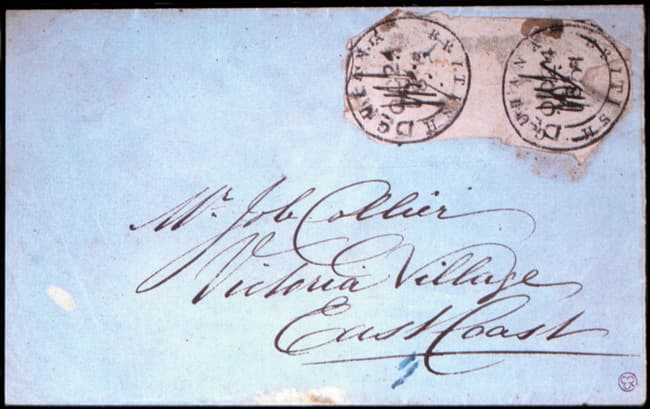
That short life is why the 2 cents is one of the great rarities of philately. Exactly ten examples are recorded: four single stamps and three pairs. The first was found in 1877, and no new example has turned up since the biographies of all ten were compiled in 1900. Four are in institutions: a repaired pair on a letter to Job Collier in the British Royal Philatelic Collection, a single in the collection that Thomas Keay Tapling left to the British Museum (now in the British Library), and a single in the postal museum in Bonn.
The Bonn stamp has a story of its own. Before World War II it hung in Berlin's postal museum in a lead wall frame with the two Mauritius "Post Office" stamps. The frame was evacuated during the bombing and vanished at the end of the war. In 1976 a former U.S. Army captain offered the frame to a London dealer at a stamp show in Philadelphia; the dealer alerted Scotland Yard, and in October 1990, two weeks after German reunification, the United States handed the frame back to Germany.
The other values were far more common. Between 1876 and 1878 searchers in British Guiana combed old letters in banks, merchants' offices and government files, and one London dealer bought a parcel of three to four hundred Cottonreels, mostly 12-cent stamps, with some scores of 4 cents, fewer 8 cents and not one 2-cent stamp. A Georgetown printer's account attached to a report of March 11, 1851, lists 656 blue 12-cent, 1,200 green 8-cent and 1,752 yellow 4-cent stamps; no comparable figure is known for the 2 cents.
Saved from the fire
The letter that carries this pair was addressed in November 1851 to Edward Gordon at Plantation Good Hope. Gordon died around 1861 and his son, T.M. Gordon, inherited his papers. As the son later told it, a local collector offered to buy his stamp album, the album then disappeared, and the letter turned up only when he was clearing bundles of his father's letters to burn. It escaped destruction and in 1897 was sold to E.C. Luard, a well-known local collector. The son could not remember the price, and called the episode the time "when they all went stamp mad."
It then moved fast. In 1897 alone it went to a London dealer for £650, to Carl Willadt of Pforzheim, to a Berlin collector named Kosack and to Baron Otto von Transehe-Roseneck in Russia for 20,000 marks. It passed to Paul Kohl in 1899, back to London in 1900, and in 1901 to Philipp von Ferrary, the greatest collector of the age, for £1,000.
After Ferrary's death his collection was seized by France and sold to pay toward German war reparations. At the first sale, on June 23, 1921, the Swiss tobacco industrialist Maurice Burrus bought the letter for 210,000 francs plus a 17.5 percent government tax; one account calls it the highest price Burrus ever paid for a single item. When Burrus's collection was sold in London in November 1963, the letter went to the New Orleans dealer Raymond H. Weill, whose name it still carries. Accounts differ on the details: one gives £25,000 and says Weill was buying for Frederick T. Small, the Australian-born engineer in Florida who then owned the one-cent magenta; the 2024 catalog gives £25,500 and lists the next owner only as "Mr. P" in 1964.
Later it sold at auction in London on March 26, 1970, for £75,000; in Geneva in 1975 for 450,000 Swiss francs, again to Weill; and in Zurich on November 22, 1989, from the Weill brothers' stock, to the British collector Simon Greenwood. Reported prices for that sale range from 510,000 to 585,000 Swiss francs depending on the account and on whether the buyer's commission is counted. Greenwood showed it at Stamp World London 90 and at Anphilex '96 in New York. On December 11, 2024, as the lead lot of the first sale of Greenwood's British Guiana collection, it sold at auction in London for £240,000, below its £300,000 to £500,000 estimate.
What makes this pair different
The pair is a vertical pair of the 2-cent black on rose, initialed "E.D.W." and cancelled with a Demerara double-arc datestamp of November 26, 1851. The pairs were placed sideways on their letters, which is why descriptions differ on whether the closest margin is at the left or at the top. The 2024 sale description calls the color excellent, the margins good to large on three sides, and the age staining slight and normal for an old domestic letter from the colony.
Its rarity within a rarity is the cut. Being round, Cottonreels were almost always cut round, close to the frame. The 2024 description states that apart from this pair the other eight surviving 2-cent stamps are all cut round, which makes this the only cut-square 2-cent pair, and the finest of the three pairs. The other two are the repaired Job Collier pair and the pair on the "Miss Rose" letter, which is cut round with parts of the frame missing.
The type is disputed. The issue's frames were set up in several slightly different ways, which specialists call types. The 2024 sale catalog calls this pair Type B. A Guyana Philatelic Society account, which reproduces L.N. Williams's encyclopedia, assigns Type B to the Miss Rose pair and implies Type A for the rest. Collectors should treat the type as unsettled.
Fakes and repairs are a constant worry with this issue. The paper ranges from stout to thin pelure and tears easily; the stamps were ungummed and stuck down with glue, wafers or sealing wax, so many were damaged in removal. Thins, surface cracks, added margins and painted repairs are common, and the Job Collier pair itself has had missing pieces filled with colored paper and painted in.
Ugly, rare and revered
The nickname came later. Early writers called them the "round stamps of 1850"; by 1921 the British Guiana specialist A.D. Ferguson was writing of "these crude primitive stamps of 1850, commonly called 'Cotton reels'," because they looked like the labels on the ends of wooden cotton spools. The brothers L.N. and M. Williams called the issue "the crudest classic issue by a government Post Office in what used to be called the British Empire."
Their fame rests on rarity and on the company they have kept. Cottonreels sat in the Royal Collection, the Tapling bequest and the collections of Ferrary, Burrus, King Farouk and John E. du Pont. The 2024 catalog ranked this letter among the top three covers of the British Empire and the top fifteen philatelic gems of the world.
The rarest value has a matching legend. The Miss Rose pair was found on Easter Monday 1896 by Canon Luigi Josa in an old basket of bills belonging to an elderly parishioner; the addressee, Miss Rose, gave it to Christ Church, Demerara, which was deep in debt, and refused any share of the proceeds. Together with the Edward Gordon letter, it is one of only two 2-cent pairs a private collector can own.
The numbers
- Issue dates
- 4, 8 and 12 cents from July 1850; 2 cents from about February 1851
- Values and papers
- 2c black on rose; 4c on orange or yellow; 8c on green; 12c on blue to indigo
- Printing
- Typeset inside circles of bent brass rule; black ink on colored paper; probably printed four at a time
- Perforation and gum
- Imperforate and ungummed; usually cut round
- Paper
- Variable, from stout rough wove to thin pelure
- Quantities recorded in an 1851 account
- 656 of the 12c, 1,200 of the 8c, 1,752 of the 4c; no figure for the 2c
- 2-cent stamps known
- 10 (four singles, three pairs); 4 in institutions
- This pair
- Vertical pair, cut square, initialed E.D.W., Demerara November 26, 1851
Timeline
Deputy Postmaster-General E.T.E. Dalton announces a daily inland mail from July 1 and 4-, 8- and 12-cent stamps printed locally.
The first Cottonreels, British Guiana's first stamps, come into use.
A notice sets up twice-daily delivery in Georgetown with a 2-cent stamp; the service is soon dropped for lack of use.
This pair, initialed "E.D.W.", is cancelled at Demerara on a letter to Edward Gordon at Plantation Good Hope.
Edward Gordon dies around this year; his son T.M. Gordon inherits his papers.
The first 2-cent stamp known to collectors is found.
The letter is rescued from papers set aside for burning and sold to E.C. Luard; it changes hands four more times that year, reaching Baron Otto von Transehe-Roseneck for 20,000 marks.
The biographies of all ten known 2-cent stamps are published; none has been found since.
Bought by Philipp von Ferrary for £1,000.
Sold in Paris at the first sale of the seized Ferrary collection to Maurice Burrus, for 210,000 francs plus tax.
Sold in London from the Burrus collection to the dealer Raymond H. Weill.
Sold at auction in London for £75,000.
Sold at auction in Geneva for 450,000 Swiss francs, to Raymond H. Weill.
Sold at auction in Zurich from the Weill brothers' stock to Simon Greenwood.
Exhibited at Stamp World London 90.
Exhibited at Anphilex '96 in New York.
Shown by Simon Greenwood at the Royal Philatelic Society London.
Sold at auction in London for £240,000 as the lead lot of Greenwood's British Guiana collection.
The world in 1851
Hong Xiuquan begins the Taiping Rebellion in China.
Edward Hargraves claims to have found gold in Australia.
Queen Victoria opens the Great Exhibition at the Crystal Palace in London.
The yacht America wins the first America's Cup race off the coast of England.
The New York Times is founded.
Herman Melville's Moby-Dick is published in the United States.
Louis-Napoleon Bonaparte dissolves the French National Assembly in a coup.
Price record
A realized auction price is what a buyer actually paid on the date shown, including the buyer's premium where the sale reported it. It is the strongest kind of reference price, and it is a record of one sale of one object on one day, not a promise of what the next example will bring.
By reference price, British Guiana 'Cottonreels' is number 31 of 100 in the stamps entries of the FLOAT 100. 82 of those 100 rest on a realized sale; the rest carry an asking price or a guide value, and each page says which. Rank within the FLOAT 100 itself (21 here) is editorial: how much an object defines its field, not price alone.
Did you know
- The Cottonreels came from the same Georgetown printers who produced the one-cent magenta in 1856.
- The man who saved this letter found it while sorting his late father's letters to burn, and later remembered the whole episode only as the time "when they all went stamp mad."
- The postmaster who issued them called them "of the most ordinary workmanship" and initialed them because any print shop could copy them.
- A 2-cent stamp that hung in Berlin's postal museum vanished in 1945, resurfaced at a Philadelphia stamp show in 1976 and was handed back to Germany in 1990.
- The nickname comes from the printed labels on the ends of wooden cotton spools.
How this page is made
- The figure
- One reference price, shown with its own kind. FLOAT does not average it with anything or adjust it for time.
- Realized or not
- A realized price is a completed sale. An asking price, an estimate and a price-guide value are not sales, and are labeled as such wherever they appear.
- The story
- Researched from published records and checked fact by fact. Updated Oct 1, 2026.
- Archive
- Oct 5, 2026