FLOAT 100 · Stamps · No. 1
British Guiana 1c Magenta
A schoolboy sold it for six shillings because it was too ugly to keep; it has since set the world record for a stamp four times and carries the private marks of nearly every owner on its back.
- Year
- 1856
- Maker
- British Guiana (British colony)
- By price in stamps
- 1 of 100
Create a free account to see every recorded price and every grade.
Create a free account- Issued
- 1856, Georgetown, British Guiana (now Guyana), as an emergency provisional
- Printed by
- Joseph Baum and William Dallas, publishers of the Official Gazette newspaper in Georgetown
- Postmark
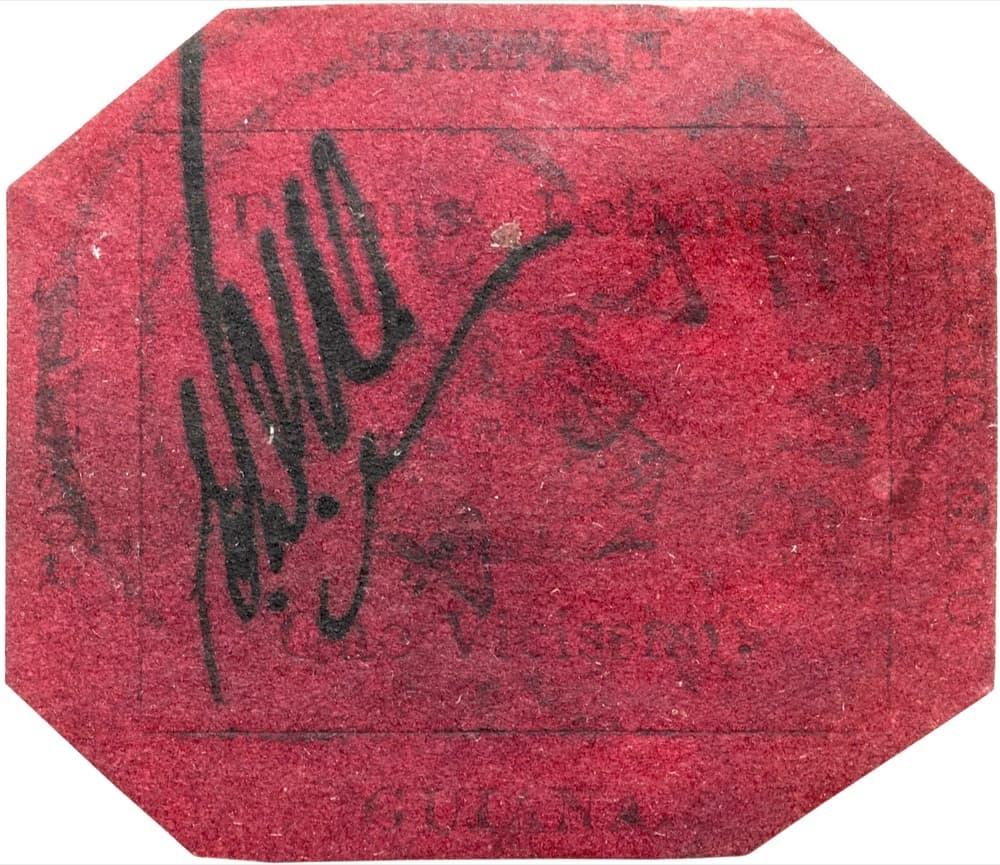
- April 4, 1856, reading "Demerara"
- Design
- Black on surface-colored magenta paper; a three-masted sailing ship with the colony's motto "Damus Petimus Que Vicissim"; corners clipped into an octagon
- Signed by
- Postal clerk Edmond D. Wight, whose handwritten initials "E.D.W." were an anti-counterfeiting measure
- Size and weight
- Reported as about 1 x 1.25 inches (2014) and 29 x 26 mm (2021); weighs about one-twentieth of a gram
- Surviving examples
- One. It is the only universally recognized example of the one-cent stamp
- Owners
- Vaughan, McKinnon, Ridpath, Ferrary, Hind, Ann Hind, Small, Weinberg syndicate, du Pont, Weitzman, a London stamp firm (2021)
- Record
- $9,480,000 at auction in New York, June 17, 2014, the highest price ever paid for a single stamp
- Last public sale
- $8,307,000 at auction in New York, June 8, 2021
A stamp made in a hurry
In 1856 the postmaster at Georgetown, the capital of the British colony of British Guiana on the north coast of South America, was running out of stamps. A shipment of postage was on its way from England but had not arrived. To keep the mail moving, the postmaster, E.T.E. Dalton, asked a local printer to prepare one-cent and four-cent stamps for provisional use until the real ones landed.
The job went to Joseph Baum and William Dallas, who published the Official Gazette newspaper in Georgetown. They set the stamps from ordinary printer's type and stock ornaments: a small woodcut of a barque, a three-masted sailing ship common at the time, which the Smithsonian's National Postal Museum notes was not meant to depict any particular vessel and would have been available in many print shops. Around it ran the colony's Latin motto, "Damus Petimus Que Vicissim," derived from Horace and usually translated as "We give and we ask in return."
Because anyone with type and a press could have copied such a stamp, clerks in the post office initialed each one by hand before sale. The surviving one-cent bears the initials "E.D.W." of postal clerk Edmond D. Wight. The stamps were printed in black on surface-colored paper, a cheap process in which a thin layer of color is laid over white paper and which smudged easily.
The one-cent value paid for newspapers; the four-cent value paid for letters. The postal museum suggests this may explain why only one one-cent stamp survives while multiple four-cent stamps do: people kept letters and threw newspapers away.
Reading the stamp, front and back
The front reads "British Guiana. Postage One Cent." Its postmark is dated April 4, 1856, and says "Demerara," the county name, even though the stamp was printed, sold and used in Georgetown. Its corners were clipped, turning the rectangle into the octagon that makes it instantly recognizable. No one knows why; the postal museum notes that four-cent stamps exist both clipped and with intact corners.
The back is a provenance record in miniature. Owners and the dealers who handled the stamp have added marks in sequence: two strikes of a circled trefoil for the collector Philipp von Ferrary; a four-leaf clover and "AH" for Arthur Hind; a seventeen-point star applied by his widow, Ann Hind, to obscure her husband's mark; a comet for Frederick T. Small; pencil initials "FK" for Finbar Kenny, who brokered the sale to Small; pencil "IW" for Irwin Weinberg and his partners; and a handwritten "J.E.d.P." for John E. du Pont. Infrared photographs taken at the National Postal Museum in 2014 revealed Hind's four-leaf clover hidden under Ann Hind's star.
In October 2020 Stuart Weitzman continued the tradition, adding his initials "SW" beside a small line drawing of a stiletto shoe. The addition drew some criticism among collectors.
Measurements reported for the stamp differ. A 2014 news report gave it as roughly 1 by 1.25 inches; a 2021 report gave 29 by 26 millimeters. Collectors who weighed it on coin balances arrived at about one-twentieth of a gram, which is why it is often described as, gram for gram, one of the most valuable objects in the world.
A second copy has been claimed at least once. In 1999 a stamp in Bremen, Germany, was put forward as another one-cent magenta; the Royal Philatelic Society London examined it twice and concluded it was an altered four-cent stamp.
From a schoolboy's album to a count's vault
In 1873 a twelve-year-old collector, Louis Vernon Vaughan, found the stamp among old family letters at his uncle's home in British Guiana. He did not think much of its appearance. He sold it for six shillings to a local collector, Neil Ross McKinnon, and used the money to buy a packet of prettier foreign stamps.
In 1878 McKinnon's collection went to a Liverpool dealer, Thomas Ridpath, for £120, and the same year Ridpath sold the one-cent to Count Philipp von Ferrary, the most ambitious stamp collector of his age. Sources differ on what Ferrary paid: several give about £150, while the National Postal Museum's timeline gives a sum thought to be £40. The stamp then stayed inside Ferrary's Paris collection for nearly forty years.
Ferrary died in 1917 and left his collection to the postal museum in Berlin. Because France and Germany were at war, the French government seized it as enemy property and sold it at auction in Paris to pay toward German war reparations. At the 1922 sale the one-cent brought 300,000 francs plus a 17.5 percent French sales tax, for a total of 352,500 francs. The buyer was the American industrialist Arthur Hind, who was reported to have outbid an agent of King George V.
Widows, recluses, showmen and a murderer
Hind exhibited the stamp freely. When he died, his will left his widow a dwelling, furniture and paintings, "but not my stamp collection." Ann Hind sued, claiming her husband had given her the one-cent before his death, and the case was settled in her favor. Sources disagree on the year Hind died: the postal museum gives 1933, while other accounts date the start of Ann Hind's ownership to 1932.
Ann Hind showed the stamp in the British Pavilion at the 1939 New York World's Fair and soon afterward sold it, through the stamp department of a New York department store, to a buyer who kept his name hidden. The postal museum gives the price as $45,000; other sources give $40,000. In 1954 LIFE pictured the stamp in color for the first time and claimed that even the owner's wife did not know he had it. He was Frederick T. Small, an Australian living in Florida, identified only when he sold it in 1970.
The 1970 buyer, for $280,000, was a group of nine investors led by Irwin Weinberg, a Pennsylvania stamp dealer who had first seen the stamp as a teenager at the 1939 World's Fair. Weinberg spent the decade touring it, carrying it in a briefcase handcuffed to his wrist under armed guard. At the 1978 CAPEX exhibition in Toronto the handcuff key broke off in the lock, a hacksaw failed to free him, and a replacement key had to be found.
In 1980 the stamp sold at auction for $935,000 to an anonymous buyer later revealed as John E. du Pont, heir to the chemical fortune. Du Pont kept it out of public view. In 1996 he shot and killed the Olympic wrestler David Schultz; he was convicted of third-degree murder and died in prison in 2010, aged 72, while serving a sentence of 13 to 30 years.
On June 17, 2014, du Pont's estate sold the stamp at auction in New York for $9,480,000 including buyer's premium, against a presale estimate of $10 million to $20 million, to an anonymous telephone bidder. He was the shoe designer Stuart Weitzman, who lent it to the Smithsonian's National Postal Museum. When Weitzman sold it at auction in New York on June 8, 2021, it brought $8,307,000, the first time it had sold for less than at its previous sale. The buyer, a London stamp firm, displayed it at its shop on the Strand and offered the public fractional shares, dividing the stamp into 80,000 pieces.
The most famous stamp in the world
The National Postal Museum notes that the stamp has generated headlines and broken records nearly every time it has sold; its 1922 price made it the most valuable stamp in the world. Its 2014 price more than quadrupled the previous record for any stamp, about $2.2 million paid in 1996 for Sweden's Treskilling Yellow.
For most of its life the stamp has been hidden. The National Postal Museum notes it has spent most of its existence behind bank vault bars, appearing only on rare occasions: London in 1923, the New York World's Fair in 1939, FIPEX in New York in 1956, CAPEX in Toronto in 1978. Its showing in the museum's William H. Gross Stamp Gallery, from June 4, 2015, to December 22, 2019, was its longest and most publicly accessible exhibition ever.
Its fame spread well beyond collectors. The 1952 comic book Walt Disney's Donald Duck and the Gilded Man sent Donald and his nephews to British Guiana in search of the stamp, introducing a generation of children to it. After independence in 1966, Guyana pictured the one-cent magenta on one of its own early stamps.
Timeline
Georgetown's postmaster, short of stamps while waiting for a shipment from England, has the Official Gazette's printers produce one-cent and four-cent provisionals.
The surviving one-cent is postmarked "Demerara," the county name, after being sold and used in Georgetown.
Twelve-year-old Louis Vernon Vaughan finds the stamp among family papers and sells it for six shillings to collector Neil Ross McKinnon.
McKinnon's collection goes to Liverpool dealer Thomas Ridpath, who sells the one-cent to Count Philipp von Ferrary in Paris.
Ferrary dies and leaves his collection to the Berlin postal museum; France later seizes it as enemy property.
Sold at auction in Paris to American industrialist Arthur Hind for 300,000 francs plus tax, a record for a stamp.
Shown at the London International Stamp Exhibition.
After winning a lawsuit against her husband's estate, Ann Hind shows the stamp at the New York World's Fair, then sells it to the then-anonymous Frederick T. Small.
LIFE pictures the stamp in color for the first time.
Small sells it for $280,000 to a nine-member syndicate led by Pennsylvania dealer Irwin Weinberg.
At CAPEX in Toronto, the key to Weinberg's handcuffed briefcase breaks off in the lock.
Sold at auction for $935,000 to a buyer later revealed as John E. du Pont.
Du Pont dies in prison while serving a 13-to-30-year sentence for third-degree murder.
Sold at auction in New York for $9,480,000 on behalf of du Pont's estate, to Stuart Weitzman.
Goes on long-term display at the Smithsonian's National Postal Museum in Washington, on loan from Weitzman.
The postal museum exhibition closes after four and a half years.
Weitzman adds his initials and a stiletto-shoe drawing to the back of the stamp.
Sold at auction in New York for $8,307,000 to a London stamp firm.
Displayed in London as the new owner offers the public fractional shares.
The world in 1856
Queen Victoria institutes the Victoria Cross, Britain's highest military decoration.
William Henry Perkin creates mauveine, the first synthetic dye. The color name "magenta" did not yet exist; it was adopted in 1860 for a new aniline dye named after the 1859 Battle of Magenta.
The Treaty of Paris ends the Crimean War.
Congressman Preston Brooks beats Senator Charles Sumner with a cane on the floor of the U.S. Senate.
Nikola Tesla is born; Sigmund Freud (May 6) and George Bernard Shaw (July 26) are also born this year.
Fossil remains are found in the Neander Valley in Prussia, a landmark find in the study of human origins.
The Arrow Incident on China's Pearl River starts the Second Opium War.
James Buchanan wins the U.S. presidential election over John C. Fremont and Millard Fillmore.
Price record
| Date | Price | Kind |
|---|---|---|
| 1922 | $32,500 | Sold at auctionSold at auction in Paris from the seized Ferrary collection for 300,000 francs plus 17.5% tax (352,500 francs). USD figure as given by the National Postal Museum; other accounts give $35,000 or $40,000. |
| 1940 | $45,000 | Private saleAnn Hind's sale to Frederick T. Small, brokered through a New York department store's stamp department. National Postal Museum figure; other sources give $40,000. |
| 1970 | $280,000 | Sold at auctionSold by Frederick T. Small to a syndicate led by Irwin Weinberg. |
| 1980 | $935,000 | Sold at auctionSold at auction to John E. du Pont. |
| Jun 17, 2014 | $10,000,000 | Estimate, not a salePresale estimate of $10 million to $20 million (low end shown). |
| Jun 17, 2014 | $9,480,000 | Sold at auctionSold at auction in New York for the du Pont estate, including buyer's premium; buyer Stuart Weitzman. World record for a stamp. |
| Jun 8, 2021 | $10,000,000 | Estimate, not a salePresale estimate of $10 million to $15 million (low end shown). |
| Jun 8, 2021 | $8,307,000 | Sold at auctionSold at auction in New York by Stuart Weitzman to a London stamp firm. |
A realized auction price is what a buyer actually paid on the date shown, including the buyer's premium where the sale reported it. It is the strongest kind of reference price, and it is a record of one sale of one object on one day, not a promise of what the next example will bring.
By reference price, British Guiana 1c Magenta is number 1 of 100 in the stamps entries of the FLOAT 100. 82 of those 100 rest on a realized sale; the rest carry an asking price or a guide value, and each page says which. Rank within the FLOAT 100 itself (1 here) is editorial: how much an object defines its field, not price alone.
Did you know
- The boy who found it in 1873 sold it for six shillings because he did not like how it looked, and spent the money on prettier stamps.
- The word "magenta" did not exist as a color name when the stamp was printed. The dye was renamed magenta in 1860, after a battle fought in 1859.
- Its postmark says "Demerara," but that is a county name; the stamp was printed, sold and used in Georgetown.
- Ann Hind stamped a seventeen-point star on the back to cover her late husband's mark. Infrared photography in 2014 revealed his four-leaf clover underneath.
- Irwin Weinberg toured the stamp in a briefcase handcuffed to his wrist. In Toronto in 1978 the key snapped off in the lock and a hacksaw could not cut him free.
- It weighs about one-twentieth of a gram.
- A 1952 Donald Duck comic sent Donald and his nephews to British Guiana to hunt for it.
How this page is made
- The figure
- One reference price, shown with its own kind. FLOAT does not average it with anything or adjust it for time.
- Realized or not
- A realized price is a completed sale. An asking price, an estimate and a price-guide value are not sales, and are labeled as such wherever they appear.
- The story
- Researched from published records and checked fact by fact. Updated Oct 1, 2026.
- Archive
- Oct 5, 2026