FLOAT 100 · Stamps · No. 2
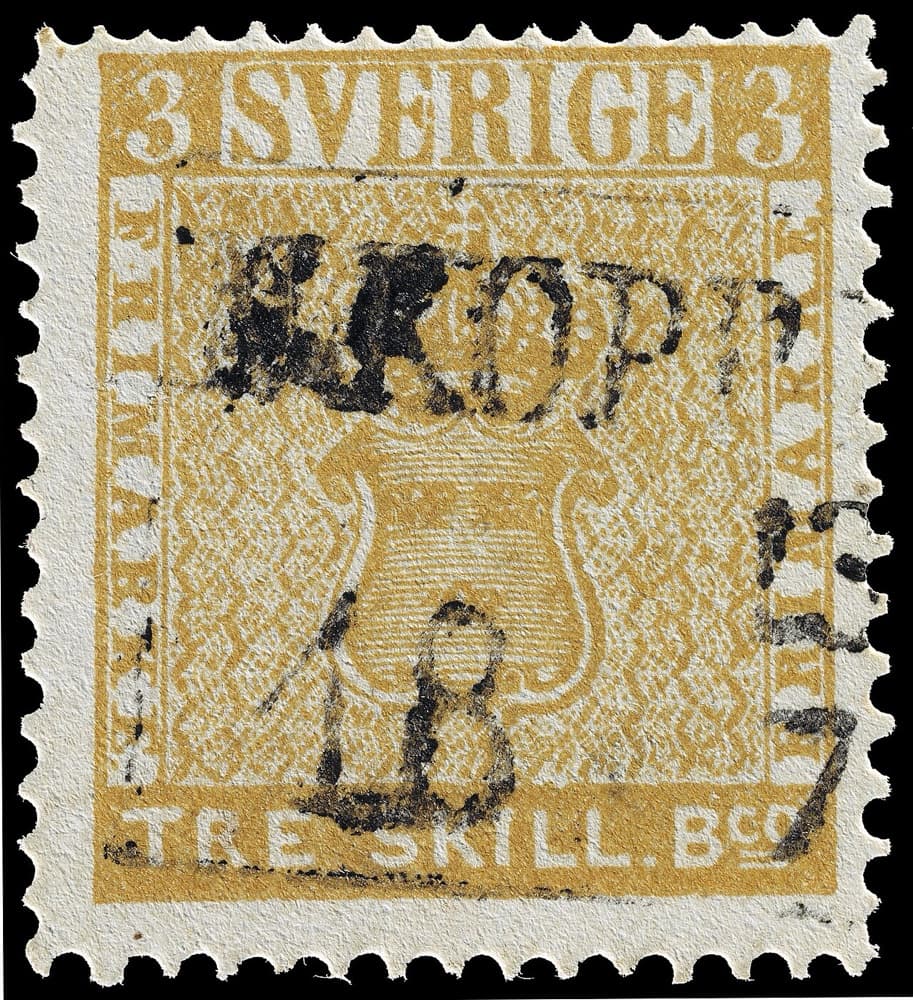
Treskilling Yellow (Tre Skilling Banco colour error)
Sweden's three-skilling stamp should have been blue-green, but one came off the press in the yellow-orange of the eight-skilling. A teenager found it on an old letter, and it went on to set the world record for a stamp three times and to be owned by a count, a king and a string of anonymous investors.
- Year
- 1855
- Maker
- Sweden (Kingdom of Sweden)
- By price in stamps
- 7 of 100
Create a free account to see every recorded price and every grade.
Create a free account- What it is
- Sweden's 3 skilling banco stamp printed in the yellow-orange color of the 8 skilling, a color error
- Issue
- Sweden's first postage stamps, a set of five values, on sale from July 1, 1855
- Normal color
- Blue-green; this example is yellow-orange
- Known examples
- One
- Postmark
- Nya Kopparberget (now Kopparberg), July 13, 1857
- Found
- 1885 or 1886, by a young collector, Georg Wilhelm Backman, on a letter at his grandmother's farm
- Notable owners
- Philipp von Ferrary, Baron Eric Leijonhufvud, Claes A. Tamm, Johan Ramberg, King Carol II of Romania, Rene Berlingen, Count Gustaf Douglas (2013)
- Record sale
- About $2.3 million at auction in Switzerland, November 1996, then the highest price ever paid for a single stamp
- Weight
- About 0.027 grams
Sweden's first stamps
On October 25, 1854, Sweden's parliament, the Riksdag, set a single domestic letter rate that applied regardless of distance. The decision to introduce uniform postage and stamps was confirmed on March 9, 1855. The contract to make the stamps went to Count Pehr Ambjörn Sparre, an inventor who set up a printing house in Stockholm in early 1855 with two presses and a staff of three.
Sparre signed the approved design and cut the master die himself. The Post Office rejected his first die, and it had to be redone. The stamps were printed by letterpress, with raised areas of the plate carrying the ink, and Sparre perforated whole sheets at once on a 'harrow' machine he built. His first delivery, due by June 2, 1855, was late. On June 12 he delivered 6,569 full sheets, three weeks before the stamps went on sale.
Sweden's first stamps went on sale on July 1, 1855. All five values showed the Swedish coat of arms and the word 'SVERIGE' and were denominated in skilling banco, from 3 to 24 skilling. The 3 skilling was printed in blue-green and the 8 skilling in yellowish orange. The issue lasted three years. On July 1, 1858, Sweden switched to öre and riksdaler and issued new stamps in the same design but slightly smaller.
How a green stamp came out yellow
No one knows exactly what happened. The most widely accepted explanation is about how the plates were built. Each plate was assembled by hand from 100 individual stereotypes, small cast copies of the die, laid out ten by ten. If one stereotype on an 8 skilling plate was damaged and a worker replaced it by mistake with a 3 skilling stereotype, every sheet printed from that plate would contain one 3 skilling value printed in the 8 skilling's yellow.
That would also explain why the error went unnoticed. One wrong value among 99 correct ones in the same color is easy to miss, both for the printer's checker and for the postal clerk who sold the stamp at the 8 skilling rate. Experts in a 2013 London court case agreed that the error arose during the seventh of the eight deliveries of skilling stamps, and that only about 10 percent of skilling stamps have survived. How many yellow 3 skilling stamps were printed is unknown.
The surviving stamp was canceled at Nya Kopparberget, now Kopparberg, on July 13, 1857, before the eighth delivery was printed. It is not in perfect condition. It has a cut at the upper left, and its top margin has been reperforated at some point.
From an attic to a king's collection
In 1885 or 1886 (sources disagree on the year), a teenage collector named Georg Wilhelm Backman was going through old letters at his grandmother's farm, Väster Munga, north of Västerås. On one he found a 3 skilling stamp in the wrong color. He sold it to the Stockholm stamp dealer Heinrich Lichtenstein for 7 kronor.
The stamp changed hands several times. In 1894 Sigmund Friedl sold it for 4,000 florins to Philipp von Ferrary, who then owned the largest stamp collection in the world. Collectors kept searching, but no second example turned up, and over time it became clear that this one might be the only survivor.
Ferrary's collection was sold off in the 1920s, and the Swedish baron Eric Leijonhufvud bought the yellow stamp. Claes A. Tamm paid £1,500 for it in 1926 to complete his collection of Swedish stamps. Lawyer Johan Ramberg bought it for £2,000 in 1928 and kept it for nine years. In 1937 King Carol II of Romania, a keen collector, bought it at auction in London for £5,000. In 1950 it went to Rene Berlingen for an undisclosed sum.
Its authenticity has been challenged and confirmed more than once. One account says a court ruled it genuine in 1932 and that experts confirmed it again in 1975, using crystallography among other tests to show that its paper and ink match the 8 skilling yellow. In the 1970s the Swedish Postal Museum declared it a forgery, which caused a controversy. Two separate commissions examined it and concluded it was genuine.
Three world records, then secrecy
In 1984 the stamp sold at auction in Switzerland for a world-record price, reported as 977,500 Swiss francs in one source and 997,500 in another. In 1990 it sold at auction again for 1,897,500 Swiss francs, reported as more than $1 million. In November 1996 it set a third record at auction, at 2,875,000 Swiss francs according to the auctioneer (rounded to 2.88 million in some reports). That was about $2.3 million at the time, though one account gives $2.2 million. It was the highest price ever paid for a single stamp until the British Guiana one-cent magenta sold for about $9.5 million in 2014.
After 1996 the stamp's ownership became hard to follow. One report says the owner was described only as 'an individual of a magnetic interest for the media.' Banks and investors held it at various times.
On May 22, 2010, it was auctioned again in Geneva. The auctioneer said the owner had given the stamp as a pledge, as financial security. Bidders were vetted, took part by telephone and were sworn to secrecy. The auctioneer said it sold to an international consortium for at least its 1996 price, and the consortium called it 'a solid investment in these times of crisis.' A later report said the buyer was the dealer Armand Rousso and that he paid slightly less than the 1996 record. The two accounts cannot both be right, and the price has never been confirmed.
In May 2013 Count Gustaf Douglas, a Swedish nobleman, politician and serious philatelist, bought the stamp by private treaty. He showed it at the Royal Philatelic Society London on October 31, 2013. One account dates his purchase to 2010, but reports from 2013 and other accounts of his life give May 2013. The price was not disclosed.
The trunk that held nine more
In or before 2012, Jean-Claude Andre and his wife Jane sued Clydesdale Bank in London's High Court. They said a trunk they had left at the bank from 1986 to 2004 held six covers carrying nine Treskilling Yellows, and that the lock had been removed and the covers taken. An expert valued the covers at about £3.7 million. In a judgment dated January 31 and February 1, 2013, the court rejected the claim. It found the Andres unreliable witnesses and the story marked by 'sheer inherent implausibility.' The stamp found by Backman is still the only one known.
The stamp has shown up beyond philately. It is the subject of several books, including a 185-page 2004 history, and the name 'The Treskilling Yellow' has been registered as a trade name. In season six of the television series 'White Collar,' the con man Neal Caffrey has to steal it as part of a heist.
The numbers
- Issue date
- July 1, 1855 (first Swedish stamps)
- Set
- Five values, 3, 4, 6, 8 and 24 skilling banco, coat of arms design, inscribed 'SVERIGE'
- Printing
- Letterpress (typography) by Count Pehr Ambjörn Sparre's printing house, Stockholm
- Perforation
- 14, applied by a harrow machine that perforated a whole sheet at once
- Plate
- 100 stereotypes in a 10 by 10 arrangement, the basis of the accepted explanation for the error
- Normal color
- 3 skilling: blue-green. 8 skilling: yellowish orange
- Known copies of the error
- 1
- Cancellation
- Nya Kopparberget, July 13, 1857
- Condition
- Cut at upper left; top margin reperforated
- Weight
- About 0.02675 grams
Timeline
Sweden's parliament adopts a uniform domestic letter rate.
Pehr Ambjörn Sparre delivers the first 6,569 sheets of stamps.
Sweden's first stamps go on sale: five skilling banco values with the coat of arms.
The surviving yellow 3 skilling is canceled at Nya Kopparberget.
Sweden adopts öre currency, ending the skilling stamps.
Georg Wilhelm Backman finds the stamp on a family letter and sells it for 7 kronor. Some sources give 1886.
Philipp von Ferrary buys it for 4,000 florins.
Claes A. Tamm buys it for £1,500 after the Ferrary sales.
Lawyer Johan Ramberg buys it for £2,000.
King Carol II of Romania buys it at auction in London for £5,000.
Rene Berlingen acquires it for an undisclosed sum.
The Swedish Postal Museum declares it a forgery. Two commissions find it genuine.
It sells at auction in Switzerland for a world-record price for a stamp.
It sells again for 1,897,500 Swiss francs, a second world record.
It sets a third record, about $2.3 million at auction.
It is auctioned in Geneva after its owner pledged it as financial security. The buyer and price are kept secret.
A London court rejects a claim that nine more Treskilling Yellows were stolen from a bank trunk.
Count Gustaf Douglas buys the stamp by private treaty.
Douglas shows it at the Royal Philatelic Society London.
The British Guiana one-cent magenta passes its record price for a single stamp.
The world in 1855
Alexander II becomes tsar of Russia.
The Exposition Universelle, an early world's fair, opens in Paris.
Walt Whitman publishes 'Leaves of Grass' in Brooklyn.
In the Crimean War, Sevastopol falls to French and British troops.
Henry Bessemer files his British patent for the Bessemer steelmaking process.
David Livingstone becomes the first European to see Victoria Falls.
The U.S. Supreme Court decides Dred Scott v. Sandford.
Elisha Otis's first passenger elevator is installed at 488 Broadway in New York.
Price record
| Date | Price | Kind |
|---|---|---|
| Nov 1996 | $2,300,000 | Sold at auctionSold at auction in Switzerland for 2,875,000 Swiss francs (also reported as 2.88 million), then about $2.3 million. One account gives $2.2 million. The world record for a stamp until 2014. |
A realized auction price is what a buyer actually paid on the date shown, including the buyer's premium where the sale reported it. It is the strongest kind of reference price, and it is a record of one sale of one object on one day, not a promise of what the next example will bring.
By reference price, Treskilling Yellow (Tre Skilling Banco colour error) is number 7 of 100 in the stamps entries of the FLOAT 100. 82 of those 100 rest on a realized sale; the rest carry an asking price or a guide value, and each page says which. Rank within the FLOAT 100 itself (2 here) is editorial: how much an object defines its field, not price alone.
Did you know
- The teenager who found the stamp sold it for 7 kronor.
- The stamp weighs about 0.027 grams. One writer worked out that at its auction prices it was worth about $32 billion a pound.
- Sweden's own Postal Museum once declared it a forgery. Two commissions later found it genuine.
- When it was auctioned in 2010, every bidder was sworn to secrecy, and the price has never been confirmed.
- A London court threw out a 2013 claim that nine more Treskilling Yellows had been stolen from a bank trunk, citing the claim's 'sheer inherent implausibility.'
- A U.S. stamp expert said the story of the schoolboy finding it may be apocryphal, because a similar story is told about the British Guiana one-cent magenta.
- The heist plot of a 'White Collar' episode turns on stealing the stamp.
How this page is made
- The figure
- One reference price, shown with its own kind. FLOAT does not average it with anything or adjust it for time.
- Realized or not
- A realized price is a completed sale. An asking price, an estimate and a price-guide value are not sales, and are labeled as such wherever they appear.
- The story
- Researched from published records and checked fact by fact. Updated Oct 1, 2026.
- Archive
- Oct 5, 2026