FLOAT 100 · Stamps · No. 62
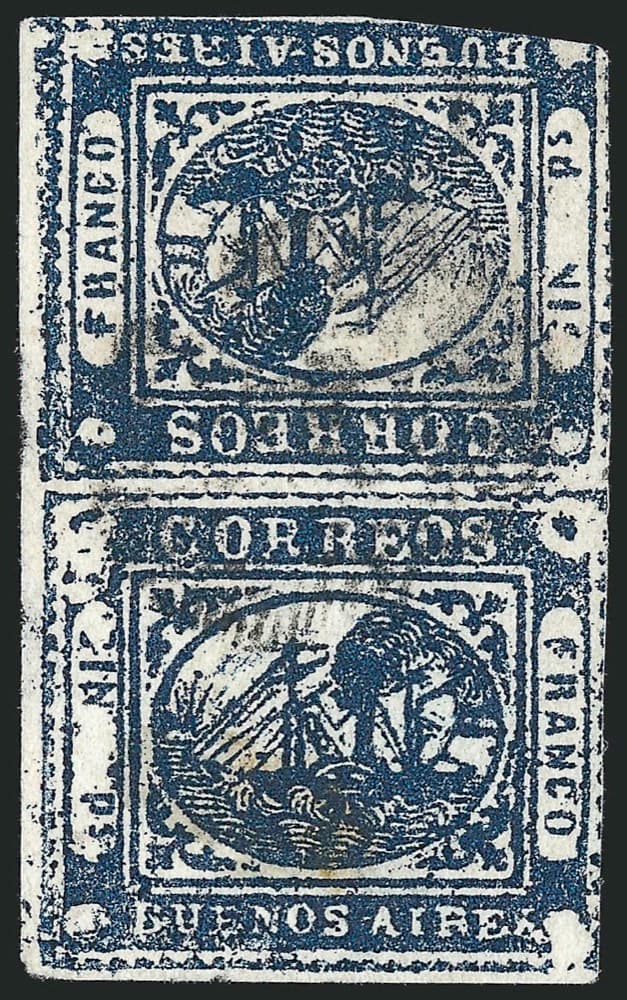
Buenos Aires 1859 'Barquitos' 1p 'In Ps' Tete-beche Pair
A hurried rate cut, a worn printing plate and one metal cliche nailed back on upside down produced a pair of little blue ship stamps that is now the only one of its kind, after its twin vanished in 1940.
- Year
- 1859
- Maker
- State of Buenos Aires (Argentina, pre-confederation)
- By price in stamps
- 23 of 100
Create a free account to see every recorded price and every grade.
Create a free account- What it is
- A vertical tete-beche pair of the 1-peso "In Ps" Barquitos stamp of the State of Buenos Aires, the top stamp printed upside down relative to the one below
- Issued
- The 1-peso value in blue went on sale January 1, 1859
- Issuer
- The sovereign State of Buenos Aires, independent of the Argentine Confederation from 1852 to 1861
- Color
- Deep blue, lightly canceled in black with a "ponchito" postmark
- Plate positions
- 33 (the inverted cliche, first stamp of row five) and 41 (bottom left corner of the sheet) on a plate of 48
- Known examples
- One. A second, horizontal pair was last seen in 1940 and is presumed lost
- Owners
- Alfred H. Caspary, Lars Amundsen, Joseph Schatzkes, John R. Boker Jr., Gabriel Sanchez, the Islander collection
- Shown as
- An "Aristocrat of Philately" at Ameripex 1986 and Anphilex 1996
- Last public sale
- $575,000 at auction in New York, June 2008
Little ships from a breakaway state
In September 1852 the province of Buenos Aires broke away from the Argentine Confederation after the fall of Juan Manuel de Rosas. For the next nine years it ran itself as a separate state, with its own constitution from April 1854, its own legislature and its own diplomacy, until it rejoined Argentina in December 1861 after the Battle of Pavon. The stamps it issued in 1858 and 1859 were therefore the postage of an independent state, not a provincial issue, a point the cataloguers of the 2008 sale were at pains to make.
Those stamps are known as the Barquitos, the "little ships," after the small steamship at the center of the design. The first four values went on sale in April 1858: 2 pesos in blue, 3 pesos in green, 4 pesos in red and 5 pesos in orange. The 2-peso stamp paid the basic single-letter rate set by a decree of April 9, 1858, and the higher values covered heavier letters and services such as registration.
The designs were engraved by Pablo Cataldi and printed by letterpress at the Banco y Casa de Moneda, the bank and mint of Buenos Aires. The engraver cut one master die with blank value tablets. Four copies were taken from it and the values cut into each: "Dos Ps," "Tres Ps," "Cuato Ps" (misspelled, without the r) and "Cinco Ps." From each of these, 48 metal clichés were cast and nailed by their four corners onto a thick wooden block, eight stamps across and six down. The brass nails, driven below the printing surface, show up as tiny white holes in the printed stamps, and those holes and other flaws let specialists identify each stamp's position on the plate.
How a five became a one, and a cliche turned upside down
In October 1858 the letter rate was cut to one peso per ounce, plus four reales (half a peso) for each extra half-ounce. Two new stamps were needed at once, and the mint had no time to make new dies and plates. Instead it altered two plates it already had. On the 4-peso plate, the bottom of the loop of the "P" in "Ps" was cut away on each cliché so that it read "rs" for reales. On the 5-peso plate, workers cut the "C" and "co" out of "Cinco Ps" on all 48 clichés, leaving "In Ps" for one peso. Tiny leftovers of the old lettering, such as a remnant of the "C" that looks like a colon before "IN," are still visible on many stamps.
Both new stamps were printed in brown, and their shades were close enough to cause confusion. On January 1, 1859, the color of the "In Ps" one-peso was changed to blue. Around the same time the 4-reales plate was cut again to print more one-peso stamps, leaving the crude legend "T rs," a rough stand-in for "1 ps."
The "In Ps" plate began to wear, and some of its clichés were taken off the wooden base and nailed back on. During one of these repairs, the cliché in position 33, the first stamp of the fifth row, went back upside down. Every sheet printed while it stayed that way carried one inverted stamp. A pair that includes it, with a normal stamp beside or below it, is a tete-beche pair. This is a true mistake, unlike tete-beche varieties produced on purpose by printing a sheet twice with the paper turned around.
The 2008 catalogue explains that the "In Ps" plate existed in two states and that both known tete-beche pairs came from the second. According to the 1925 study of the issue by F. J. Peplow, the first hint of the error was a single stamp carrying part of its neighbor rotated 180 degrees.
Two pairs, and then one
The first tete-beche pair to surface was a horizontal one, positions 33 and 34, in the collection of Count Philipp von Ferrary. At the Ferrary sale in Paris on June 13, 1923, it was lot 146 and brought 37,600 French francs including a 17.5 percent surcharge, about $2,400 at that day's exchange rate. The 2008 catalogue compared that with famous United States stamps in the same sale: an unused 15-cent 1869 invert, later worth more than $750,000, fetched the equivalent of $1,378. The buyer of the Buenos Aires pair was the New York collector Alfred F. Lichtenstein.
Around the same time, a second pair turned up in Germany. It was vertical, positions 33 and 41, and went to another American collector, Alfred H. Caspary. It settled a question collectors had argued about: it proved that position 33 was the stamp turned upside down relative to all the others.
Lichtenstein showed his horizontal pair in 1940 at the Collectors Club of New York's exhibition marking 100 years of postage stamps. It was never seen again. His daughter, Louise Boyd Dale, carried on the family collection and was assumed to have it, but it did not appear in any of the long series of Dale-Lichtenstein auctions. Once the last of those collections had been sold, collectors gave it up as lost. The Caspary pair has been the only known example ever since.
From Caspary to the Islander
Caspary, who was born in 1877 and died in January 1955, assembled one of the finest collections of United States stamps ever formed and founded the Philatelic Foundation. His collections were sold at auction in New York between 1955 and 1958, his South American stamps in June 1958.
After Caspary, the vertical pair passed in turn to Lars Amundsen, Joseph Schatzkes, John R. Boker Jr. and Gabriel Sanchez. Boker, who lived from 1913 to 2003, was best known for German States stamps and served as president of the Collectors Club of New York.
On October 28, 1982, the pair was lot 8148 in a Swiss auction of the Sanchez collection. It realized 181,500 Swiss francs, about $89,000, and became part of the Islander collection of South America. It was chosen as one of the "Aristocrats of Philately" at the Ameripex international exhibition in 1986 and again at Anphilex in 1996.
The Islander collection of South America was sold at auction in New York on June 5 and 6, 2008. The pair was lot 82, described as deep blue with minor faults and lightly canceled with a black ponchito postmark that leaves the ship clearly visible. Against an estimate of $400,000 to $500,000, it sold for $575,000.
Reading the pair
The pair is vertical. The upper stamp is the inverted cliché from position 33, in the second state of the plate; the lower stamp, right side up, is position 41, the bottom left corner of the 48-stamp sheet. The value reads "In Ps," the old "Cinco Ps" with its "C" and "co" cut away.
Specialists check the paper as well as the design. Genuine Barquitos are on slightly rough, grayish paper, while many forgeries, including work by the forger Jean de Sperati, are on paper that is too white and smooth. Forgeries of the ordinary stamps were already being described in 1882, and the French forger Francois Fournier also produced copies. Genuine stamps were printed very close together, so wide margins on all sides are rare, and copies with extra-large margins are reprints.
Even ordinary Barquitos stamps have been prized for a long time. They were the highest-priced stamps listed in an 1868 catalogue, and the plate alterations were already being discussed in June 1864 in one of the first stamp journals.
The numbers
- Issue date
- One-peso "In Ps" in brown, October 1858; in blue, January 1, 1859
- Printing
- Letterpress from 48 stereotyped clichés nailed to a wooden base, at the Banco y Casa de Moneda, Buenos Aires
- Engraver
- Pablo Cataldi
- Sheet
- 48 stamps, 8 across by 6 down
- Error
- Cliché at position 33 reattached upside down, in the second state of the plate
- This pair
- Vertical, positions 33 and 41, deep blue, minor faults, black ponchito cancel
- Paper
- Genuine stamps on slightly rough, grayish paper
- Known tete-beche pairs
- One surviving; a horizontal pair (positions 33 and 34) unseen since 1940
Timeline
A revolution in Buenos Aires breaks the province away from the Argentine Confederation.
The State of Buenos Aires adopts its own constitution.
The first Barquitos stamps go on sale: 2, 3, 4 and 5 pesos.
Postal rates are cut; the mint alters the 5-peso plate to read "In Ps" and issues it as a brown one-peso stamp.
The "In Ps" one-peso is reissued in blue. Later, a worn cliché is reattached upside down at position 33.
Buenos Aires rejoins Argentina after the Battle of Pavon.
A Liverpool stamp journal reports that the Buenos Aires plates had been modified.
Ferrary's horizontal tete-beche pair sells in Paris for 37,600 francs and goes to Alfred F. Lichtenstein.
Around this time the vertical pair is found in Germany and sold to Alfred H. Caspary.
Lichtenstein exhibits the horizontal pair in New York. It is never seen again.
Caspary's South American collection is sold at auction after his death.
Sold at auction in Switzerland from the Sanchez collection for 181,500 Swiss francs; enters the Islander collection.
Shown as an Aristocrat of Philately at Ameripex.
Shown as an Aristocrat of Philately at Anphilex.
Sold at auction in New York for $575,000 as lot 82 of the Islander collection.
The world in 1857
The first Argentine railway line opens in Buenos Aires under governor Pastor Obligado.
Felice Orsini's bomb attack on Napoleon III in Paris fails but kills eight people.
Bernadette Soubirous reports the first of her visions at Lourdes.
The Government of India Act transfers the East India Company's territories to the British Crown.
The first transatlantic telegraph cable is completed; it fails within weeks.
Abraham Lincoln and Stephen Douglas hold their first debate in Illinois.
Buenos Aires and the Argentine Confederation fight the Battle of Cepeda.
Price record
| Date | Price | Kind |
|---|---|---|
| Oct 28, 1982 | $89,000 | Sold at auctionSold at auction in Switzerland from the Gabriel Sanchez collection, lot 8148, for 181,500 Swiss francs, given by the 2008 catalogue as approximately $89,000. |
| Jun 5, 2008 | $400,000 | Estimate, not a salePresale estimate of $400,000 to $500,000 (low end shown). |
| Jun 5, 2008 | $575,000 | Sold at auctionSold at auction in New York as lot 82 of the Islander collection of South America. |
A realized auction price is what a buyer actually paid on the date shown, including the buyer's premium where the sale reported it. It is the strongest kind of reference price, and it is a record of one sale of one object on one day, not a promise of what the next example will bring.
By reference price, Buenos Aires 1859 'Barquitos' 1p 'In Ps' Tete-beche Pair is number 23 of 100 in the stamps entries of the FLOAT 100. 82 of those 100 rest on a realized sale; the rest carry an asking price or a guide value, and each page says which. Rank within the FLOAT 100 itself (62 here) is editorial: how much an object defines its field, not price alone.
Did you know
- The 4-peso stamp's value was engraved as "Cuato Ps," missing the r in "Cuatro."
- The one-peso stamp exists only because officials cut letters out of the 5-peso plate: "Cinco Ps" lost its "C" and "co" and became "In Ps."
- When the mint needed more one-peso stamps, it cut down "Cuato rs" to "T rs" and relied on the blue color to tell people what it meant.
- The tiny white dots in Barquitos designs are the heads of the brass nails that held each cliché to the wooden plate.
- In 1923 the lost horizontal pair outsold an unused U.S. 15-cent 1869 invert in the same Paris sale.
- The horizontal pair disappeared after a 1940 exhibition in New York and was never found, even after its owner's family collection was sold off.
How this page is made
- The figure
- One reference price, shown with its own kind. FLOAT does not average it with anything or adjust it for time.
- Realized or not
- A realized price is a completed sale. An asking price, an estimate and a price-guide value are not sales, and are labeled as such wherever they appear.
- The story
- Researched from published records and checked fact by fact. Updated Oct 3, 2026.
- Archive
- Oct 5, 2026