FLOAT 100 · Stamps · No. 61
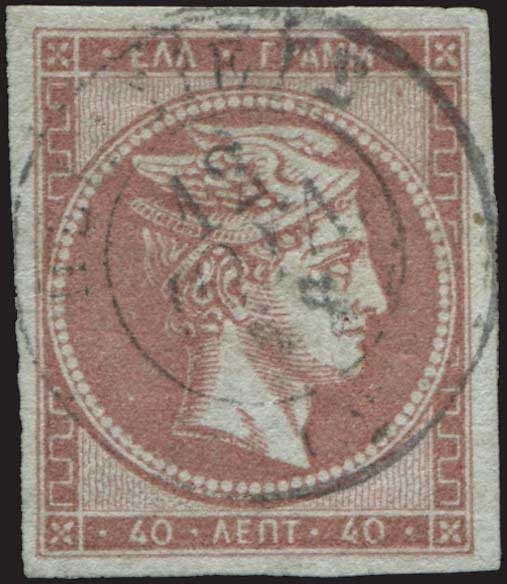
Greece 1861 Large Hermes Head (Solferino Cover)
For three days in July 1871 the Piraeus post office sold 40 lepta stamps printed in the wrong color; thirteen survive, only one on a complete letter, a note about a cargo of carobs sent to Cyprus, and it is the most valuable item in Greek philately.
- Year
- 1861
- Maker
- Kingdom of Greece (Athens printing from Paris-made plates)
- By price in stamps
- 30 of 100
Create a free account to see every recorded price and every grade.
Create a free account- The object
- A folded cover from Piraeus to Larnaca, Cyprus, dated July 13, 1871 (Julian calendar)
- The stamp
- Large Hermes Head 40 lepta, lilac-rose on greenish paper, known as the "Solferino"
- Why it is rare
- Printed in the shade of the control numbers instead of the normal color; apparently a single sheet, used at Piraeus
- Cancellation dates
- Only July 12, 13 and 14, 1871 are recorded on surviving Solferinos
- Survivors
- 13 recorded: 11 used singles, one on a small fragment and one on this complete cover
- Route
- By Austrian Lloyd steamer via Smyrna, with a Smyrna Lloyd agency transit mark of July 27 (Gregorian)
- Postage
- 40 lepta, then the normal rate for letters carried by Lloyd ships from Greece to Levant ports
- Plate position
- 51, according to an online museum's record of the cover
- Last recorded sale
- CHF 646,250 at auction in 2002, the highest price ever paid for a Greek philatelic item
Greece's first stamps, made in Paris
Greece's first postage stamps grew out of a law of May 19, 1855, which set out the organization of the postal service and the introduction of the stamp. It was never brought into effect. A new bill fixing the rates, denominations and colors of seven values was introduced on February 8, 1860, passed on May 21, 1860, and enacted by royal decree on September 21, 1861.
The design shows the profile of Hermes, messenger of the gods, in a frame closely resembling those of contemporary French stamps. It was the work of Desire-Albert Barre, chief engraver of the Paris Mint, who drew the model, engraved the dies and made the seven printing plates between July 1860 and September 1861. Barre took his inspiration from France's first stamps, designed by his father, Jacques-Jean Barre. With the Paris printer Ernest Meyer he made about a hundred kinds of plate proofs to settle the inks and papers.
Meyer printed 1,345,000 stamps of the first seven values (1, 2, 5, 10, 20, 40 and 80 lepta) in Paris in spring and summer 1861, on sheets of 150. The stamps were issued on October 1, 1861 by the Julian calendar then used in Greece, October 13 by the Gregorian. In August and September 1861 the plates were shipped to Athens, where all later printings were made at the National Printing Office from the same seven plates until 1882. The stamps were imperforate and were cut apart at the counter with scissors.
The wrong ink in 1871
Because the same plates were used for twenty years, on many papers and with changing inks, the Large Hermes Heads are divided into a long series of printings, and the back of most Athens printings carries a small printed "control number" showing the value. These control numbers are the key to telling the printings apart.
At the start of the 1870s the supply of paper from France stopped because of the Franco-Prussian War, and the Greek mint turned to papers of unknown origin. The printings of 1871 and 1872 are known as the "inferior quality paper" printings. The normal 40 lepta of this period is a bistre shade: one specialist source describes the typical stamp as rose-bistre or yellow-bistre.
The Solferino is a variety of this printing. Its stamp was printed in the lilac-rose shade normally used for the control numbers on the back of the 40 lepta, on the greenish paper used for the 10 lepta. Unique plate positions confirmed by independent scholars, and only three postmark dates, July 12 to 14, 1871, suggest that no more than one sheet was used at the Piraeus post office counter. Every recorded copy is cancelled at Piraeus, either with the dotted numeral "2" or the Piraeus dated postmark.
The nickname comes from the Battle of Solferino of June 24, 1859, in which French and Piedmont-Sardinian armies defeated Austria in northern Italy. It was rumored that the blood on the dead soldiers' uniforms had this particular shade. The same battle moved the Swiss businessman Henry Dunant to write A Memory of Solferino, which led to the founding of the International Red Cross.
A letter about carobs
The cover is a folded letter sent from Piraeus to Larnaca, Cyprus, then part of the Ottoman Empire, and dated July 13, 1871 by the Julian calendar. The 40 lepta Solferino is tied by the Piraeus "2" numeral cancel and also by the recipient's pen endorsement. The front carries a Piraeus dated postmark and a boxed "PD", showing that postage was paid to the final destination. On the back is a transit mark of the Lloyd agency at Smyrna dated July 27, by the Gregorian calendar.
Forty lepta was then the normal rate for letters carried by Lloyd ships from Greece to the Levant ports where the Austrian company ran post offices. The letter inside concerns the terms for a shipment of carobs from Cyprus. The chocolate-colored carob pod, sometimes called the black gold of Cyprus, had for centuries been the island's most important source of income.
The stamp is described as in superb condition, a contrast with the loose singles: of the eleven used single copies, eight have defects. That makes the cover both the only complete letter bearing a Solferino and one of the very few copies without faults.
Thirteen stamps and a record sale
The Solferinos were catalogued as a group by L.N. Williams in his Encyclopaedia of Rare and Famous Stamps (1993), whose Roman-numeral classification collectors still use, and again by M. Tseriotis in 2002 and N.Z. Zafeirakopoulos in 2002. Sources disagree on the cover's number in the Williams list: the 2002 sale description calls it number X, while an online museum's record of the cover calls it example VII in its description and No. XII in its title. The census published for the NOTOS 2021 exhibition lists plate position 51 as Williams no. XII.
The cover came to the public market for the first time in 2002, with a certificate from M. Tseriotis, in a sale of a collection of Large Hermes Heads. It sold for CHF 646,250, the highest price ever recorded for a Greek philatelic item. No later public sale is recorded in the sources consulted.
Loose Solferinos also have pedigrees. Copy V in the Williams list, ex-Herbert Bloch, plate position 140, with three large margins and a 1988 certificate stating it was without defects, sold in the United States in December 2011 for $35,000; that is a loose stamp, not this cover. Two of the thirteen stamps were once a pair (plate positions 91 and 92); they were separated at some point and were reunited in the same collection only in 2018.
In 2021 the Hellenic Philotelic Society's NOTOS 2021 exhibition set out to bring the Solferinos together, and eleven of the thirteen copies confirmed their participation. Its census traces the owners of each copy: G. Zachariades appears in the provenance of several, and C. Binos and R.A.G. Lee each owned two.
How to recognize a Solferino
A Solferino is a 40 lepta Large Hermes Head of the 1871 printing in a lilac-rose shade on greenish paper, instead of the bistre shades of the regular stamp, with the control number on the back still printed in the normal lilac. It is imperforate and should carry a Piraeus cancel, the dotted numeral "2" or the Piraeus dated postmark, dated between July 12 and 14, 1871. It is listed as Yvert 22Ba and Hellas 36a.
Descriptions of the color vary. One reference calls it bloody red; a 2021 museum blog post notes that the stamps are not obviously blood-red to the modern eye, and the same online museum's record of the cover says the color of this printing was changed to bistre, which describes the normal stamp rather than the variety. One more caution: one 2021 article dates the stamps to 1870, but the postmarks and every other source place them in July 1871.
Given that there are only thirteen, any copy should be matched against the published census by plate position and accompanied by an expert certificate.
Legacy
The Large Hermes Heads remained in use until 1886, when the Small Hermes Heads replaced them, and they were brought back with overprints in 1900 and 1901. Their long run of printings, papers and shades has made them one of the most intensely studied classic issues, with specialist literature running from the early 20th century to a 2023 color guide with 1,144 shades.
Within that field the Solferino is the pinnacle, and the Piraeus to Larnaca cover is the pinnacle of the Solferinos: the only one still on the letter it paid for, carrying a stamp that existed at a single post office for three summer days.
The numbers
- Series issue date
- October 1, 1861 (Julian) / October 13, 1861 (Gregorian)
- Solferino use
- July 12-14, 1871, Piraeus only
- Cover date
- July 13, 1871 (Julian)
- Value
- 40 lepta
- Color
- Lilac-rose, the shade of the control numbers
- Paper
- Greenish, as used for the 10 lepta
- Perforation
- Imperforate
- Sheet
- 150 stamps; apparently one sheet used
- Known copies
- 13: 11 singles, 1 on fragment, 1 on cover
- Catalog numbers
- Yvert 22Ba; Hellas 36a
- Printer
- Athens printing from the Paris-made plates (not one of the 1861 Paris printings)
Timeline
A Greek law provides for a postal service and the introduction of postage stamps; it is never put into effect.
The Battle of Solferino is fought in northern Italy; its name later becomes the stamp's nickname.
A new bill setting rates, values and colors for seven stamps is passed.
Desire-Albert Barre of the Paris Mint begins the design, dies and plates, finished by September 1861.
Ernest Meyer prints 1,345,000 stamps in Paris in spring and summer; the plates go to Athens in August and September.
The Large Hermes Heads are issued (October 1 by the Julian calendar).
Paper from France stops because of the Franco-Prussian War; Athens prints on papers of unknown origin.
The first recorded Solferino postmark date at Piraeus; the last is July 14.
The cover is sent from Piraeus to Larnaca, Cyprus (Julian date).
The cover passes the Lloyd agency at Smyrna (Gregorian date).
The last printings from the original plates are made.
The Small Hermes Heads replace the Large Hermes Heads.
L.N. Williams publishes a numbered classification of the Solferinos.
The cover sells at auction for CHF 646,250, the record for a Greek philatelic item.
Loose copy V of the Williams list sells in the United States for $35,000.
The two Solferinos that were once a pair are reunited in one collection.
Eleven of the thirteen recorded Solferinos are confirmed for the NOTOS 2021 exhibition.
The world in 1871
The German Empire is proclaimed, with the King of Prussia as German Emperor.
The Paris Commune is formally established.
The Treaty of Frankfurt transfers Alsace and Lorraine from France to Germany.
The first cat show is held at the Crystal Palace in London.
British Columbia joins Canada.
The Great Chicago Fire breaks out.
Heinrich Schliemann begins excavating Troy, then in the Ottoman Empire.
Price record
| Date | Price | Kind |
|---|---|---|
| Feb 2002 | $380,819 | Sold at auctionAt auction in Geneva: CHF 646,250 (including buyer's premium), shown in USD at the Federal Reserve monthly average (1 CHF = 0.5893 USD). |
A realized auction price is what a buyer actually paid on the date shown, including the buyer's premium where the sale reported it. It is the strongest kind of reference price, and it is a record of one sale of one object on one day, not a promise of what the next example will bring.
By reference price, Greece 1861 Large Hermes Head (Solferino Cover) is number 30 of 100 in the stamps entries of the FLOAT 100. 82 of those 100 rest on a realized sale; the rest carry an asking price or a guide value, and each page says which. Rank within the FLOAT 100 itself (61 here) is editorial: how much an object defines its field, not price alone.
Did you know
- All thirteen known Solferinos were cancelled at a single post office, Piraeus, over just three days.
- The stamp got its name from a battle fought twelve years earlier: legend says the blood on soldiers' uniforms at Solferino had the same shade.
- The only Solferino on a complete letter paid for a business note about a shipment of carobs from Cyprus.
- Greece's first stamps were engraved by the chief engraver of the Paris Mint, whose father designed France's first stamps.
- Large Hermes Head sheets were imperforate, so clerks cut stamps apart with scissors and many copies lost part of the design.
- Two Solferinos that were once joined as a pair were separated and only reunited in one collection in 2018.
How this page is made
- The figure
- One reference price, shown with its own kind. FLOAT does not average it with anything or adjust it for time.
- Realized or not
- A realized price is a completed sale. An asking price, an estimate and a price-guide value are not sales, and are labeled as such wherever they appear.
- The story
- Researched from published records and checked fact by fact. Updated Oct 3, 2026.
- Archive
- Oct 5, 2026