FLOAT 100 · Stamps · No. 49
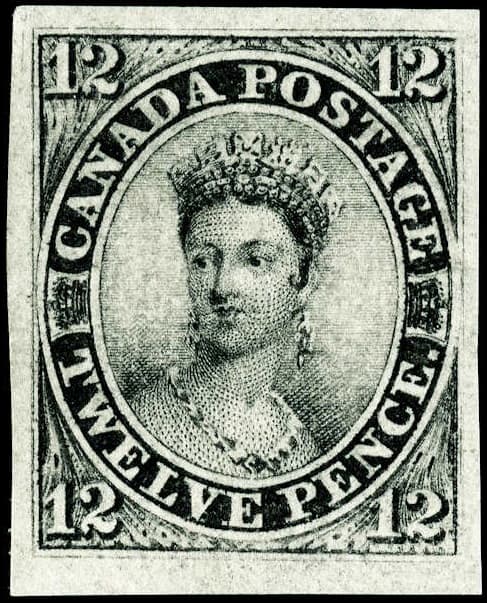
Canada 1851 '12d Black' (Twelve Penny Black)
Canada printed 51,000 of them in 1851, the public bought about 1,450, the post office destroyed the rest, and a young Queen Victoria in black became the country's most coveted stamp.
- Year
- 1851
- Maker
- Province of Canada
- By price in stamps
- 24 of 100
Create a free account to see every recorded price and every grade.
Create a free account- Issued
- June 14, 1851, by the Province of Canada (today roughly Ontario and Quebec), its third postage stamp
- Printed by
- Rawdon, Wright, Hatch & Edson of New York, the firm that printed the first U.S. stamps; die engraved by Alfred Jones
- Design
- Full-face portrait of a young Queen Victoria after Alfred Edward Chalon, inscribed CANADA POSTAGE and TWELVE PENCE, with a 12 in each corner
- Paper and format
- Black, line-engraved, imperforate, on hand-made laid paper
- Printed
- 51,000 by most accounts (one auction census and one news report give 50,000)
- Sold to the public
- About 1,450; 1,510 went out to post offices and 60 came back
- Destroyed
- The 49,490 undistributed stamps, on or about May 1, 1857
- Survivors
- Roughly 120 to 150 by different estimates; one published census lists 77 recorded examples
- Multiples
- Only a handful of pairs exist; accounts range from three known pairs to five unused and two used pairs
- Nickname
- The Black Empress of Canada
Why twelve pence and not a shilling
In 1851 the Province of Canada issued its first postage stamps, a set of three: a three-pence stamp showing a beaver, a six-pence stamp showing Prince Albert and a twelve-pence stamp showing Queen Victoria. The beaver came out first, in April 1851, and paid the domestic letter rate. The twelve-pence value followed on June 14, 1851.
The odd face value had a practical reason. A shilling was nominally twelve pence, but in North America the word meant different amounts depending on whose reckoning you used. In New England a shilling was worth 16 and two-thirds cents, equal to 10 pence; in New York it was 12 and a half cents, about seven and a half pence. Writing "Twelve Pence" on the stamp removed any doubt.
The authorities were content to put a beaver on the everyday domestic stamp but felt that the higher values, meant mainly for mail leaving the province, should carry royal portraits. In practice the twelve-pence rate covered letters to places Canadians seldom wrote to, such as Newfoundland, Bermuda and the British West Indies, or a double-rate letter to the United States. It was a high denomination with little to do.
Engraved in New York
All three stamps were engraved by Alfred Jones and printed by the New York security printers Rawdon, Wright, Hatch & Edson, the same firm that produced the New York postmaster's provisional and the first United States stamps of 1847. The twelve-pence stamp shows the same fine engraving that collectors admire on those early American issues. Stamps were a sideline for the firm, whose main business was bank notes.
The portrait came from Alfred Edward Chalon's painting of the young queen, and the twelve-pence was the first stamp to use it. The Chalon head was later copied on stamps of the Bahamas, Queensland, Tasmania, New Zealand, New Brunswick, Nova Scotia and other British colonies.
The paper was hand-made laid paper supplied by Ivy Mills of Chester, Pennsylvania, varying from very thin to fairly stout. Laid paper was what the printers kept on hand for bank notes, and it gave the stamps a slightly soft impression. The three-pence and six-pence values were later printed on wove paper, but the twelve-pence never was reissued: every genuine example is on laid paper, with the laid lines running vertically.
The firm sent a single consignment of 51,000 twelve-pence stamps to Postmaster General James Morris in Toronto. One auction catalog, quoted by a Canadian stamp newspaper, dates the shipment May 14, 1851; another account says May 1. A separate auction census describes the printing as 50,000 stamps from 250 sheets of 200, each sheet made up of two panes of 100.
A stamp nobody bought
The public did not want it. According to an auction catalog cited in the Canadian stamp press, only 1,510 twelve-pence stamps were ever issued to post offices, going to 14 offices between June 14, 1851, and December 4, 1854. The post office at Ingersoll sent 60 back, which leaves about 1,450 sold in the three and a half years the stamp was offered. A Canadian stamp newspaper adds that the paper was disliked by postal workers and the public alike.
After a change in postal rates there was even less need for a twelve-pence stamp. The remaining stock of 49,490 was destroyed on or about May 1, 1857. Because so few had been used, the stamp was already rare in the earliest days of stamp collecting, and forgers took an interest in it early.
Unused examples with original gum are rarer still. At twelve pence the stamp was expensive, and few people could afford to buy one and not mail a letter with it. A 2017 collectors' account describes an arrangement under which the Marquess of Lorne, Governor General of Canada from 1878 to 1883 and husband of Queen Victoria's daughter Princess Louise, later met discreetly with a London stamp dealer, who afterward could offer up to five fine mint copies to clients at a thousand pounds each. The same account notes that there is no record of any payment.
The great copies and where they went
Estimates of how many survive range from about 120 to about 150. One auction firm's published census of individually recorded examples lists 77: unused singles with gum, unused singles without gum, used singles and pairs, with 34 of them described as faulty. A 2018 catalog drawn from that census counted 33 used singles and two used pairs, more than half of them faulty or cut into on at least one side.
The most celebrated single is a never-hinged copy with very large margins, which its 2011 sellers called "The Black Empress." The Canadian auctioneer J.N. Sissons described it in a 1965 letter as "genuine and flawless, brilliant original gum, never hinged and immaculate in all respects." In 2010 an American expert committee certified it as never hinged and graded it Superb 98, and in 2011 it sold at auction in the United States for $425,000. Its sellers said every other known single or pair had been hinged.
Other copies carry long pedigrees. One with gum came from the 1924 dispersal of the collection of Philipp von Ferrary, the greatest stamp collector of his era, and passed through several major collections before selling for $218,300 at auction in New York in 2022. Another, with a sheet margin at right, belonged to the Marquess of Lorne and later to the Dale-Lichtenstein collection; it sold in Halifax in February 2013 for $225,000 including fees, which its auctioneer called a record for his firm. He said the consignor had owned it since 1980.
Two of the finest mint singles began as one vertical pair owned by the American collector Charles Lathrop Pack. The pair, illustrated in Clifton A. Howes's 1911 book on Canadian stamps, sold at auction in New York in 1944 and again in 1959, and by 1976 it had been separated. The top stamp, position 60 on the plate, sold in Ottawa in September 2017 for C$327,750 with premium. Its former neighbor sold in Ottawa on January 21, 2023, for $292,500.
Multiples are the summit. A used pair, illustrated in Howes's 1911 book and later owned by Pack and other leading collectors, changed hands privately in August 2021 for $165,000. On March 8, 2024, a mint pair with original gum, once in the Dale-Lichtenstein collection and later in Ron Brigham's collection, sold at auction in New Brunswick for C$625,000 hammer, C$740,625 with buyer's premium. Its auctioneer called it one of three known pairs, and the result was, by a fair margin, a record for a philatelic item sold in Canada.
How to tell a real one
The stamp shows a full-face portrait of the queen wearing a diadem, not the profile head familiar from British stamps. The portrait sits in an oval band inscribed CANADA POSTAGE above and TWELVE PENCE below, with the numeral 12 in all four corners. It is printed in black without perforations; sheets were cut apart with scissors, so the width of the margins matters enormously to collectors.
The paper is the key test. Genuine stamps are on laid paper, which shows faint parallel lines when held to the light. Plate proofs printed in black on thin India paper are genuine impressions from the original plate but are not issued stamps, and they have no laid lines. Forgers have added fake cancellations to such proofs to pass them off as used stamps; from the front they can look perfect, and only the back gives them away.
Because the stamp is so valuable, nearly every candidate goes to an expert committee before it sells. Some examples show re-entries, doubled lines from the engraving process, which specialists use to identify particular plate positions.
Canada's classic
The chief cataloger of the 2024 sale called the twelve-pence black one of the most expensive, recognizable and iconic items in Canadian philately. Recorded auction prices for single copies have climbed from a few thousand dollars in the late 1960s to hundreds of thousands today.
The Province of Canada's first issue also set several firsts: the beaver was the first land animal on a stamp, the six-pence was the first stamp to show Prince Albert, and the twelve-pence was the first to use the Chalon portrait that later spread across the British Empire.
The numbers
- Issue date
- June 14, 1851
- Face value
- 12 pence, colonial currency
- Quantity printed
- 51,000 (some sources: 50,000)
- Quantity sold
- About 1,450 (1,510 distributed, 60 returned)
- Quantity destroyed
- 49,490, about May 1, 1857
- Surviving examples
- About 120 to 150 estimated; 77 individually recorded in one census
- Printing
- Line engraving, black, by Rawdon, Wright, Hatch & Edson, New York
- Sheet
- 200 subjects in two panes of 100, per one auction census
- Paper
- Hand-made laid paper from Ivy Mills, Chester, Pennsylvania; laid lines vertical
- Perforation
- None (imperforate)
Timeline
The Province of Canada issues its first stamp, the three-pence beaver.
The New York printers ship 51,000 twelve-pence stamps to Postmaster General James Morris in Toronto, according to one auction catalog; another account says May 1.
The twelve-pence black is issued.
The last of 1,510 twelve-pence stamps distributed to 14 post offices goes out; the Ingersoll office returns 60.
The 49,490 undistributed stamps are destroyed, on or about May 1.
The Marquess of Lorne becomes Governor General of Canada, serving until 1883; several fine mint copies are later traced to him.
Clifton A. Howes's book on Canadian stamps illustrates the Pack mint pair and a used pair.
A mint copy is sold in the dispersal of Philipp von Ferrary's collection.
The Charles Lathrop Pack vertical pair is sold at auction in New York.
Auctioneer J.N. Sissons writes that the never-hinged copy later called the Black Empress is, he believes, "the finest existing copy."
A mint copy from the collection of William H. Gross sells at auction in New York, part of a sale raising funds for the Smithsonian's National Postal Museum.
An American expert committee certifies the Black Empress as never hinged and grades it Superb 98.
The Black Empress sells at auction in the United States for $425,000.
The Marquess of Lorne's copy sells in Halifax for $225,000 including fees.
The top stamp of the former Pack pair sells in Ottawa for C$327,750 with premium.
A used pair changes hands privately for $165,000.
The other stamp from the Pack pair sells in Ottawa for $292,500.
A mint pair with original gum sells at auction in New Brunswick for C$740,625 with premium, a record for a philatelic item sold in Canada.
The world in 1851
Hong Xiuquan officially begins the Taiping Rebellion in China.
Queen Victoria opens the Great Exhibition in the Crystal Palace in London's Hyde Park.
Isaac Singer receives a U.S. patent for his improved sewing machine.
The yacht America wins the first America's Cup race, off the coast of England.
The New York Times is founded.
Herman Melville's Moby-Dick is published in New York, after first appearing in London in October as The Whale.
The first YMCA in North America is established in Montreal.
Price record
| Date | Price | Kind |
|---|---|---|
| Feb 23, 1967 | $4,070 | Sold at auctionUnused, right margin restored. Sold at auction in New York. |
| Mar 24, 1970 | $7,975 | Sold at auctionMint with traces of original gum, faint crease. Sold at auction in New York. |
| Apr 5, 1980 | $82,500 | Sold at auctionMint, disturbed original gum. Sold at auction in New York. |
| Sep 29, 1994 | $41,250 | Sold at auctionUnused single. Sold at auction in New York. |
| May 13, 2000 | $68,750 | Sold at auctionUnused with traces of original gum. Sold at auction in New York. |
| Jun 3, 2005 | $82,500 | Sold at auctionThe same copy as the 2000 sale, resold at auction in New York. |
| Nov 2009 | $299,100 | Sold at auctionMint copy from the William H. Gross collection, sold at auction in New York. $299,100 including premium per the selling firm; CBC and an auction census give $260,000. |
| 2011 | $425,000 | Sold at auction"The Black Empress," the only never-hinged copy, graded Superb 98. Sold at auction in the United States. |
| Mar 13, 2013 | $159,300 | Sold at auctionMint copy. Sold at auction in New York. |
| Jan 21, 2015 | $24,000 | Sold at auctionMint, with a repaired tear and an added lower margin. Sold at auction in the United States. |
| Nov 17, 2015 | $72,500 | Sold at auctionThe 1980 copy with disturbed gum, resold at auction in the United States. |
| Sep 2016 | $205,000 | Sold at auctionUsed single. Sold at auction in the United States. |
| May 8, 2019 | $120,000 | Sold at auctionUsed single. Sold at auction in the United States. |
| Oct 20, 2021 | $253,700 | Sold at auctionThe former Gross copy, resold at auction in New York. |
| Dec 6, 2022 | $218,300 | Sold at auctionMint copy with 1924 Ferrary provenance. Sold at auction in New York. |
| Mar 30, 2023 | $53,100 | Sold at auctionUsed single. Sold at auction in New York. |
A realized auction price is what a buyer actually paid on the date shown, including the buyer's premium where the sale reported it. It is the strongest kind of reference price, and it is a record of one sale of one object on one day, not a promise of what the next example will bring.
By reference price, Canada 1851 '12d Black' (Twelve Penny Black) is number 24 of 100 in the stamps entries of the FLOAT 100. 82 of those 100 rest on a realized sale; the rest carry an asking price or a guide value, and each page says which. Rank within the FLOAT 100 itself (49 here) is editorial: how much an object defines its field, not price alone.
Did you know
- The stamp says "Twelve Pence" instead of "One Shilling" because a shilling meant about 10 pence in New England reckoning and about seven and a half pence in New York reckoning.
- Of 51,000 printed, about 1,450 were sold; the other 49,490 were destroyed in 1857.
- It was the first stamp to use Alfred Chalon's portrait of Queen Victoria, later copied by colonies from the Bahamas to New Zealand.
- The never-hinged copy called "The Black Empress" was graded Superb 98, a grade almost never given to a classic stamp.
- Two of the finest mint copies were once joined as a single vertical pair; they sold separately in Ottawa in 2017 and 2023.
- Its printer, Rawdon, Wright, Hatch & Edson, also printed the first United States stamps of 1847.
- A clever forgery adds a fake cancellation to a genuine plate proof; it gives itself away on the back, where the India paper shows no laid lines.
How this page is made
- The figure
- One reference price, shown with its own kind. FLOAT does not average it with anything or adjust it for time.
- Realized or not
- A realized price is a completed sale. An asking price, an estimate and a price-guide value are not sales, and are labeled as such wherever they appear.
- The story
- Researched from published records and checked fact by fact. Updated Oct 1, 2026.
- Archive
- Oct 5, 2026