FLOAT 100 · Stamps · No. 48
Trinidad 1847 'Lady McLeod'
A steamboat captain tired of chasing fares from non-subscribers put blue labels on sale in 1847, giving a British colony its first stamp while its governor was still lobbying London for a post office.
- Year
- 1847
- Maker
- Private ship local (David Bryce, SS Lady McLeod), Trinidad
- By price in stamps
- 53 of 100
Create a free account to see every recorded price and every grade.
Create a free account- Issued
- Announced April 16, 1847, required on non-subscribers' letters from April 24, 1847
- Issued by
- David Bryce, captain and owner of the paddle steamer Lady McLeod
- Route
- Port of Spain to San Fernando, along Trinidad's west coast on the Gulf of Paria
- Design
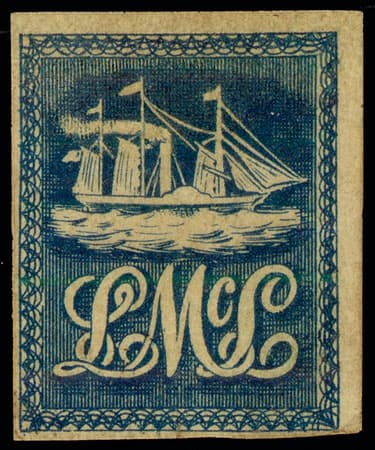
- A white ship on a blue background with the initials "LMcL" beneath
- Printing
- Lithographed, imperforate, no face value printed
- Price to the public
- 5 cents each, or $4 per hundred
- Cancellation
- A pen cross, or by tearing or scraping away part of the stamp
- Known copies
- 92 in a 2016 census (earlier estimates: 30 in 1963, 65 in 1991, 89 in 2009)
- Standing
- Described as the first stamp issued in a British colony, and listed first in Trinidad's stamp catalogs
A steamer for the Gulf of Paria
In the early 1840s Trinidad had no proper internal mail service. A 2016 study in the British Caribbean Philatelic Journal quotes the island's postal historian John Marriott: as late as 1844 the island was without one, and mail was often carried by an old ship named the Paria. The two main towns, Port of Spain and San Fernando, were linked most easily by water.
In September 1845 a paddle steamer from the Napier shipyards on the Clyde was bought for the run and named for the wife of Governor Sir Henry McLeod. Accounts differ on who bought her. The journal study names the Port of Spain firm Turnbull, Stewart & Co.; a Trinidad society article says the plantation owner John Lamont bought an iron paddle steamer called the Blue Belle and renamed her. Her captain was David Bryce, who sailed her from the Clyde on September 5, 1845, coaling at Cork, and reached Port of Spain on October 23, 1845.
She was a small boat: one account gives 60 tons and 40 horsepower; another gives a length of 109.2 feet, a beam of 13.5 feet and a draft of 6.2 feet, shallow enough for Trinidad's waters. Her first trip out of Port of Spain was on November 3, 1845. The operators announced that letters, money and small parcels would be carried for subscribers at one dollar a month, payable quarterly, while letters of non-subscribers would cost 10 cents each.
Captain Bryce's labels
In November 1846 the ship was sold to her captain. On April 16, 1847, Bryce placed a notice in the Port of Spain Gazette: experiencing inconvenience in collecting money from non-subscribers, he had procured labels, available from him or the steamer's agents at five cents each or four dollars per hundred, and from the 24th no letters would be carried except those of paid-up subscribers or those bearing the labels.
The stamp was lithographed, showing a white ship on a blue background with the initials "LMcL" beneath. It carries no face value. Stamps were cancelled with a pen cross or by tearing or scraping away a corner of the design.
Who printed them is a mystery. No archival record of the printing survives. A 1913 book wrongly called them recess-printed; a 1949 book said the printer and sheet size had never been discovered and suggested a local newspaper press; a 1983 study said they were printed in sheets of 100. In 2016 the researcher Gregory Frantz compared their engine-turned frame and size with the early stamps of Great Britain, Barbados, Mauritius and Trinidad printed by the London firm Perkins Bacon, and argued, as his own interpretation, that Perkins Bacon most likely produced them, probably as samples, in sheets of 20. He estimated that only 250 to 400 were printed.
A private stamp ahead of the Empire
In April 1847 postage stamps existed in Great Britain, Brazil, three Swiss cantons and a scattering of American local posts and postmasters' provisionals. No British colony had issued one. That timing is why the Lady McLeod is described as the first stamp issued in a British colony, even though it was a private ship's label rather than a government issue.
Trinidad's governor at the time, Lord George Harris, had been campaigning for an island post. A committee report of December 1, 1847, recommended that all letters be prepaid. Trinidad's government stamps were ordered from Perkins Bacon on December 21, 1848, and the island post finally opened on August 14, 1851, at a rate of one penny per letter.
The labels were used only briefly. Frantz's survey of dated covers shows use running from April 1847 to March 1848, with just two later examples. Most surviving covers come from the archive of a single firm, Taylor & Smyth, because Taylor was a stamp collector who corresponded with Sir Edward Bacon.
Covers, collectors and a king
A letter dated June 2, 1847, bearing an uncancelled Lady McLeod, was acquired around the 1890s by the Duke of York, later King George V, and two uncancelled stamps on cover are in the Royal Collection. In 1891 Governor Napier Broome ordered old postal stock destroyed, and the die for the Lady McLeod went with it.
Census figures have climbed as research improved: John Marriott estimated 30 copies in 1963, Joe Chin Aleong 65 in 1991, Peter Ford 89 in 2009, and Frantz recorded 92 in 2016. No multiples are known, though Frantz was able to match several singles back into pairs and strips by their irregular edges.
One well-traveled cover, a letter of May 12, 1847, from San Fernando to Taylor, Graham & Argus at Port of Spain, shows how condition is judged. Its certificates note the stamp was lifted and replaced and the cover cleaned. It was offered at auction in Texas on June 15, 2001, with an estimate of $10,000 to $15,000, and later sold at auction for £25,000.
On September 24, 2015, a Lady McLeod from the Vestey collection sold at auction in London for £34,000 ($51,775), the top lot of the sale.
The first stamp of Trinidad and its afterlife
The paddle steamer kept running between Port of Spain and San Fernando until she foundered near San Fernando and was abandoned; most accounts date this to 1854, though the 2016 journal study says she sailed until 1852. Her bell was recovered. One account says it was displayed by the Trinidad Philatelic Society; another says it is kept in San Fernando's city hall.
The stamp became the emblem of the Philatelic Society of Trinidad and Tobago, which puts it on its badges and membership card. Trinidad and Tobago issued stamps commemorating it on April 24, 1972, 125 years to the day after the labels came into required use. Montserrat pictured the Lady McLeod on a $2.75 stamp in 2008, and Antigua and Barbuda issued a gold facsimile on April 4, 1986.
Its fame has always attracted imitators. Facsimiles in many colors are sold online, and a postcard survives from the forger James Petrie to a Trinidad firm after he bought some Lady McLeods.
The numbers
- Issue date
- Announced April 16, 1847; in required use from April 24, 1847
- Quantity printed
- Unknown; one 2016 estimate is 250 to 400
- Known copies
- 92 (2016 census)
- Multiples known
- None
- Perforation
- Imperforate
- Printing
- Lithography; printer unknown
- Paper
- Unwatermarked, per Ringström and Tester
Timeline
A paddle steamer from the Napier shipyards is bought for the Port of Spain to San Fernando run and named Lady McLeod.
Captain David Bryce sails her from the Clyde.
The Lady McLeod arrives at Port of Spain.
First trip out of Port of Spain; letters carried for subscribers at $1 a month, or 10 cents each for non-subscribers.
The ship is sold to Bryce.
Bryce advertises his labels in the Port of Spain Gazette at 5 cents each or $4 per hundred.
Labels become required on non-subscribers' letters.
A letter from San Fernando to Port of Spain is franked with a Lady McLeod; it survives and has sold several times.
Date of a letter with an uncancelled Lady McLeod later acquired by the future King George V.
Governor Harris's committee recommends that all letters in Trinidad be prepaid.
Regular use of the labels ends, according to a 2016 survey of dated covers.
Trinidad's first government stamps are ordered from Perkins Bacon.
Trinidad's island post opens at one penny per letter.
The Lady McLeod founders near San Fernando (one study says she sailed until 1852).
Governor Napier Broome orders old postal stock destroyed, including the Lady McLeod die.
John Marriott estimates 30 surviving copies.
Trinidad and Tobago issues commemorative stamps for the Lady McLeod.
The May 12, 1847 cover is offered at auction in Texas, estimated at $10,000-15,000.
A Lady McLeod sells at auction in London for £34,000 ($51,775).
Gregory Frantz publishes a census of 92 copies and argues the stamps were printed in sheets of 20.
The world in 1847
The Great Famine continues in Ireland.
Thomas Edison is born; Alexander Graham Bell is born on March 3.
The United States issues its first postage stamps.
Brigham Young leads Mormon pioneers into the Salt Lake Valley.
Liberia becomes independent.
U.S. troops under General Winfield Scott enter Mexico City.
Charlotte Brontë publishes Jane Eyre.
Wuthering Heights and Agnes Grey are published.
Price record
| Date | Price | Kind |
|---|---|---|
| Jun 15, 2001 | $10,000 | Estimate, not a salePresale estimate of $10,000-15,000 (low end shown) for the stamp on a May 12, 1847 letter, stamp lifted and replaced, at auction in Texas. |
| Sep 24, 2015 | $51,775 | Sold at auctionSold at auction in London for £34,000; top lot of the Vestey collection sale. |
A realized auction price is what a buyer actually paid on the date shown, including the buyer's premium where the sale reported it. It is the strongest kind of reference price, and it is a record of one sale of one object on one day, not a promise of what the next example will bring.
By reference price, Trinidad 1847 'Lady McLeod' is number 53 of 100 in the stamps entries of the FLOAT 100. 82 of those 100 rest on a realized sale; the rest carry an asking price or a guide value, and each page says which. Rank within the FLOAT 100 itself (48 here) is editorial: how much an object defines its field, not price alone.
Did you know
- The stamp has no face value printed on it; buyers paid 5 cents each, or $4 for a hundred.
- One way to cancel a Lady McLeod was to tear or scrape off part of it.
- The die was destroyed in 1891, when the governor ordered all old postal stock destroyed.
- Most surviving covers come from one firm's correspondence, kept because a partner collected stamps.
- The future King George V owned a Lady McLeod letter from June 1847.
- Known copies have tripled on paper since 1963, from an estimated 30 to 92, as researchers tracked down more examples.
How this page is made
- The figure
- One reference price, shown with its own kind. FLOAT does not average it with anything or adjust it for time.
- Realized or not
- A realized price is a completed sale. An asking price, an estimate and a price-guide value are not sales, and are labeled as such wherever they appear.
- The story
- Researched from published records and checked fact by fact. Updated Oct 1, 2026.
- Archive
- Oct 5, 2026