FLOAT 100 · Stamps · No. 90
Confederate Postmaster Provisionals (general)
For five months in 1861 the Confederacy had a post office but no stamps, so town postmasters across the South made their own, from engraved woodcuts to scraps of paper marked 'Paid,' and some now survive as a single copy.
- Year
- 1861
- Maker
- Confederate States of America — local postmasters
- By price in stamps
- 62 of 100
Create a free account to see every recorded price and every grade.
Create a free account- What they are
- Stamps, envelopes and handstamps made by individual Southern postmasters in 1861 before the Confederacy issued its own stamps
- Period of use
- Chiefly from June 1, 1861, when Confederate postal rates took effect, until the first general issue in October 1861
- How many towns
- More than 40 towns issued provisionals
- Forms
- Adhesive stamps, press-printed envelopes, and handstamped envelopes with a rate and control marking
- Rates
- 5 cents per half ounce under 500 miles, 10 cents over 500 miles, 2 cents for drop letters
- Famous examples
- Nashville 5c and 10c, the unique Large Beaumont, Texas, 10c on cover, the only known Baton Rouge 10c cover, Mount Lebanon, Louisiana (one copy known)
- Highest price cited here
- $247,800 for the Large Beaumont cover at auction in December 2019
- Biggest risk
- Fakes, made since 1862 and increasingly common since the 1990s
A government without stamps
The Confederate States of America was formed on February 4, 1861. Five days later, its Provisional Congress at Montgomery, Alabama, kept U.S. laws in force until it could replace them, which meant Confederate postal rates were at first the same as those of the United States. A new rate act was signed on February 23, 1861, but did not take effect until June 1.
That left Southern postmasters in a difficult spot. Most sympathized with the South and planned to accept Confederate commissions, but until June 1 they were still technically under oath to the U.S. Post Office Department, which demanded a confirming oath before it would ship them more U.S. stamps. Confederate Postmaster General John H. Reagan, appointed on March 6, 1861, asked postmasters to keep working and to settle their accounts with the United States until the Confederate department could take over.
When the Confederacy took control of its mail on June 1, it had no stamps of its own. The first Confederate general issue, a 5-cent green stamp showing Jefferson Davis printed by Hoyer & Ludwig of Richmond, did not appear until October 16, 1861. U.S. stamps could not be used in the South during the war. In the gap, local postmasters improvised.
Postmasters as printers
More than 40 towns, from Athens, Georgia, and Charleston, South Carolina, to Memphis, Mobile and New Orleans, produced provisionals. Some postmasters designed real adhesive stamps carrying their own name, the town and the rate, often with an elaborate design, and had them printed at a local newspaper or print shop. Others went back to the practice used before stamps were introduced in 1847, marking envelopes 'Paid' with the rate by hand or with a handstamp. At the crudest, a rate was scribbled on a small piece of paper and used as a stamp.
A handstamped provisional envelope was sold in advance at the post office, marked with the rate and a 'control' marking. When it came back to be mailed, it received the town's date stamp. The control marking is what separates a true provisional envelope from an ordinary letter simply marked 'Paid.'
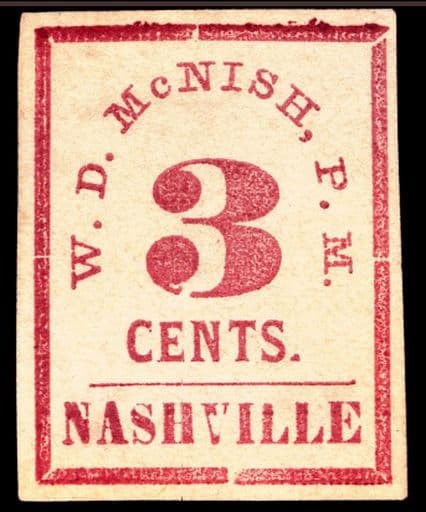
The rates were 5 cents per half ounce for under 500 miles and 10 cents for longer distances, with 2 cents for drop letters, higher than in the Union. Some postmasters also prepared 3-cent stamps at the old U.S. rate; most of these are rare, but the 3-cent Nashville was prepared and never issued.
Nashville: one postmaster's initiative
William D. McNish was postmaster of Nashville in May and June 1861, when Tennessee seceded and joined the Confederacy. He resigned his U.S. post but settled his U.S. accounts in full, and, expecting the Confederacy's delay in issuing stamps, he prepared his own.
According to an 1896 Nashville post office pamphlet, McNish had a local engraver, Dan Adams, make plates for 3-cent, 5-cent and 10-cent stamps, and the stamps were printed at the offices of the Nashville Daily Gazette. The red 3-cent stamps, printed from a typeset form of five, were probably ready shortly after June 17, 1861, but the new Confederate rates were already in effect and they were never used.
The 5-cent and 10-cent stamps were engraved in wood, and stereotypes made from the woodcuts were built up into plates. They went on sale on July 19, 1861. The 10-cent is always deep or dark green. The 5-cent comes in a range of colors, from carmine and brick red to violet brown, with a fiery orange red and a gray among the rarest. Because the sheet was printed once, turned and printed again, some blocks show stamps upside down relative to each other. Nashville received Confederate general issue stamps in the late fall of 1861 and fell to Union forces at the end of February 1862.
Icons on cover
Because provisionals were made in tiny numbers for local use, many are known in only a few copies, and the most prized survive on the covers they paid for. The 'Large Beaumont' cover carries the only known example of the large Beaumont, Texas, 10-cent black on yellow provisional. It came to light in 1923, was featured in Life magazine's 1954 'World's Rarest Stamps,' and passed through the collections of Alfred H. Caspary, Josiah K. Lilly and Erivan Haub. At auction on December 10, 2019, it opened at $25,000 and sold for $247,800 including the buyer's premium, against a 2020 catalog value of $90,000.
At a June 3, 2016, sale of Haub's U.S. and Confederate postmasters' provisionals during World Stamp Show-NY 2016, the only known cover bearing a Baton Rouge, Louisiana, 10-cent provisional, an orange legal-size envelope sent from the General Land Office to a lawyer in Lake Charles, sold for $60,000. A March 1862 cover with a Marion, Virginia, provisional, described as one of six in private hands, also brought $60,000.
On March 3, 2017, at auction, a September 27, 1861, cover franked with a 5-cent violet-brown Nashville provisional sold for $31,860. Much of its appeal was the envelope: a patriotic design showing an 11-star Confederate flag, a configuration the flag had only from July to November 1861.
Fakes and how collectors guard against them
Faking began almost as soon as the stamps did. In 1862 Samuel Upham was already producing fakes of Confederate provisionals and general issues, and by 1885 a stamp catalog warned collectors of 'numberless imitations.' Provisionals are especially vulnerable because they are extremely rare and few collectors know the genuine items well.
Fakes of the Mobile and Greenville, Alabama, Rheatown, Tennessee, Austin, Texas, and Colaparchee, Georgia, provisionals are all recorded, along with traced handstamped provisionals on cut squares. Since the 1990s, scanners and printers have made dangerous fakes easier to produce. Collectors rely on expert certificates, including the authentication service of the Civil War Philatelic Society, and on reference works that illustrate known forgeries.
One of the great American specialties
Confederate postmasters' provisionals, as stamps and as postal history, form one of the richest collecting fields in American philately. Each town's issue is a small record of how a community kept its mail moving in the first months of the Civil War.
Great collections, from Alfred H. Caspary's and Josiah K. Lilly's to Erivan Haub's, have included the finest pieces, and when a unique item such as the Large Beaumont cover comes to auction, it can sell for several times its catalog value.
The numbers
- Issue period
- 1861, mainly June 1 to the October 16 first general issue
- Towns issuing
- More than 40
- Rates
- 5c under 500 miles; 10c over 500 miles; 2c drop letters
- Nashville printing
- 5c and 10c from woodcut stereotypes, printed at the Nashville Daily Gazette; 3c typeset, never issued
- Nashville issue date
- July 19, 1861
- Unique items
- Large Beaumont 10c (one known); Baton Rouge 10c (one cover known); Mount Lebanon, La. (one copy known)
Timeline
The Confederate States of America is formed.
The Provisional Congress keeps U.S. laws, including postal rates, in force for now.
The Confederate postal rate act is signed; it takes effect June 1.
John H. Reagan is appointed Confederate Postmaster General.
The Confederate Post Office takes over; postmasters begin improvising provisionals.
About this time Nashville's 3-cent provisionals are ready; they are never issued.
Nashville's 5-cent and 10-cent provisionals go on sale.
The first Confederate general issue, a 5-cent Jefferson Davis, appears.
Samuel Upham begins producing fakes of Confederate provisionals.
The Large Beaumont cover comes to light.
Life magazine features the Large Beaumont cover among the world's rarest stamps.
The only known Baton Rouge 10-cent provisional cover sells for $60,000.
A Nashville 5-cent provisional on an 11-star flag patriotic cover sells for $31,860.
The Large Beaumont cover sells for $247,800.
The world in 1861
Jefferson Davis is inaugurated as provisional president of the Confederacy.
Alexander II abolishes serfdom in Russia.
Abraham Lincoln is inaugurated as the 16th president.
The Kingdom of Italy is proclaimed under Victor Emmanuel II.
Confederate forces bombard Fort Sumter, beginning the Civil War.
The Confederacy wins the First Battle of Bull Run.
The first transcontinental telegraph line across the United States is completed.
The Trent Affair begins when Union forces seize two Confederate envoys from a British ship.
Price record
A realized auction price is what a buyer actually paid on the date shown, including the buyer's premium where the sale reported it. It is the strongest kind of reference price, and it is a record of one sale of one object on one day, not a promise of what the next example will bring.
By reference price, Confederate Postmaster Provisionals (general) is number 62 of 100 in the stamps entries of the FLOAT 100. 82 of those 100 rest on a realized sale; the rest carry an asking price or a guide value, and each page says which. Rank within the FLOAT 100 itself (90 here) is editorial: how much an object defines its field, not price alone.
Did you know
- Some postmasters' 'stamps' were nothing more than a rate scribbled on a small piece of paper.
- Nashville's postmaster had his stamps printed at the offices of the local newspaper, the Nashville Daily Gazette.
- Fakes of Confederate provisionals were already being made in 1862, while the war was still on.
- The Confederate flag had 11 stars only from July to November 1861, which makes patriotic covers with that flag especially sought after.
- The Large Beaumont cover first surfaced in 1923 and appeared in Life magazine's 1954 feature on the world's rarest stamps.
- The 3-cent Nashville provisional was printed at the old U.S. rate and never used, because Confederate rates had already taken effect.
How this page is made
- The figure
- One reference price, shown with its own kind. FLOAT does not average it with anything or adjust it for time.
- Realized or not
- A realized price is a completed sale. An asking price, an estimate and a price-guide value are not sales, and are labeled as such wherever they appear.
- The story
- Researched from published records and checked fact by fact. Updated Oct 3, 2026.
- Archive
- Oct 5, 2026