FLOAT 100 · Stamps · No. 89
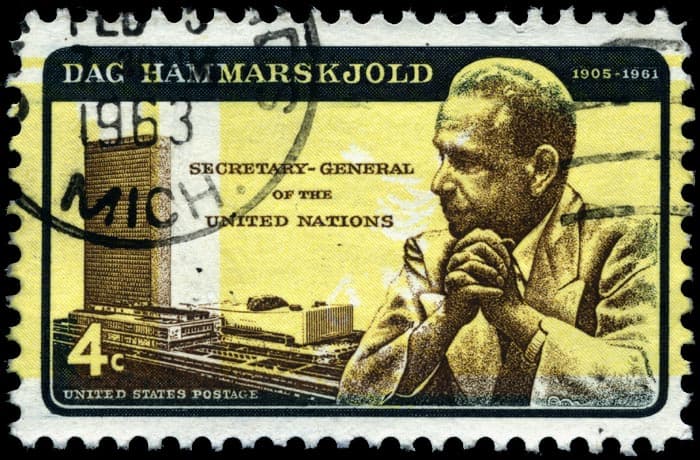
US 1962 4c Dag Hammarskjold Invert
A New Jersey jeweler found a sheet of upside-down stamps and thought he had a fortune, until the Postmaster General printed 40 million more on purpose to make sure nobody did.
- Year
- 1962
- Maker
- United States Post Office Department
- By price in stamps
- 100 of 100
Create a free account to see every recorded price and every grade.
Create a free account- What it is
- The 4-cent 1962 Dag Hammarskjöld stamp with its yellow background printed upside down, catalog number 1204
- Original issue
- October 23, 1962, with the yellow printed correctly (catalog number 1203)
- Deliberate reprint
- 40,270,000 inverts, issued November 16, 1962, as a 'Special Printing'
- Ordered by
- Postmaster General J. Edward Day, who said the Post Office was 'not running a jackpot operation'
- Nickname
- 'Day's Folly'
- Discoverer
- Leonard Sherman, a New Jersey jeweler
- Printing
- Giori press, 200-subject plates in four panes of 50; perforated 11; black, brown and yellow
- Design
- Designed by Herbert Sanborn, engraved by C. A. Brooks; shows Hammarskjöld and the United Nations headquarters
- Value today
- Mint singles sell for well under a dollar; only covers dated before November 16, 1962, prove an original error
A stamp for a fallen peacemaker
Dag Hammarskjöld of Sweden became the second Secretary-General of the United Nations on April 10, 1953, at 47 the youngest person ever elected to the post. On September 18, 1961, he was killed when his plane crashed near Ndola in Northern Rhodesia, now Zambia, while he was flying to negotiate a cease-fire in the Congo crisis. All 16 people on board died. He was awarded the 1961 Nobel Peace Prize after his death, the only person to receive it posthumously.
The United States honored him a year later with a 4-cent commemorative stamp. Designed by Herbert Sanborn and engraved by C. A. Brooks, it shows Hammarskjöld beside the United Nations headquarters in New York, printed in black, brown and yellow. It went on sale on October 23, 1962.
The stamp was printed by the Bureau of Engraving and Printing on its Giori press from plates of 200 stamps divided into four panes of 50. A total of 121,440,000 normal stamps were printed.
The sheet that came out wrong
At least one sheet left the printer with the yellow background upside down relative to the portrait and the lettering. The result is easy to see: a white 'shadow' appears beside the United Nations building where the yellow should be.
Leonard Sherman, a New Jersey jeweler, found a pane of the error. One account says he paid $2 for it at the post office, the face value of 50 four-cent stamps. Sherman announced his find.
How many original error stamps were printed has never been recorded.
'Not running a jackpot operation'
Postmaster General J. Edward Day decided that no one should profit from the Post Office's mistake. Instead of recalling the error, he ordered the stamp printed again with the yellow deliberately inverted, so many copies would exist that the error would be worth no more than face value. 'The Post Office Department is not running a jackpot operation,' he said.
The reprints, 40,270,000 of them, went on sale on November 16, 1962, less than a month after the original issue, and were described as a 'Special Printing.' Collectors nicknamed it 'Day's Folly.'
Sherman went to court for an injunction to stop the reprinting, but it came too late to stop production. He did get an affidavit from the Post Office Department confirming that his sheet came from the original printing. In 1987 he donated it to the American Philatelic Society.
Day served as Postmaster General from January 21, 1961, to August 9, 1963, and is best remembered for introducing ZIP codes.
Original or reprint?
The main catalog lists the normal stamp as 1203 and the invert as 1204, and values the invert at little more than the normal stamp. An original error and a reprint look virtually the same, so a loose stamp cannot be identified as an original.
The exception is a cover. A first day cover, or any cover with a clear postmark dated before November 16, 1962, proves the stamp came from the original error printing. One invert on a first day cover sold in 2005 for $3,500.
The reprint itself has collectible varieties based on where the stamp sat on the pane. On 40 of every 50 stamps, the yellow is shifted about 3 mm; on 10, the gap is about 10 mm because of the gutter; on another 10, no yellow appears in the left margin. One catalog account puts the totals at 32,216,000, 4,027,000 and 4,027,000. None of them is scarce.
An error in the middle of a crisis
The stamp went on sale on October 23, 1962, in the middle of the Cuban Missile Crisis, which began on October 16 when President Kennedy learned of Soviet missiles in Cuba and ended on October 28 when Nikita Khrushchev announced their removal.
It was also the year John Glenn became the first American to orbit the Earth, and the year the Telstar communications satellite was launched. Against that backdrop, the Post Office's reprint became a small but lasting story about government and collectors.
The rarity that never was
The Hammarskjöld invert became the textbook case of how a postal authority can erase a windfall. Day's decision meant that the most famous U.S. error of its time is one of the cheapest: mint singles are offered by U.S. dealers for well under a dollar.
The affair entered popular culture. Mad magazine printed a parody stamp that looked like the real one but showed a crying Sherman, with money flying away from him, in place of Hammarskjöld.
The next U.S. stamp issued with a major design element printed upside down was the so-called CIA invert, discovered years later.
The numbers
- Original issue date
- October 23, 1962 (normal stamp, catalog 1203)
- Reprint issue date
- November 16, 1962 (invert, catalog 1204)
- Quantity of inverts
- 40,270,000 deliberate reprints; number of original errors unknown
- Normal stamps printed
- 121,440,000
- Press and format
- Giori press; 200-subject plates, four panes of 50 (5 x 10)
- Perforation
- 11
- Colors
- Black, brown and yellow
- Printer
- Bureau of Engraving and Printing
Timeline
Dag Hammarskjöld becomes Secretary-General of the United Nations.
Hammarskjöld dies in a plane crash near Ndola, Northern Rhodesia.
He is awarded the Nobel Peace Prize posthumously.
The 4-cent Hammarskjöld stamp goes on sale; at least one sheet has the yellow inverted.
Leonard Sherman, a New Jersey jeweler, announces his discovery of the error.
Postmaster General J. Edward Day orders the invert reprinted; Sherman seeks an injunction, too late to stop it.
40,270,000 deliberate inverts go on sale as a 'Special Printing.'
Day leaves office as Postmaster General.
Sherman donates his original sheet to the American Philatelic Society.
An original invert on a first day cover sells for $3,500.
The world in 1962
John Glenn becomes the first American to orbit the Earth.
Algeria becomes independent from France.
The Telstar communications satellite is launched.
Marilyn Monroe is found dead in Los Angeles.
James Meredith registers at the University of Mississippi, escorted by federal marshals.
Pope John XXIII opens the Second Vatican Council.
The Cuban Missile Crisis begins; it ends on October 28.
Price record
| Date | Price | Kind |
|---|---|---|
| Oct 3, 2026 | $0 | Asking price, not a saleMint single, offered by a U.S. stamp dealer. |
| Oct 3, 2026 | $0 | Asking price, not a saleMint never-hinged single, nicely centered, offered by a U.S. stamp dealer. |
A price-guide value is an editorial estimate, not a transaction and not an asking price. Guides lag the market and smooth over grade and condition. It is neither a floor nor a ceiling: a sale can land above or below it, and it should be checked against a realized sale before anything rests on it.
By reference price, US 1962 4c Dag Hammarskjold Invert is number 100 of 100 in the stamps entries of the FLOAT 100. 82 of those 100 rest on a realized sale; the rest carry an asking price or a guide value, and each page says which. Rank within the FLOAT 100 itself (89 here) is editorial: how much an object defines its field, not price alone.
Did you know
- The government printed 40,270,000 copies of its own mistake on purpose.
- Leonard Sherman reportedly paid $2 for the pane he hoped would make him rich.
- Only a cover postmarked before November 16, 1962, can prove a Hammarskjöld invert is an original error.
- Mad magazine parodied the affair with a stamp showing a weeping Sherman in place of Hammarskjöld.
- The Postmaster General behind 'Day's Folly' is the same man who introduced ZIP codes.
- The original stamp went on sale during the Cuban Missile Crisis.
How this page is made
- The figure
- One reference price, shown with its own kind. FLOAT does not average it with anything or adjust it for time.
- Realized or not
- A realized price is a completed sale. An asking price, an estimate and a price-guide value are not sales, and are labeled as such wherever they appear.
- The story
- Researched from published records and checked fact by fact. Updated Oct 3, 2026.
- Archive
- Oct 5, 2026