FLOAT 100 · Stamps · No. 66
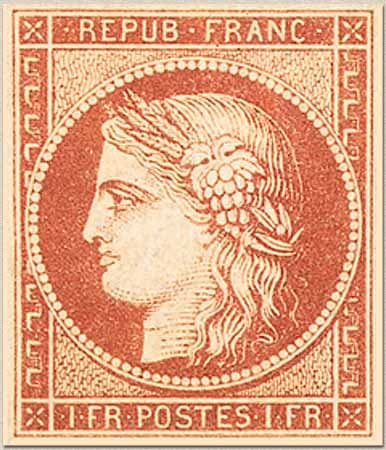
France 1849 '1 Franc Vermillion' (Ceres)
France's first high-value stamp was printed with a mercury-based red that ate the printing plates, then pulled from sale before its first birthday because clerks in dim post offices might mistake it for a cheaper orange stamp; it is now the key to every collection of France.
- Year
- 1849
- Maker
- France (Second Republic)
- By price in stamps
- 48 of 100
Create a free account to see every recorded price and every grade.
Create a free account- What it is
- The 1 franc Ceres of 1849 in its first, vermilion (light red) shade, number 7 in the standard French catalogue
- Issued
- January 1, 1849, with the 20 centimes black, as France's first postage stamps; earliest known use January 2, 1849
- Rate
- Letters in the third weight step, 15 to 100 grams
- Design
- Head of Ceres, Roman goddess of agriculture and symbol of the Republic, by Jacques-Jean Barre, chief engraver of the Paris Mint
- Printed
- 509,700, imperforate, under Anatole Hulot, between December 30, 1848, and January 7, 1849
- Withdrawn
- Circular of December 1, 1849, ordering the light red stamps returned for destruction
- Destroyed
- Unsold stock burned in July 1851; figures given range from 112,400 to 122,400
- Survivors
- Estimated at 200 to 300 (unused, according to a 2024 account)
- Notable sale
- $75,000 for an unused single with original gum at auction in New York, November 2013
A republic's first stamps
France's Second Republic adopted a postal reform modeled on the one Britain had carried out in 1840: prepaid postage at uniform rates, paid with adhesive stamps. A decision of September 7, 1848, assigned the color red to the 1 franc stamp, which would pay for letters in the third weight step, from 15 to 100 grams. The first two values, the 20 centimes black and the 1 franc red, went on sale on January 1, 1849.
The design, the head of Ceres, the Roman goddess of agriculture and harvests, was chosen as a symbol of the Republic. It was drawn by Jacques-Jean Barre, chief engraver at the Paris Mint, under the supervision of Anatole Hulot, who printed the stamps by letterpress under contract with the government. The stamps were imperforate.
According to one account, 509,700 of the red 1 franc stamps were printed between December 30, 1848, and January 7, 1849. The earliest recorded use is January 2, 1849, on two letters, both from Paris.
Light red, dark red and a poisonous pigment
The first printing was in a bright, light red. Its ink was made from mineral vermilion, or cinnabar, whose red pigment is mercury sulfide. The mercury attacked the copper printing plates, and the printers soon switched to carmine, a lake made from cochineal insects that was cheaper and gentler on the equipment. That is why the 1 franc exists in a range of shades: bright vermilion, dull vermilion, red-brown, brown carmine, deep carmine and others. Specialists separate the vermilion group from the carmine group by the presence of the mercury pigment.
Carmine copies appeared very early, in January 1849. Then a new problem arose. A 40 centimes stamp in orange was being prepared, and the postal administration worried that in poorly lit post offices clerks might sell a light red 1 franc at the 40-centime price, or misread a letter's postage, especially since the lettering on the stamps was tiny. Clerks were personally liable for the stamps entrusted to them.
A circular of December 1, 1849, made the official distinction between light red and dark red stamps. The light red ones were to be returned to the administration for destruction, and only dark red stamps were to be sold. The 40 centimes orange followed on February 3, 1850. The leftover vermilion stock was destroyed in July 1851; French Wikipedia gives 112,400 copies in its text and 122,400 in its summary table, and another account gives 122,398. The carmine 1 franc remained in use until November 1853, when a Napoleon III stamp of the same value replaced it.
The postal administration never used the word "vermilion." It knew only red, then light red and dark red. According to a 2024 history of the stamp, the term appears to have been introduced by Alfred Potiquet in his early world stamp catalogues of December 1861 and March 1862, and was adopted by the French Philatelic Society, founded in 1874, at a meeting on April 1, 1875.
Vervelle, tete-beche and the withdrawal circular
Collectors prize several special forms. The pale shade called "Vervelle" is named for a merchant, Vervelle, who found stamps of this shade in the printer Hulot's archives. These stamps were never gummed, are printed on thin paper and are often thinned, and they were probably a first printing that the post office rejected.
In some sheets one cliché was inverted, producing tete-beche pairs, in which one stamp is upside down relative to its neighbor. Only one used tete-beche of the vermilion is known, in a strip of three. A strip of three with a tete-beche on a piece of letter sold for 262,500 euros in December 2002. In 2003, at the sale of the "La Fayette" collection of French stamps, a block of four in bright vermilion containing a tete-beche sold for 820,000 euros, or 924,000 euros with tax and fees, making it the most expensive French philatelic item. A block of four of the pale Vervelle with a tete-beche, one of only two known, sold for 460,000 euros, or 521,000 euros with fees.
Even ordinary pairs are rare; one dealer has said only five pairs of the vermilion are known, and one he sold in 2020 brought 23,000 euros. The withdrawal circular of December 1, 1849, is itself a collector's item: it carried two half-stamps cut apart so that postmasters could see the difference between the two reds. Fewer than 10 copies are known.
Finding a genuine one
The 1 franc vermilion is the most sought-after and most expensive regular stamp of France, both because it was used so briefly and because of its striking color. Used copies in average condition turn up fairly often, many of them repaired. Unused copies with large margins, fresh color and original gum are very rare. A 2011 French catalogue valued it at 95,000 euros or more unused with gum and 20,000 euros or more used.
On November 13, 2013, an unused single in the scarcer dull orange-red vermilion shade, with original gum and full margins, sold at auction in New York for $75,000, from the collection of Porter W. Venn. At the same sale a carmine 1 franc brought $9,500. In September 2018 an unused copy with a tiny hinge trace and clear to large margins was offered at auction in Germany with a starting price of $51,518.
Forgeries are a constant danger. Good fakes exist by Jean de Sperati and others, and a postmark can give a fake away: one widely discussed forged tete-beche carries a cancellation type that did not come into use until 1852.
A legend in red
French philatelists call it the star of the French collection, and a 2024 article in a leading French newspaper described it as the rarest stamp in the collection of France, approaching a million euros in its rarest form. It even has its own crime novel: Guy Lejaille's "Du sang sur un vermillon" (Blood on a Vermilion), published in 2018.
In 2014 the French post office paid tribute with a souvenir sheet for the Salon du Timbre containing ten 1-euro Ceres stamps in vermilion, ten in carmine and two tete-beche pairs.
The numbers
- Issue date
- January 1, 1849
- Quantity printed
- 509,700
- Destroyed
- 112,400 to 122,400 in July 1851 (sources differ)
- Printing
- Letterpress, under Anatole Hulot, Paris
- Perforation
- Imperforate
- Ink
- Vermilion (cinnabar, mercury sulfide), later replaced by cochineal carmine
- Withdrawn
- December 1, 1849
- Estimated survivors
- 200 to 300
- Known tete-beche blocks of four
- Vervelle shade: two
Timeline
A decision assigns the color red to the planned 1 franc stamp.
Printing of the red 1 franc begins; 509,700 are printed by January 7, 1849.
France issues its first stamps, the 20 centimes black and the 1 franc red.
Earliest known use of the 1 franc, on two letters from Paris.
A circular orders light red 1 franc stamps withdrawn; only dark red may be sold.
The 40 centimes orange is issued.
The remaining vermilion stock is destroyed.
A Napoleon III 1 franc replaces the carmine Ceres.
Alfred Potiquet's catalogue appears to introduce the name "vermilion."
The French Philatelic Society adopts the vermilion description.
A used strip of three with a tete-beche sells for 262,500 euros.
A bright vermilion block of four with a tete-beche sells for 924,000 euros with fees, a record for France.
An unused single sells at auction in New York for $75,000.
France issues a souvenir sheet honoring the red 1 franc Ceres.
An unused single is offered at auction in Germany at a starting price of $51,518.
The world in 1849
Elizabeth Blackwell becomes the first woman to receive a medical degree in the United States.
The short-lived Roman Republic is proclaimed.
Sardinia is defeated at the Battle of Novara in the First Italian War of Independence.
Britain annexes the Punjab.
Denmark becomes a constitutional monarchy.
French physicist Hippolyte Fizeau measures the speed of light in air.
The Hungarian army surrenders at Vilagos, ending the Hungarian Revolution.
Price record
| Date | Price | Kind |
|---|---|---|
| Nov 13, 2013 | $75,000 | Sold at auctionSingle, unused with original gum, full margins, dull orange-red vermilion shade; Porter W. Venn collection, sold at auction in New York. |
A realized auction price is what a buyer actually paid on the date shown, including the buyer's premium where the sale reported it. It is the strongest kind of reference price, and it is a record of one sale of one object on one day, not a promise of what the next example will bring.
By reference price, France 1849 '1 Franc Vermillion' (Ceres) is number 48 of 100 in the stamps entries of the FLOAT 100. 82 of those 100 rest on a realized sale; the rest carry an asking price or a guide value, and each page says which. Rank within the FLOAT 100 itself (66 here) is editorial: how much an object defines its field, not price alone.
Did you know
- The vermilion ink contained mercury sulfide, which attacked the copper printing plates.
- The stamp was withdrawn because clerks in dim post offices might confuse it with a 40-centime orange stamp, and clerks paid for mistakes out of their own pockets.
- The French post office never called it vermilion; officially it was just "light red."
- The withdrawal circular carried two cut halves of stamps so postmasters could compare the reds, and fewer than 10 copies survive.
- The pale "Vervelle" shade is named after the merchant who found it in the printer's archives.
- There is a French crime novel built around the stamp, "Du sang sur un vermillon."
How this page is made
- The figure
- One reference price, shown with its own kind. FLOAT does not average it with anything or adjust it for time.
- Realized or not
- A realized price is a completed sale. An asking price, an estimate and a price-guide value are not sales, and are labeled as such wherever they appear.
- The story
- Researched from published records and checked fact by fact. Updated Oct 3, 2026.
- Archive
- Oct 5, 2026