FLOAT 100 · Stamps · No. 83
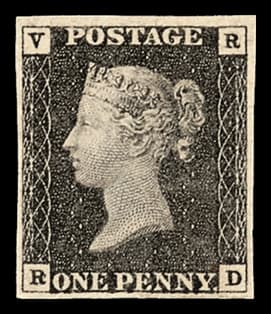
Great Britain 1840 'VR Official' Penny Black
Alongside the Penny Black, Britain printed a version for government mail with the queen's initials in the top corners, then changed its mind and burned almost every sheet, leaving a stamp that was never issued but still turns up on a handful of letters.
- Year
- 1840
- Maker
- United Kingdom (Inland Revenue / GPO)
- By price in stamps
- 60 of 100
Create a free account to see every recorded price and every grade.
Create a free account- What it is
- The 1840 1d black prepared for official government mail, with the letters V and R in the upper corners (SG V1)
- Prepared
- April 1840; registration sheets dated April 15 and May 9, 1840
- Sheets printed
- 3,323 sheets, by dealers' counts
- Destroyed
- All but 21 sheets, on January 25, 1843, about 94 percent of the printing
- Why
- Government offices were given surplus Mulready envelopes instead, and the official stamp was abandoned
- Imprimaturs
- Dealers describe about 27 to 33 possible examples from the registration sheets, many in institutions
- Paper
- Small Crown watermark, imperforate, like the Penny Black
- Famous piece
- The 'Largentière' cover of July 3, 1840, London to Tetbury, called the finest known
A stamp for the government's own letters
Rowland Hill's postal reform of 1840 let anyone send a letter of up to half an ounce anywhere in Britain for one penny, paid in advance with an adhesive stamp. The Penny Black went on sale on May 1, 1840, and became valid on May 6. It was printed by Perkins Bacon in London from a portrait of the young Queen Victoria engraved by Charles Heath and his son Frederick after William Wyon's 1834 medal.
Government departments were to have a stamp of their own. The VR Official was the same design as the Penny Black, printed in the same black on the same watermarked paper, except that the ornaments in the two top corners were replaced by the letters V and R, for Victoria Regina. It was prepared in April 1840 and registered twice, on April 15 and May 9, 1840. Dealers give the printing as 3,323 sheets.
Why it was never issued
The plan died because of the Mulready envelope and letter sheet, prepaid postal stationery introduced alongside the stamps, which the public disliked and mocked. Vast numbers of unsold Mulreadies were handed to government departments to use up, with the tax office the heaviest user. With that stock on hand, the idea of a separate official stamp was dropped.
Nearly all of the supplies were destroyed on January 25, 1843. All but 21 sheets went, which the Smithsonian's National Postal Museum puts at 94 percent of the copies printed. The museum notes that most surviving unused copies had been distributed before the destruction.
Some stamps escaped in other ways. A few passed through the post even though they were never valid, and Rowland Hill used some, including part of a sheet, in experiments on how to cancel stamps so they could not be cleaned and reused.
Cancellation trials and a clever cleanup
The Penny Black's red Maltese cross cancellation turned out to be easy to remove, which let people reuse stamps. That flaw led Britain to switch to the Penny Red, cancelled in black, in February 1841. Before the switch, officials cancelled spare VR Officials and tried to remove the cancels with chemical agents, which is why a number of VR Officials show trial cancellations.
In 2009 a British stamp auctioneer described a VR Official lettered SH, the only listed re-entry of the issue, that a collector had bought as unused. Under close examination it showed small traces of red ink in the lattice below the V and an unusual shiny glaze. He concluded it had been varnished, cancelled in red and cleaned in an official trial, the first known red cancel-removal trial, since such trials had been thought to use only black. He suggested that some 'unused' VR Officials may be trials whose cancels were removed completely.
The stamp has also been forged. Bernhardt Assmus forged it in August 1890 and was exposed by the dealer Morris Giwelb.
Imprimaturs, covers and prices
The most prized examples are imprimaturs, stamps from the official registration sheets that approved the printing. Dealers' counts vary: one listing calls an imprimatur lettered TI 'one of only 33 possible examples,' and another says only 27 are known from the second registration sheet, many of them in institutional collections. One example lettered TC, from the Maurice Burrus collection with a 1980 certificate, sold at £22,500; another lettered TI, with a 2006 certificate, has been offered at £20,000; a third lettered NL has been offered at £48,000.
Ordinary unused examples sell for much less. At a British auction in 2015, a single realized £5,782, a pair £17,110 and a block of four £31,860. A leading British catalog cut its value for the stamp from £35,000 to £20,000 in its November 2020 edition.
A VR Official on cover is the great prize. The 'Largentière' cover, posted in London on July 3, 1840, to Tetbury, Gloucestershire, carries a stamp with four large margins and has been called the finest known. First recorded in 1899, it passed through the Largentière, Maximus, Wills and Shaida collections and was offered by a dealer at £550,000.
How to tell one
A VR Official looks like a Penny Black except for the top corners, which show V and R instead of the usual ornaments. Like the Penny Black it is imperforate, on paper watermarked with a small crown, and carries check letters such as TI, TC or SH that give its position in the sheet.
Because forgeries exist, the examples offered by dealers come with expert certificates, some of them decades old. Signs of a cancellation trial, such as traces of ink or a glazed surface, matter too: an apparently unused stamp may be a cleaned trial.
The numbers
- Catalog number
- SG V1
- Prepared
- April 1840; registered April 15 and May 9, 1840; never issued
- Printer
- Perkins Bacon, London
- Quantity printed
- 3,323 sheets (dealers' figure)
- Surviving sheets
- 21 after the destruction of January 25, 1843
- Watermark
- Small Crown
- Perforation
- Imperforate
- Size
- 2.2 x 2 cm (Smithsonian example)
Timeline
The VR Official is prepared for government mail.
First registration of the VR Official plate.
The Penny Black goes on sale.
The Penny Black becomes valid for postage.
Second registration of the VR Official.
A VR Official is used on the 'Largentière' cover from London to Tetbury.
The Penny Red replaces the Penny Black, partly because red cancels were easy to clean off.
All but 21 sheets of VR Officials are destroyed.
Bernhardt Assmus forges the stamp; the dealer Morris Giwelb exposes him.
The 'Largentière' cover is first recorded.
A previously unknown red cancel-removal trial on a VR Official is described.
At a British auction, a single realizes £5,782 and a block of four £31,860.
A leading catalog lowers its value from £35,000 to £20,000.
The world in 1840
The Treaty of Waitangi is signed in New Zealand.
Queen Victoria marries Prince Albert.
Britain issues the Penny Black, the world's first postage stamp.
The RMS Britannia starts the first steam transatlantic mail service from Liverpool.
William Henry Harrison defeats Martin Van Buren for the U.S. presidency.
Britain is fighting the First Opium War with China and the First Anglo-Afghan War.
Price record
| Date | Price | Kind |
|---|---|---|
| Apr 2015 | $8,654 | Sold at auctionAt auction in England: GBP 5,782 (including buyer's premium), shown in USD at the Federal Reserve monthly average (1 GBP = 1.4968 USD). |
| Oct 4, 2026 | $26,500 | Asking price, not a saleA UK dealer: GBP 20,000 (asking price), shown in USD at the Federal Reserve rate on the sale date (1 GBP = 1.3250 USD). |
| Oct 4, 2026 | $63,600 | Asking price, not a saleA UK dealer: GBP 48,000 (asking price), shown in USD at the Federal Reserve rate on the sale date (1 GBP = 1.3250 USD). |
A realized auction price is what a buyer actually paid on the date shown, including the buyer's premium where the sale reported it. It is the strongest kind of reference price, and it is a record of one sale of one object on one day, not a promise of what the next example will bring.
By reference price, Great Britain 1840 'VR Official' Penny Black is number 60 of 100 in the stamps entries of the FLOAT 100. 82 of those 100 rest on a realized sale; the rest carry an asking price or a guide value, and each page says which. Rank within the FLOAT 100 itself (83 here) is editorial: how much an object defines its field, not price alone.
Did you know
- The government stamp was killed by a flop: unwanted Mulready envelopes were dumped on government offices instead.
- Rowland Hill used VR Officials as test pieces to work out how to cancel stamps so they could not be cleaned and reused.
- A VR Official sold as unused turned out to be a cancelled stamp cleaned in an official trial.
- The finest known VR Official cover has been offered at £550,000.
- A forger copied the stamp in 1890, half a century after it was abandoned.
How this page is made
- The figure
- One reference price, shown with its own kind. FLOAT does not average it with anything or adjust it for time.
- Realized or not
- A realized price is a completed sale. An asking price, an estimate and a price-guide value are not sales, and are labeled as such wherever they appear.
- The story
- Researched from published records and checked fact by fact. Updated Oct 3, 2026.
- Archive
- Oct 5, 2026