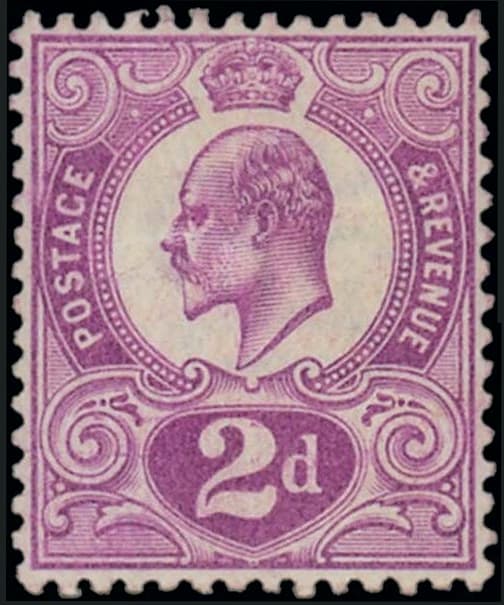
FLOAT 100 · Stamps · No. 82
Great Britain 1910 2d 'Tyrian Plum'
Britain printed 24 million of its new purple two-penny stamp, then the king died on the eve of its release and almost every copy was destroyed. Only one was ever used, on a letter that reached the Prince of Wales on the day he became king.
- Year
- 1910
- Maker
- Great Britain (Royal Mail), King Edward VII
- By price in stamps
- 44 of 100
Create a free account to see every recorded price and every grade.
Create a free account- What it is
- Great Britain's King Edward VII 2d stamp in a single purple shade known as Tyrian plum, prepared for use in 1910 but never issued (SG 266a)
- Printer
- De La Rue
- Printed
- 100,000 sheets, 24,000,000 stamps, by the most cited count; one account gives almost 200,000 sheets of 240
- Why it never went on sale
- Edward VII died on May 6, 1910, and the Post Office decided not to issue it
- Mint examples known
- About 12, three of them in the Royal Philatelic Collection; estimates for private hands run from 8 to 12
- Used examples
- One, on a cover sent to the Prince of Wales at Marlborough House on May 5, 1910
- Also surviving
- An imperforate registration sheet of 240 and a perforated sheet of 139 in the British postal archive
- Record sale
- £102,000 at auction in London, December 6, 2011
A cheaper stamp for a thrifty Post Office
In 1909 Britain's postal authorities decided to modernize the Edwardian stamps and move to single-color designs. One account says the aim was to economize on production, since printing each stamp in one color cut ink costs. The existing two-penny stamp of King Edward VII was printed in two colors, and a new version was planned to replace it.
The color chosen was a shade of purple that collectors came to call 'Tyrian plum.' One hundred thousand sheets, 24,000,000 stamps in all, were printed by De La Rue and delivered to the Post Office stores to be sent out to postmasters. Another account of the printing puts it at almost 200,000 sheets of 240 stamps; the two counts cannot be reconciled from the sources.
Distribution was held back on purpose so that post offices would first use up their stocks of the old two-color stamp. One account says a new single-color 7d grey had gone on sale on May 4, 1910, and that May 6 had been the planned release date for the 2d.
The king dies, and the stamp dies with him
King Edward VII died on May 6, 1910. His son, the Prince of Wales, became King George V that day. With the old king gone, the Post Office decided that a new stamp bearing his portrait should not be issued, and orders went out for the stock to be destroyed.
Almost all of the 24 million stamps were destroyed without ever being distributed. Not every sheet was accounted for, though, and a handful of examples escaped. Those survivors, together with a few official file copies, are all that remain of the printing.
The only letter, sent to a future king
Just one Tyrian plum is known to have done the job it was made for. On May 5, 1910, Frederick Atterbury, controller of stamps at the Inland Revenue, posted an envelope bearing one of the new stamps to the Prince of Wales at Marlborough House, even though the stamp had not been officially issued. The letter reached the prince on May 6, the day he became King George V.
Accounts of who sent it differ. Some describe the cover as sent by the Prince of Wales to himself, and one says a friend of the prince obtained a copy and mailed it to him. The accounts agree that it is the only used example known and that it belongs to the Royal Philatelic Collection.
George V was a serious collector. In 1904, as Prince of Wales, he paid £1,450 for a Mauritius two pence blue, then a record for a single stamp. The Tyrian plum cover is part of the collection he built. It has been shown in public, including in an exhibition at the Guildhall Gallery in London.
A dozen survivors and their prices
About 12 mint examples are believed to exist, and three of them are in the Royal Philatelic Collection. One dealer's estimate puts the number in private collections at between 8 and 12; another, in 2012, said only nine were available to private collectors. A complete exhibition sheet missing one corner stamp was shown at a London stamp exhibition in 1950. The British postal archive holds a complete imperforate registration sheet of 240 and a perforated sheet of 139. There are also examples overprinted SPECIMEN and color trials in other shades.
The stamp's price history tracks the rise of British philately. One example bought from the Per Gjerding collection in 1956 cost £310. A catalog listed the stamp at £3,500 in 1978, at £65,000 in 2007 and at £100,000 by 2011.
On December 6, 2011, an example from the Chartwell collection, a celebrated holding of Edward VII stamps, sold at auction in London for £102,000, reported at the time as approximately $159,500. It came from the lower right corner of a sheet with full margins and most of its original gum, and had a small tear in the bottom margin and a small mark on the king's cheek.
Other copies have changed hands for less. A fine mint example with a 1961 expert certificate was offered at auction in May 2012, and another example realized £48,300 in 2012. A very fine mint copy sold at auction in Britain for £40,000. A copy from the collection of Walter Bloch, with a 1982 expert certificate, was sold privately in 2015 for £95,000 and later offered again by a dealer at £90,000.
Britain's favorite stamp that never was
The Tyrian plum is often called one of the great rarities of British philately. Its appeal lies in the story as much as the scarcity: a stamp printed by the million, killed by a royal death, and saved in a few copies and a single letter to the new king.
In 2019 Britain's Royal Mail honored it in a set of 'Stamp Classics,' reproducing the Tyrian plum alongside other landmark designs such as the 1891 £1 green of Queen Victoria and the 1913 'Seahorse' high value of George V.
The numbers
- Planned issue
- May 1910; never issued
- Catalog number
- SG 266a
- Denomination and color
- 2d, Tyrian plum (a single purple shade), replacing a two-color 2d
- Printer
- De La Rue
- Quantity printed
- 24,000,000 (100,000 sheets) by the usual count; one account says almost 200,000 sheets of 240
- Mint examples known
- About 12, three in the Royal Philatelic Collection
- Used examples known
- 1, on cover, Royal Philatelic Collection
- Archive sheets
- Imperforate registration sheet of 240 and a perforated sheet of 139
Timeline
Postal authorities decide to move British stamps to single-color designs.
De La Rue prints the new 2d in Tyrian plum; 100,000 sheets, 24 million stamps, go to Post Office stores.
By one account, the new single-color 7d grey goes on sale.
Frederick Atterbury of the Inland Revenue posts a cover with a Tyrian plum to the Prince of Wales at Marlborough House.
Edward VII dies. The Prince of Wales receives the cover the same day and becomes King George V.
The Post Office decides not to issue the stamp and orders the stock destroyed.
An almost complete sheet, missing one corner stamp, is shown at a London stamp exhibition.
A mint example from the Per Gjerding collection sells for £310.
A catalog lists the stamp at £3,500.
A catalog lists it at £65,000.
The Chartwell collection example sells at auction in London for £102,000.
Another example realizes £48,300 at auction.
The Walter Bloch copy is sold privately for £95,000.
Royal Mail reproduces the Tyrian plum in its 'Stamp Classics' set.
The world in 1910
A U.K. general election amid the crisis over the 'People's Budget' produces a hung parliament.
The Seine overflows and floods Paris.
Halley's Comet becomes visible to the naked eye.
The Union of South Africa is established.
A wireless message from a ship leads to the arrest of the murderer Dr. Crippen.
Japan formally annexes Korea.
Portugal's monarchy falls and a republic is proclaimed in Lisbon.
Price record
| Date | Price | Kind |
|---|---|---|
| 1956 | $868 | Sold at auctionAt auction in Britain: GBP 310 (hammer price), shown in USD at the official par value of the time (1 GBP = 2.8000 USD). |
| Dec 6, 2011 | $158,916 | Sold at auctionAt auction in London: GBP 102,000 (hammer price), shown in USD at the Federal Reserve rate on the sale date (1 GBP = 1.5580 USD). |
A realized auction price is what a buyer actually paid on the date shown, including the buyer's premium where the sale reported it. It is the strongest kind of reference price, and it is a record of one sale of one object on one day, not a promise of what the next example will bring.
By reference price, Great Britain 1910 2d 'Tyrian Plum' is number 44 of 100 in the stamps entries of the FLOAT 100. 82 of those 100 rest on a realized sale; the rest carry an asking price or a guide value, and each page says which. Rank within the FLOAT 100 itself (82 here) is editorial: how much an object defines its field, not price alone.
Did you know
- Of 24 million stamps printed, only about a dozen loose mint copies are known outside archives.
- The only used Tyrian plum reached the Prince of Wales on the very day he became King George V.
- A Tyrian plum that cost £310 in 1956 would have been catalogued at £100,000 by 2011.
- The future George V once paid £1,450 for a single stamp and kept his collection in 328 red albums.
- Royal Mail put a picture of the stamp it never issued on a stamp it did issue, in 2019.
How this page is made
- The figure
- One reference price, shown with its own kind. FLOAT does not average it with anything or adjust it for time.
- Realized or not
- A realized price is a completed sale. An asking price, an estimate and a price-guide value are not sales, and are labeled as such wherever they appear.
- The story
- Researched from published records and checked fact by fact. Updated Oct 3, 2026.
- Archive
- Oct 5, 2026