FLOAT 100 · Stamps · No. 85
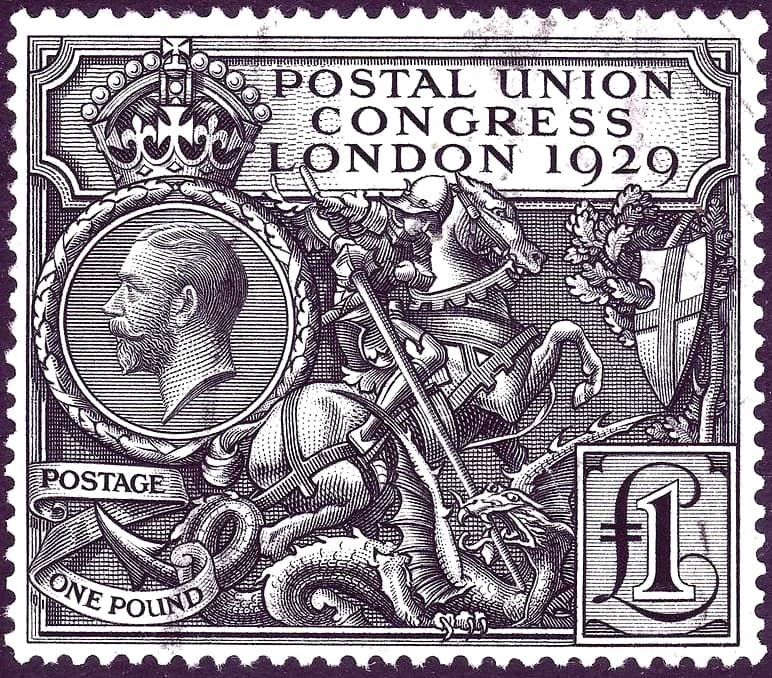
Great Britain 1929 PUC GBP 1 'Postal Union Congress'
Made for a postal congress that needed little more than five and a half pence in stamps, Britain's 1929 £1 St. George and the Dragon became the country's most admired commemorative, approved by the queen while the king lay gravely ill.
- Year
- 1929
- Maker
- United Kingdom
- By price in stamps
- 87 of 100
Create a free account to see every recorded price and every grade.
Create a free account- What it is
- Great Britain's 1929 £1 black commemorative for the Ninth Postal Union Congress in London (SG 438), mint
- Issued
- May 10, 1929, the opening day of the congress
- Design
- St. George slaying the dragon with King George V's portrait, by Harold Nelson
- Engraver
- J.A.C. Harrison
- Printer
- Bradbury, Wilkinson & Co., line-engraved, sheets of 20
- Watermark
- A large script GVR cypher with crown, one per stamp, used only for this stamp
- Quantity
- 69,340 delivered and 66,788 sold, per Post Office records; other sources say 61,000
- On sale
- From May 1929; withdrawn from general distribution May 1933, final stock stopped July 1937
A stamp the king did not want
The Universal Postal Union held its Ninth Congress in London, opening on May 10, 1929. The two previous congresses, in Madrid and Stockholm, had been marked with special stamps, and by 1927 Britain's General Post Office was discussing whether to do the same. Britain had issued only one commemorative set before, for the British Empire Exhibition of 1924.
King George V, a serious stamp collector, was wary of special issues. He is reported to have told Kenneth Clark, director of the National Gallery, that Britain had invented the postage stamp and that all it needed was the sovereign's head, the word postage and its value. The Post Office went ahead anyway, partly because special stamps could raise money: the Stockholm congress was said to have been funded entirely by the Swedish stamps that marked it.
Late in the summer of 1928 the Post Office decided to add a high value. The Post Office archive does not record why. Philatelic journals usually say that officials realized the set they would present to the delegates was worth only 5½ pence, but the stamp's later history suggests that revenue from collectors was a strong motive. On December 8, 1928, the Postmaster General announced five stamps in the House of Commons: ½d, 1d, 1½d, 2½d and £1. It was the first £1 stamp since the reign of Edward VII.
Nelson's dragon and Harrison's burin
A committee invited artists including Eric Gill, Eric Ravilious, Noel Rooke and Harold Nelson to submit designs, and asked that any £1 design be of national significance or symbolic of the congress. Designs arrived on December 10, 1928. Two days later the committee chose Nelson's St. George and the Dragon for the £1, a design similar to one he had submitted for the 1924 British Empire Exhibition. At a committee member's suggestion, Nelson replaced the word 'Revenue' with 'One Pound', and his revised drawing was finished on January 2, 1929.
The king was so ill at the end of 1928 that it was feared he might not survive, and the approvals stopped. When he improved, Queen Mary saw the designs and approved them on his behalf. The Prince of Wales opened the congress in his place.
The committee wanted the £1 line-engraved for the finest result and asked for J.A.C. Harrison, regarded as possibly the best engraver of the day. Harrison was working for Waterlow and Sons on the low values and was seconded to Bradbury, Wilkinson for the £1. He worked in the king's portrait from the dies of the 2s 6d, 5s and 10s high values, which he had also engraved. The first proofs reached the Post Office on January 25, 1929, and the finished die was approved on February 11.
Seventeen color trials, marked A to Q, were made in shades of blue, green and other colors. The engraver Sir Frank Short, who oversaw the work, asked for a proof in full black to sharpen the horse and armor. On March 1, 1929, the committee chose that proof, Q, for the issue.
How many were made
Because so few would be needed, the £1 was printed in sheets of 20, four across and five down, rather than 40. It was printed on paper with a special watermark, a large script GVR royal cypher with a crown above, one to each stamp, similar to the watermark used for high-value National Savings Certificates. A proposal to buy a £38 comb perforator was rejected on cost grounds.
Post Office records show that Bradbury, Wilkinson printed 3,750 sheets of 20, of which 5,660 stamps were waste, leaving 69,340 stamps delivered. A memo of July 7, 1937, records final sales of 66,788. Some dealer and reference sources give the issue as 61,000 stamps, a figure the archive does not support.
Some special pieces were made too. Twelve sets of four imperforate stamps on art paper in sunk mounts were given to committee members and artists, extracted from 50 sheets whose remaining stamps were destroyed. Two prints from a second die with extra-wide margins were presented to King George V for the Royal Collection. A small flaw, a line above and to the right of the £1, was found on the sheet proofs and left alone rather than risk damaging the plate.
Praised by critics, bought by collectors
The stamps went on sale on May 10, 1929, and the £1 was available at all London sub-post offices. Each delegate received a commemorative album, and the king was sent mint stamps and a cancelled first day cover for the Royal Collection.
Critics mocked the low values, comparing them to beer bottle labels and railway parcel stamps. The £1 was praised almost unanimously, though one critic said it was better suited to a bookplate than a stamp. The Post Office was also attacked for exploiting collectors, since a £1 stamp had very little postal use. Almost all the early £1 sales went to the philatelic market.
The £1 stayed on sale until further notice. It was withdrawn from general distribution in May 1933, though the London Chief Office kept a supply, and it was included in the album given to delegates at the 1934 congress in Cairo. In July 1937 the Post Office stores were told to stop issuing it.
A keystone for collectors
The PUC £1 is called one of the classics of British philately and one of the most beautiful British stamps ever issued. Survival is high, since most copies went straight into collections, but one dealer notes that unmounted mint examples in perfect condition are not common. A leading British catalog values a fine unmounted mint single at £1,100, and a very fine unmounted mint copy sold at £950 from a dealer.
Auction prices are lower. At auction in the United States in March 2023, a very fine copy with a hinge remnant realized $290, and in September 2023 a never-hinged bottom-margin single realized $475.
The design has outlived the congress. In 2010, facsimiles were printed for the London International Stamp Exhibition, including imperforate versions in blue.
The numbers
- Issue date
- May 10, 1929
- Catalog number
- SG 438
- Printing
- Line-engraved (recess) by Bradbury, Wilkinson & Co.; engraved by J.A.C. Harrison
- Sheet
- 20 stamps, 4 across by 5 down
- Watermark
- Large script GVR royal cypher with crown, one per stamp
- Quantity
- 3,750 sheets printed; 69,340 delivered after 5,660 waste; 66,788 sold (Post Office archive). Some sources give 61,000
- Color
- Black, chosen from 17 trial proofs
- Withdrawn
- General distribution May 1933; stores stopped July 1937
Timeline
The Post Office begins discussing stamps for the London congress.
A memorandum on special congress stamps goes to the Post Office secretary.
Late in the summer, a £1 value is added to the plan.
The Postmaster General announces five commemorative stamps in the House of Commons.
The committee selects Harold Nelson's St. George and the Dragon for the £1.
Nelson completes the revised drawing.
First proofs of J.A.C. Harrison's engraving reach the Post Office.
The committee chooses black, proof Q, for the issue.
The congress opens in London and the stamps are issued.
The £1 is withdrawn from general distribution.
The £1 is included in the album for delegates to the Cairo congress.
A memo records final sales of 66,788 £1 stamps.
Facsimiles are printed for the London International Stamp Exhibition.
A never-hinged margin single realizes $475 at auction in the U.S.
The world in 1929
The Lateran Treaty establishes Vatican City.
The St. Valentine's Day Massacre takes place in Chicago.
The first Academy Awards are held in Hollywood; 'Wings' wins Best Picture.
Britain's 'Flapper' election, the first in which women under 30 can vote, returns a hung parliament.
Ramsay MacDonald forms a Labour government.
The airship Graf Zeppelin circles the Northern Hemisphere in 21 days.
The Wall Street Crash begins.
Price record
| Date | Price | Kind |
|---|---|---|
| Mar 2023 | $290 | Sold at auctionMint with hinge remnant, very fine; sold at auction in the U.S. |
| Sep 2023 | $475 | Sold at auctionNever hinged, bottom sheet margin single, very fine; sold at auction in the U.S. |
A realized auction price is what a buyer actually paid on the date shown, including the buyer's premium where the sale reported it. It is the strongest kind of reference price, and it is a record of one sale of one object on one day, not a promise of what the next example will bring.
By reference price, Great Britain 1929 PUC GBP 1 'Postal Union Congress' is number 87 of 100 in the stamps entries of the FLOAT 100. 82 of those 100 rest on a realized sale; the rest carry an asking price or a guide value, and each page says which. Rank within the FLOAT 100 itself (85 here) is editorial: how much an object defines its field, not price alone.
Did you know
- George V reportedly told Kenneth Clark he never wanted Britain to issue 'funny' stamps like San Marino's.
- Queen Mary approved the design because the king was too ill to do it himself.
- Without the £1, the full set for congress delegates would have been worth just 5½ pence.
- Nelson's St. George and the Dragon was first drawn as an essay for the 1924 British Empire Exhibition stamps.
- The word 'Revenue' could not be removed from the design cleanly, so it became 'One Pound'.
- The engraver Sir Frank Short asked for a black proof, and black won.
How this page is made
- The figure
- One reference price, shown with its own kind. FLOAT does not average it with anything or adjust it for time.
- Realized or not
- A realized price is a completed sale. An asking price, an estimate and a price-guide value are not sales, and are labeled as such wherever they appear.
- The story
- Researched from published records and checked fact by fact. Updated Oct 3, 2026.
- Archive
- Oct 5, 2026