FLOAT 100 · Stamps · No. 93
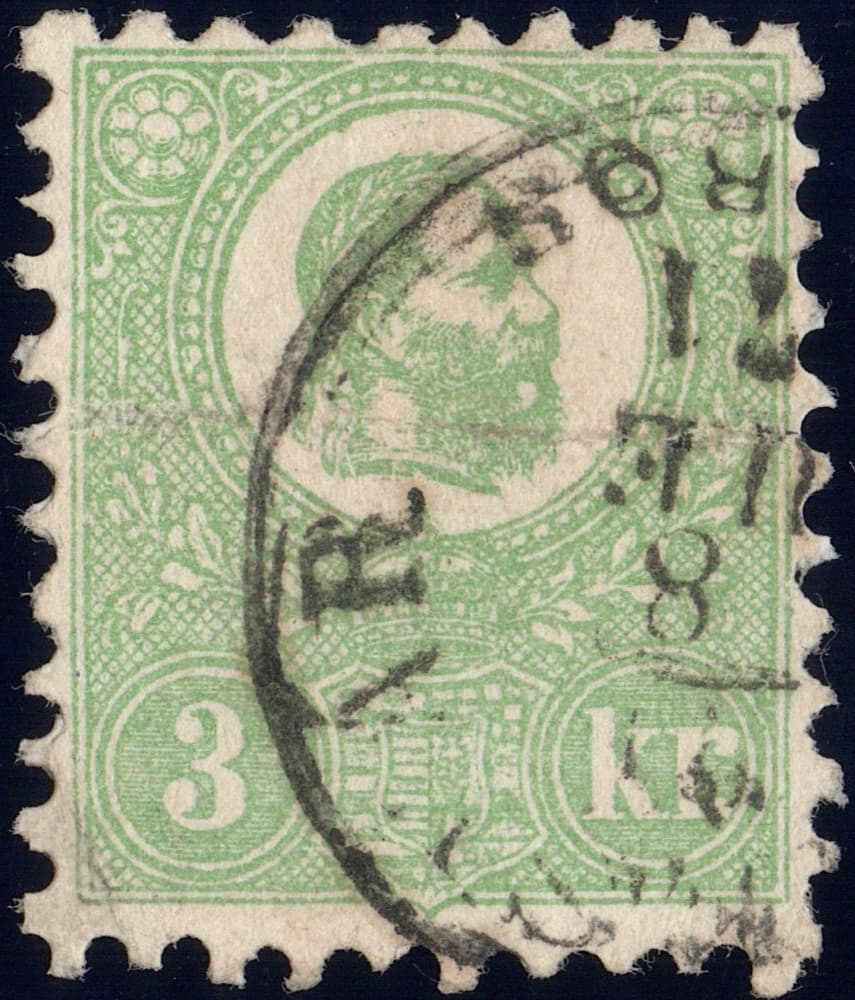
Hungary 1871 First Issue (Lithographed 3kr)
Hungary's first stamps were printed in a rush from stone, so badly that the first printing was destroyed, and the 3 krajcár of the set that survived was made in a run of only 46,000 before engraved stamps replaced it within months.
- Year
- 1871
- Maker
- Kingdom of Hungary (State Press of Buda)
- By price in stamps
- 85 of 100
Create a free account to see every recorded price and every grade.
Create a free account- What it is
- The 3 krajcár light green from Hungary's first stamp set, printed by lithography
- Issued
- May 1, 1871
- Printer
- The State Press of Buda
- Design
- Profile of Franz Joseph I, King of Hungary, with denominations in krajcár ('KR')
- Set
- Six values: 2k orange, 3k light green, 5k rose, 10k light blue, 15k yellow brown, 25k violet
- Printed
- 46,000 of the 3k, against 2,800,000 of the 5k, according to a leading German catalog as cited by a collector's reference
- Perforation
- 9½, no watermark
- Replaced
- Later in 1871 by an engraved set of the same design
- Valid until
- 1876
A kingdom that needed its own stamps
Hungary's first stamp design was drawn in 1848, during the Hungarian Revolution. Lajos Kossuth, then minister of finance, asked a young painter, Mór Than, to design it. The revolution failed, the stamp was never printed, and after 1849 Hungary was effectively part of the Austrian Empire, using Austrian stamps from 1850.
The Austro-Hungarian Compromise of 1867 created a monarchy of two equal states. The part of the agreement covering the post took effect on May 1, 1867, when every post office on Hungarian territory passed to the Hungarian postal administration under the Ministry of Agriculture, Industry and Commerce. Hungarian collectors still argue over the stamps issued on June 1, 1867, which bore Franz Joseph's portrait and used the abbreviation 'kr.' A Hungarian philatelic monograph calls them Austrian, valid in Hungary too, and points out that their watermark was in German.
Hungary could not yet print its own stamps. Its first newspaper stamp, in 1868, was printed in Vienna. In 1870 the ministers of finance and commerce reorganized the State Printing House in Buda, rebuilt it and installed new machinery so it could produce postal items. On May 1, 1871, Hungary's first postage stamp set appeared.
Stone against copper at the State Printing House
The stamps were meant to be engraved, but tight deadlines and delays led the printers to use lithography, printing from flat stones. The State Printing House was split over the method. Its director, Norbert Bauer, came from a lithographic printing house and favored lithography. Several of his staff, who had spent years abroad learning to engrave and produce stamps, favored engraving, and Bauer eventually gave way to them.
The stones were not drawn from scratch. According to the Hungarian monograph, the printers made them from galvanic copies of the engraved designs that were already being prepared. Each time the image was transferred to stone it changed slightly, which is how the different 'types' of the lithographed stamps arose. Fifteen stones were used for the six values, and no record says how many were used for which value.
The first printing failed. A collector's blog on Hungarian stamps says the first chrome-yellow 2 krajcár stamps were so badly printed, with Franz Joseph's face spotted as if pockmarked, that all 8 million copies were ordered destroyed. On April 4, 1871, the stones from that first run were defaced with pumice in the presence of an engineer, and the act was recorded in a protocol. A few of the 2k stamps escaped and were posted from Pest in August 1873. Collectors call them the 'Spotted Joseph.'
A short life
The second, accepted lithographed printing went on sale on May 1, 1871. It did not last. Its portrait was considered a poor way to present and honor the King of Hungary, and an engraved set of the same design replaced it later in 1871. Sources give different dates for the change: one reference says the engraved set appeared on August 31, 1871, another dates the first engraved stamps to June 1871, and a third says production shifted to engraving between July and August.
Both sets stayed valid until 1876, but lithographed stamps were rarely used after 1871. That is why used lithographed stamps are scarce, and why pairs, strips and blocks are seldom seen.
In the spring of 1873 a foreign dealer offered to buy all remaining lithographed stamps and asked for reprints. Neither stock nor stones were left. A British dealer then suggested making new stones. The money was tempting, but the State Printing House argued that making new, nearly identical stamps would amount to forgery by the state, and the minister of finance turned the offer down.
Why the 3 krajcár is the key
The six lithographed values were 2k orange, 3k light green, 5k rose, 10k light blue, 15k yellow brown and 25k violet, perforated 9½ on unwatermarked paper. The 3k is the rarest by a wide margin. A collector's reference citing a leading German catalog says only 46,000 3k stamps were produced, compared with 2,800,000 of the 5k. The same reference puts the lithographed values in the American catalog at $25 to $600, with the 3k at the top.
Telling a lithographed stamp from its engraved replacement takes a careful eye. On the lithograph, Franz Joseph's face looks flat, while on the engraved stamp it looks three-dimensional. The lithographed beard tends to look bushier, and the colors differ: the lithographed 3k is a light green, unlike the green shades of the engraved stamp. The stamps are usually not well centered.
Collectors also have to watch for imitations. In May 1921 a Hungarian collectors' cooperative issued lithographed reprints for the 50th anniversary of the first set. The monograph's author says they were often used to fool poorly informed collectors, and in 1962 some were shown at an exhibition in Cegléd labeled as the 1871 lithographs until he had them removed. Forgeries, including some by the master forger Jean de Sperati, also exist for values in the set.
The cornerstone of Hungarian collecting
The lithographed set is Hungary's first, and its short life, botched first printing and tiny 3k run give it the stories that collectors prize. In December 2011 a single specialized collection offered at auction included final proofs, unused and used stamps of every type, multiples and covers of the issue. Lots ranged from a 3k on a piece with an engraved 2k to the 'first printing' 2k in dark yellow.
Hungarian philately grew up alongside these stamps. The first Hungarian philatelic association was formed in Pest in the spring of 1874, the same year Hungary became one of the founding members of the Universal Postal Union.
The numbers
- Issue date
- May 1, 1871
- Printing
- Lithography, State Press of Buda, from 15 stones for six values
- Perforation
- 9½
- Paper
- No watermark
- Color
- Light green
- Quantity printed (3k)
- 46,000, versus 2,800,000 of the 5k
- Validity
- Until 1876; rarely used after 1871
- Multiples
- Pairs, strips and blocks are seldom seen
Timeline
Mór Than designs a Hungarian stamp for Lajos Kossuth's revolutionary government; it is never printed.
Post offices in Hungary pass to the Hungarian postal administration under the Compromise.
A new Franz Joseph series appears, valid in Hungary but, in the monograph's view, Austrian.
Hungary's first newspaper stamp is printed in Vienna.
The State Printing House in Buda is rebuilt to produce postal items.
The stones from the failed first printing are defaced with pumice.
Hungary's first stamps, the lithographed Franz Joseph set, go on sale.
Engraved stamps of the same design take over, by one reference's date; others give June or July-August.
In the spring, a foreign dealer asks to buy all remaining lithographs and for reprints; the state refuses.
A few 'first printing' 2k stamps that escaped destruction are posted from Pest.
The First Hungarian Philatelic Association is formed in Pest.
The 1871 stamps stop being valid for postage.
Lithographed reprints mark the 50th anniversary of the first set.
A large specialized collection of the issue is offered at auction.
The world in 1871
The German Empire is proclaimed at Versailles.
The Paris Commune is established.
The Treaty of Frankfurt transfers Alsace and Lorraine from France to Germany.
The Paris Commune falls to French government forces.
The Great Chicago Fire breaks out.
Henry Morton Stanley finds David Livingstone near Lake Tanganyika.
Verdi's opera 'Aida' premieres in Cairo.
Price record
A price-guide value is an editorial estimate, not a transaction and not an asking price. Guides lag the market and smooth over grade and condition. It is neither a floor nor a ceiling: a sale can land above or below it, and it should be checked against a realized sale before anything rests on it.
By reference price, Hungary 1871 First Issue (Lithographed 3kr) is number 85 of 100 in the stamps entries of the FLOAT 100. 82 of those 100 rest on a realized sale; the rest carry an asking price or a guide value, and each page says which. Rank within the FLOAT 100 itself (93 here) is editorial: how much an object defines its field, not price alone.
Did you know
- The first printing of Hungary's first stamps was destroyed because the king's face looked pockmarked.
- The printers made the stones from copies of the engraved designs that were already under way, so the stamps they replaced were, in a sense, waiting in the wings.
- A dealer offered so much for reprints in 1873 that the finance minister was tempted; the State Printing House talked him out of it, calling it forgery by the state.
- For every 3k lithograph printed, roughly 60 of the 5k were made.
- Hungary's first stamp design dates to 1848, 23 years before its first stamps.
- Reprints made for the set's 50th anniversary were once displayed at a Hungarian exhibition as the real 1871 stamps.
How this page is made
- The figure
- One reference price, shown with its own kind. FLOAT does not average it with anything or adjust it for time.
- Realized or not
- A realized price is a completed sale. An asking price, an estimate and a price-guide value are not sales, and are labeled as such wherever they appear.
- The story
- Researched from published records and checked fact by fact. Updated Oct 3, 2026.
- Archive
- Oct 5, 2026