FLOAT 100 · Stamps · No. 92
US 1845 New York Postmaster's Provisional 5c
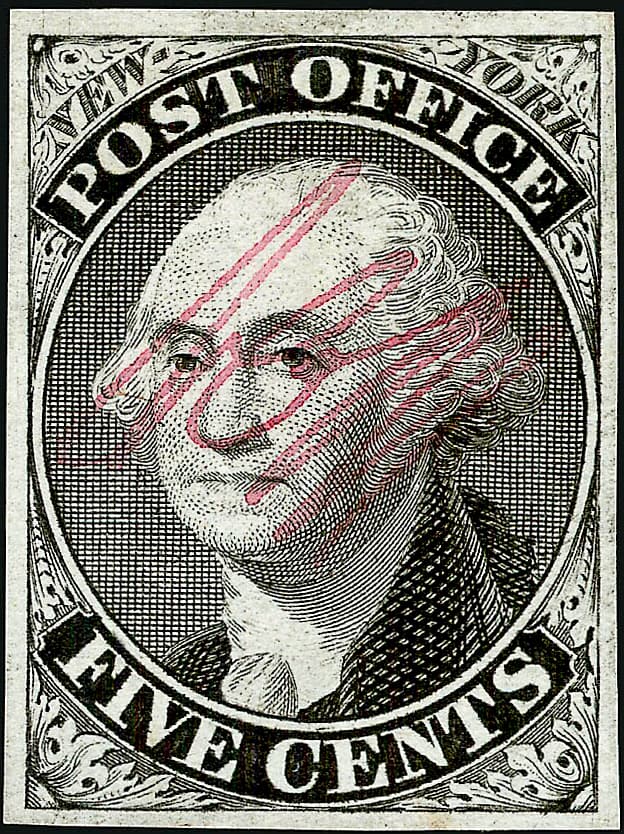
Two years before the United States printed a single postage stamp, New York's postmaster hired a banknote firm to make his own, had a clerk sign each one in red ink, and created the stamp that carried American letters as far as Trieste and Puerto Rico.
- Year
- 1845
- Maker
- United States — New York, N.Y. postmaster (Robert H. Morris)
- By price in stamps
- 92 of 100
Create a free account to see every recorded price and every grade.
Create a free account- What it is
- A 5-cent stamp issued by the New York post office before the first national U.S. stamps
- On sale
- July 14, 1845, at the New York City post office
- Issued by
- Postmaster Robert H. Morris, a former mayor of New York
- Printer
- Rawdon, Wright & Hatch, a New York banknote engraving firm
- Design
- George Washington, after the Gilbert Stuart portrait
- Quantity
- 143,600 stamps, printed in panes of 40 and delivered in 18 shipments
- Control mark
- Initials in red ink, most often 'ACM' for clerk Alonzo Castle Monson
- Catalog number
- 9X1 in the standard U.S. catalog, black on bluish paper, signed 'ACM'
- Replaced
- July 1, 1847, by the first national U.S. stamps
A stamp before there were American stamps
Before 1845, sending a letter in the United States could be expensive and hard to predict. Rates started at 6 cents a sheet for up to 40 miles and climbed to 25 cents for more than 400 miles. A letter from New York to Providence in June 1843 cost 18¾ cents. Usually the person receiving the letter paid. From 1839, independent mail companies carried letters far more cheaply, and they put real pressure on the Post Office.
On March 3, 1845, Congress answered with a simpler, cheaper rate: 5 cents per half ounce for a letter going up to 300 miles and 10 cents for anything farther. With a flat rate, paying in advance with a stamp finally made sense. But Congress did not authorize postage stamps. Britain had used them since 1840 and Brazil since 1843, and some American private mail companies had used them since early 1844.
Since nothing forbade stamps, postmasters in several towns had their own printed. Eleven post offices issued these 'postmasters' provisionals' between 1845 and 1847, from Alexandria, Virginia, to St. Louis. Most are scarce or rare. New York's, placed on sale on July 14, 1845, was the first to appear in response to the new law, and it became the most widely used and the most finely made of the group.
The postmaster, the banknote engravers and the clerk
Robert Hunter Morris had been mayor of New York from 1841 to 1844, and he took office as postmaster on May 21, 1845. He later became a justice of the New York Supreme Court. Within weeks of taking office he hired Rawdon, Wright & Hatch, a leading security printer that made banknotes, to design and print a stamp.
The engravers already used a portrait of George Washington on paper currency, taken from the famous Gilbert Stuart painting, and they built the stamp around it. Morris paid $55.01 for the first batch. Accounts differ on its arrival. The Wikipedia history says he received it on June 12, 1845, while a 2020 study by philatelist Mark Schwartz says the first stamps were delivered on July 12. Morris put them on sale on July 14 and ran newspaper advertisements the same day, one of which pointed out that the stamp was useful on foreign mail.
To protect against stolen or forged stamps, someone at the post office initialed each stamp in red ink. After a few days without control marks, initials appear from July 17, 1845. Morris signed a few with 'RHM.' Most were signed 'ACM' by Alonzo Castle Monson, a 23-year-old clerk who was Morris's brother-in-law. Monson's brother, Marcena Monson Jr., an assistant deputy postmaster, signed a handful 'MM Jr.' Schwartz believes other clerks also wrote 'ACM,' which would explain the differences in handwriting.
A New York stamp that went around the world
New Yorkers were already used to stamps. A private carrier, the City Despatch Post, had issued a crude 3-cent Washington stamp in February 1842, which Wikipedia calls the first adhesive postage stamp produced in the Western Hemisphere. The provisional caught on immediately. The earliest known covers are postmarked July 15, 1845, the day after it went on sale. Of the covers known from that day, 11 went to foreign countries, including Britain, Germany and France, and only two were domestic.
The stamp traveled widely: to Canada, the Maritimes, Mexico, Puerto Rico, Britain, Ireland, France, Germany, Belgium, Switzerland, Holland, Austria and Italy. Letters crossed the Atlantic on Cunard steamers such as the Britannia and the Hibernia, and the person receiving them paid the foreign and transit postage. The 5-cent stamp only paid the American leg.
Morris knew people in other cities would sometimes use his stamps. He wrote to other postmasters asking them to treat such letters as unpaid, and he accepted them as paid when they reached New York. Covers survive from Boston, Philadelphia and Charleston, and Schwartz knows of no other cover from Charleston. Some stamps rode the railroads: four covers are known from the New York to Philadelphia line, and one unique cover went through the Atlantic Avenue tunnel in Brooklyn, built in 1844, by Long Island Rail Road train and steamboat to Boston.
Shipments, collectors and famous covers
Rawdon, Wright & Hatch made 18 shipments to the New York post office. The last, on January 7, 1847, brought the total to 143,600 stamps, which Schwartz counts as 3,590 panes of 40. For decades collectors were not sure how the sheet was laid out. Some thought it held 50 or 100 stamps. Attempts at reconstructing the plate began as early as 1894, but the first published reconstruction, eight rows of five, came from philatelist Abraham Hatfield in 1921.
Henry G. Lapham won a gold medal at the 1926 New York International Philatelic Exhibition for his collection of the stamp. It held more than 700 examples, six of them signed 'RHM,' and a complete plate rebuilt from 40 stamps. Later, two of the four known covers bearing a strip of four were in the collection of Erivan Haub.
The most impressive covers carry multiples. The largest, called the Hasbrouck cover, carries a block of nine and a strip of three, 60 cents in postage for a letter to Ogdensburgh, New York, on the Canadian border. Another cover, to Buffalo, carries 30 cents in stamps for a heavy letter going more than 300 miles. Some of the earliest registered, or 'recorded,' letters in America carry the stamp: Schwartz lists seven such covers, the earliest from November 1, 1845.
How to read the initials and the paper
The stamp is large, engraved in black and imperforate, so it was cut from the sheet with scissors. More than 95 percent were printed on a bluish-white paper. In the last shipment, in January 1847, some sheets were on a deeper blue or a battleship gray paper. These are hard to tell apart from the front, especially when canceled, and easier to see from the back. Schwartz estimates about 50 blue-paper stamps exist, with 12 covers recorded in a census kept by the U.S. Philatelic Classics Society. He has records of 25 gray-paper stamps off cover.
The initials decide much of a stamp's value. The common type, catalog number 9X1, is 'ACM' with all three letters joined. A version with only 'AC' joined is slightly less common, and 'A.C.M.' with periods is the scarcest of the 'ACM' types. 'RHM' is rarer still: Schwartz counts 13 covers and fewer than 25 off-cover stamps. Only three examples of 'MM Jr' are known: one stamp off cover, a single on a full cover and a pair on a cover front. Stamps with no initials at all also exist, and so do a few consecutive pairs with two different signatures.
Most cancellations were applied by pen. Of the manuscript cancels in the census, about 85 percent are in bright blue ink, about 5 percent in magenta and about 10 percent in black. Red 'PAID' handstamps and town postmarks also appear. Wikipedia reports that, in the standard U.S. catalog, a used 'ACM' copy is listed at about $500, with unsigned and 'RHM' copies far higher.
The model for America's first stamps
On March 3, 1847, Congress authorized the Postmaster General to issue national stamps. The Post Office went straight to the same firm, now Rawdon, Wright, Hatch and Edson, without the usual competitive bidding. The 5-cent and 10-cent stamps went on sale on July 1, 1847, and the New York post office stopped selling its provisional.
The national 5-cent stamp looked much like the New York stamp but was more than 20 percent smaller. Wikipedia notes that no later U.S. definitive stamp, not even the large banknote issues of 1870 to 1890, would be as big as the New York provisional.
Because so many were printed and used, the New York provisional is the one postmaster's provisional that a collector can still find with some ease. That is why it is the usual first rarity in a collection of pre-1847 American stamps, and why its rare signatures, papers and covers keep specialists busy.
The numbers
- Issue date
- July 14, 1845
- Face value
- 5 cents, the rate for a half-ounce letter up to 300 miles
- Quantity printed
- 143,600 (3,590 panes of 40)
- Sheet layout
- 40 stamps, eight rows of five
- Printing
- Engraved, by Rawdon, Wright & Hatch, New York
- Perforation
- Imperforate
- Paper
- Bluish-white wove for more than 95 percent; scarce blue and gray papers in the January 1847 shipment
- Control initials
- ACM (common), A.C.M., RHM (fewer than 25 off cover), MM Jr (three known)
- Used
- July 15, 1845 to July 1, 1847
Timeline
The private City Despatch Post in New York issues a 3-cent Washington stamp.
Congress sets a 5-cent rate for letters up to 300 miles, without authorizing stamps.
Robert H. Morris takes office as postmaster of New York.
The New York provisional goes on sale; Morris advertises it in the papers.
Earliest known covers: 11 to foreign countries and two domestic.
Earliest known control initials appear, including 'A.C.M.' with periods.
Earliest known 'recorded' (registered) cover with the stamp.
The 18th and last shipment brings the total delivered to 143,600.
Congress authorizes national postage stamps.
Earliest recorded cover on the scarce blue paper.
The first U.S. national stamps go on sale and the provisional is withdrawn.
Early attempts to reconstruct the printing plate begin.
Abraham Hatfield publishes the plate as eight rows of five.
Henry G. Lapham's collection of more than 700 wins a gold medal in New York.
An 'ACM' single graded XF-90 sells for $1,000 at auction.
Mark Schwartz presents a study of the stamp at a postal history symposium.
The world in 1845
Edgar Allan Poe's 'The Raven' appears in the New York Evening Mirror.
President John Tyler signs the bill to annex Texas.
Florida becomes the 27th state.
Frederick Douglass's autobiographical Narrative is published in Boston.
Potato blight appears in Ireland, beginning the Great Famine.
The Naval School, later the U.S. Naval Academy, opens in Annapolis.
Texas becomes the 28th state.
Price record
| Date | Price | Kind |
|---|---|---|
| May 2015 | $1,000 | Sold at auction'ACM' single on bluish paper, light blue cancel, certificate graded XF-90. |
| May 2015 | $300 | Sold at auctionUsed single, red 'PAID' cancel, Fine to Very Fine. |
| May 2015 | $275 | Sold at auctionUsed single, blue manuscript cancel, Fine to Very Fine. |
| May 2015 | $225 | Sold at auctionUsed single, red 'PAID' cancel, Fine to Very Fine, 1980 certificate. |
| May 2015 | $180 | Sold at auctionUsed single, blue manuscript cancel, deep color, Very Fine. |
| Jul 2015 | $275 | Sold at auction'ACM' single, full to large margins, canceled only by a red 'PAID' arc. |
A realized auction price is what a buyer actually paid on the date shown, including the buyer's premium where the sale reported it. It is the strongest kind of reference price, and it is a record of one sale of one object on one day, not a promise of what the next example will bring.
By reference price, US 1845 New York Postmaster's Provisional 5c is number 92 of 100 in the stamps entries of the FLOAT 100. 82 of those 100 rest on a realized sale; the rest carry an asking price or a guide value, and each page says which. Rank within the FLOAT 100 itself (92 here) is editorial: how much an object defines its field, not price alone.
Did you know
- Most of the earliest known covers, mailed the day after the stamp went on sale, were going abroad, not across town.
- The first batch cost the postmaster $55.01.
- For more than 70 years collectors guessed wrong about how many stamps were on a sheet; some thought 50 or even 100.
- Only three examples of the 'MM Jr' initials are known.
- One cover went from Manhattan through the Atlantic Avenue tunnel in Brooklyn, built in 1844, which Schwartz calls the world's oldest subway tunnel.
- No later U.S. definitive stamp was as large as this one; the national 5-cent of 1847 was more than 20 percent smaller.
- Morris accepted letters stamped with his provisional from other cities as paid once they reached New York.
How this page is made
- The figure
- One reference price, shown with its own kind. FLOAT does not average it with anything or adjust it for time.
- Realized or not
- A realized price is a completed sale. An asking price, an estimate and a price-guide value are not sales, and are labeled as such wherever they appear.
- The story
- Researched from published records and checked fact by fact. Updated Oct 3, 2026.
- Archive
- Oct 5, 2026