FLOAT 100 · Stamps · No. 58
Japan 1871 Dragon (First Issue)
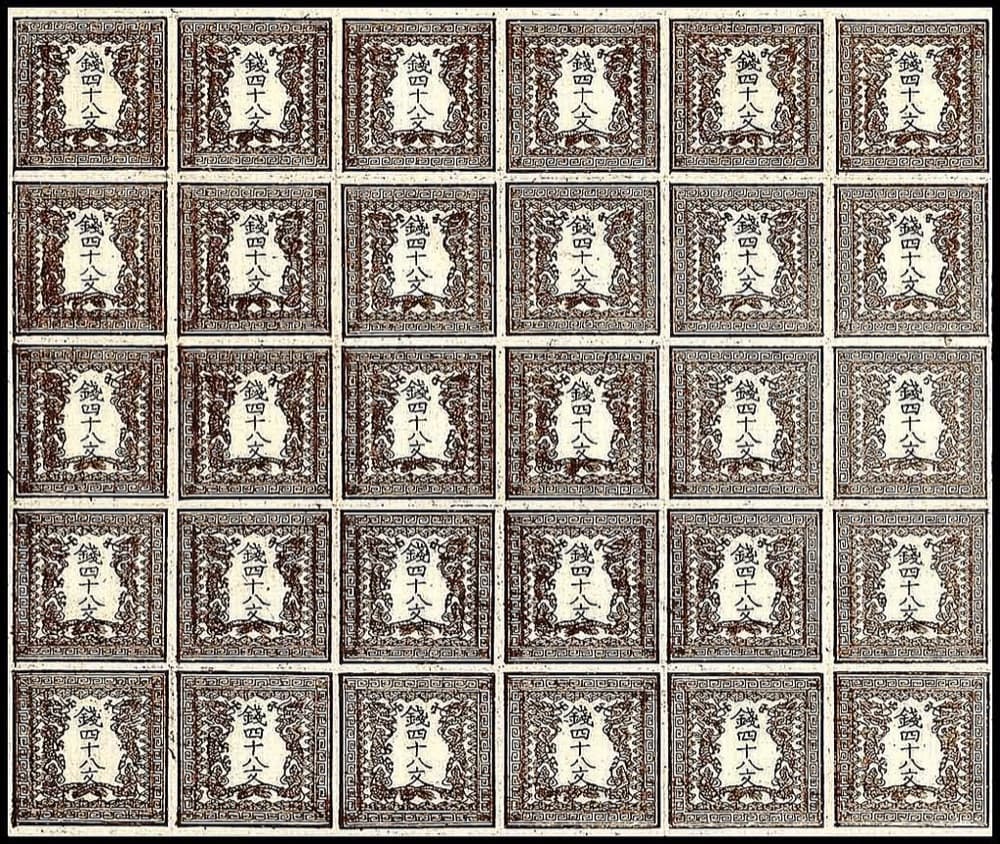
Hand-engraved on soft copper plates that wore down with every pull of the press, Japan's first stamps were printed so that no two positions on a sheet are quite alike, which lets collectors trace every surviving Dragon to its exact spot on the plate.
- Year
- 1871
- Maker
- Empire of Japan
- By price in stamps
- 93 of 100
Create a free account to see every recorded price and every grade.
Create a free account- What it is
- Japan's first postage stamps, the 1871 "Dragon" issue denominated in mon
- Values and colors
- 48 mon brown, 100 mon blue, 200 mon vermilion, 500 mon green (shades range from blue green to yellow green)
- Issued
- April 20, 1871 (Meiji 4, 3rd month, 1st day), when the national post opened; on sale in Tokyo about a week earlier
- Founder of the post
- Maejima Hisoka, often called the father of the Japanese post
- Design
- Two dragons facing a central tablet, with the value in black characters
- Production
- Hand-engraved copper plates; imperforate; sheets of 40 (five rows of eight)
- Withdrawn
- Recalled from post office counters by March 1873; valid for postage until November 30, 1889
- Successor
- "Sen" Dragons of April 1872, Japan's first perforated stamps
- Watch out for
- Extensive forgeries, found even in high-quality collections
A nation builds a post office
Before 1871, letters in Japan moved through private courier guilds called hikyaku. They served the shogunate, provincial lords and wealthy merchants along the great highways, but they were expensive, unstandardized and had no public post offices for ordinary people. Foreign governments filled part of the gap: Britain, France and the United States ran their own post offices in Japanese treaty ports, using Hong Kong, French and U.S. stamps.
Maejima Hisoka, a government official later called the father of the Japanese post, presented a plan for a unified public service in June 1870. It was approved that October. In December the Council of State ordered the Ministry of Finance to start printing stamps, and in February 1871 the first postal regulations, setting routes and rates, were published.
The service opened on April 20, 1871 (the first day of the third month of Meiji 4), when the first official mail left Tokyo on the route along the old Tokaido highway toward Kyoto and Osaka. The stamps had gone on sale in Tokyo about a week before. The network began with 65 post offices; within a year it had 264, by July 1872 it reached 994 and was declared nationwide, and by April 1873 it had 1,229.
Sources disagree about Maejima's time in Britain. Some accounts say he studied the British post in London before founding Japan's system; another argues that his stay in England came after the service had already started. This page leaves the question open.
Dragons, copper and black ink
All four stamps share one design: a pair of dragons facing each other around a central tablet, with the value reading downward in black characters. The 48 mon was printed in brown, the 100 mon in blue, the 200 mon in vermilion and the 500 mon in green, with shades running from blue green to yellow green. The stamps were imperforate and had to be cut apart with scissors.
They were printed from soft, unhardened copper plates engraved by hand. Each stamp needed two passes through the press: first the frame and dragons in color, then, once dry, the value in black from a second plate. Because each of the forty positions on a plate was engraved separately, and because the soft plates wore quickly under pressure, every position is slightly different and changed over time.
Collectors use those differences to "plate" the stamps, assigning each one to its plate and position. Named flaws include the "blind dragon" (48 mon, plate 2, position 25), the "missing fingers" and "bald dragon" varieties on the 200 mon, the "dragon's tail partly missing" (plate 2, position 7) and the "3 claws missing" (plate 2, position 15). Stamps were printed on more than one kind of paper, including native laid paper and wove paper.
The two-pass printing also explains Japan's most famous stamp. At least one sheet of the 500 mon went through the second pass upside down, producing the unique inverted-center error, a separate entry in the FLOAT 100.
What each value paid for
Under the first rate schedule, from April 1871 to January 1872, there were no fixed distance zones. Instead the government published rates from the three capitals, Tokyo, Kyoto and Osaka, to named destinations. The 100 mon was the workhorse, paying a basic-weight letter (up to 5 momme, about 18.75 grams) over short distances. The 200 mon covered middle distances, and the 500 mon long distances and heavy letters. The odd-looking 48 mon paid weight surcharges: a letter of 5 to 10 momme cost the base rate plus 50 percent. The full basic rate from Tokyo to Osaka was 1,500 mon.
On January 14, 1872, a second schedule replaced the destination list with five distance zones, from 100 mon within 25 ri to 500 mon beyond 200 ri, and cut the cost of long-distance mail. Meanwhile Japan was changing its money: the yen became the national currency in June 1871, stamps in sen were ordered that autumn, and by early 1872 postal rates were quoted only in sen, at 48 mon to half a sen and 100 mon to one sen.
The "Sen Dragons" of April 1872 kept the dragon design but were Japan's first perforated stamps. The mon Dragons were withdrawn from post office counters by March 1873 to make way for new issues, but they stayed valid for postage until November 30, 1889.
Collecting the Dragons today
Ordinary single Dragons are attainable. At a May 2021 auction in the United States, an unused 500 mon blue green on laid paper sold for $375, a used 100 mon blue on wove paper for $260 and a 100 mon blue plate 2 single on piece with a postmaster's seal cancel for $425. At a June 2023 auction in Geneva, a used 500 mon from the earliest printing of plate 1 with a large Fushimi cancel sold for EUR 2,200.
Multiples, sheets and covers cost far more. In the same 2021 sale, complete sheets of 40 of the 48 mon and the 100 mon sold for $10,500 and $10,000. Covers are scarcer still: a collection of Dragon covers offered in New York in 2026 was said to hold about 40 percent of all known Dragon covers still in private hands, including the earliest recorded cover of the Japanese post, a 100 mon plate 1 stamp processed at Minakuchi on the third day of service.
Specialists warn that Dragons were extensively forged, and that fakes turn up even in high-quality collections and in sales by specialist dealers. Because every genuine stamp can be matched to a plate position, plating is also a key defense: an expert can check whether a stamp's tiny engraving details agree with the position it claims to be.
Japanese exhibitors have made the issue a showpiece. Yasushi Tejima's exhibit of Dragon covers won the Grand Prix National at Philanippon 2011, and a collection of the 1871-1876 hand-engraved issues, including the unique 500 mon invert, won the same award at Philanippon 2021.
The numbers
- Issue date
- April 20, 1871 (Meiji 4.3.1)
- Values
- 48, 100, 200 and 500 mon
- Sheet
- 40 stamps, five rows of eight
- Perforation
- Imperforate
- Paper
- Native laid paper and wove paper both recorded
- Printing
- Hand-engraved copper plates, two passes (frame in color, value in black)
- Quantity printed
- Not found in the sources consulted
- Valid for postage until
- November 30, 1889
Timeline
Maejima Hisoka presents his plan for a unified postal service.
The plan is approved.
The Council of State orders the Ministry of Finance to begin printing stamps.
The first postal regulations, with routes and rates, are published.
The national post opens; the first official mail leaves Tokyo with the four Dragon stamps.
Earliest recorded cover of the Japanese post, a 100 mon processed at Minakuchi on the service's third day (Meiji 4.3.3).
The yen becomes Japan's national currency.
Stamps denominated in sen are ordered.
A simpler five-zone rate schedule takes effect.
The "Sen Dragons" appear, Japan's first perforated stamps.
With 994 post offices, the service is declared nationwide.
Dragon stamps are recalled from post office counters.
The Dragon stamps are finally demonetized.
Yasushi Tejima's Dragon cover exhibit wins the Grand Prix National at Philanippon 2011.
The unique 500 mon inverted center sells at auction in Geneva for almost $5.8 million; in the same sale an ordinary used 500 mon from the same plate makes EUR 2,200.
Part I of the Tejima collection of Dragon covers and plate reconstructions is offered at auction in New York.
The world in 1871
The German Empire is proclaimed at Versailles, with Wilhelm I as emperor.
Japan's first Japanese-language daily newspaper is printed in Yokohama.
The Paris Commune begins; government forces crush it on May 28.
The yen becomes Japan's national currency.
The Great Chicago Fire breaks out and burns for two days.
Henry Morton Stanley finds David Livingstone at Ujiji.
Price record
| Date | Price | Kind |
|---|---|---|
| May 2021 | $260 | Sold at auction100 mon blue, plate 1, wove paper, used with fancy grid cancels; single. Sold at auction in the United States in a May 25-26, 2021 sale. |
| May 2021 | $375 | Sold at auction500 mon blue green, laid paper, unused without gum as issued; single. Sold at auction in the United States in a May 25-26, 2021 sale. |
| May 2021 | $425 | Sold at auction100 mon blue, plate 2, top sheet-margin single on piece, canceled by postmaster's seals. Sold at auction in the United States in a May 25-26, 2021 sale. |
| Jun 3, 2023 | $2,359 | Sold at auctionAt auction in Geneva: EUR 2,200 (hammer price), shown in USD at the Federal Reserve rate on the sale date (1 EUR = 1.0724 USD). |
A realized auction price is what a buyer actually paid on the date shown, including the buyer's premium where the sale reported it. It is the strongest kind of reference price, and it is a record of one sale of one object on one day, not a promise of what the next example will bring.
By reference price, Japan 1871 Dragon (First Issue) is number 93 of 100 in the stamps entries of the FLOAT 100. 82 of those 100 rest on a realized sale; the rest carry an asking price or a guide value, and each page says which. Rank within the FLOAT 100 itself (58 here) is editorial: how much an object defines its field, not price alone.
Did you know
- Every Dragon can be assigned to an exact position on its plate, because each of the forty positions was engraved by hand.
- The 48 mon was created to pay a 50 percent surcharge on heavier letters, which is why its value looks so odd.
- Sending a basic letter from Tokyo to Osaka in 1871 cost 1,500 mon, three times the highest stamp.
- Collectors name the plate flaws: a "blind dragon," a "bald dragon" and a dragon with "3 claws missing."
- The stamps were withdrawn from sale in 1873 but stayed valid for postage for another sixteen years.
- Japan's post opened with 65 offices and passed 1,200 within two years.
How this page is made
- The figure
- One reference price, shown with its own kind. FLOAT does not average it with anything or adjust it for time.
- Realized or not
- A realized price is a completed sale. An asking price, an estimate and a price-guide value are not sales, and are labeled as such wherever they appear.
- The story
- Researched from published records and checked fact by fact. Updated Oct 1, 2026.
- Archive
- Oct 5, 2026