FLOAT 100 · Stamps · No. 59
Ottoman Empire 1863 Tughra (First Issue)
The Ottoman Empire's first stamps were drawn by the Imperial Mint's seal engravers around the sultan's calligraphic signature, and they were thought so crude that within two years the empire sent its next issue to Paris; today their best survivors are prized above almost anything else in Turkish philately.
- Year
- 1863
- Maker
- Ottoman Empire (Sultan Abdulaziz)
- By price in stamps
- 51 of 100
Create a free account to see every recorded price and every grade.
Create a free account- Issued
- January 1863, Constantinople (sources give January 1 and January 13, 1863)
- Ruler
- Sultan Abdulaziz (reigned 1861-1876), whose tughra, or calligraphic monogram, is the design
- Inscription
- Devlet-i Aliye-i Osmaniye, "The Sublime Ottoman Empire", in Ottoman Turkish on a crescent below the tughra
- Values
- 20 para, 1 piastre (kurus), 2 piastres and 5 piastres; the same four values also printed in brown for unpaid letters
- Printed at
- The Imperial Mint (Darphane-i Amire), Constantinople, by lithography
- Designers
- Named in one Turkish account as the Mint's chief seal engraver Abdulfettah Efendi and Eksercioglu Agah Efendi
- Format
- Imperforate and gummed, with a control band reading "Ministry of Finance of the Imperial Government" between some stamps; tete-beche (head-to-tail) arrangements exist
- Printings
- Three: 2 and 5 piastres prepared in 1862, a four-value printing, and a December 1863 printing of the 20 para and 1 piastre on thicker paper
- Record piece
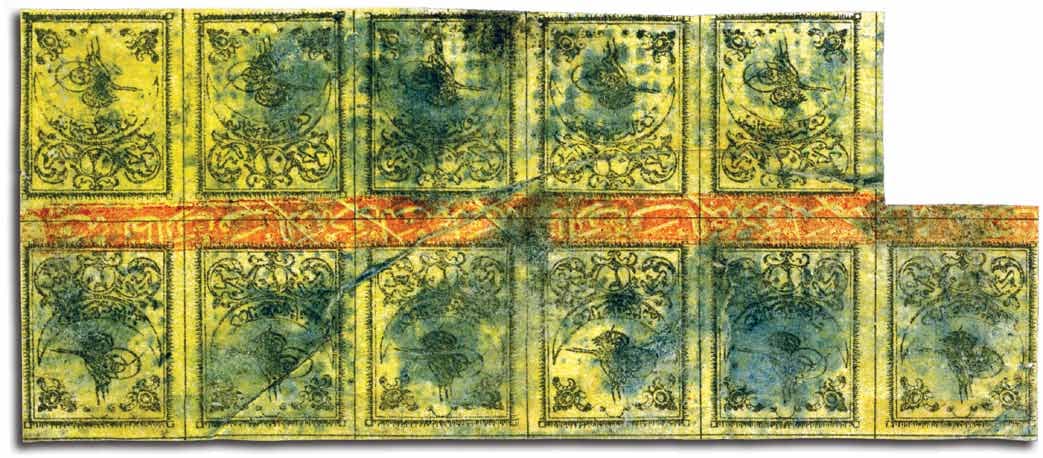
- A vertical tete-beche block of six 20 para stamps with the red control band, on a cover from Samakov to Istanbul, reported at $70,800 in August 2010
An empire late to the adhesive stamp
For most of its history the Ottoman Empire left long-distance mail to others. In the 18th century foreign powers ran courier services through their missions in the empire, and treaties known as Capitulations let Russia, Austria, France, Great Britain, Greece and several other states keep their own post offices on Ottoman soil. The empire did not run a regular public mail service of its own until 1840, when one was set up between Constantinople and other major cities. As late as 1863 there were only 63 domestic post offices in the entire empire, and service was sporadic and slow.
Before stamps, Ottoman letters were marked with each post office's own seal, usually struck in black or blue and naming the town and the year. Turkish collectors call the period from 1840 to January 1863 the age of seals, the empire's pre-stamp era.
The push for stamps came from inside the postal ministry. According to a 2022 account from Turkey's state news agency, Agah Bey, the fifth Minister of Posts (in office from August 24, 1861 to March 21, 1865), proposed adhesive stamps to the government. His proposal was accepted, and an imperial decree of March 15, 1862 ordered that stamps come into use on January 13, 1863. A notice published in the official newspaper Ceride-i Havadis on December 31, 1862 announced the first stamp and listed four values in four colors: yellow for 20 para, purple for 1 piastre, blue for 2 piastres and red for 5 piastres.
Sources disagree on the first day. English-language references give January 1, 1863; the Turkish accounts consulted give January 13, 1863. Either way, the Ottoman Empire became the second independent country in Asia, after Russia, to issue adhesive postage stamps, and it did so less than two years after its neighbor and former territory Greece.
Made at the Imperial Mint
The stamps were designed and lithographed at the Imperial Mint in Constantinople. One Turkish account names the Mint's chief seal engraver, Abdulfettah Efendi, together with Eksercioglu Agah Efendi, as the makers of the tughra and the ornament around it. Because the design carried no portrait, only the sultan's tughra and fine ornament, the issue has always been known as the Tughra stamps.
The design places the tughra of Sultan Abdulaziz above a crescent bearing the words Devlet-i Aliye-i Osmaniye, "The Sublime Ottoman Empire". All the writing is in Ottoman Turkish in Arabic script. Between some of the stamps runs a control band with the words "Ministry of Finance of the Imperial Government", an anti-forgery device; one account describes the red band running down the middle of the sheet between rows of stamps, which were printed head to tail.
Sources describe the color differently. Auction descriptions and the Turkish catalog literature describe black printing on colored paper (20 para black on yellow, 2 piastres black on greenish blue, 5 piastres black on rose). The state news agency's account says the design was lithographed in black on white paper and the color then applied with a sponge. The stamps were imperforate and gummed. How many stamps were on a sheet is debated, though the common view is 240 (12 by 20). No record of how many were printed survives, and neither do the printing stones.
Alongside the regular stamps, the Mint printed the same four values in brown, applied on arrival to unpaid letters from places with no post office. A Turkish account cautions that these should not simply be thought of as postage due stamps, though English-language references list them that way.
Three printings and a short life
Specialists divide the issue into three printings. There is a consensus among collectors that the 2 and 5 piastre values were actually prepared in 1862; these form the first printing. The four-value set announced at the end of 1862 is the second printing, and the 20 para and 1 piastre issued in December 1863 form the third. The first two printings were on thin paper and the third on thicker paper.
The stamps did not last. The Ottoman authorities were dissatisfied with the issue when they compared it with the well-executed stamps of other countries, and, following Greece's example, they turned to Paris. The new Duloz issue, engraved by the Frenchman Pierre Dulos and printed by the Poitevin firm, appeared in 1865; one Turkish account dates it to January 13, 1865. The Tughra stamps had been current for about two years.
That short life, the improvised production and the many variations in paper, color and setting are what make the issue a specialist's field. Auction descriptions distinguish first, second and third printings, thin and thick papers, settings, transfer-block positions and essays, and the issue has been extensively forged.
From Samakov to the record books
Much of the surviving postal history of the issue comes from the European provinces of the empire, in what is now Bulgaria. Letters from Samakov and from Filibe (Plovdiv, also written Philippopolis) to Istanbul turn up in sale catalogs. Two Samakov letters offered together in July 2009 came from the same correspondence; one carried a tete-beche pair of the 20 para used with two 1 piastre stamps to pay the 3 piastre rate to Istanbul. It was offered in the United States and went unsold.
The most celebrated piece of all is a vertical tete-beche block of six 20 para stamps from 1863-65, showing the red control band in the middle and at the foot, used on a cover from Samakov to Istanbul. The selling firm called it "the most important item of Turkish Philately". A collectors' price site reports it at $70,800 in an August 2010 sale; that figure is for a block of six on a cover, not for a single stamp.
Single stamps are far more modest. In July 2008 a never-hinged 2 piastre on thin paper sold at auction in the United States for $350, and a never-hinged 5 piastre on thin paper for $450. Covers carrying the stamps generally sell in the low thousands of dollars: a cover from Philippopolis with the only recorded 1 piastre in the red lilac shade of the third setting on cover realized $2,100 in July 2009.
Among the great collections of Turkish stamps, the chairman of the Philatelic Federation of Turkey named Tevfik Kuyas's collection of Tughra stamps in a 2017 interview.
How to recognize the first issue
Look for the tughra above a crescent with the inscription Devlet-i Aliye-i Osmaniye, ornate surrounding decoration and denominations in Ottoman numerals, with no portrait and no Western lettering. The stamps are imperforate. The 20 para is black on yellow, the 1 piastre black on lilac or violet shades (gray on the thick paper printing), the 2 piastres black on greenish blue and the 5 piastres black on rose. Copies attached to the control band carry the Ministry of Finance inscription.
Because both rarities and common values were forged, and because printings are distinguished by paper thickness and fine details of the setting, serious pieces trade with expert certificates. Do not confuse the first issue with the later Tughra designs of 1901-1911, which also carry the reigning sultan's monogram but are perforated and printed by different methods.
Legacy
The Tughra stamps began a tradition. The tughra of the reigning sultan appeared on most Ottoman stamps from 1863 until the end of the empire in 1922, and it was the Republic of Turkey's first issue, with its crescent and star, that finally ended its use. On July 1, 1875, the empire became a founding member of the General Postal Union, soon renamed the Universal Postal Union.
The Ottoman Empire's classic issues of 1863 to 1888 remain popular with collectors, and its postal cancellations have been studied extensively. Turkey's PTT Stamp Museum displays the country's stamps in chronological order, starting with the stamp first put into circulation in 1863.
The numbers
- Issue date
- January 1863 (January 1 or January 13 depending on source)
- Values
- 20 para, 1, 2 and 5 piastres, plus the same values in brown for unpaid letters
- Printing method
- Lithography, Imperial Mint, Constantinople
- Printings
- Three (1862, 1862-63, December 1863)
- Paper
- Colored paper; thin for the first two printings, thicker for the third
- Perforation
- Imperforate
- Gum
- Gummed
- Sheet
- Debated; commonly thought to be 240 stamps (12 by 20)
- Quantity printed
- Unknown; no printing records or stones survive
- In use
- About two years, until the 1865 Duloz issue
Timeline
The Ottoman Empire establishes a regular public mail service between Constantinople and other major cities.
Abdulaziz becomes sultan, succeeding his brother Abdulmejid I.
Agah Bey takes office as the fifth Minister of Posts and later proposes adhesive stamps.
An imperial decree orders that postage stamps come into use on January 13, 1863.
The 2 and 5 piastre values of the first printing are prepared, according to specialist consensus.
A notice in the official newspaper Ceride-i Havadis announces the first stamps in four values and colors.
The Tughra stamps go into use: January 1 in English-language references, January 13 in Turkish accounts.
A third printing of the 20 para and 1 piastre appears on thicker paper.
The French-made Duloz issue replaces the Tughra stamps, according to a Turkish account.
Agah Bey's term as Minister of Posts ends.
The Ottoman Empire becomes a founding member of the General Postal Union.
Never-hinged single copies of the 2 piastres and 5 piastres sell at auction in the United States for $350 and $450.
A 20 para tete-beche pair on a Samakov letter to Istanbul is offered at auction in the United States and goes unsold.
The Samakov cover with a tete-beche block of six 20 para stamps is reported at $70,800.
The world in 1863
Abraham Lincoln signs the Emancipation Proclamation.
The world's first underground railway opens in London, from Paddington to Farringdon Street.
The January Uprising against Russian rule breaks out in Poland, Lithuania and Belarus.
The Committee of the Five meets in Geneva, regarded as the founding of the International Committee of the Red Cross.
Prince Wilhelm George of Denmark is elected King of the Hellenes as George I.
The Salon des Refuses opens in Paris, showing Manet's Le Dejeuner sur l'herbe.
Abdulaziz becomes the first Ottoman sultan to travel to Western Europe on a diplomatic visit, touring Paris, London and Vienna.
Price record
A realized auction price is what a buyer actually paid on the date shown, including the buyer's premium where the sale reported it. It is the strongest kind of reference price, and it is a record of one sale of one object on one day, not a promise of what the next example will bring.
By reference price, Ottoman Empire 1863 Tughra (First Issue) is number 51 of 100 in the stamps entries of the FLOAT 100. 82 of those 100 rest on a realized sale; the rest carry an asking price or a guide value, and each page says which. Rank within the FLOAT 100 itself (59 here) is editorial: how much an object defines its field, not price alone.
Did you know
- Before 1863 the Ottoman Empire had only 63 domestic post offices, and foreign powers ran their own post offices inside the empire.
- The design has no portrait at all: the sultan is represented only by his tughra, his calligraphic signature.
- Some sheets were printed head to tail, so pairs and blocks exist with one stamp upside down relative to its neighbor.
- The Ottoman authorities were so unhappy with the look of their first stamps that the next issue was engraved and printed in Paris.
- The tughra of the reigning sultan stayed on most Ottoman stamps from 1863 to 1922; the Republic of Turkey dropped it for the crescent and star.
- Many of the finest surviving covers were mailed from towns that are now in Bulgaria, such as Samakov and Plovdiv.
How this page is made
- The figure
- One reference price, shown with its own kind. FLOAT does not average it with anything or adjust it for time.
- Realized or not
- A realized price is a completed sale. An asking price, an estimate and a price-guide value are not sales, and are labeled as such wherever they appear.
- The story
- Researched from published records and checked fact by fact. Updated Oct 3, 2026.
- Archive
- Oct 5, 2026