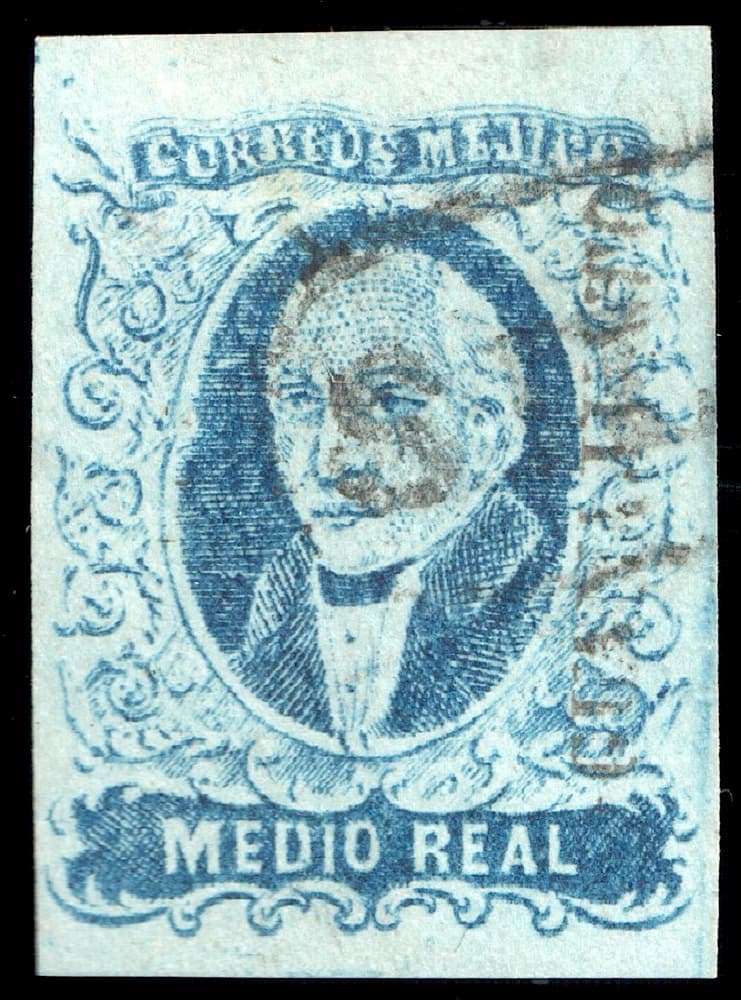
FLOAT 100 · Stamps · No. 97
Mexico 1856 Hidalgo (First Issue)
Mexico's first stamps were worthless until a clerk in one of some fifty postal districts struck the town's name across them by hand, so every genuine example carries a small piece of local history, and collectors have spent a century and a half mapping which town touched which stamp.
- Year
- 1856
- Maker
- Republic of Mexico
- By price in stamps
- 90 of 100
- Issued
- August 1, 1856, Mexico City
- Authorized
- Decree of President Ignacio Comonfort, February 21, 1856
- Values
- Five: 1/2 real blue, 1 real yellow, 2 reales green, 4 reales red, 8 reales lilac (violet)
- Design
- Portrait of Miguel Hidalgo y Costilla, the priest who began Mexico's independence movement in 1810
- Engraver
- Vicente Villegas, a medal engraver trained at the Academia de San Carlos in Mexico City
- Format
- Line-engraved (intaglio), imperforate, no watermark; plates of 60 subjects (one later 2 reales plate of 190)
- Control marks
- District name handstamped at the district office; stamps without it were not valid for postage
- Quantities sent out
- 825,573 (1/2r), about 1.42 million (1r; sources give 1,424,275 and 1,425,275), 1,629,773 (2r), 157,189 (4r), 100,784 (8r)
- In use
- 1856 to 1861, when the issue was replaced by stamps on colored paper
A reform government's first stamps
Mexico came late to the adhesive postage stamp. Britain had issued the Penny Black in 1840, and by the mid-1850s much of Europe and the Americas had followed. On February 21, 1856, President Ignacio Comonfort, who had taken power in December 1855 after the liberal revolt known as the Plan of Ayutla, authorized prepayment of postage with adhesive stamps by decree.
New postal regulations were supposed to be published on July 15, 1856, but problems with engraving the stamps pushed that back to July 31. On August 1, 1856, Mexico issued its first stamps. For the first four weeks they were available only in Mexico City: three consignments went to the capital before eight other districts received their first stamps on August 29, and another 28 districts followed the next day.
All five values used one design, a portrait of Miguel Hidalgo y Costilla. Hidalgo, a parish priest, had launched the revolt against Spanish rule with the Cry of Dolores on September 16, 1810, and was executed by firing squad in Chihuahua on July 30, 1811. He is remembered as the Father of the Nation. One history of Mexican stamps notes that choosing him reflected the reform politics of the Comonfort government.
A medal engraver tries his hand at stamps
The stamps were designed, engraved and printed by Vicente Villegas, who had trained in medal engraving at the Academia de San Carlos, Mexico's leading art school, between 1843 and 1853. Researcher Farley Katz, writing in 2020, notes that Villegas was appointed head of the engraving department at the Government Printing Office in August 1856 and that the Hidalgo stamps show his inexperience with intaglio plate engraving, which differs from cutting dies for medals. Some references give the engraver's first name differently, as José or as "A."
The stamps were line-engraved: the design was cut in reverse into a steel master die, hardened, and transferred to further dies and then rocked 60 times into each printing plate. One specialist study of the issue finds traces of nail heads on the stamps, suggesting the transfer dies were curved plates nailed into place. The value tablet at the bottom was left blank on the master die and added separately for each denomination.
Printing took place at the Government Printers in Mexico City. Records of the printing do not survive, so exactly how many stamps were printed is unknown. The same study suggests Villegas may have printed the first three deliveries and the Government Printers the remaining sixteen, and that a different printer took over later printings from the same plates, with a first delivery on November 20, 1857.
The ink was mixed as needed and not always well, and the paper was printed damp. Too-dry paper gave pale, dry-looking impressions; too-wet paper gave deep, dark ones. As a result almost any shade of each color exists, and color can vary within a single sheet.
Fifty districts, fifty handstamps
The feature that sets these stamps apart is the district name. When the issue appeared, Mexico had 50 principal postal districts in addition to the central office in Mexico City. Stamps were shipped on consignment from the capital, and each district office was required to handstamp its own name on every stamp it received. A stamp without the name was not valid for postage; once named, it was valid anywhere in the country, and covers are known with stamps from two different districts.
The purpose was security. Stamps lost or stolen on the long roads between the capital and the provinces could not be used until a district had marked them. The system began with this issue and remained official until the end of 1883, and it is often described as unique among the world's postal services.
Each district made its own handstamp, probably from type metal, perhaps from newspaper type, and applied it by hand to each stamp. Names appear at every angle, upside down and diagonally; double and triple strikes exist; and pairs are known with one stamp named and the other not. Some districts never named their stamps at all, and stamps without a district name, many canceled at Apam, are often remainders.
Between August 1, 1856, and April 17, 1861, the post office sent 893 consignments to 59 districts and sub-offices. Common district names include Mexico, Veracruz, Puebla and Guadalajara; scarce ones include Baja California, Isla del Carmen, Colima and Tacubaya. Because each consignment was logged, specialists can say, for example, that Baja California received just 60 copies of the 8 reales.
Rates, splits and a bonfire
Under the first rates, the 1/2 real paid a light letter traveling up to 30 leagues (about 78 miles) and also served as the newspaper rate. Those rates proved too low to cover costs, and on December 20, 1856, after less than five months, new rates took effect and prepayment became mandatory. The 1/2 real lost its role on letters, and the 2 reales replaced the 1 real as the workhorse value.
Short of low values, some offices cut stamps into halves, quarters and even eighths. The practice was never sanctioned, but in Zacatecas it was so common that whole 8 reales stamps from that district are very rare while fragments are relatively common. One specialist estimates that, after splitting, perhaps fewer than 1,000 whole 8 reales stamps survive.
Surplus stock was destroyed. A large cache of 165,986 copies of the 1/2 real was burned on April 18, 1861. That year the Hidalgo design was reissued in new colors on colored paper, and the first issue was retired; Mexico City received the last consignments of the 1856 stamps between April 5 and 17, 1861.
How collectors read them
Three papers were used: a handmade plain wove paper showing no mesh against the light, a handmade wove showing lines and dots, and, from at least January 1858, a thicker machine-made wire wove paper that shows a diamond pattern. The 1/2 real was printed only on the first two.
Plates are a field of study in themselves. The 1/2 real and 2 reales each used three plates; the third 2 reales plate had 190 subjects in 19 columns, against 60 for the others. By tracking which consignments were divisible by 60 and which by 190, specialists have argued that the first 2 reales delivery came entirely from the 60-subject plates and that any Mexico City stamp canceled after late March 1857 is most likely from the larger plate.
Counterfeits are a hazard. Crude forgeries were made for the packet trade, and reprints were later made from the original plates, possibly in the 1880s, mostly of the 4 and 8 reales and often with forged handstamps of rare districts. Specialists note that reprints tend to be on more opaque, smoother paper; held face down, genuine stamps show the design faintly through the paper, while reprints do not.
The numbers
- Issue date
- August 1, 1856
- Values and colors
- 1/2 real blue, 1 real yellow, 2 reales green, 4 reales red, 8 reales lilac
- Quantities sent to districts
- 825,573 / 1,424,275 (one source: 1,425,275) / 1,629,773 / 157,189 / 100,784
- Net issued after returns
- 768,360 / 1,403,383 / 1,616,335 / 152,647 / 94,460
- Plates
- 1/2r: 3; 1r: 4; 2r: 3; 4r: 1; 8r: 1. 60 subjects (6 x 10), except one 2r plate of 190
- Printing
- Line-engraved (intaglio), Mexico City
- Perforation
- Imperforate
- Paper
- Handmade plain wove, handmade wove with lines and dots, and (from about 1858) machine-made wire wove; no watermark
- Control overprint
- District name handstamped locally; official from 1856 to the end of 1883
Timeline
Ignacio Comonfort becomes president of Mexico.
Comonfort's decree authorizes prepayment of postage with adhesive stamps.
First delivery of stamps from the printer, including 285,780 good 2 reales stamps.
New postal regulations are published after engraving problems delay them from July 15.
Mexico's first stamps go on sale, in Mexico City only.
Eight districts receive their first consignments; 28 more follow the next day.
New, higher postal rates take effect and prepayment becomes mandatory.
Last delivery of the 1/2 real; no more are printed after this date.
Earliest likely date for 2 reales stamps from the new 190-subject plate, sent to Mexico City.
First delivery from a different printer using the original plates.
Thicker machine-made wire wove paper is in use by this month.
Mexico City receives the last consignment of first-issue stamps; a new issue on colored paper follows.
A cache of 165,986 copies of the 1/2 real is burned.
The district-name control system ends after 27 years.
The world in 1856
Queen Victoria institutes the Victoria Cross.
The Treaty of Paris ends the Crimean War.
Congressman Preston Brooks beats Senator Charles Sumner with a cane in the U.S. Senate.
Mexico promulgates the Ley Lerdo, part of the Comonfort government's liberal reforms.
American filibuster William Walker effectively takes control of Nicaragua.
James Buchanan is elected president of the United States.
Mexico promulgates its Constitution of 1857; within a year the Plan of Tacubaya sets off the Reform War.
Price record
A realized auction price is what a buyer actually paid on the date shown, including the buyer's premium where the sale reported it. It is the strongest kind of reference price, and it is a record of one sale of one object on one day, not a promise of what the next example will bring.
By reference price, Mexico 1856 Hidalgo (First Issue) is number 90 of 100 in the stamps entries of the FLOAT 100. 82 of those 100 rest on a realized sale; the rest carry an asking price or a guide value, and each page says which. Rank within the FLOAT 100 itself (97 here) is editorial: how much an object defines its field, not price alone.
Did you know
- A stamp without its district name was not valid for postage, so a clean, unmarked example is technically an unissued stamp.
- For their first four weeks, Mexico's stamps could be bought only in Mexico City, so a first-day cover can only come from the capital.
- The postal rates were found to be too low and were raised after less than five months.
- In Zacatecas, clerks cut so many 8 reales stamps into quarters and eighths that a whole one from that district is very rare.
- In April 1861 the post office burned 165,986 unused copies of the 1/2 real.
- Genuine stamps, laid face down, show their design faintly through the paper; later reprints do not.
- The 1 real total is itself disputed by a thousand stamps: one summary of the consignment records gives 1,425,275 sent out, another 1,424,275.
How this page is made
- The figure
- One reference price, shown with its own kind. FLOAT does not average it with anything or adjust it for time.
- Realized or not
- A realized price is a completed sale. An asking price, an estimate and a price-guide value are not sales, and are labeled as such wherever they appear.
- The story
- Researched from published records and checked fact by fact. Updated Oct 3, 2026.
- Archive
- Oct 5, 2026