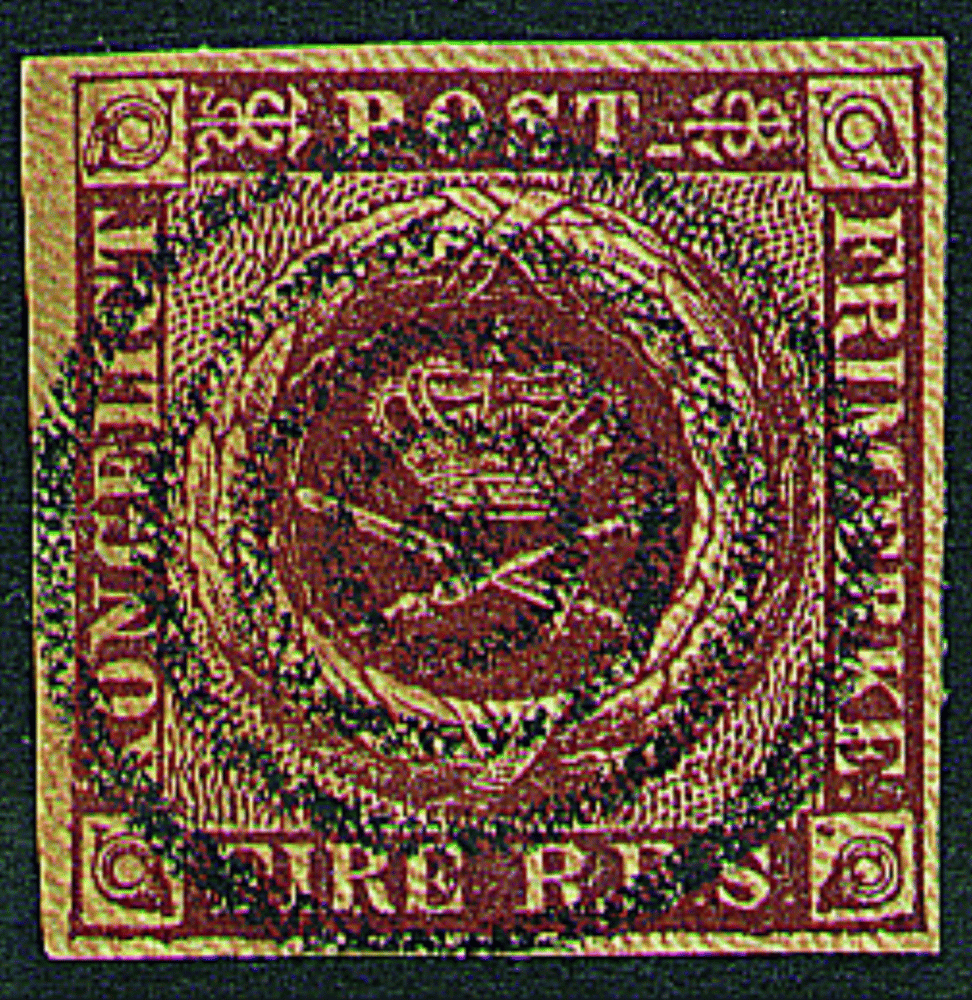
FLOAT 100 · Stamps · No. 96
Denmark 1851 'Fire R.B.S.' (4 Rigsbank-Skilling)
Denmark's first stamp went on sale on the same day the rebel Schleswig-Holstein army was disbanded, and its royal engraver died before the job was done, leaving collectors two printings, two kinds of wavy background and a lifetime of shades to sort out.
- Year
- 1851
- Maker
- Kingdom of Denmark (Royal Danish Post)
- By price in stamps
- 98 of 100
Create a free account to see every recorded price and every grade.
Create a free account- What it is
- Denmark's first postage stamp, the 4 rigsbankskilling ('Fire R.B.S.') in brown
- Issued
- April 1, 1851, under a law passed on March 11
- Design
- Square, with a crown, sword and scepter in the center
- Designer and engraver
- M. W. Ferslew, court engraver
- Printing
- Typographed, with a yellow-brown burelage (fine wavy background) printed over the design
- Paper
- Watermarked with a crown, imperforate
- Rate
- The national letter rate; the 2 R.B.S. blue paid the Copenhagen local rate
- Printings
- First by Ferslew (engraved burelage, mostly chocolate brown), later by H. H. Thiele (typographed burelage)
- Catalog number
- 1 in the Danish catalog; 2 in the standard U.S. catalog
Stamps for a kingdom at war
Denmark came to postage stamps in the middle of a war. The First Schleswig War began on March 24, 1848, when the duchies of Schleswig and Holstein rose against the Danish crown under King Frederick VII. Prussia backed the rebels at first but had to back down by the summer of 1850, and on April 1, 1851, the Schleswig-Holstein army was disbanded.
That same day, April 1, 1851, Denmark's first postage stamp went on sale, under a law passed on March 11. It was a 4 rigsbankskilling stamp, the 'Fire R.B.S.,' printed in brown. A 2 rigsbankskilling in blue followed on May 1. The 2 R.B.S. paid the local rate in Copenhagen, while the 4 R.B.S. paid the national rate, which is why it was used far more widely.
Danish collectors treat the 4 R.B.S. as Denmark's first stamp. A Scandinavian stamp specialist explains that the two values were not issued as a set, so the Danish catalog numbers them by order of issue and lists the 4 R.B.S. as number 1. In the standard U.S. catalog, the 2 R.B.S. is number 1 and the 4 R.B.S. is number 2.
Ferslew, Thiele and the wavy background
The stamp was designed and engraved by M. W. Ferslew, a court engraver who worked for the royal printers, H. H. Thiele & Co. Ferslew also made the first printings. The stamps were printed from two plates, known as plate I and plate II. After Ferslew died, the printing passed to H. H. Thiele, whose firm went on to print Denmark's stamps for the next 80 years.
The design is a square with a crown, sword and scepter in the center. The stamps were typographed, printed on paper watermarked with a crown and left imperforate. Their most distinctive feature is a yellow-brown burelage, a fine pattern of wavy lines printed on top of the design.
The two printers made the burelage differently. In Ferslew's printing it was engraved; in Thiele's it was typographed. That difference is the key to identifying the printings. On a Ferslew stamp, the nearly solid area around the crown can take on a wavy-line look from the engraved burelage, and the same effect can show in the cancellation.
Printings, shades and plate flaws
Most Ferslew stamps are chocolate brown. A U.S. dealer specializing in Scandinavia calls a light red brown Ferslew example 'quite exceptional.' The later Thiele printings come in a range of browns, including a light yellow brown. According to the same dealer, the light-colored stamps of the third Thiele printing were first issued in March 1854 and replaced in May 1854 by the 4 skilling stamp with dotted spandrels.
The stamp offers a wealth of printings, colors and plate flaws. The best known is the 'Kranholds Retouch.' The cliché in position 5 of plate II had the word 'POST' re-engraved, leaving shorter, differently shaped O and S letters. It is found on the Ferslew printing and the first two Thiele printings, and a specialist valued a Ferslew example at 3,500 Danish kroner, about $675.
Cancellations matter too. Stamps were usually canceled with ring-shaped 'mute' or numeral cancels. Some numbers are scarce: the dealer notes that number 172, for Marne in Schleswig-Holstein, was not issued until February 1, 1855, so it is found only on the light-colored late printing, and even then rarely.
Common in singles, rare in multiples
The 4 R.B.S. is not a costly stamp in ordinary condition. A specialist blog puts collectible copies at about $10 and catalog values from about $40, with premium four-margin copies selling for much more. Wikipedia quotes an unused copy at about $700 and a used copy at $40. Dealers in the U.S. offer used singles of the later printings for well under $100.
Large multiples are another matter. The largest recorded multiple of the stamp, a block of six with a light mute cancel and wide margins all around, sold at auction in September 2018 for $11,530.
Its companion is far rarer. Few 2 R.B.S. stamps were printed, and Wikipedia quotes copies at about $3,000 unused and $1,000 used. A block of four of the 2 R.B.S. sold at auction in Geneva in December 2011 for $250,000, and a pair from a later Thiele printing brought $75,000 in May 2008.
A Scandinavian classic
The war that framed the stamp's birth ended with the London Protocol of May 8, 1852, which joined Schleswig, Holstein and Lauenburg to the Danish king by personal union while keeping them separate entities.
The 4 R.B.S. remains the stamp that opens a Danish collection, and its printings, burelage types, shades, retouches and cancellations make it a study in itself.
The numbers
- Issue date
- April 1, 1851
- Face value
- 4 rigsbankskilling, the national letter rate
- Printing
- Typography; Ferslew printing with engraved burelage, Thiele printings with typographed burelage
- Plates
- Two, plate I and plate II
- Perforation
- Imperforate
- Watermark
- Crown
- Shades
- Ferslew mostly chocolate brown; Thiele printings in browns to light yellow brown
- Known variety
- Kranholds Retouch, plate II position 5
- Largest multiple
- Block of six
Timeline
The First Schleswig War begins.
A law introducing postage stamps is passed.
The 4 R.B.S. brown goes on sale, Denmark's first stamp; the Schleswig-Holstein army is disbanded the same day.
The 2 R.B.S. blue follows, for the Copenhagen local rate.
The London Protocol settles the First Schleswig War.
Light-colored stamps from the third Thiele printing are issued.
The 4 R.B.S. is replaced by the 4 skilling stamp with dotted spandrels.
Numeral cancel 172 is issued to Marne, Schleswig-Holstein.
A pair of the companion 2 R.B.S. sells for $75,000 at auction.
A block of four 2 R.B.S. sells for $250,000 at auction in Geneva.
The largest recorded multiple of the 4 R.B.S., a block of six, sells for $11,530.
The world in 1851
Hong Xiuquan begins the Taiping Rebellion in China.
The Great Exhibition opens at the Crystal Palace in London.
Isaac Singer receives a U.S. patent for his improved sewing machine.
The yacht America wins the first America's Cup race.
The New York Times publishes its first issue.
Herman Melville's 'Moby-Dick' is published in the U.S.
Louis-Napoleon Bonaparte dissolves France's National Assembly in a coup.
Price record
This is an asking price, not a sale. It is what a seller wanted on the date shown. Asking prices often sit above what buyers pay, but an ask is not a ceiling: a sale can land on either side of it. It is not a value.
By reference price, Denmark 1851 'Fire R.B.S.' (4 Rigsbank-Skilling) is number 98 of 100 in the stamps entries of the FLOAT 100. 82 of those 100 rest on a realized sale; the rest carry an asking price or a guide value, and each page says which. Rank within the FLOAT 100 itself (96 here) is editorial: how much an object defines its field, not price alone.
Did you know
- Denmark's first stamp went on sale the same day the Schleswig-Holstein rebel army was disbanded.
- The engraver who designed it died before all the printing was done, and the firm that took over printed Denmark's stamps for 80 years.
- The two printings can be told apart by whether the wavy background was engraved or typographed.
- The largest recorded multiple of the stamp is a block of just six.
- Danish and U.S. catalogs disagree on which value is Denmark's first stamp: the Danes list the 4 R.B.S. as number 1.
- A re-engraved 'POST' in one position on one plate created the collectible Kranholds Retouch.
How this page is made
- The figure
- One reference price, shown with its own kind. FLOAT does not average it with anything or adjust it for time.
- Realized or not
- A realized price is a completed sale. An asking price, an estimate and a price-guide value are not sales, and are labeled as such wherever they appear.
- The story
- Researched from published records and checked fact by fact. Updated Oct 3, 2026.
- Archive
- Oct 5, 2026