FLOAT 100 · Stamps · No. 78
Nepal 1881 First Issue (1 Anna)
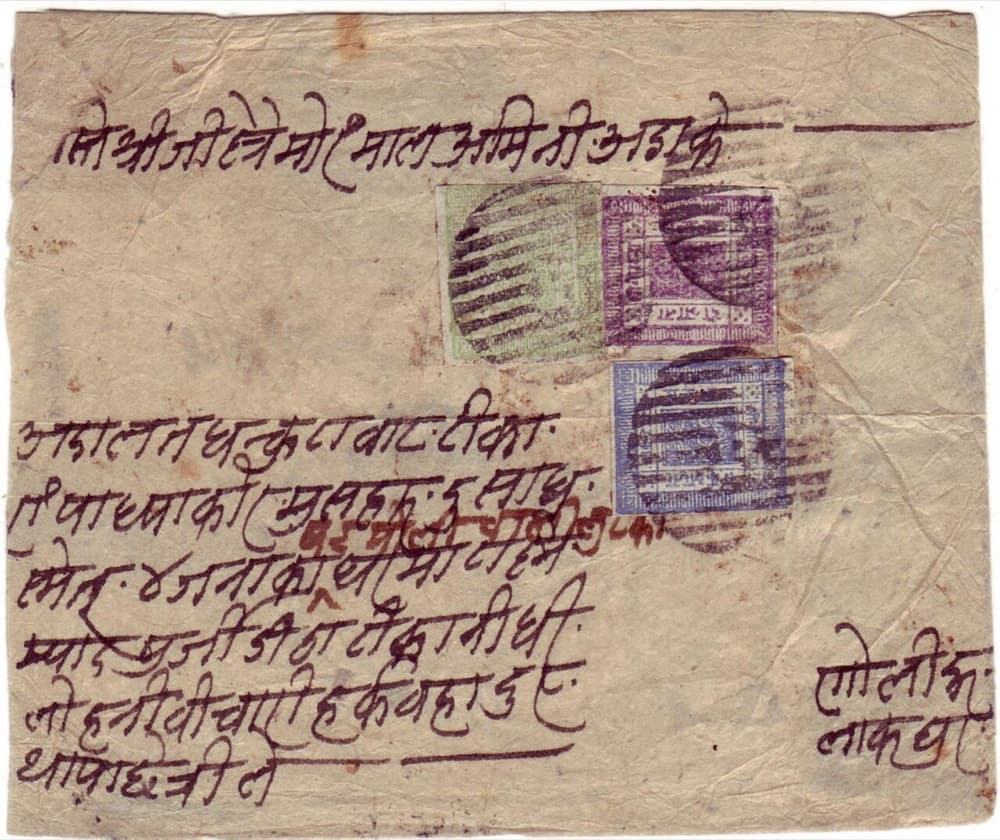
Nepal's first stamp showed a royal crown above two crossed Gurkha knives, was printed on a press brought from England, and served a postal system that carried letters only inside the kingdom, and a complete sheet of 64 is the showpiece of the issue.
- Year
- 1881
- Maker
- Kingdom of Nepal
- By price in stamps
- 65 of 100
Create a free account to see every recorded price and every grade.
Create a free account- What it is
- The 1 anna value of Nepal's first stamps, issued with a 2 anna and a 4 anna
- Issued
- April 1881
- Design
- The sripech, the royal plumed headdress, above crossed khukris (kukris), the curved Nepalese knife
- Color
- Ultramarine in the first setting, then blue and milky blue
- Printing
- Typography in Kathmandu, 64 stamps to the sheet (eight by eight)
- Paper
- White European wove paper, 1881 to 1885; handmade Nepalese paper from 1886
- Perforation
- Pin-perforated and gummed for the earliest sheets, April to June 1881; imperforate and ungummed after that
- Famous example
- A complete sheet of 64 of the 1 anna, sold for $25,400 at auction in New York in January 2017
- In use
- The same design was printed for postal use until 1907
A post office for a closed kingdom
Nepal's modern postal service began in 1878, when the Rana prime minister Ranodip Singh established the first post office, the Nepal Hulak Ghar. Ranodip had succeeded his elder brother, the powerful Jang Bahadur Rana, in 1877, and governed until he was assassinated by his nephews in a coup in 1885.
Three years after the post office opened, in April 1881, Nepal issued its first postage stamps: a set of three values, 1 anna, 2 annas and 4 annas. They were printed on a press that Jang Bahadur had brought back from England.
The service was strictly domestic. A 1 anna stamp paid for a letter of up to one tola in weight sent any distance within the country. Sources differ on where the stamps could be used beyond Nepal: one exhibit of the classic issues says none were valid for postage outside the country, one account says Nepalese stamps were valid only in Nepal and India until 1959, and a third says they became valid in India and some Tibetan border towns in 1937.
Crown and knives
The center of the design is a simple drawing of the sripech, the jeweled and plumed royal headdress, above a pair of crossed khukris, the curved knife carried by Gurkha soldiers. Devanagari lettering at the top reads 'Shri Gorkha' and at the bottom 'Sarkar,' meaning government; the stamps were inscribed in the name of the Kingdom of Gorkha. Side panels give the value.
The 1 anna was printed in shades of blue, the 2 annas in purple and the 4 annas in green. Each sheet held 64 stamps in eight rows of eight, set up from individual printing pieces, or cliches. At least three settings were used for the 1 and 2 annas and two for the 4 annas. For the 1 anna, the shade changes from setting to setting: ultramarine in the first, blue in the second and milky blue in the third.
Only the first setting carried side inscriptions and an ornamental border around the sheet. One printing piece, at position F8, split at the top right in the first setting, and the resulting flaw appears on every setting until the frames were recut many years later.
Pin holes, then scissors
Some of the first sheets printed between April and June 1881 were pin-perforated and gummed, with either a clear white gum or a thick brown gum brushed on. After June 1881 the stamps were issued imperforate and without gum, printed from the same settings. The pin-perforated stamps saw little postal use. One exhibit records only five uses of the pin-perforated 1 anna on cover, four from Kathmandu between 1881 and 1883 and one from Jumla in 1881.
From 1881 to 1885 the stamps were printed on white European wove paper, which has a tight, regular mesh. In 1886 printing moved to handmade Nepalese paper, made from the bark of a native evergreen, and numerous printings of the three values followed. The design stayed in postal use until a new pictorial issue arrived from England in 1907.
Even then the old design was not finished. The leftover sheets were put in storage and pressed into service in 1917 to pay fees on a new telephone and telegraph line. New printings followed, mainly for telegraph use, until the classic design was last printed in 1930.
Letters from the period are rare. About 50 of the 60 recorded first-issue stamps used on cover are single 1 anna stamps paying the basic rate. The earliest recorded use of the imperforate 1 anna is a letter from Kalaiya to Kathmandu dated June 16, 1881, a date written on the postmark in the Bikram Sambat calendar as 1938/3/3.
The sheet of 64
The most celebrated object of the issue is a complete sheet of 64 of the 1 anna. Intact sheets are great rarities: a specialist exhibit of the classic issues shows sheets rebuilt from blocks, and notes of one later printing that no complete sheets are known. This one belonged to Henry 'Hap' Pattiz, whose collection of Nepal was offered at auction in New York on January 26, 2017.
The sheet realized $25,400. Because that price is for a block of 64 stamps, it is not a price for one stamp. Another highlight of the same sale was an imperforate tete-beche pair of the 2 annas, with one stamp upside down relative to the other, which brought $15,625 against an estimate of $3,000 to $4,000.
Single stamps are far more modest. In January 2017 a U.S. dealer listed unused pin-perforated 1 anna stamps with white gum at $250 and $225, and imperforate copies, unused and used, for less.
A design that lasted 49 years
The crown and knives remained on Nepal's stamps from 1881 until 1930, and their many settings, papers, shades and inverted printing pieces have made them a deep field for specialists. In later settings on native paper, individual cliches were set upside down, producing tete-beche pairs; the only inverted cliche in the first period appears in the third setting of the 2 annas.
None of the first-issue material is common, and postal uses of the 2 and 4 annas are exceptional. The complete 1 anna sheet sold in 2017 stands as the landmark of the issue.
The numbers
- Issue date
- April 1881
- Set
- 1 anna blue, 2 annas purple, 4 annas green
- Printing
- Typography, Kathmandu, on a press brought from England by Jang Bahadur Rana
- Sheet
- 64 stamps, eight by eight; at least three settings of the 1 anna on European paper
- Perforation
- Pin-perforated, April to June 1881; imperforate afterward
- Paper
- White European wove, 1881 to 1885
- Gum
- Clear white or thick brown, brushed on, on the pin-perforated sheets only
- Recorded covers
- About 60 first-issue stamp uses on cover; five of the pin-perforated 1 anna
- Showpiece
- Complete sheet of 64 of the 1 anna, sold 2017
Timeline
Ranodip Singh becomes prime minister of Nepal after his brother Jang Bahadur's death.
Ranodip Singh establishes Nepal's first post office, the Nepal Hulak Ghar.
Nepal issues its first stamps: 1, 2 and 4 annas showing the sripech and crossed khukris.
Earliest recorded use of any imperforate first-issue stamp, a 2 annas cover from Kathmandu.
Earliest recorded use of the imperforate 1 anna, Kalaiya to Kathmandu.
Pin-perforation and gumming stop; later stamps are issued imperforate without gum.
Ranodip Singh is assassinated by his nephews in a coup.
Printing moves from European paper to handmade Nepalese paper.
A new pictorial issue from England replaces the classic design for postal use.
Stored sheets of the old design are brought back to pay telegraph and telephone fees.
The classic crown-and-knives design is printed for the last time.
The Pattiz collection is sold in New York; a complete sheet of the 1 anna brings $25,400.
The world in 1881
Tsar Alexander II of Russia is assassinated in Saint Petersburg.
Tunisia becomes a French protectorate under the Treaty of Bardo.
The world's first regular electric tram service starts near Berlin.
Clara Barton founds the American Red Cross.
U.S. President James A. Garfield is shot in Washington; he dies in September.
London's Savoy Theatre opens, the first public building lit entirely by electricity.
The gunfight at the O.K. Corral takes place in Tombstone, Arizona.
Price record
A realized auction price is what a buyer actually paid on the date shown, including the buyer's premium where the sale reported it. It is the strongest kind of reference price, and it is a record of one sale of one object on one day, not a promise of what the next example will bring.
By reference price, Nepal 1881 First Issue (1 Anna) is number 65 of 100 in the stamps entries of the FLOAT 100. 82 of those 100 rest on a realized sale; the rest carry an asking price or a guide value, and each page says which. Rank within the FLOAT 100 itself (78 here) is editorial: how much an object defines its field, not price alone.
Did you know
- Nepalese postmarks were dated in the Bikram Sambat calendar, so a letter dated 1938 was actually sent in 1881.
- The press that printed the stamps was brought from England by Jang Bahadur Rana.
- Only five uses of the pin-perforated 1 anna on a letter are recorded.
- Leftover sheets were put back to work in 1917 to pay for telegrams on Nepal's new telegraph line.
- The same crown-and-knives design was printed, on and off, for nearly 50 years, until 1930.
- An imperforate pair of the 2 annas with one stamp upside down sold for nearly four times its high estimate in 2017.
How this page is made
- The figure
- One reference price, shown with its own kind. FLOAT does not average it with anything or adjust it for time.
- Realized or not
- A realized price is a completed sale. An asking price, an estimate and a price-guide value are not sales, and are labeled as such wherever they appear.
- The story
- Researched from published records and checked fact by fact. Updated Oct 3, 2026.
- Archive
- Oct 5, 2026