FLOAT 100 · Stamps · No. 77
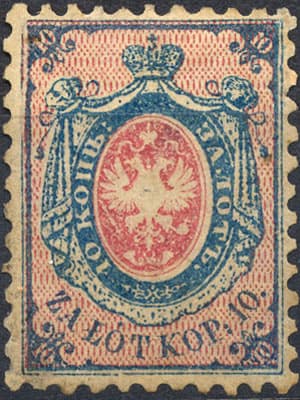
Poland 1860 'Polish No. 1' (10 Kopeck)
For five years in the shadow of the Russian Empire, the Kingdom of Poland had a stamp of its own, printed in two colors on a Warsaw inventor's press, and then it was abolished, the leftover stock destroyed, and Poland would not issue another stamp until it was free again.
- Year
- 1860
- Maker
- Kingdom of Poland (Congress Poland, under Russian Empire)
- By price in stamps
- 57 of 100
Create a free account to see every recorded price and every grade.
Create a free account- What it is
- The 10 kopeck stamp of the Kingdom of Poland (Congress Poland), the first stamp issued on Polish lands
- Issued
- January 1, 1860, Warsaw; in practice on sale from January 2, because January 1 fell on a Sunday
- Design
- Arms of the Kingdom, the Polish white eagle on the breast of the double-headed Russian eagle, in a frame modeled on Russia's first stamp
- Inscription
- Cyrillic at the sides and 'ZA ŁÓT KOP. 10' in Polish below, '10 kopecks for a łut,' an old unit of weight of about 12.66 grams
- Printing
- Letterpress in blue and rose-carmine, on a two-color press built by the Warsaw inventor Izrael Abraham Staffel
- Quantity
- About 3 million printed; 208,515 left over and destroyed at withdrawal
- Withdrawn
- April 1, 1865, after the January Uprising
- This copy
- A mint, never-hinged example with plate flaws: damaged lower tens and a spot between the oval and the outer frame line at lower right
- Sale
- $40,671 at auction in Germany, August 2018
A stamp for a kingdom that was not quite a country
After the Napoleonic Wars, the Congress of Vienna created a Kingdom of Poland, usually called Congress Poland, ruled by the Russian tsar as king. By the 1850s it kept its own administration, and on September 1, 1858, its postal service won autonomy from Russian control. Russia had issued its first stamp, a 10 kopeck value showing the imperial arms, in December 1857, and Warsaw soon followed.
An official circular dated December 2/14, 1859 (the two dates reflect the Julian and Gregorian calendars) announced the new stamp. It was issued on January 1, 1860. Because that day was a Sunday, it was actually available from January 2. Russian stamps could still be used in the Kingdom until April 1, 1860.
The design was almost a copy of Russia's first stamp. In place of the Russian arms it showed the arms of the Kingdom, the white eagle of Poland set on the breast of the double-headed Russian eagle. The value appears six times. The sides carry Cyrillic lettering, '10 KOPE.' at the left and 'SA LOT KOP' at the right, and below the arms the Polish words 'ZA ŁÓT KOP. 10' read, in effect, '10 kopecks for a łut,' an old Polish unit of weight of about 12.66 grams.
The stamp paid postage only inside the Kingdom and to Russia. Letters to other countries had to be paid in cash and went unstamped.
The engraver and the inventor
The original dies were cut by Henryk Mejer (also spelled Majer), an engraver at the Bank of Poland. Who designed the stamp is less certain. One Polish philatelic study credits the design to Jan Münchheymer, another bank engraver, while a later study from the same source says the designer is unknown.
The stamps were printed at the state stamp works in Warsaw on a press built by Izrael Abraham Staffel, a self-taught Jewish watchmaker and mechanic who had already won a gold medal at the 1851 Great Exhibition in London for a calculating machine. His press printed two colors and had a sheet counter. Sources disagree sharply on its speed: one gives 1,000 sheets an hour, a Polish study 120 sheets, or 12,000 stamps, an hour. The press was later used to print banknotes. Staffel, one biography notes, died as poor as he was born.
From Mejer's original dies, copper galvanotypes were made and assembled into two printing forms of 100 stamps each, one for the blue and one for the red. Each sheet was laid out in four blocks of 25, five by five, separated by unprinted gutters of 8 to 9 millimeters.
Five years, then a rising
The stamp lived through one of the most turbulent periods in Polish history. Anger over conscription into the Russian army set off the January Uprising, which began on January 22, 1863. Roughly 10,000 volunteers took on 90,000 Russian troops at first, fighting mostly as guerrillas, and the rising was crushed by June 1864.
The reprisals were heavy. The Kingdom lost what remained of its autonomy, Russian became the mandatory official language, and Russification intensified. The separate Polish stamp did not survive the crackdown. It was withdrawn on April 1, 1865, and Russian stamps replaced it. The 208,515 stamps still in stock were destroyed.
Polish collectors have identified eight printing batches between 1860 and early 1865, told apart by paper and shades of ink. The last printing run was completed in 1864.
Telling one copy from another
The paper came from the mill at Jeziorna, near Warsaw. It is white and unwatermarked, usually 0.06 to 0.08 millimeters thick, with thicker and thinner papers also known. The gum was rolled on before printing and ranges from yellowish to brownish, sometimes smooth and sometimes with vertical streaks.
Perforation was done after printing on a simple frame machine, and it shows. Gauges range from 11½ to 12¾, with 10 to 12 teeth across and 14 to 15 down. Colors fall into three main groups: light blue with pink, dark blue with pink, and dark blue with carmine.
Because the printing forms were built from many individual copper pieces that wore and cracked, the stamp has a large family of plate flaws, broken frames, damaged ornaments, spots in the shield and retouches, which specialists use to place a stamp on the sheet. Used copies usually carry a numeral cancel, a number from 1 to 332 inside concentric circles about 25 millimeters across, identifying the post office.
Forgeries are plentiful, and collectors are advised to have any copy examined by a recognized expert. Unused blocks are great rarities: one Polish study records a single block of six, a single block of four with full original gum and a single pair.
The never-hinged flaw copy
The example that sets the price benchmark here is unusual on two counts. It is mint and never hinged, with its gum untouched, and it shows two plate flaws: damage to the two lower numerals 10, and a spot between the oval and the outer frame line at lower right.
That stamp sold at auction in Germany in August 2018 for $40,671, a figure far above ordinary copies. The sale shows how condition and a documented plate flaw can turn a common first issue into a rarity.
Poland's 'Number One'
To Polish collectors the stamp is simply 'Polska nr 1,' the first entry in every catalog of Polish stamps. It remained the only Polish stamp of the 19th century: after its withdrawal, Poland issued no stamps of its own until independence in 1918.
Polish specialists have catalogued its printings, shades and plate flaws in close detail, and a Polish web site, 'Polska Jedynka' ('Poland One'), is devoted to this single stamp, with studies published for its 145th and 150th anniversaries.
The numbers
- Issue date
- January 1, 1860 (on sale January 2)
- Withdrawn
- April 1, 1865
- Quantity
- About 3 million printed in eight batches; 208,515 destroyed
- Printing
- Letterpress, two colors (blue and rose to carmine), state stamp works, Warsaw
- Plate
- Two forms of 100 copper galvanotypes, in four blocks of 25
- Perforation
- Frame perforation, gauge 11½ to 12¾
- Paper
- White, unwatermarked, from the Jeziorna mill, about 0.06 to 0.08 mm
- Gum
- Yellowish to brownish, smooth or vertically streaked
- Cancellations
- Numeral cancels 1 to 332 in concentric circles
Timeline
Russia issues its first stamp, a 10 kopeck value whose design the Polish stamp will copy.
The Kingdom of Poland's postal service gains autonomy from Russian control.
An official circular (dated December 2 in the Julian calendar) announces the new stamp.
The 10 kopeck stamp is issued; it goes on sale January 2 because the 1st is a Sunday.
Russian stamps can no longer be used in the Kingdom.
The January Uprising begins.
The last printing run of the stamp is completed; the uprising is crushed in June.
The stamp is withdrawn and replaced by Russian stamps; 208,515 unsold copies are destroyed.
Poland regains independence; the 1860 stamp remains its only 19th-century issue.
A mint, never-hinged copy with plate flaws sells at auction in Germany for $40,671.
The world in 1860
Abraham Lincoln gives his Cooper Union speech in New York.
The Pony Express begins carrying mail from Missouri to California.
Garibaldi sets out on the Expedition of the Thousand to unify Italy.
The first Open Championship in golf is played at Prestwick, Scotland.
British forces begin burning Beijing's Old Summer Palace in the Second Opium War.
Lincoln is elected president of the United States.
Britain launches HMS Warrior, the first ocean-going iron-hulled armored warship.
Price record
| Date | Price | Kind |
|---|---|---|
| Aug 2018 | $40,671 | Sold at auctionMint, never-hinged copy with plate flaws (damaged lower tens, spot at lower right). Sold at auction in Germany. |
A realized auction price is what a buyer actually paid on the date shown, including the buyer's premium where the sale reported it. It is the strongest kind of reference price, and it is a record of one sale of one object on one day, not a promise of what the next example will bring.
By reference price, Poland 1860 'Polish No. 1' (10 Kopeck) is number 57 of 100 in the stamps entries of the FLOAT 100. 82 of those 100 rest on a realized sale; the rest carry an asking price or a guide value, and each page says which. Rank within the FLOAT 100 itself (77 here) is editorial: how much an object defines its field, not price alone.
Did you know
- The stamp's official first day, January 1, 1860, was a Sunday, so nobody could buy one until the next day.
- The value 10 appears six times in the design.
- The press that printed it was built by Izrael Abraham Staffel, a watchmaker who also won a gold medal in London for a calculating machine.
- The stamp could not pay postage abroad. Letters leaving the Kingdom and Russia were paid in cash.
- When the stamp was abolished in 1865, 208,515 unsold copies were destroyed.
- Poland issued no other stamp in the 19th century; its next stamps came with independence in 1918.
How this page is made
- The figure
- One reference price, shown with its own kind. FLOAT does not average it with anything or adjust it for time.
- Realized or not
- A realized price is a completed sale. An asking price, an estimate and a price-guide value are not sales, and are labeled as such wherever they appear.
- The story
- Researched from published records and checked fact by fact. Updated Oct 3, 2026.
- Archive
- Oct 5, 2026