FLOAT 100 · Stamps · No. 70
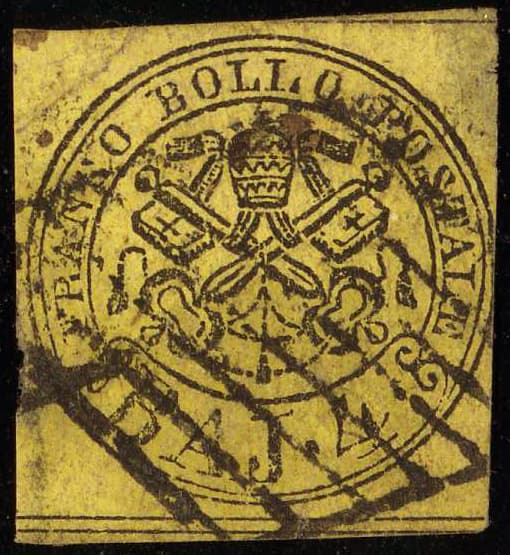
Papal States 1852 First Issue
Three years after French troops put Pope Pius IX back on his throne, his government issued stamps bearing the papal tiara and the keys of St. Peter; the single complete sheet of the top value, the 1 scudo, is called the most valuable item in all of papal philately.
- Year
- 1852
- Maker
- Papal States (Pope Pius IX administration)
- By price in stamps
- 41 of 100
Create a free account to see every recorded price and every grade.
Create a free account- What it is
- The first stamps of the Papal States (Roman States), eleven values from 1/2 bajocco to 1 scudo
- Announced
- November 21, 1851, by Cardinal Secretary of State Giacomo Antonelli
- Issued
- January 1, 1852 (1/2 to 7 bajocchi); 8 bajocchi, 50 bajocchi and 1 scudo later in 1852
- Design
- The crossed keys of St. Peter under the papal triple tiara, with a different frame for each value
- Currency
- 100 bajocchi to the Roman scudo
- Headline rarity
- The only known complete mint sheet of 50 of the 1 scudo carmine-rose (Sassone 11)
- Sheet's sales
- £200,000 hammer at auction, October 25, 1990; 120,000 euros hammer (146,400 with premium) at auction in Switzerland, December 15, 2021
- In use
- About fifteen years, until the centesimi issue of 1867
A pope's return and a postal reform
Pius IX became pope in 1846. In 1849 nationalist revolt in Rome led to the proclamation of a Roman Republic under Giuseppe Mazzini and Giuseppe Garibaldi, and the pope fled to Gaeta. French troops sent by Louis Napoleon Bonaparte crushed the republic, and papal rule returned to Rome.
On November 21, 1851, Cardinal Secretary of State Giacomo Antonelli announced the introduction of bolli franchi, postage stamps. At the time the pope ruled a large stretch of central Italy, covering today's Lazio, including Rome, Marche, Umbria and Romagna, and part of Emilia.
The first eight values, 1/2, 1, 2, 3, 4, 5, 6 and 7 bajocchi, went on sale on January 1, 1852. Three higher values followed the same year. One specialist history dates the 50 bajocchi and 1 scudo to July 12 and the 8 bajocchi to October 1, while another source puts all three in October.
Keys, tiara and colored paper
Every value carries the same emblem, the crossed keys of St. Peter under the triregno, the papal triple tiara, but with a frame and side ornaments of its own. The dies were engraved by Doublet and Decoppet and Co., and the stamps were typographed at the Vatican's print shop. They were imperforate and printed on unwatermarked paper, made mostly by the Graziosi mill at Subiaco, at first by hand and later by machine.
The lower values were printed in black on colored paper. The 8 bajocchi was black on white, the 50 bajocchi blue on white and the 1 scudo carmine-rose on white. The lower values came in sheets of 100, divided into four panes of 25. The 50 bajocchi and 1 scudo came in sheets of 50, ten by five, without panes.
With 100 bajocchi to the scudo, the 1 scudo was the top value of the set. A Swiss auction house history of the issue notes that mint or used examples of the 1 scudo are elusive.
The sheet of fifty
The most famous object of the issue is a complete mint sheet of the 1 scudo carmine-rose, all 50 stamps with original gum and full margins. It includes the interpanneau, the gutter between the fifth and sixth rows. It has only a closed tear at the upper right corner, from a single crease.
The Italian expert Enzo Diena called it, in a 1990 certificate written in English, 'the single most valuable item in the entire area of Pontifical States philately.' Raffaele Diena signed a second certificate in 1993, calling it the greatest rarity among the stamps of the Papal States. A complete sheet of 100 of the unissued 1858 20 bajocchi, found later in private hands, is now considered its only rival.
The sheet came from a celebrated Rothschild collection, sold at auction as the 'Alphonse' collection. Sources differ on which Rothschild formed it. The 2021 lot description names Baron Arthur de Rothschild, while an article published by the same auction house a month later names the Austrian philatelist Alphonse Mayer von Rothschild. The whole collection raised almost £7 million when it was sold.
On October 25, 1990, the sheet was the cover illustration of the Rothschild sale of Pontifical States and Sicily, lot 136, estimated at £150,000 to £200,000. It sold for £200,000 before a 10 percent premium, then about 500,000 Swiss francs. On December 15, 2021, it sold again at auction in Switzerland for 120,000 euros hammer, against an estimate of 120,000 to 160,000 euros, or 146,400 euros with the buyer's premium.
Identifying the 1852 stamps
Because the stamps are imperforate and were cut apart by hand, margins decide value. A forgery specialist puts it simply: stamps with no frame lines visible have little value, and the more frame line shows, the higher the value.
The issue was forged early and often. In 1855 the 1, 5 and 8 bajocchi were forged at Bologna to cheat the post office. Later forgers, among them Fournier, Zechmeyer and Jean de Sperati, made copies for collectors, with Fournier forgeries particularly of the 1/2 bajocchi, 50 bajocchi and 1 scudo. Each forger left telltale flaws in the keys, lettering or spacing.
The last stamps of a temporal power
The 1852 stamps served for about fifteen years. In 1867 the Papal States switched to centesimi, and three years later, in 1870, the pope's temporal power in Rome ended. The first issue is the cornerstone of collections of the Papal States, which had ruled central Italy since 756.
Its top value has only become more famous. The sheet's sales in 1990 and 2021, each with a certificate from the Diena family of experts, tie it to one of the great Rothschild collections and to the standards of Italian philately.
The numbers
- Issue date
- January 1, 1852 (1/2 to 7 bajocchi)
- Values
- 11: 1/2, 1, 2, 3, 4, 5, 6, 7, 8 and 50 bajocchi, and 1 scudo
- Printing
- Typography, Vatican print shop; dies by Doublet and Decoppet and Co.
- Perforation
- Imperforate
- Paper
- Unwatermarked; colored for the lower values, white for 8 and 50 bajocchi and 1 scudo; mostly from the Graziosi mill at Subiaco
- Sheet format
- 100 in four panes of 25; 50 bajocchi and 1 scudo in sheets of 50 (10 by 5)
- 1 scudo
- Carmine-rose on white, Sassone 11
- Complete 1 scudo sheets known
- 1, mint with original gum
Timeline
Pius IX becomes pope.
A Roman Republic is proclaimed; the pope flees to Gaeta until French troops restore him.
Cardinal Antonelli announces postage stamps for the Papal States.
The 1/2 to 7 bajocchi values go on sale.
The 50 bajocchi and 1 scudo are issued, according to one specialist history; another source says October.
The 8 bajocchi is issued.
The 1, 5 and 8 bajocchi are forged in Bologna to defraud the post.
Centesimi stamps replace the bajocchi issue.
Papal temporal rule over Rome ends.
The complete 1 scudo sheet of 50 sells for £200,000 hammer in the Rothschild sale.
Raffaele Diena signs a certificate calling the sheet the greatest rarity of the Papal States.
The sheet sells at auction in Switzerland for 120,000 euros hammer, 146,400 euros with premium.
The world in 1852
Louis-Napoleon Bonaparte proclaims a new constitution for France.
Henry Wells and William Fargo found Wells Fargo & Company.
'Uncle Tom's Cabin' is published in book form in Boston.
Yale and Harvard row in the first American intercollegiate athletic event.
Count Cavour becomes prime minister of Piedmont.
The new Palace of Westminster opens in London.
Napoleon III becomes emperor of the French.
Price record
| Date | Price | Kind |
|---|---|---|
| Oct 25, 1990 | $390,800 | Sold at auctionAt auction: GBP 200,000 (hammer price), shown in USD at the Federal Reserve rate on the sale date (1 GBP = 1.9540 USD). |
| Dec 15, 2021 | $164,861 | Sold at auctionAt auction in Switzerland: EUR 146,400 (including buyer's premium), shown in USD at the Federal Reserve rate on the sale date (1 EUR = 1.1261 USD). |
A realized auction price is what a buyer actually paid on the date shown, including the buyer's premium where the sale reported it. It is the strongest kind of reference price, and it is a record of one sale of one object on one day, not a promise of what the next example will bring.
By reference price, Papal States 1852 First Issue is number 41 of 100 in the stamps entries of the FLOAT 100. 82 of those 100 rest on a realized sale; the rest carry an asking price or a guide value, and each page says which. Rank within the FLOAT 100 itself (70 here) is editorial: how much an object defines its field, not price alone.
Did you know
- Every value shares the keys and tiara emblem, but each has its own frame design.
- Post office forgers in Bologna copied three values in 1855, only three years after issue.
- The 1 scudo sheet's 1990 hammer price, £200,000, was then worth about 500,000 Swiss francs.
- An expert who examined the sheet signed his certificate with his full name because he considered it the greatest rarity of the Papal States.
- For imperforate stamps of this issue, how much of the frame line shows can matter more than anything else to value.
How this page is made
- The figure
- One reference price, shown with its own kind. FLOAT does not average it with anything or adjust it for time.
- Realized or not
- A realized price is a completed sale. An asking price, an estimate and a price-guide value are not sales, and are labeled as such wherever they appear.
- The story
- Researched from published records and checked fact by fact. Updated Oct 3, 2026.
- Archive
- Oct 5, 2026