FLOAT 100 · Stamps · No. 71
Switzerland 'Zurich 4' (1843 Cantonal)
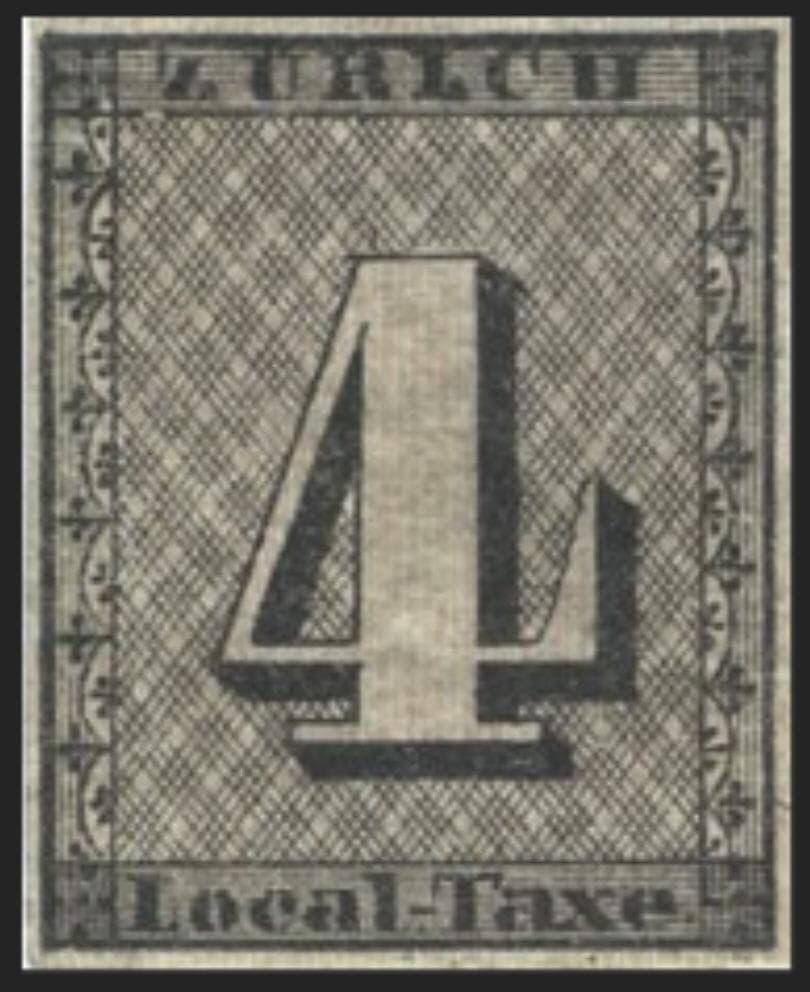
Less than six weeks after its council said yes, the Swiss canton of Zurich put continental Europe's first postage stamps on sale, a big black '4' on fine red lines that owes an obvious debt to Britain's Penny Black.
- Year
- 1843
- Maker
- Canton of Zurich, Switzerland
- By price in stamps
- 38 of 100
Create a free account to see every recorded price and every grade.
Create a free account- What it is
- Zurich's 4 rappen stamp for letters within the city, one of the first two stamps of continental Europe
- Issued
- March 1, 1843, with the 6 rappen for letters within the canton
- Approved
- January 21, 1843, by Zurich's council
- Inscriptions
- 'Zurich' at the top and 'Local-Taxe' at the bottom
- Printer
- Orell Fussli & Co. of Zurich, by lithography
- Types
- Five, because the design was hand drawn five times
- Background
- Fine red lines, vertical on the 1843 printing and horizontal on the 1846 printing
- Record cover
- The only known cover with a rosette handstamp and a whole and a half 4 rappen, $156,000 (180,000 Swiss francs) in 2010
The second country to issue stamps
In 1843 Switzerland was a loose confederation, and each canton ran its own post. Britain's Penny Black had shown in 1840 that prepaid adhesive stamps worked. Zurich's council approved a stamp scheme on January 21, 1843, and in less than six weeks the stamps were ready. They went on sale on March 1, 1843, making Zurich, as the Helvetia Philatelic Society puts it, the second stamp-issuing state in the world.
There were two rates and two stamps. The 4 rappen, inscribed 'Local-Taxe,' paid for letters within the city, the 'Local Rayon.' The 6 rappen, inscribed 'Cantonal-Taxe,' paid for letters to places in the rest of the canton. Both were inscribed 'Zurich' at the top.
Zurich was an important postal canton. When the federal post began in 1849, about 100 of Switzerland's 403 post offices were in the canton of Zurich, against 45 in Bern.
A Penny Black in numbers
Speed left no time for a design competition, which is probably why the stamps look so much like the Penny Black. A large '4' or '6' takes the place of the queen's head, inside an ornamental frame. The stamps were printed in black over a background of fine red lines.
The printing went to Orell Fussli & Co., a Zurich firm founded in 1519 and probably the oldest printing house in Switzerland. The stamps were lithographed. Each design was drawn by hand five times, so there are five distinct types of each value, told apart by small differences in the ornaments and numerals. The five were repeated on the stone in ten double rows of five, 100 stamps to a sheet.
The paper was white or grayish white and was ruled with faint red lines before the black was printed. The first printing of 1843 has vertical red lines. A later printing of 1846 has horizontal lines. Multiples are almost unknown, and some specialists think the stamps were sold in horizontal strips, almost like modern coil stamps.
The Zurich rosette
Zurich also borrowed the idea of a special cancel. Its postmark, a Swiss cross inside an ornamental quatrefoil frame, is known as the Zurich rosette, an echo of Britain's Maltese cross. The rule was that the rosette would be struck in black for letters within the city and in red for letters to the rest of the canton. There were exceptions, and blue or greenish-blue strikes are known from a few offices.
The stamps outlived the cantonal post. The federal government took over the mails in 1849 and issued its first stamps for all of Switzerland in 1850, but Zurich stamps stayed in use for some time and are found with later cancels such as the federal grid and 'P.P.' or 'P.D.' markings. How many were printed is not known.
Covers and singles at auction
Covers carrying the 4 rappen are prized, and the rosette is part of their appeal. On June 4, 2010, at auction in Switzerland, a cover from 1849, the only known cover to bear a rosette handstamp together with a whole and a half 4 rappen stamp, sold for 180,000 Swiss francs, reported as $156,000. The estimate had been 100,000 to 150,000 francs.
In 2016 an 1846 cover franked with an 1843 4 rappen with vertical lines and margins on all four sides was offered at auction in Zurich. It was addressed to the Roemergasse, struck with the red Zurich postmark, and the stamp was tied by a red Zurich rosette.
Single stamps sell for far less. In December 2019 an unused 1843 4 rappen with vertical lines, type III, without gum, sold at auction in the United States for $6,250.00. In the same sale an unused 1846 4 rappen with horizontal lines, type IV, brought $8,000.00. In November 2023 an unused 1843 4 rappen with vertical lines, type 4, with good margins and a certificate, sold in Vienna for 8,700 euros.
Switzerland's first, and Europe's
Zurich's stamps opened the classic era of Swiss philately. Geneva followed on September 30, 1843, with the Double Geneva, the world's first green stamp, and Basel issued its three-color Dove in 1845. The federal Rayon stamps of 1850 then replaced the cantonal issues.
The Zurich 4 and 6 have been widely forged, and the Helvetia Philatelic Society library lists several whole books on detecting Zurich forgeries. They remain classics: the society calls them among the world's classics and very desirable items.
The numbers
- Issue date
- March 1, 1843
- Rate
- Local letters within the city of Zurich
- Printing
- Lithography by Orell Fussli & Co., Zurich; black on a ground of fine red lines
- Sheet
- 100 stamps: ten double rows of five
- Types
- 5, from five hand-drawn designs
- Paper
- White or grayish white
- Printings
- 1843 with vertical red lines; 1846 with horizontal red lines
- Quantity printed
- Not known
Timeline
Britain issues the Penny Black, the model for Zurich's design.
Zurich's council approves the stamp scheme.
The 4 rappen and 6 rappen go on sale, the first stamps of continental Europe.
Geneva issues the Double Geneva, Switzerland's second cantonal stamp.
Basel issues the Basel Dove.
A new printing of the Zurich stamps appears with horizontal red background lines.
The federal government takes over the Swiss post; Zurich stamps stay in use for a time.
The first federal stamps for all of Switzerland are issued.
The only known cover with a rosette and a whole and a half 4 rappen sells for 180,000 Swiss francs ($156,000).
An 1846 cover with a 4 rappen tied by a red rosette is offered at auction in Zurich.
An unused 1843 4 rappen sells for $6,250.00 at auction in the United States.
An unused 1843 4 rappen, type 4, sells for 8,700 euros at auction in Vienna.
The world in 1843
The Thames Tunnel, the first tunnel bored under a river, opens in London.
The SS Great Britain, the first iron-hulled propeller ship to cross the Atlantic, is launched.
Brazil issues its Bull's Eye stamps.
The Economist first publishes in London.
William Rowan Hamilton discovers quaternions.
Shanghai opens to foreign trade.
Charles Dickens publishes 'A Christmas Carol.'
Price record
| Date | Price | Kind |
|---|---|---|
| Jun 4, 2010 | $156,000 | Sold at auctionCover of 1849, the only known cover with a rosette handstamp, franked with a whole and a half 4 rappen; 180,000 Swiss francs, sold at auction in Switzerland against a 100,000-150,000 franc estimate. |
| Dec 4, 2019 | $6,250 | Sold at auction1843 4 rappen, vertical red lines, type III, unused without gum; sold at auction in the United States. |
| Dec 4, 2019 | $8,000 | Sold at auction1846 printing of the 4 rappen, horizontal red lines, type IV, unused with traces of gum; same sale. |
| Nov 22, 2023 | $9,458 | Sold at auctionAt auction in Vienna: EUR 8,700 (hammer price), shown in USD at the Federal Reserve rate on the sale date (1 EUR = 1.0871 USD). |
A realized auction price is what a buyer actually paid on the date shown, including the buyer's premium where the sale reported it. It is the strongest kind of reference price, and it is a record of one sale of one object on one day, not a promise of what the next example will bring.
By reference price, Switzerland 'Zurich 4' (1843 Cantonal) is number 38 of 100 in the stamps entries of the FLOAT 100. 82 of those 100 rest on a realized sale; the rest carry an asking price or a guide value, and each page says which. Rank within the FLOAT 100 itself (71 here) is editorial: how much an object defines its field, not price alone.
Did you know
- Zurich went from council approval to stamps on sale in less than six weeks.
- The printer, Orell Fussli, was founded in 1519.
- Because blocks are almost unknown, some specialists think the stamps were sold in horizontal strips, which would make them a forerunner of coil stamps.
- The rosette cancel was meant to be black for city letters and red for the rest of the canton.
- About a quarter of all Swiss post offices in 1849 were in the canton of Zurich.
How this page is made
- The figure
- One reference price, shown with its own kind. FLOAT does not average it with anything or adjust it for time.
- Realized or not
- A realized price is a completed sale. An asking price, an estimate and a price-guide value are not sales, and are labeled as such wherever they appear.
- The story
- Researched from published records and checked fact by fact. Updated Oct 3, 2026.
- Archive
- Oct 5, 2026