FLOAT 100 · Stamps · No. 72
Switzerland 'Double Geneva' (1843 Double de Geneve)
In 1843 Geneva printed a stamp you could cut in half: each side paid a letter across town, the whole paid one across the canton, and almost nobody wanted to use it, which is exactly why an intact pair on a letter is now one of Europe's great rarities.
- Year
- 1843
- Maker
- Canton of Geneva, Switzerland
- By price in stamps
- 33 of 100
Create a free account to see every recorded price and every grade.
Create a free account- What it is
- Geneva's first postage stamp: two 5-centime stamps joined side by side under one heading, worth 10 centimes together
- Issued
- September 30, 1843, by the Canton of Geneva (some catalogs give October 1)
- Design
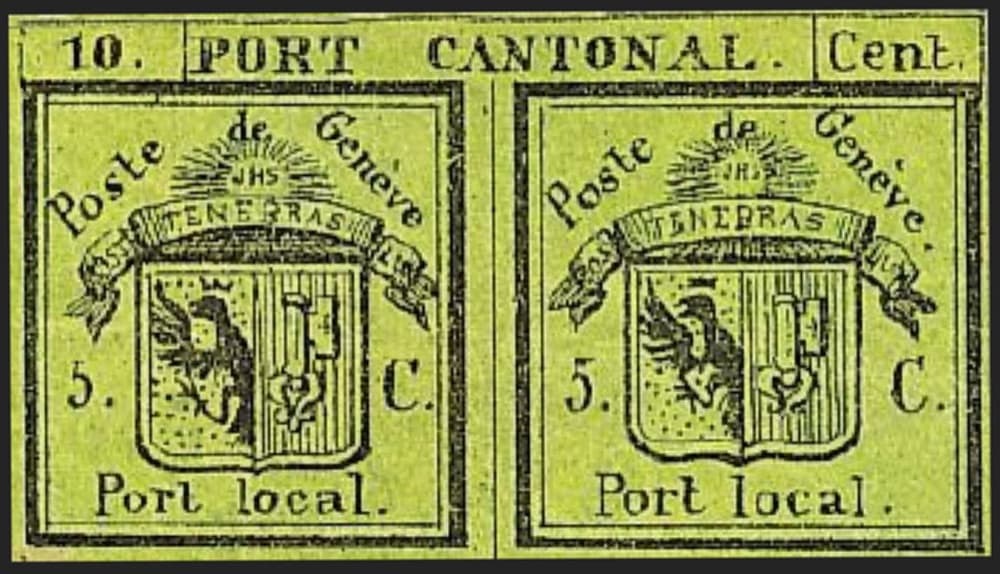
- Twin Geneva coats of arms, each framed by 'Poste de Geneve', '5 C' and 'Port local'
- Printing
- Lithographed in black on yellow-green paper by Charles Alphonse Schmid, Geneva; imperforate
- Quantity
- 1,200 sheets of 50 doubles, or 60,000 doubles; about 6,000 used and about 600 preserved, by one count
- Place in history
- Third stamp issue of continental Europe, after the Zurich 4 and 6; called the world's first green postage stamp
- Rarest form
- An intact double on its original letter; fewer than twenty complete doubles on cover are said to exist
- Record lot
- A cover with an intact double, postmarked September 12, 1844, sold for $235,000 at auction in Switzerland in June 2010
A stamp that could be cut in two
Before Switzerland had a federal post, each canton ran its own mail. Zurich went first, issuing its 4 and 6 rappen stamps on March 1, 1843. Geneva followed six months later. On May 22, 1843, Professor Alphonse de Candolle proposed stamps for the canton, the plan was approved on September 13, and the new stamp was first used on Saturday, September 30, 1843. Some catalogs list October 1.
Geneva's solution to a two-rate postal system was unusual. The local rate inside the city of Geneva was 5 centimes, and the rate to other places in the canton was 10 centimes. Instead of printing two separate stamps, Geneva printed a 'double': two identical 5-centime stamps side by side under a shared heading. Cut in half, each side paid a letter within the city. Used whole, the double paid 10 centimes for a letter going elsewhere in the canton.
Each half shows the Geneva coat of arms inside a square frame lettered 'Poste de Geneve' above and 'Port local' below, with '5 C' for the value. The stamps were printed in black on yellow-green paper, which is why the Double Geneva is often called the world's first green postage stamp.
The printer and the slow start
The stamps were lithographed in Geneva by Charles Alphonse Schmid, in sheets of 50 doubles, and issued without perforations, so clerks and customers cut them apart with scissors. Schmid went on to print Geneva's next stamp, the 'Small Eagle' of April 1, 1845, also in a run of 1,200 sheets.
The public was not convinced. Very few stamped letters survive from late 1843, and by one account only about one letter in 15 carried a stamp in 1844. To encourage people to pay in advance, the post office decided on February 6, 1844, to sell the double for 8 centimes and a single half for 4 centimes, below face value. Another account dates the discount from March 1, 1844, which may be when it took effect. By 1845, about one piece of mail in five was franked.
That reluctance is the root of the rarity. The printing was 1,200 sheets, or 60,000 doubles, but by one widely repeated count only about 6,000 were ever used and only about 600 are preserved. The figures are not settled: one encyclopedia says only 6,000 doubles were printed at all, and a 2017 auction report said 30,000 doubles were issued.
Europe learns to stick stamps on letters
In 1843 the postage stamp was barely three years old. Britain's Penny Black had appeared in 1840, Zurich issued its stamps in March 1843, and Brazil released its 'Bull's Eyes' on August 1, 1843. The Double Geneva ranks as the third-oldest stamp issue of continental Europe, after the Zurich 4 and 6.
The cantonal system did not last. The new federal government took over the postal service in 1849, and Zurich and Geneva printed stamps only briefly until the first federal stamps appeared in May 1850. All cantonal stamps stayed valid until September 30, 1854. Recorded uses of the Double Geneva run from November 3, 1843, to January 8, 1850, for intact doubles, and from October 14, 1843, to September 9, 1854, for single halves.
Covers, records and the finest copies
Most survivors are single halves or doubles off their letters. Covers, and especially covers with an intact double, are described as exceedingly rare, and one account puts the number of complete doubles on cover at fewer than twenty.
The most expensive Double Geneva cover on public record sold at auction in Switzerland on June 4, 2010. Postmarked 'GENEVE 12 SEPT 44' and addressed to the Eaux-Vives district of Geneva, it came from the collection of Alfred F. Lichtenstein and carried a pair described as 'exceptionally fresh, exquisite quality.' It brought 270,000 Swiss francs, or $235,000, well over its estimate of 150,000 to 200,000 francs.
The earliest known use of a Double Geneva on cover, a letter dated October 24, 1843, sold at auction in Zurich in May 2015. The auctioneer's report gave its price as 100,000 Swiss francs, the top lot of the Swiss section. A later account gives 200,000 francs, so the two reports disagree.
Loose doubles sell for far less. An intact used double has been described as fetching around $60,000 at auction. In March 2015 a double sold for $34,500 at auction, and in April 2017 another, called one of the very finest known for its large margins and red Geneva rosette cancel, was offered in New York with an estimate of $42,500.
How to recognize one
A genuine Double Geneva is lithographed in black on yellow-green paper, imperforate and without watermark. The two halves sit under a common inscription, and each shows the coat of arms in a square frame with 'Poste de Geneve', '5 C' and 'Port local'. Cancellations are usually a red 'rosette', though a black grid was also used.
One variety is especially rare: only six doubles are known in which the left stamp is the right half.
Forgeries exist; the forgers Sperati and Fournier are among those who imitated it.
The numbers
- Issue date
- September 30, 1843 (catalogs often give October 1)
- Face value
- 5 centimes per half (city of Geneva), 10 centimes for the whole (rest of the canton)
- Printing
- Lithography by Charles Alphonse Schmid, Geneva
- Paper and color
- Black on yellow-green paper, no watermark
- Separation
- Imperforate
- Sheet
- 50 doubles
- Quantity printed
- 1,200 sheets, 60,000 doubles (sources disagree; 6,000 and 30,000 are also cited)
- Survivors
- About 6,000 used and about 600 preserved, by one count
- Recorded use
- Doubles November 3, 1843 to January 8, 1850; halves October 14, 1843 to September 9, 1854
Timeline
Zurich issues its 4 and 6 rappen stamps, the first in Switzerland.
Professor Alphonse de Candolle proposes postage stamps for Geneva.
Geneva approves the stamp.
The Double Geneva is first used.
Earliest recorded use of a single half.
Date of the earliest known Double Geneva cover, sold in Zurich in 2015.
Earliest recorded use of an intact double.
The post office decides to sell the double for 8 centimes and a half for 4 centimes to encourage prepayment.
Postmark date on the cover that set the auction record in 2010.
Geneva's 'Small Eagle' stamp is issued, also printed by Schmid.
The Swiss federal government takes over the postal service.
Latest recorded use of an intact double.
The first federal stamps appear.
Latest recorded use of a single half.
Cantonal stamps lose their postal validity.
An intact double on cover sells for $235,000 at auction in Switzerland.
The earliest known Double Geneva cover sells at auction in Zurich.
The world in 1843
The Thames Tunnel opens in London, the first tunnel bored under a navigable river.
About 1,000 pioneers leave Missouri for Oregon in the first major wagon train.
The SS Great Britain, the first iron-hulled, propeller-driven ship to cross the Atlantic, is launched in Bristol.
Brazil issues its 'Bull's Eye' stamps, the second national stamps after Britain's.
Ada Lovelace completes her notes on Charles Babbage's Analytical Engine.
Charles Dickens publishes 'A Christmas Carol'.
Price record
| Date | Price | Kind |
|---|---|---|
| Jun 4, 2010 | $235,000 | Sold at auctionIntact double on cover postmarked 'GENEVE 12 SEPT 44', ex-Alfred F. Lichtenstein. 270,000 Swiss francs at auction in Switzerland, against an estimate of 150,000-200,000 francs. |
| Nov 2015 | $99,030 | Sold at auctionAt auction in Zurich: CHF 100,000 (hammer price), shown in USD at the Federal Reserve monthly average (1 CHF = 0.9903 USD). |
A realized auction price is what a buyer actually paid on the date shown, including the buyer's premium where the sale reported it. It is the strongest kind of reference price, and it is a record of one sale of one object on one day, not a promise of what the next example will bring.
By reference price, Switzerland 'Double Geneva' (1843 Double de Geneve) is number 33 of 100 in the stamps entries of the FLOAT 100. 82 of those 100 rest on a realized sale; the rest carry an asking price or a guide value, and each page says which. Rank within the FLOAT 100 itself (72 here) is editorial: how much an object defines its field, not price alone.
Did you know
- Geneva sold the stamp below face value, 8 centimes for a 10-centime double, because the public would not use it.
- In 1844 only about one letter in 15 in Geneva carried a stamp.
- It is often called the world's first green postage stamp.
- Only six doubles are known in which the left stamp is the right half.
- Its stamps stayed valid for nearly four years after the federal stamps appeared, until September 30, 1854.
- The record cover was addressed to Eaux-Vives, a district of Geneva itself.
How this page is made
- The figure
- One reference price, shown with its own kind. FLOAT does not average it with anything or adjust it for time.
- Realized or not
- A realized price is a completed sale. An asking price, an estimate and a price-guide value are not sales, and are labeled as such wherever they appear.
- The story
- Researched from published records and checked fact by fact. Updated Oct 3, 2026.
- Archive
- Oct 5, 2026