FLOAT 100 · Stamps · No. 95
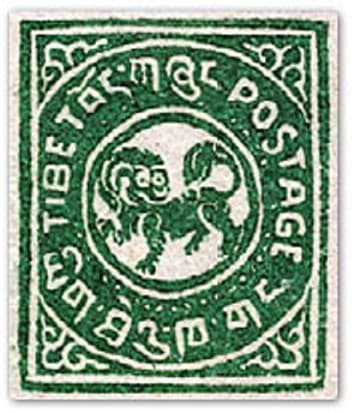
Tibet 1912 First Issue (Lion Design)
When the 13th Dalai Lama's government set up its own post after the fall of the Qing, it carved its first stamps by hand, twelve to a wooden block, so that no two stamps on a sheet are quite the same.
- Year
- 1912
- Maker
- Government of Tibet (Lhasa)
- By price in stamps
- 99 of 100
Create a free account to see every recorded price and every grade.
Create a free account- What it is
- Tibet's first postage stamps, a set of five values showing a snow lion
- Issued
- December 1912, in Lhasa
- Values
- 1/6, 1/3, 1/2 and 2/3 trangka and 1 trangka
- Colors
- Green, blue, violet, carmine and vermilion
- Plates
- One hand-carved block of 12 stamps per value, three rows of four
- Paper
- Native Tibetan paper, imperforate, no gum, no watermark
- Inscriptions
- 'Tibet Government' in Tibetan and 'Tibet' in English
- Valid
- Inside Tibet only; Tibet never joined the Universal Postal Union
- Forgeries
- Exist of all values; one study lists seven forgeries of the issue
A post office for a newly independent Tibet
Mail had come to Tibet from outside. After the British expedition of 1904, British Indian post offices operated at places such as Lhasa, Gyantse, Yatung, Pharijong and Gartok. In 1909 China set up its own postal service in Tibet, and in 1911 Chinese stamps were overprinted with new values in Chinese, English and Tibetan for use there.
The Qing dynasty sent an expedition to assert control over Tibet in 1910. After the Xinhai Revolution, Tibetan militia attacked the Qing garrison, and the Qing officials in Lhasa signed an agreement for the surrender and expulsion of their forces from central Tibet. The 13th Dalai Lama returned to Lhasa and in January 1913 proclaimed that Tibet's relationship with Beijing had been one of patron and priest, not of subordination.
In those years the Tibetan government set about building the tools of a modern state. It created its own currency, began building up its army with British help, and set up a postal service. Its first stamps were issued in Lhasa in 1912, and Tibetan post offices eventually opened in places including Lhasa, Shigatse, Gyantse and Nagartse.
Carved by hand, twelve at a time
Each value was printed from its own 'plate,' a wooden block into which 12 stamp images were carved by hand, in three rows of four. Because every image was carved separately, each stamp in a sheet differs slightly from the others. That lets specialists 'plate' the stamps, working out which of the twelve positions a single stamp came from.
The stamps were printed by relief printing on native Tibetan paper, without gum or watermark, and were imperforate, so they had to be cut apart. They were printed on request from the post offices, and every printing has a different shade. Between about 1920 and 1930 some printings were made with shiny enamel paint from Europe instead of ink, which gives the surface a glossy look.
The design shows a snow lion, the national emblem of Tibet, and is inscribed in Tibetan characters meaning 'Tibet Government' and in English 'Tibet.' A misprint on the 2/3 trangka carmine reads 'POTSAGE' instead of 'POSTAGE.'
The snow lion and the trangka
The snow lion represents Tibet's snowy mountains and glaciers, and it can also stand for power, strength, fearlessness and joy. From 1909 to 1959 it appeared on Tibet's national emblem, coins, banknotes, flag and stamps. The 13th Dalai Lama introduced the two-lion flag in 1912, based on old military banners, and it is still used by the Tibetan government in exile.
The stamps were valued in the trangka, the traditional Tibetan coin, and its fractions. Each fraction had its own name: the 1/6 trangka was one 'khakang,' the 1/3 one 'karmanga,' the 1/2 one 'tschakey' and the 2/3 one 'shokang.' Paper money in tangka denominations was also issued from 1912, and one mint struck a silver 2 tangka coin that year.
The stamps were good only inside Tibet. Tibet never joined the Universal Postal Union. The Tibetan government opened fourteen post offices of its own.
Shades, settings and forgeries
The five original values are the 1/6 trangka green, 1/3 trangka blue (also found in ultramarine), 1/2 trangka violet, 2/3 trangka carmine and 1 trangka vermilion. A sixth value in the same design, the 1 sang in sage green, worth 6 2/3 trangka, came later. Sources disagree on when: one reference dates it to 1922 and another to 1950.
Because each sheet holds 12 different hand-carved images and each printing differs in shade, the first issue rewards close study. One reference notes that the stamps occur both as prints on Tibetan paper and on European paper. The ink printings run from 1912 to 1950, so a 'first issue' stamp may have been printed decades after 1912.
Forgeries are a real hazard. A forgery reference says forgeries exist of all values, and the standard postal history of Tibet, by Arnold C. Waterfall, includes plating tables, describes seven forgeries of the issue and covers fraudulent cancellations. A reference catalog warns that excellent counterfeits exist, and Wikipedia notes that collectors meet many fakes of both Tibetan stamps and cancellations.
From Lhasa to the collector's album
Tibet went on to issue stamps in 1914 and 1933 and kept using them until the end of the 1950s. China re-established its postal service in Tibet in 1951, and the last Tibetan post offices closed in 1959, the year the Dalai Lama went into exile in India.
Ordinary copies are not costly. A collector's reference quotes the American catalog at $40 to $55 for the individual first-issue values. Specialized material includes complete sheets that show all twelve carved positions, the enamel printings and the 'POTSAGE' error. Major studies by Waterfall, first published in 1965 and revised in 1981, and earlier by Henry Robert Holmes in 1941, are the standard references.
The numbers
- Issue date
- December 1912
- Values
- 1/6 trangka green, 1/3 blue, 1/2 violet, 2/3 carmine, 1 trangka vermilion
- Sheet
- 12 stamps, three rows of four, each image hand carved
- Printing
- Relief printing from wooden blocks; some later printings in enamel paint
- Perforation
- Imperforate
- Paper
- Native Tibetan paper, no gum, no watermark
- Period printed
- 1912 to 1950 in ink
- Known error
- 'POTSAGE' on the 2/3 trangka
Timeline
After the British expedition, Indian post offices open in Tibet.
China establishes a postal service in Tibet.
A Qing expedition is sent to assert control over Tibet.
Chinese stamps are overprinted in Chinese, English and Tibetan for use in Tibet.
The 13th Dalai Lama introduces the two-snow-lion flag.
Tibet's first stamps, the hand-carved snow lion issue, appear in Lhasa in sheets of 12.
The Dalai Lama, back in Lhasa, proclaims Tibet's independence.
Tibet issues a new series of stamps.
The Simla Convention is signed.
Printings in European enamel paint begin, continuing to about 1930.
Another Tibetan stamp series appears.
Henry Robert Holmes publishes a study of Tibetan stamps.
China re-establishes its postal service in Tibet.
The last Tibetan post offices close; the Dalai Lama goes into exile.
Arnold C. Waterfall's postal history of Tibet is published; it is revised in 1981.
The world in 1912
The Republic of China is established.
A British expedition reaches the South Pole, the second group to do so.
Puyi, the last Qing emperor, abdicates.
The Titanic sinks, with the loss of more than 1,500 lives.
The Summer Olympics open in Stockholm.
Emperor Meiji of Japan dies.
The First Balkan War begins.
Woodrow Wilson is elected U.S. president.
Price record
A price-guide value is an editorial estimate, not a transaction and not an asking price. Guides lag the market and smooth over grade and condition. It is neither a floor nor a ceiling: a sale can land above or below it, and it should be checked against a realized sale before anything rests on it.
By reference price, Tibet 1912 First Issue (Lion Design) is number 99 of 100 in the stamps entries of the FLOAT 100. 82 of those 100 rest on a realized sale; the rest carry an asking price or a guide value, and each page says which. Rank within the FLOAT 100 itself (95 here) is editorial: how much an object defines its field, not price alone.
Did you know
- Every stamp on a sheet of Tibet's first issue is slightly different, because each of the twelve images was carved by hand.
- Some printings used shiny European enamel paint instead of printing ink.
- Tibet's stamps were valid only inside Tibet; the country never joined the Universal Postal Union.
- One value carries a spelling error: 'POTSAGE.'
- The same design stayed in use for decades, so a first-issue stamp may have been printed long after 1912.
- The 13th Dalai Lama introduced the Snow Lion flag in the same year the stamps appeared.
How this page is made
- The figure
- One reference price, shown with its own kind. FLOAT does not average it with anything or adjust it for time.
- Realized or not
- A realized price is a completed sale. An asking price, an estimate and a price-guide value are not sales, and are labeled as such wherever they appear.
- The story
- Researched from published records and checked fact by fact. Updated Oct 3, 2026.
- Archive
- Oct 5, 2026