FLOAT 100 · Stamps · No. 20
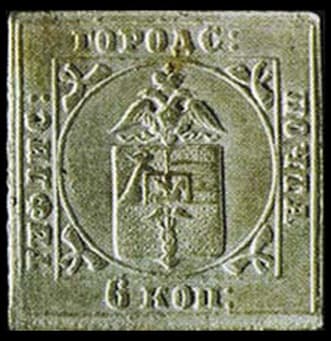
Tiflis City Post Stamp ('Tiflis Unica')
A colorless, embossed square of paper from a Caucasus city post, it is dated months before the Russian Empire's first national stamps, went unseen by collectors for decades, and has since surfaced in the Fabergé collection, a Smithsonian vault and a New Zealand auction lot.
- Year
- 1857
- Maker
- Russian Empire (Tiflis/Kojori city post, modern Tbilisi)
- By price in stamps
- 19 of 100
Create a free account to see every recorded price and every grade.
Create a free account- Issued
- 1857 for the city post of Tiflis (now Tbilisi, Georgia) and the nearby summer resort of Kojori; newer research dates it to June 20, 1857
- Value
- 6 kopecks: 5 kopecks of city postage plus 1 kopeck for the cost of making the stamp
- Design
- The arms of Tiflis beneath a double-headed eagle with lowered wings, embossed without ink on yellowish paper
- Inscriptions
- "ТИФЛИС:" (Tiflis), "ГОРОДС:" (city), "ПОЧТА" (post) and "6 КОП:" around the four sides
- Instigator
- N.S. Kokhanov, head of the postal district of the Caucasus
- Nickname
- "Tiflis Unica," coined in 1929 by the Baku philatelist Sergei Kuzovkin
- Known examples
- Counts differ: five, six or eight depending on the source; at least two are in museums
- This example
- The copy from the collection of Zbigniew Mikulski, sold in Geneva on October 5, 2008, for €480,000, reported as about $700,000
A stamp for a city post
In 1857 Tiflis, today Tbilisi, the capital of Georgia, was part of the Russian Empire. The summer residence of the tsar's representative was at nearby Kojori. A local city post carried letters within Tiflis and out to Kojori, and on the initiative of N.S. Kokhanov, who managed the postal district of the Caucasus and Transcaucasia, it issued its own prepaid labels.
Officially they were not called stamps at all. The original issue was described as "paper stamp seals that have the properties of wafers." One was required for a letter within the city and three for a letter to Kojori or back. The value was 6 kopecks: 5 for the city postage and 1 to cover the cost of making the stamp.
The dating matters, because it decides whether this is Russia's first stamp. Older accounts placed the issue in November or December 1857, before December 10, 1857, which those sources give as the date of the first stamps for the whole empire. Newer research cited by Russian specialists puts the issue on June 20, 1857. The stamps may have stayed in use in Tiflis and Kojori until about 1865 or 1866, although earlier accounts say they were withdrawn on March 1, 1858, when the empire's general stamps and envelopes reached the Caucasus.
Reading a stamp with no ink
The Tiflis stamp is square, imperforate and printed without any ink: the design is pressed into yellowish paper as colorless relief, and the back carries a thick layer of yellowish gum. It was probably produced in strips of five.
At the center is the arms of Tiflis with a double-headed eagle above it, wings lowered. The old arms of the city were divided in two: the upper half showed Mount Ararat with Noah's Ark on its summit, the Kura River and Saint George on horseback, the patron saint of Georgia; the lower half showed the staff of the god Mercury. Around the four sides run the words "ТИФЛИС:", "ГОРОДС:", "ПОЧТА" and "6 КОП:", meaning Tiflis City Post, 6 kopecks.
Because the design is only relief, the stamp is hard to photograph and easy to misread. When a German catalog listed it in 1957, its drawing of the design and inscription was wrong. Authentication has relied on side-by-side comparison of the paper and embossing with the known genuine examples.
A stamp everyone talked about and nobody had seen
Collectors first heard of a Tiflis city post with its own stamp in the 1880s, but no one had seen one. From 1889 the leading stamp catalog of the day kept mentioning it anyway, with the question "Il y a des timbres, mais lesquels?" ("There are stamps, but which ones?"). The listing later lapsed, and the stamp disappeared from catalogs until a German catalog described it in 1933 and illustrated it from 1934.
Only three examples were found before World War I. The first known to collectors was bought in 1913 by the architect K.K. Schmidt. During the 1910s and 1920s all three were acquired by Agathon Fabergé, the philatelist son of the jeweler Peter Carl Fabergé, who emigrated from Russia; his best copy came from George Kirchner and his second from V. Werkmeister. Fabergé exhibited them at Helsingfors (Helsinki) in 1928 and at the WIPA international exhibition in Vienna in 1933.
The Fabergé collection was later pledged, taken to London and sold at auction in 1939. On November 20, 1939, the best Tiflis stamp went to J. Wilson for £28. A second went for £25 to T. Lavrov for the collection of H. Stubbe, and a third sold for £14.
From £14 to half a million dollars
The Stubbe stamp sold again on October 2, 1957, for £180, to R. Davidson. It later belonged to R. Bergman and was sold at auction in New York on March 24, 1971, for $7,250, which New York newspapers reported as the largest sum ever paid for a Russian stamp. The third Fabergé copy sold for £175 on February 19, 1958, with the collection of H. Goss.
Two of the stamps later belonged to Zbigniew Mikulski, a noted specialist in Russian stamps living in Switzerland, who showed them at the Moscow-97 world exhibition. The third, the worst preserved, went to the collection of the daughter of the Luxembourg collector Berlinger. In 2000 Mikulski sold his two copies privately for half a million dollars; the buyer was not named.
On October 5, 2008, one of the ex-Mikulski stamps, then one of only three examples known in the world, sold at auction in Geneva for €480,000, reported as more than $700,000. It is the price most often cited for the stamp and the one this page tracks.
Two more turned up in unlikely places. In March 2011 an unused copy was identified at the Smithsonian's National Postal Museum in Washington, in the collection of George H. Kaestlin, a Russian émigré in England whose 14,000-stamp collection had been donated to the museum in 1984 and had sat uncataloged for decades. Then in 2014 Robin Gwynn of Hawke's Bay, New Zealand, paid NZ$3,300 at an Auckland auction for an old album and found a stamp he could not identify. An expert opinion obtained from New York first called it a forgery; after Gwynn took it to the Royal Philatelic Society London in 2016 and it was compared with the known copies, including the Smithsonian's, it was certified genuine and sold at auction in London in October 2017 for £165,000.
Russia's first stamp, or not
Whether the Tiflis stamp counts as Russia's first postage stamp depends on whom you ask. Specialists have classified it as a local provisional, as the first government stamp of Russia, as a rural-post stamp, as the first issue of the Tiflis city post, and in one dissenting view as a speculative fantasy of the late 19th or early 20th century. Its date and its imperial eagle are the main arguments for calling it the first.
The census is unsettled too. A U.S. State Department article on the Kaestlin collection said five examples are known; the 2017 sale catalog called the New Zealand find one of six recorded genuine examples, two in institutions; a New Zealand report said five were known before Gwynn's, three from the Fabergé collection, one at the Smithsonian and one in the Berlin postal museum; and a Russian philatelic site counts eight.
Georgia has honored it on its own stamps: in 1997 it issued a stamp marking 140 years of the Tiflis Unica.
The numbers
- Issue date
- June 20, 1857 (newer research); earlier accounts say November or December 1857
- Value
- 6 kopecks
- Printing
- Colorless embossing (relief) on yellowish paper, thick yellowish gum
- Perforation
- Imperforate; square format, probably in strips of five
- Quantity printed
- Unknown; rarity attributed to a small printing
- Quantity known
- Five, six or eight depending on the source
- Postage
- One stamp for a letter within Tiflis; three for a letter to or from Kojori
Timeline
Issue date of the Tiflis city post stamp according to newer research; older accounts place it in November or December 1857.
Date given by Russian sources for the first stamps of the Russian Empire as a whole.
Withdrawal date given by earlier accounts; other research says the stamps were used until about 1865-66.
A leading stamp catalog begins listing a Tiflis stamp that no collector has yet seen.
The architect K.K. Schmidt buys the first example known to collectors.
Agathon Fabergé exhibits his Tiflis stamps in Helsingfors (Helsinki).
Baku philatelist Sergei Kuzovkin coins the name "Tiflis Unica."
Shown at the WIPA exhibition in Vienna; a German catalog describes the stamp for the first time.
The Fabergé copies are sold at auction in London; the best goes to J. Wilson for £28.
The ex-Stubbe copy sells for £180 to R. Davidson.
The same copy sells at auction in New York for $7,250, a record for a Russian stamp.
George H. Kaestlin's Russian collection, including a Tiflis stamp, is donated to the Smithsonian.
Zbigniew Mikulski shows two copies at the Moscow-97 world exhibition; Georgia issues a stamp marking 140 years of the Tiflis Unica.
Mikulski sells his two copies privately for half a million dollars.
An ex-Mikulski copy sells at auction in Geneva for €480,000.
A Tiflis stamp is identified in the Kaestlin collection at the National Postal Museum in Washington.
Robin Gwynn buys an old album at auction in Auckland that contains an unrecognized Tiflis stamp.
Gwynn's stamp, certified genuine in 2016, sells at auction in London for £165,000.
The world in 1857
The U.S. Supreme Court rules in Dred Scott v. Sandford.
Elisha Otis installs his first passenger elevator, at 488 Broadway in New York.
The Indian Rebellion of 1857 begins when the 3rd Light Cavalry of the East India Company's army turns on its British officers.
Queen Victoria officially opens the Victoria and Albert Museum in London.
The Panic of 1857 begins in the United States.
The Russian ship of the line Lefort sinks in a squall in the Gulf of Finland with the loss of 826 lives.
British and French forces begin their assault on Canton in the Second Opium War.
Price record
| Date | Price | Kind |
|---|---|---|
| Oct 2, 1957 | $504 | Sold at auctionAt auction: GBP 180 (hammer price), shown in USD at the official par value of the time (1 GBP = 2.8000 USD). |
| Feb 19, 1958 | $490 | Sold at auctionAt auction: GBP 175 (hammer price), shown in USD at the official par value of the time (1 GBP = 2.8000 USD). |
| Oct 5, 2008 | $700,000 | Sold at auctionEx-Mikulski copy sold at auction in Geneva for €480,000; one source gives about $700,000, others say more than $700,000. |
| Oct 2017 | $217,833 | Sold at auctionAt auction in London: GBP 165,000 (hammer price), shown in USD at the Federal Reserve monthly average (1 GBP = 1.3202 USD). |
A realized auction price is what a buyer actually paid on the date shown, including the buyer's premium where the sale reported it. It is the strongest kind of reference price, and it is a record of one sale of one object on one day, not a promise of what the next example will bring.
By reference price, Tiflis City Post Stamp ('Tiflis Unica') is number 19 of 100 in the stamps entries of the FLOAT 100. 82 of those 100 rest on a realized sale; the rest carry an asking price or a guide value, and each page says which. Rank within the FLOAT 100 itself (20 here) is editorial: how much an object defines its field, not price alone.
Did you know
- The stamp has no ink at all: the design is pressed into the paper as colorless relief.
- For decades a major catalog listed it while admitting it did not know what it looked like: "There are stamps, but which ones?"
- In 1939 the best example sold for £28.
- One example sat uncataloged in a Smithsonian collection for more than 25 years before it was recognized in 2011.
- A New Zealand collector found one in an album he bought for NZ$3,300. It was first called a forgery, then certified genuine and sold for £165,000.
- Postage within the city was 5 kopecks; the sixth kopeck paid for making the stamp.
How this page is made
- The figure
- One reference price, shown with its own kind. FLOAT does not average it with anything or adjust it for time.
- Realized or not
- A realized price is a completed sale. An asking price, an estimate and a price-guide value are not sales, and are labeled as such wherever they appear.
- The story
- Researched from published records and checked fact by fact. Updated Oct 1, 2026.
- Archive
- Oct 5, 2026