FLOAT 100 · Stamps · No. 42
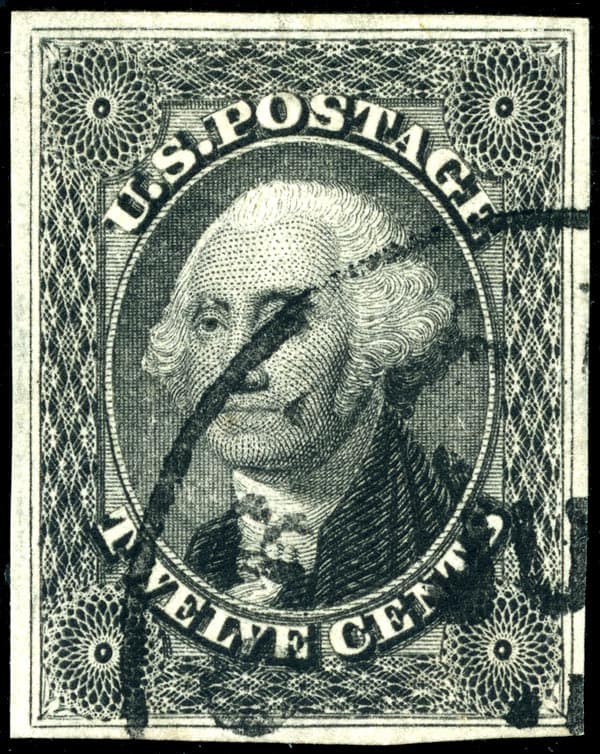
US 1851 12c Washington
The highest-value American stamp of its day matched no ordinary postage rate, was cut in half, against the rules, by Californians short of smaller stamps, and today is almost never found with the gum it left the post office with.
- Year
- 1851
- Maker
- United States (USPOD)
- By price in stamps
- 73 of 100
Create a free account to see every recorded price and every grade.
Create a free account- Catalog number
- Scott 17
- Issued
- July 1, 1851, with the 1-cent and 3-cent stamps of the same series
- Earliest recorded use
- August 4, 1851
- Design
- George Washington, after a Gilbert Stuart portrait, in gray black
- Printer
- Toppan, Carpenter, Casilear & Co.
- Format
- Imperforate; sheets of 200 in two panes of 100
- Quantity
- About 2,500,000 imperforate stamps printed
- Main use
- Pairs paid the 24-cent letter rate to Britain
- Scarcity
- Unused examples are usually without gum; sound original-gum copies are rare
- Catalog value
- $6,250 unused with original gum, $250 used per a market column
A stamp for no single rate
America's first two postage stamps, issued in 1847, served a rate system based on weight and distance: 5 cents per half ounce for up to 300 miles and 10 cents beyond. On March 3, 1851, Congress cut those rates. From July 1, a half-ounce letter cost 3 cents for up to 3,000 miles and 6 cents for longer distances, and the 1847 stamps were demonetized.
Three new stamps went on sale that day: a 1-cent Franklin, a 3-cent Washington and a 12-cent Washington. The 12-cent stamp was the highest U.S. denomination ever issued at the time, and it corresponded to no single-letter rate. Philatelists have had to speculate about why it was made at all. It could pay a quadruple-weight 3-cent letter or a double-weight 6-cent letter, and a pair paid the 24-cent treaty rate on a letter to England, which became its most common use. It also went on mail to places such as Holland, Spain, Mexico and Switzerland, often combined with other values.
One auction firm's history of the issue calls it odd that the post office chose a 12-cent stamp instead of a 6-cent one. When stamped envelopes arrived in 1853 there was no 12-cent value at all; a 6-cent envelope came first.
How it was made
The firm Toppan, Carpenter, Casilear & Co. designed and printed the 1851 series. Its stamps were engraved on a steel die, transferred to a roll and then rocked into a printing plate, a process that left tiny differences between positions that specialists still study.
Washington's portrait was taken from a painting by Gilbert Stuart. Henry Earle, who had worked with Charles Toppan since 1840, engraved the frame and lettering for the whole 1851-1861 series. Corner rosettes and a geometric mosaic background surround the portrait medallion. When the post office needed a 10-cent stamp in 1855, the printers reused the 12-cent vignette for it.
Mint records show three 12-cent plates were engraved, but no stamps from Plate 2 are known. Plate 1 printed all the imperforate stamps: 200 subjects in two panes of 100, so tightly spaced that most copies have small margins. Its impressions are generally clear and well inked, and the subjects are consistent enough that specialists have plated all 200 positions from double transfers, recut lines and guide dots.
Cut in half in California
Because the series had no 6-cent stamp, some mailers cut the 12-cent stamp in half, diagonally or vertically, to pay the 6-cent rate for letters going more than 3,000 miles. The Post Office Department banned the practice; if caught, the letter was treated as unpaid and the recipient owed a 10-cent fee. Most surviving bisects are on covers from California.
One such cover, sent from San Francisco to Peoria, Illinois, was docketed as sent August 1, 1853, and received September 8. An auction description from 2012 explained that 12-cent stamps were bisected in San Francisco when 3-cent stamps were in short supply. It sold for $2,100.
Prepayment was optional when the stamp appeared, but higher collect rates pushed people toward stamps, and prepayment became mandatory on January 1, 1856.
How to identify it
Scott 17 is the imperforate 12-cent gray black Washington of 1851. Perforated stamps from the same Plate 1 are known used as early as July 30, 1857, and a later Plate 3, in use from late 1859, has uneven or broken frame lines and blurrier impressions. A common fake is a perforated stamp with its perforations trimmed off to pass as imperforate, so wide, even margins and a certificate matter.
The scarce state is unused. One auction catalog described the 12-cent as one of the most difficult early classics to find mint, noting that unused copies are 'invariably found without gum' and that several great U.S. collections sold in recent years had no original-gum example at all. That superb original-gum single sold for $16,000; the page does not give the year.
Varieties include diagonal and vertical bisects (17a, 17b), copies on thin Part India paper from what students believe are the earliest impressions, and the stamp printed on both sides (17c). How many of the last exist is disputed: one dealer says four are known, while a 2012 auction catalog says only two complete examples can be located and that none is known unused.
A market column put the standard specialized catalog value at $6,250 for an unused, original-gum stamp and $250 used, and suggested a good four-margin used copy is a fair buy at 80 to 100 percent of catalog.
In the auction record
Results from 2012 show the range for single stamps: a used single with a red arrival mark sold for $150, an original-gum Fine copy with a 1977 certificate for $2,800, a superb used copy graded 98 for $1,900, and a used single with a large part of the printer's imprint, which the auction firm called the finest used imprint single of the issue, for $6,250. The printed-on-both-sides copy offered that June sold for $45,000.
Multiples are rarer. The largest recorded unused multiple, a corner block of 15 from the top right of the left pane, realized $55,000 hammer at auction in 1998. Used blocks are extremely rare, and only a few are known on cover.
The numbers
- Issue date
- July 1, 1851 (earliest recorded use August 4, 1851)
- Quantity printed
- About 2,500,000 imperforate
- Perforation
- Imperforate
- Paper
- Unwatermarked; a Part India paper variety exists
- Printing
- Intaglio from steel plates, Plate 1, 200 subjects in two panes of 100
- Color
- Gray black
- Printed on both sides
- Two complete examples located per one 2012 census; one dealer says four
Timeline
America's first two postage stamps are issued.
Congress passes the act lowering postal rates, effective July 1.
The 12-cent Washington is issued with the 1-cent and 3-cent stamps; the 1847 stamps are demonetized.
Earliest recorded use of the 12-cent stamp.
Stamped envelopes are introduced, with no 12-cent value.
A diagonal half of a 12-cent stamp pays postage on a cover from San Francisco to Peoria, Illinois.
The over-3,000-mile rate rises to 10 cents; the new 10-cent stamp reuses the 12-cent vignette.
Prepayment of postage with stamps becomes mandatory.
Earliest known use of a perforated 12-cent stamp from Plate 1.
Earliest known use of the perforated 12-cent from the new Plate 3.
Late in the year, the federal demonetization order takes effect.
The largest recorded unused multiple, a block of 15, realizes $55,000 hammer at auction.
A used 12-cent printed on both sides, one of two complete examples located, sells for $45,000.
The world in 1851
Western Union is founded as the New York and Mississippi Valley Printing Telegraph Company.
Queen Victoria opens the Great Exhibition at the Crystal Palace in London.
Isaac Singer is granted a U.S. patent for his improved sewing machine.
The yacht America wins the first America's Cup race off England.
The New York Times publishes its first issue.
Herman Melville's Moby-Dick is published in the United States.
Price record
| Date | Price | Kind |
|---|---|---|
| Mar 2012 | $2,100 | Sold at auctionDiagonal half used as 6 cents (17a), tied on a San Francisco-to-Peoria cover, Extremely Fine. |
| Apr 2012 | $675 | Sold at auctionUnused without gum, Fine, with 1982 certificate. |
| Apr 2012 | $550 | Sold at auctionUnused without gum, Fine to Very Fine, 1996 certificate. |
| Jun 2012 | $150 | Sold at auctionUsed single, full margins, red arrival postmark. |
| Jun 2012 | $1,100 | Sold at auctionUnused without gum, position 27R, Very Fine, 2000 certificate. |
| Jun 2012 | $400 | Sold at auctionLarge part original gum, small tear at top, Fine, 2009 certificate. |
| Jun 2012 | $2,800 | Sold at auctionOriginal gum, Fine, intense shade, 1977 certificate. |
| Jun 2012 | $1,900 | Sold at auctionUsed, sheet margin at left, graded Superb 98, blue Philadelphia datestamp. |
| Jun 2012 | $275 | Sold at auctionUsed, Part India paper variety, small thin spot, Fine. |
| Jun 2012 | $6,250 | Sold at auctionUsed imprint single, position 51L1, described as the finest used imprint single of the issue. |
| Jun 2012 | $45,000 | Sold at auctionPrinted on both sides (17c), used; one of two complete examples located. |
| Oct 1, 2026 | $4,500 | Asking price, not a saleMint single, Fine, dealer's listed price. |
| Oct 1, 2026 | $795 | Asking price, not a saleUsed single, Very Fine, dealer's sale price. |
A price-guide value is an editorial estimate, not a transaction and not an asking price. Guides lag the market and smooth over grade and condition. It is neither a floor nor a ceiling: a sale can land above or below it, and it should be checked against a realized sale before anything rests on it.
By reference price, US 1851 12c Washington is number 73 of 100 in the stamps entries of the FLOAT 100. 82 of those 100 rest on a realized sale; the rest carry an asking price or a guide value, and each page says which. Rank within the FLOAT 100 itself (42 here) is editorial: how much an object defines its field, not price alone.
Did you know
- When it was issued, the 12-cent was the highest U.S. stamp denomination ever, yet it matched no single-letter rate.
- Using half a 12-cent stamp as 6 cents was banned; caught letters were treated as unpaid and charged 10 cents.
- Three 12-cent plates were made, but no stamp from Plate 2 has ever been found.
- The 10-cent stamp of 1855 reused the 12-cent stamp's portrait of Washington.
- Specialists have identified the exact sheet position of all 200 stamps on the 12-cent plate.
- Unused copies are usually found without gum; one auction catalog said several great U.S. collections had no original-gum example.
How this page is made
- The figure
- One reference price, shown with its own kind. FLOAT does not average it with anything or adjust it for time.
- Realized or not
- A realized price is a completed sale. An asking price, an estimate and a price-guide value are not sales, and are labeled as such wherever they appear.
- The story
- Researched from published records and checked fact by fact. Updated Oct 1, 2026.
- Archive
- Oct 5, 2026