FLOAT 100 · Stamps · No. 43
US Alexandria 'Blue Boy' Postmaster's Provisional
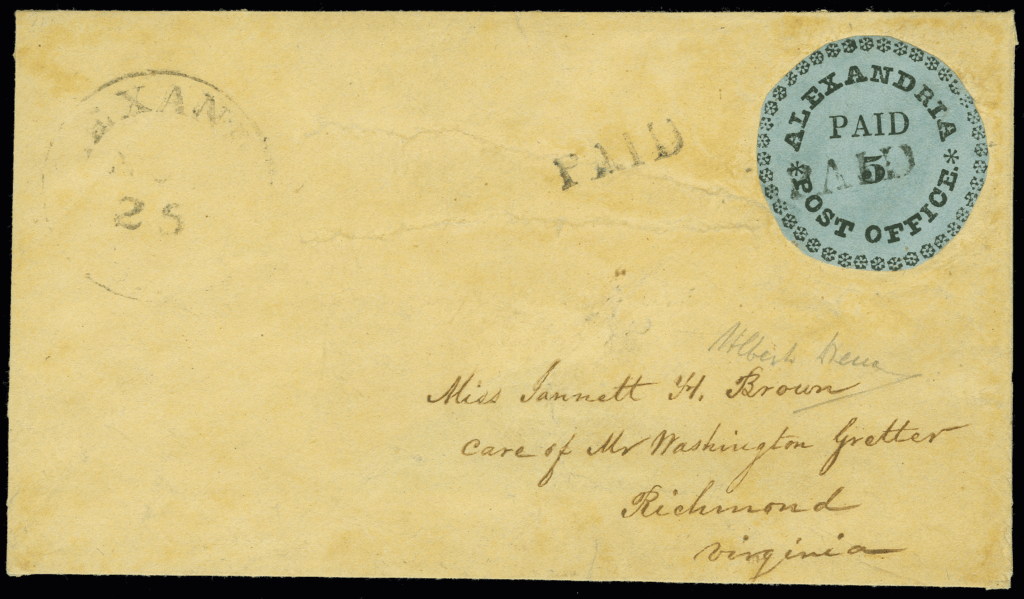
A young man in Alexandria told his secret sweetheart to burn his letter as usual; she kept the envelope instead, and the only blue Alexandria stamp in existence survived on it to become one of the great icons of American stamp collecting.
- Year
- 1847
- Maker
- United States — Alexandria, Va. postmaster
- By price in stamps
- 13 of 100
Create a free account to see every recorded price and every grade.
Create a free account- Issued
- 1846 or 1847, by Postmaster Daniel Bryan of Alexandria, then a town of the District of Columbia
- Stamp
- 5-cent black on blue paper, Type I (40 rosettes), catalog number 1X2
- Surviving examples
- One. No other Alexandria provisional on blue paper is known, on or off cover
- Other Alexandria provisionals
- Six on buff paper: three of Type I and three of Type II
- Used
- Letter dated November 24, 1847; town cancel "Alexandria D.C. Nov. 25"
- Sender and addressee
- James Wallace Hooff, 24, to his second cousin Jannett Hooff Brown, 23, in Richmond, Virginia
- Found
- 1907, by the couple's daughter, and sold that year for $3,000
- Owners
- Worthington, Gibson, Caspary, Lilly, Boker, a German collector (1981), Erivan Haub
- Last public sale
- $1,180,000 at auction in New York, June 22, 2019
A town stamp before the nation had one
The Act of Congress of March 3, 1845, gave the United States a simple postage rate: five cents for a half-ounce letter sent less than 300 miles, ten cents for longer distances, effective July 1, 1845. Congress did not, however, authorize postage stamps to prepay those rates. Robert H. Morris, the postmaster of New York, asked Postmaster General Cave Johnson for permission to issue his own, and a few postmasters in other cities and towns followed. Collectors call these local issues postmasters' provisionals.
In Alexandria, the postmaster was Daniel Bryan. His stamp was set from type rather than engraved: a circle with an outer rim of rosettes around a ring of text reading "ALEXANDRIA POST OFFICE," with "PAID" and the numeral "5" at the center. It is believed to have been printed in 1846, or possibly 1847. Researchers have suggested that the printer was Edgar Snowden, publisher of the Alexandria Gazette, but no convincing evidence for that attribution has been found.
The era of the provisionals ended when the Act of March 3, 1847, authorized national stamps. The first federal stamps, the 5-cent Benjamin Franklin and the 10-cent George Washington, were distributed on July 1, 1847. The Alexandria provisionals are the first stamps listed in the standard specialized catalog of United States stamps.
One blue stamp among seven
Only seven Alexandria provisionals are recorded. Six are printed in black on buff paper and come in two settings that differ by a single ornament: Type I has 40 rosettes around the text, Type II has 39. Three examples of each type are known on buff. Some researchers believe the stamps were printed in panes of two, one of each type.
The seventh is the Blue Boy: a Type I stamp printed on blue paper, the only Alexandria provisional of that color known on cover, off cover, used or unused. Research by the philatelist May Day Taylor, published in 2006, speculated that the blue stamps might have been made in a new order by Postmaster Bryan after the new federal stamps of July 1, 1847, failed to reach the Alexandria post office promptly.
The stamp is cut to shape around its circular design, just touching the outer rim. It is canceled by a straight-line "PAID," with a second strike of the same marking at left, and a town postmark reading "Alexandria D.C. Nov. 25" from 1847. The envelope itself is buff or yellowish. It has been neatly restored and shows sealed tears and minor faults.
That postmark is a small piece of history in its own right. Alexandria had been part of the District of Columbia. Congress passed a law returning it to Virginia in July 1846, local voters approved in September 1846, and the transfer took effect on March 20, 1847. Eight months later the town's postmark still read "D.C."
The nickname is borrowed. Collectors call the stamp the Alexandria Blue or Blue Alexandria; the cover carrying it came to be called the "Blue Boy," a loose nod to Thomas Gainsborough's famous 18th-century portrait.
"Burn as usual"
On November 24, 1847, James Wallace Hooff, 24, of Alexandria, wrote to Jannett Hooff Brown, 23, who was then in Richmond. They were second cousins. He was Presbyterian and she was Episcopalian, and their families opposed the match. Both families lived on Prince Street in Alexandria, he at number 1016 and she at 517.
The letter was restrained, mostly family news, with a warning that "Aunt Julia" suspected he was writing to her. It closed with the instruction "Burn as usual." Brown did not. Of all their correspondence, this is the only envelope she is known to have kept. One account says she stored it in her sewing box.
The couple married about six years later, in February 1853, and had three children. Decades afterward their daughter, Mrs. Fawcett, found the envelope. Sources give her first name differently: a 1925 history names her Jannett B. Fawcett, while a 2006 news report calls the couple's eldest daughter Mary Fawcett.
The letter did not travel with the cover through its famous sales. In the fall of 2005, May Day Taylor, a stamp collector researching the cover's family, traced descendants still living in Alexandria. They produced an old scrapbook containing photographs and the letter, still in a yellowed envelope. In 2006 the letter and the stamp were displayed together at the Washington 2006 World Philatelic Exhibition, on loan from an anonymous owner in Switzerland.
From a daughter's keepsake to a million-dollar record
According to an early history written by J. Murray Bartels and published in 1925, Mrs. Fawcett found the cover in 1907. It was first offered for $200 and was sold that year to the collector George H. Worthington for $3,000. In a private sale in 1915 or 1916 it passed to Henry C. Gibson, and in another private transaction in 1922 to Alfred H. Caspary, who kept it for more than three decades. LIFE magazine included it in a 1954 feature on the world's rarest stamps.
Caspary died in 1955, and his postmasters' provisionals were sold that year. A contemporary report recorded the moment simply: the cover opened at $5,000, one buyer called out $10,000, and it sold at that figure. It then belonged to Josiah K. Lilly Jr., whose collection was sold at auction in 1967, where the Blue Boy brought $18,500.
Next came John R. Boker Jr., in a private transaction. The cover changed hands three times in the 1970s. On May 8, 1981, it was sold by tender for $1 million to a German collector, at the time a record price for a stamp. A 2019 report noted that the 1981 price still stood as a record for a United States cover nearly four decades later.
The Blue Boy was part of the collection of the German-born business executive Erivan Haub when it returned to public auction on June 22, 2019, for the first time since 1967. Offered as the first lot of a sale held at the Collectors Club in New York, it drew a single bid of $1 million, the opening price, and sold for $1.18 million with the buyer's commission.
An icon of American philately
The auction catalog of 2019 called the Blue Boy arguably the greatest icon of American philately. Its appeal is partly rarity: the only example of its stamp, on the only cover that carries it, from a town that issued stamps for a short window before the federal government did.
It is also a love story with a paper trail. The envelope survives because a young woman ignored her suitor's request to destroy his letter, and the letter itself resurfaced in a family scrapbook more than 150 years later. Few stamps can be tied so precisely to the people who used them, down to their street addresses.
The numbers
- Issue date
- 1846, possibly 1847
- Catalog number
- 1X2 (blue); buff-paper stamps are 1X1 (Type I) and 1X1a (Type II)
- Known
- 1 on blue paper; 6 on buff paper (3 Type I, 3 Type II)
- Printing
- Typeset circular design; Type I has 40 rosettes, Type II has 39
- Paper and format
- Blue paper, cut to shape around the circular design
- Cancel
- Straight-line "PAID" (two strikes) and "Alexandria D.C. Nov. 25" town postmark
Timeline
Congress sets uniform postage rates of five and ten cents but does not authorize stamps, opening the way for postmasters' provisionals.
The new five-cent rate takes effect.
Alexandria Postmaster Daniel Bryan issues 5-cent provisional stamps, possibly as late as 1847.
Alexandria's return from the District of Columbia to Virginia takes effect.
The first federal stamps, the 5-cent Franklin and 10-cent Washington, are distributed.
James Wallace Hooff writes to Jannett Hooff Brown in Richmond, ending "Burn as usual."
The envelope is postmarked "Alexandria D.C." and canceled "PAID."
Hooff and Brown marry; they later have three children.
The couple's daughter finds the cover; it is sold to George H. Worthington for $3,000.
Henry C. Gibson acquires the cover privately (1915 or 1916).
Alfred H. Caspary acquires it in a private transaction.
LIFE features the cover among the world's rarest stamps.
After Caspary's death it sells for $10,000; it later belongs to Josiah K. Lilly Jr.
Sold at auction for $18,500 with the Lilly collection; John R. Boker Jr. later owns it.
Sold by tender for $1 million to a German collector, a record price for a stamp at the time.
Collector May Day Taylor locates the original letter in a descendant's scrapbook in Alexandria.
Letter and cover are shown together at the Washington 2006 World Philatelic Exhibition.
Sold at auction in New York for $1.18 million from the Erivan Haub collection, its first public sale in 52 years.
The world in 1847
Thomas Edison is born.
U.S. forces capture Veracruz after a siege during the Mexican-American War.
The American Medical Association is founded in Philadelphia.
The Chicago Tribune begins publication.
Brigham Young leads pioneers into the Salt Lake Valley.
The Whitman massacre takes place in Oregon Country.
Price record
| Date | Price | Kind |
|---|---|---|
| 1907 | $200 | Asking price, not a saleAsking price when the couple's daughter first offered the cover. |
| 1907 | $3,000 | Private saleSold to George H. Worthington. |
| 1955 | $10,000 | Sold at auctionSold with the collection of Alfred H. Caspary after his death; opened at $5,000. |
| 1967 | $18,500 | Sold at auctionSold with the Josiah K. Lilly Jr. collection. |
| May 8, 1981 | $1,000,000 | Private saleSold by tender to a German collector; a record price for a stamp at the time. |
| Jun 22, 2019 | $1,180,000 | Sold at auctionSold at auction in New York from the Erivan Haub collection on a single $1 million bid, plus 18% commission. |
A realized auction price is what a buyer actually paid on the date shown, including the buyer's premium where the sale reported it. It is the strongest kind of reference price, and it is a record of one sale of one object on one day, not a promise of what the next example will bring.
By reference price, US Alexandria 'Blue Boy' Postmaster's Provisional is number 13 of 100 in the stamps entries of the FLOAT 100. 82 of those 100 rest on a realized sale; the rest carry an asking price or a guide value, and each page says which. Rank within the FLOAT 100 itself (43 here) is editorial: how much an object defines its field, not price alone.
Did you know
- The letter it carried ended "Burn as usual." Its recipient kept the envelope, and it is the only one of their envelopes known to survive.
- The postmark reads "Alexandria D.C." even though Alexandria had officially returned to Virginia eight months earlier.
- The two types of Alexandria stamp differ by one ornament: 40 rosettes versus 39.
- The cover sold for $3,000 in 1907 and for $1 million in 1981.
- At the 1955 sale the bidding was over almost at once: it opened at $5,000, one buyer called out $10,000, and that was the price.
- The lost letter turned up in 2005 in a descendant's scrapbook in Alexandria, still in its yellowed envelope.
- Its nickname borrows from Gainsborough's painting The Blue Boy.
How this page is made
- The figure
- One reference price, shown with its own kind. FLOAT does not average it with anything or adjust it for time.
- Realized or not
- A realized price is a completed sale. An asking price, an estimate and a price-guide value are not sales, and are labeled as such wherever they appear.
- The story
- Researched from published records and checked fact by fact. Updated Oct 1, 2026.
- Archive
- Oct 5, 2026