FLOAT 100 · Stamps · No. 34
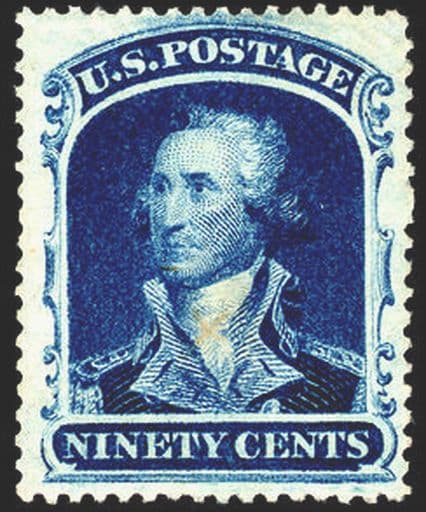
US 1860 90c Washington
America's highest-value stamp of its day was in use for barely a year before the Civil War killed it, which is why an honest used copy is worth several times a mint one and why so many used copies are not honest.
- Year
- 1860
- Maker
- United States (USPOD), Toppan, Carpenter & Co.
- By price in stamps
- 68 of 100
Create a free account to see every recorded price and every grade.
Create a free account- Issued
- 1860; earliest documented use September 11, 1860
- Catalog number
- Scott 39, 90 cents blue
- Printer
- Toppan, Carpenter & Co., Philadelphia, engraved on steel
- Design
- A young George Washington in military uniform, after a portrait by John Trumbull
- Perforation
- 15 1/2
- Printed
- About 29,000 (Smithsonian National Postal Museum); other sources give about 25,000
- Valid for postage
- About one year, until federal demonetization in 1861
- Covers known
- Six recorded complete covers
- Used examples
- About 180 certified genuine by the Philatelic Foundation, roughly a quarter of them sound
- Place in the series
- Last and highest value of the 1851-1861 issues, and of the first U.S. perforated series
A stamp without a rate
In 1857 the United States began perforating its stamps for the first time. The stamps of the 1851 designs were reissued with perforations, and new high values followed: a 24-cent and a 30-cent, both released in 1860, and finally a 90-cent, the highest denomination the country had ever issued. The National Postal Museum calls it the last and highest denominated stamp of the 1851-1861 issue.
There was no 90-cent postal rate. The Post Office Department wanted the value for heavy mail that needed a great deal of postage, and it was used in combination with other stamps to make up large foreign rates, often on packages and letters to China. The 24-cent and 30-cent values were needed for treaty rates to England, France and Germany and were used in volume; the 90-cent saw much more limited use.
Demand was expected to be low, and few were printed. The National Postal Museum puts the printing at about 29,000; dealer references and collectors' summaries give about 25,000. The stamps were printed in sheets of 200, divided into two panes of 100.
Trumbull's young general
The 1851-1861 stamps were designed and printed by a private Philadelphia firm, Toppan, Carpenter, Casilear & Co., later Toppan, Carpenter & Co. Each design was engraved on a steel die, transferred to a steel roll and rocked into the printing plate. Their stamps were so intricate that the printers had to devise new techniques to produce them, which is why the series has more types and varieties than any other of the classic period.
For the 90-cent the firm turned to John Trumbull, the painter who had served under Washington during the siege of Boston in 1776 and later studied in London under Benjamin West, sharing a studio with Gilbert Stuart. Several of the series' other Washington portraits followed Gilbert Stuart's painting; the 90-cent instead shows a youthful Washington in military dress after Trumbull. One reference identifies the source as Trumbull's 1792 portrait of Washington on the eve of the Battle of Trenton.
According to one dealer history, the stamp was first requested in pink, but the printers argued that blue would look better and the Postmaster General agreed. It is widely considered one of the handsomest stamps of the classic period, and it was voted number ten in the book 100 Greatest American Stamps by Don Sundman and Janet Klug.
Before release, the 24-cent, 30-cent and 90-cent designs were printed imperforate as a trial printing submitted to the Postmaster General for final approval. These imperforates match the issued stamps in design and color; for the 90-cent, a single pair is known.
One year, then war
The 90-cent entered service in the second half of 1860, in the months before Abraham Lincoln's election and the secession of the Southern states. Collectors' accounts date its first use to August or September 1860; the earliest documented use is a cover of September 11, 1860, to the trading firm Augustine Heard & Co. in Shanghai.
When the war began, post offices in the seceded states still held stocks of U.S. stamps. To keep the Confederacy from selling them, the federal government declared the existing stamps invalid, demonetizing the entire series in the summer of 1861, with most accounts placing it in August. The 90-cent had been in use for only about a year. Unsold stock returned to the Post Office was destroyed.
After the war, unused sheets that postmasters had kept became available to collectors. The result is an unusual inversion: genuine used copies, which had to travel on real overseas mail in a single year, are far scarcer than unused ones. The National Postal Museum notes that the 90-cent is one of the few classic stamps more collectible in genuine used condition.
Six covers, one block
Only six complete covers bearing the 90-cent are recorded. Two went to Augustine Heard & Co. in Shanghai, on September 11 and November 9, 1860; the first carries a single 90-cent paying a double rate. Another went to Barcelona on November 3, 1860; one is a legal-size cover from Cincinnati dated January 8, 1861; one went to Mackellop Stewart & Co. in Calcutta on January 26, 1861, with 12-cent and 30-cent stamps; and one went to Edwin Howland at the Cape of Good Hope on July 16, 1861, with five other stamps paying four times the 33-cent rate. Their owners read like a roll call of great American collections, among them Caspary, Ishikawa and Kapiloff.
The only recorded intact used block of four was cancelled at Washington City on July 10, 1861, and is tied to the corner of a cover with a Hong Kong backstamp dated August 3, 1861. Its $3.60 in postage probably paid eight times the 45-cent British mail rate to Hong Kong via Marseilles. Passed down through the Krug, Neinken and Bechtel collections, it later sold for $26,000 at auction in New York.
A celebrated reconstructed used block of five has its own detective story. A strip of three, once in the collection of Henry C. Needham, passed to Senator Ernest Ackerman and was bought in 1922 by the philatelic scholar Stanley Ashbrook. In the summer of 1940 Ashbrook found the matching pair, with the same magenta wavy-line pen cancel, in the stock of the dealer Philip Ward, bought it and rejoined the pieces. Ashbrook believed no other stamps had been on the original package, in which case the five would have paid ten times the 45-cent British mail rate via Marseilles; the Hong Kong backstamp on the block of four supports his theory.
Other used survivors are just as individual. One piece, the only recorded example with a fancy cancel, carries a red circle-of-diamonds marking from New Haven, Connecticut, and was the subject of an article by Thomas J. Alexander in a 1984 book on expertizing. A Boston piece bearing $1.21 in postage is the largest recorded piece with the stamp.
Identifying a genuine used copy
Because genuine used copies sell for several times the price of unused ones, the incentive to fake a cancellation is strong. One dealer reference calls the 90-cent one of the most altered nineteenth-century U.S. stamps and guesses that about one in ten carries a fake cancel, one in four has been reperforated and one in twelve regummed; it advises against buying any copy without a certificate.
About 180 used examples have been certified as genuine by the Philatelic Foundation, and only about a quarter of them are sound; many of those are off center. The cancel most often seen on genuine used copies is the New York red grid. A red London transit datestamp alongside the cancel is especially prized.
The whole series suffers from narrow margins, because the perforations took up space the designs had once had. The fine 15 1/2 gauge perforations, and clerks who still separated stamps with scissors, made tears and cut perforations common. Combined with use on heavy packages and wrappers, this explains why so many used 90-cent stamps are creased, thinned, torn or repaired.
The numbers
- Issue date
- 1860; earliest documented use September 11, 1860
- Quantity printed
- About 29,000 (another figure: about 25,000)
- Covers known
- 6
- Used copies certified genuine
- About 180, about one quarter sound
- Perforation
- 15 1/2
- Watermark
- None
- Format
- Sheets of 200 in two panes of 100; plate 1
- Printing
- Engraved, die to transfer roll to steel plate
Timeline
The United States issues its first perforated stamps, reissuing the 1851 designs with perforations.
The 24-cent, 30-cent and 90-cent values are released; the 90-cent is the highest U.S. denomination yet issued.
Earliest documented use: a cover to Augustine Heard & Co., Shanghai, with a single 90-cent paying a double rate.
A 90-cent cover is sent to Barcelona, Spain.
A second cover goes to Augustine Heard & Co. in Shanghai.
A cover with the 90-cent, 12-cent and 30-cent goes to Calcutta, India.
The only recorded intact used block of four is cancelled at Washington City; it reaches Hong Kong on August 3.
A cover to the Cape of Good Hope pays four times the 33-cent rate.
The federal government demonetizes the series; the 90-cent's postal life ends after about a year.
Stanley Ashbrook buys a used strip of three of the 90-cent.
Ashbrook finds the matching used pair in a dealer's stock and reunites the block of five.
The only recorded 90-cent with a fancy cancel is the subject of an expertizing article by Thomas J. Alexander.
An extremely fine used example, ex Ishikawa, sells for $10,000 at auction in New York.
The world in 1860
Abraham Lincoln gives his Cooper Union speech in New York.
The Pony Express makes its first run from St. Joseph, Missouri, to Sacramento, California.
Edouard-Leon Scott de Martinville records "Au clair de la lune" on his phonautograph, the earliest known intelligible recording of a human voice.
Giuseppe Garibaldi sails from Quarto on the Expedition of the Thousand.
British and French troops burn Beijing's Old Summer Palace near the end of the Second Opium War.
Abraham Lincoln is elected the 16th president of the United States.
Charles Dickens publishes the first installment of Great Expectations.
South Carolina becomes the first state to secede from the Union.
Price record
| Date | Price | Kind |
|---|---|---|
| Jun 2015 | $10,000 | Sold at auctionUsed, extremely fine, unusually wide margins, black grid and red London datestamp, ex Ishikawa; sold at auction in New York. |
| Jul 2015 | $2,000 | Sold at auctionUnused, original gum, lightly hinged, choice very fine, with two certificates; sold at auction in New York. |
| Jul 2015 | $1,100 | Sold at auctionUnused, regummed, wide margins, very fine, with a 2014 certificate; sold at auction in New York. |
| Jul 2015 | $325 | Sold at auctionLarge part original gum, well centered, minor perforation faults. |
| Aug 2015 | $2,000 | Sold at auctionGenuinely used with red grid cancel, fine, with certificate; trivial crease. Sold below its presale estimate of $3,000 to $4,000. |
| Aug 2015 | $1,300 | Sold at auctionUsed with red grid cancel; thin spot, tiny tear and crease. |
| Aug 2015 | $1,200 | Sold at auctionUnused, original gum, hinged, very fine; light crease. |
| Aug 2015 | $900 | Sold at auctionUnused, disturbed original gum, extremely fine centering; tiny thin. |
| Aug 2015 | $350 | Sold at auctionRegummed, sound, fine. |
| Oct 2026 | $10,000 | Asking price, not a saleDealer asking price for a used single. |
| Oct 2026 | $1,950 | Asking price, not a saleDealer asking price for an unused single with small flaws. |
A price-guide value is an editorial estimate, not a transaction and not an asking price. Guides lag the market and smooth over grade and condition. It is neither a floor nor a ceiling: a sale can land above or below it, and it should be checked against a realized sale before anything rests on it.
By reference price, US 1860 90c Washington is number 68 of 100 in the stamps entries of the FLOAT 100. 82 of those 100 rest on a realized sale; the rest carry an asking price or a guide value, and each page says which. Rank within the FLOAT 100 itself (34 here) is editorial: how much an object defines its field, not price alone.
Did you know
- There was no 90-cent postal rate; the stamp existed to make up big foreign rates in combination with other stamps.
- It was originally requested in pink. The printers talked the Postmaster General into blue.
- A genuinely used copy is worth several times an unused one, which has made faked cancellations on this stamp a long-running problem.
- Only six complete covers are recorded, and two of them were sent to the same trading firm in Shanghai.
- A used strip of three bought in 1922 and a pair found in a dealer's stock in 1940 turned out to be pieces of the same block, cancelled with the same magenta pen stroke.
- The only recorded intact used block of four reached Hong Kong in August 1861, just as the stamp was being demonetized at home.
How this page is made
- The figure
- One reference price, shown with its own kind. FLOAT does not average it with anything or adjust it for time.
- Realized or not
- A realized price is a completed sale. An asking price, an estimate and a price-guide value are not sales, and are labeled as such wherever they appear.
- The story
- Researched from published records and checked fact by fact. Updated Oct 1, 2026.
- Archive
- Oct 5, 2026