FLOAT 100 · Stamps · No. 33
US 1930 Graf Zeppelin Airmail Set
The Post Office printed a million of each, priced the set at $4.55 in the depths of the Great Depression, sold about seven percent and burned the rest, and in doing so created the most famous airmail stamps America ever issued.
- Year
- 1930
- Maker
- United States (USPOD), Bureau of Engraving and Printing
- By price in stamps
- 82 of 100
Create a free account to see every recorded price and every grade.
Create a free account- Issued
- April 19, 1930, Washington, D.C.; at selected other post offices from April 21
- Catalog numbers
- Scott C13 (65 cents, green), C14 ($1.30, brown), C15 ($2.60, blue)
- Printer
- Bureau of Engraving and Printing, flat plate, engraved
- Purpose
- Postage for mail carried on the airship Graf Zeppelin's 1930 Europe-Pan American flight
- Printed
- 1,000,000 of each value, by most accounts
- Sold
- 227,260 in all: 93,536 of the 65 cents, 72,428 of the $1.30, 61,296 of the $2.60
- Unsold stock
- Withdrawn and destroyed by the Post Office Department
- Face value of a set
- $4.55
- Key value
- The $2.60 (C15), the scarcest of the three
- Perforation
- 11; no straight edges, because a margin surrounded every pane
Stamps for an airship
The Graf Zeppelin, LZ 127, first flew in September 1928. Built at Friedrichshafen on Lake Constance and named for the airship pioneer Count Ferdinand von Zeppelin, it was the longest and largest airship in the world when it was completed, about 775 feet from nose to tail. In 1929 it flew around the world, and its expenses on that trip were offset by the souvenir mail it carried. A U.S.-franked letter flown the whole way from Lakehurst, New Jersey, back to Lakehurst needed $3.55 in postage.
The ship could carry only about twenty passengers, so tickets could never pay its way. Mail could. Hugo Eckener, the chairman of the Zeppelin company, was in Washington in the spring of 1930; on March 27 he received the National Geographic Society's Gold Medal, and before returning to Germany he met President Herbert Hoover and lobbied the Postmaster General for a special three-stamp issue to frank mail on a planned triangular flight from Europe to South America, North America and back.
The Post Office agreed, describing the issue as a gesture of goodwill toward Germany. The terms were lopsided. For every stamp actually used on mail that flew on the airship, the German Zeppelin Airship Works received about 93.5 percent of the face value and the U.S. Post Office kept 6.5 percent. The Post Office expected that most of the stamps would be bought by collectors who would never mail them, so it would keep that revenue in full.
The Bureau of Engraving and Printing had about six weeks to design, print and distribute the issue. Spain and Brazil, among other countries on the route, issued their own Zeppelin stamps for the same flight, and the airship's operators accepted only letters bearing the special stamps.
Three stamps, three journeys
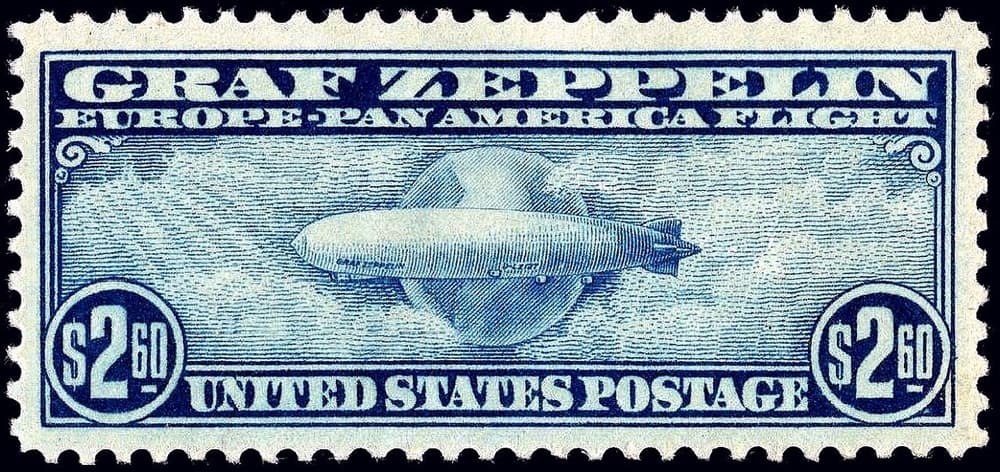
All three stamps share a common frame inscribed "GRAF ZEPPELIN" and "EUROPE-PAN AMERICAN FLIGHT" at the top and "UNITED STATES POSTAGE" along the bottom. The 65-cent green shows the airship flying eastward over the Atlantic and paid the postcard rate. The $1.30 brown shows it flying westward over a map of Europe and the Americas labeled with the cities on the route, and paid the letter rate for a one-way trip. The $2.60 blue shows the Graf Zeppelin among clouds over a globe; it paid for a letter carried on the round trip. The $2.60 was designed by C. A. Huston and A. R. Meissner, and the airship's registration, D-LZ127, can be made out in the engraving.
Put a $2.60 and a $1.30 together and they made $3.90, the exact round-trip letter rate. Mail with the stamps was sent to Germany by ship and put aboard the airship at Friedrichshafen.
The stamps were printed from plates of 200 subjects, cut into four panes of 50, and perforated 11. Because there was a margin of paper around all four sides of every pane, no Graf Zeppelin stamp has a straight edge. One dealer reference lists the $2.60 plate numbers as 20090 through 20092 and 20095; the Smithsonian's National Postal Museum holds the certified plate proof of plate 20090, signed and dated for approval before printing.
A separate 50-cent Zeppelin stamp of 1933, made for the airship's visit to the Century of Progress fair in Chicago and called the "Baby Zeppelin" by collectors, is not part of this set; 324,700 were issued, and it is far less expensive.
A $4.55 set in the Great Depression
The stamps went on sale six months after the 1929 stock market crash. A full set cost $4.55. One account compares that to fifty loaves of bread; another notes that bread cost 9 cents a loaf; a third says the set equaled a workman's wages for a week.
Collectors balked. Many refused to buy, complaining that the Post Office was charging too much and was trying to create demand by announcing that unsold stamps would be destroyed. Of the stamps printed, 227,260 were sold, roughly seven percent, and the rest were destroyed. One history of the issue notes that most of the stamps that were sold did in fact travel on mail carried by the airship, the opposite of what the Post Office had planned.
The sources differ on some of the numbers. Most give a printing of 1,000,000 of each value; one gives a combined total of 3,260,000. The date the stamps came off sale is given as June 7, 1930, in one account and June 30, 1930, in another. One encyclopedia entry gives the 65-cent sales as 93,336, but the figures for the three values add up to the widely reported 227,260 only with 93,536, the number given by stamp dealers' references.
The flight the stamps paid for
The Graf Zeppelin left on its triangular flight on May 18, 1930, carrying 38 passengers, many of them in crew quarters. (One encyclopedia account of the stamps gives a departure of May 30, which conflicts with the airship's own flight record.) On May 21, over the Cape Verde Islands, the crew dropped a sack of mail by small parachute onto the roof of the post office at Porto Praia.
The airship docked at Recife, Brazil, on May 22, with 300 soldiers helping to bring it down, and then flew to Rio de Janeiro, where there was no mooring post; the landing party held it down by hand for the two hours of the visit. On the flight north to Lakehurst a storm damaged the rear engine car, which was repaired in the Lakehurst hangar. While it was being handled on the ground there, the ship lifted suddenly and a U.S. Marine helping with the lines was seriously injured.
The return crossing went by way of Seville, Spain. A few hours from home, in a hailstorm over the Saone in France, the envelope was damaged and the ship lost lift; Eckener ordered full power and pulled out, but the Graf Zeppelin came within about 60 meters of the ground. The flight was largely paid for by stamps sold by Spain, Brazil and the United States.
Covers that made the trip carry special cancellations and cachets, including a diamond-shaped route map and a red Friedrichshafen postmark showing the airship. A flown cover bearing all three U.S. stamps, from the personal collection of James Farley, Postmaster General under Franklin D. Roosevelt, is in the Smithsonian's collection.
What collectors pay
Because the face value was so high and so few were sold, the set has become what one dealer calls the key to every U.S. airmail collection. The $2.60 is the scarcest of the three, and condition drives price. In the auction records reviewed for this page, ordinary hinged or used examples of the $2.60 sold for a few hundred dollars in 2014, while never-hinged examples in top grades brought several times as much.
In September 2014 a never-hinged $2.60 graded Superb 98, with only two examples graded higher at the time, sold for $3,250 at auction in New York. A month later a never-hinged example graded 95 sold for $1,200. A used $2.60 graded Superb 98 sold in another sale for $3,000, and complete hinged sets have sold for about $600 to $650.
Multiples are valued separately. A top plate block of six of the $2.60 sold for $8,000 in November 2014, and a block of four for $1,800. Flown covers with the $2.60 on them sold for $288 to $750 in late 2014, depending on routing and cachets.
The numbers
- Issue date
- April 19, 1930
- Printed
- 1,000,000 of each value (one source: 3,260,000 combined)
- Sold, 65 cents (C13)
- 93,536
- Sold, $1.30 (C14)
- 72,428
- Sold, $2.60 (C15)
- 61,296
- Perforation
- 11
- Watermark
- None
- Format
- Plates of 200, cut into panes of 50
- Printing
- Flat plate, engraved
Timeline
The Graf Zeppelin makes its first flight.
The airship makes its first transatlantic trip to Lakehurst, New Jersey, carrying about 66,000 postcards and covers.
The Graf Zeppelin flies around the world, starting and ending at Lakehurst; its costs are offset by souvenir mail.
Hugo Eckener receives the National Geographic Society Gold Medal in Washington, then lobbies the Postmaster General for a special stamp issue.
The 65-cent, $1.30 and $2.60 Graf Zeppelin stamps go on sale in Washington, D.C.
The stamps go on sale at selected post offices in other cities.
The Graf Zeppelin leaves on its Europe-Pan American flight.
The crew drops a sack of mail by parachute onto the post office at Porto Praia, Cape Verde.
The airship docks at Recife, Brazil, before flying on to Rio de Janeiro.
The stamps are withdrawn from sale (June 7 or June 30, depending on the source) and unsold stock is destroyed; 227,260 had been sold.
The 50-cent "Baby Zeppelin" is issued for the airship's visit to the Century of Progress fair in Chicago.
The Graf Zeppelin is retired after the Hindenburg disaster, having made 590 flights.
The Graf Zeppelin is scrapped for military aircraft production.
A never-hinged $2.60 graded Superb 98 sells for $3,250 at auction in New York.
The world in 1930
Clyde Tombaugh confirms the discovery of Pluto at Lowell Observatory.
Mahatma Gandhi breaks the salt laws of British India at the end of the Salt March.
Nurse Ellen Church becomes the world's first flight attendant.
President Hoover signs the Smoot-Hawley Tariff Act.
George Washington's sculpted head is dedicated at Mount Rushmore.
Uruguay beats Argentina 4-2 to win the first FIFA World Cup.
The National Socialists win 107 seats in the German Reichstag, becoming the second-largest party.
The British airship R101, the world's largest flying craft, crashes in France on its first overseas flight, killing 48.
Price record
| Date | Price | Kind |
|---|---|---|
| Sep 2014 | $3,250 | Sold at auction$2.60 (C15), mint never hinged, graded Superb 98 (only two graded higher at the time); sold at auction in New York. |
| Sep 2014 | $600 | Sold at auction$2.60 (C15), never hinged, well centered, very fine. |
| Oct 2014 | $1,200 | Sold at auction$2.60 (C15), never hinged, graded XF-Superb 95. |
| Oct 2014 | $550 | Sold at auction$2.60 (C15), never hinged, extremely fine; sold below its presale estimate of $750 to $1,000. |
| Oct 2014 | $325 | Sold at auction$2.60 (C15), original gum, very fine. |
| Nov 2014 | $425 | Sold at auction$2.60 (C15), lightly hinged, very fine. |
| Nov 2014 | $200 | Sold at auction$2.60 (C15), used, San Francisco postmark, fine to very fine. |
A price-guide value is an editorial estimate, not a transaction and not an asking price. Guides lag the market and smooth over grade and condition. It is neither a floor nor a ceiling: a sale can land above or below it, and it should be checked against a realized sale before anything rests on it.
By reference price, US 1930 Graf Zeppelin Airmail Set is number 82 of 100 in the stamps entries of the FLOAT 100. 82 of those 100 rest on a realized sale; the rest carry an asking price or a guide value, and each page says which. Rank within the FLOAT 100 itself (33 here) is editorial: how much an object defines its field, not price alone.
Did you know
- For every Graf Zeppelin stamp that actually flew, the U.S. Post Office kept only about 6.5 percent of the face value; the rest went to the German airship company.
- The Post Office was counting on collectors to buy the stamps and never mail them. Most of the stamps that sold ended up on mail that really did fly.
- A $2.60 stamp and a $1.30 stamp added up to $3.90, the exact round-trip letter rate.
- No Graf Zeppelin stamp has a straight edge, because every pane had a paper margin on all four sides.
- On the 1930 flight, the crew dropped a mailbag by parachute onto the roof of the post office in Porto Praia, Cape Verde.
- The $2.60 stamp's engraving shows the airship's registration, D-LZ127.
How this page is made
- The figure
- One reference price, shown with its own kind. FLOAT does not average it with anything or adjust it for time.
- Realized or not
- A realized price is a completed sale. An asking price, an estimate and a price-guide value are not sales, and are labeled as such wherever they appear.
- The story
- Researched from published records and checked fact by fact. Updated Oct 1, 2026.
- Archive
- Oct 5, 2026