FLOAT 100 · Stamps · No. 39
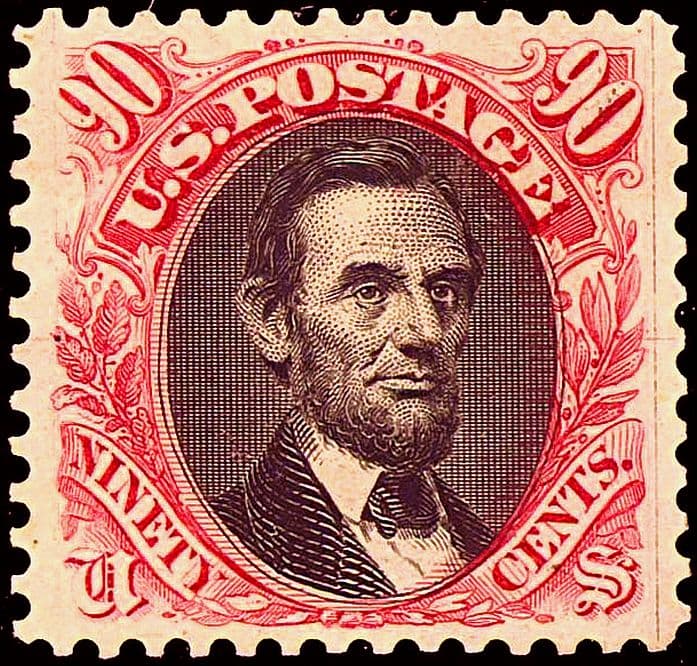
US 1869 90c Lincoln
The costliest stamp of America's first two-color set survives on exactly one envelope, and that envelope was stolen from an Indianapolis home in 1967 and walked into a Chicago stamp shop 38 years later.
- Year
- 1869
- Maker
- United States (USPOD), National Bank Note Co.
- By price in stamps
- 27 of 100
Create a free account to see every recorded price and every grade.
Create a free account- Catalog number
- Scott 122, 90-cent carmine and black Abraham Lincoln, 1869 Pictorial Issue
- Issued
- 1869; the series went on sale March 19 and 20, 1869, with the two highest values distributed somewhat later. One collector reference gives the 90-cent's earliest known use as May 10, 1869
- Printer
- National Bank Note Company
- Portrait
- Abraham Lincoln, from a photograph by Mathew Brady
- Printed
- 47,460 according to the Smithsonian's National Postal Museum; other sources give about 55,500
- Format
- Two colors, carmine frame and black portrait; G grill; perforated 12
- Distinction
- The top value of the series and the only two-color 1869 stamp with no known invert
- On cover
- One recorded: the "Ice House" cover, mailed from New England to an ice house in Calcutta in 1873
- Largest multiples
- Two unused vertical blocks of six are recorded
- Highest public sale
- $431,250 for the Ice House cover at auction in New York, June 13, 2009
A set nobody wanted
By 1868 the stamps Americans had used since the Civil War had been in service for more than six years, their printing plates were worn, and the printer's contract was due to expire in February 1869. The Post Office asked bidders to submit new designs and suggested that "there should be variety in the sizes as well as the designs of the stamps." The National Bank Note Company won the work over another Philadelphia firm, Butler & Carpenter, which complained that its own bid had been lower. Congress appointed a commission to look into the complaint, and the Smithsonian's National Postal Museum records that the commission upheld the award because the winning firm used more advanced printing methods. The museum says the contract was signed toward the end of 1868; a 2011 sale catalog dates the award to February 1869, in the last days of the Johnson administration.
The result was the 1869 Pictorial Issue: ten nearly square stamps from 1 cent to 90 cents, and the first set of United States stamps printed in two colors. Only three carried the traditional portrait of a dead statesman: the 1-cent Franklin, the 6-cent Washington and the 90-cent Lincoln. The rest showed a post rider, a locomotive, a steamship, an eagle and shield, and scenes from famous paintings. Early essays had put Lincoln on the 10-cent value; the postal museum notes that the Lincoln image was rejected there and reserved for the 90-cent stamp instead.
The public disliked the set almost at once. Critics attacked the designs, the odd shape and gum that did not hold the stamps to envelopes. A collector reference quotes one complaint that the stamps were "neither historical, national, [nor] beautiful," along with jokes that they were so small people needed microscopes to find them in their pocketbooks. A 2011 sale catalog adds that Lincoln's portrait was admired but the "prison bars" behind his head were criticized. Replacements went on sale in April 1870, less than thirteen months after the first pictorials, and the postal museum notes that no U.S. issue used more than one color again until 1918.
Ninety cents of black and red
The 90-cent stamp sets a black portrait of Lincoln, based on a photograph by Mathew Brady, inside a carmine frame. Each sheet went through the press twice, once for the portrait and once for the frame, which is how the 15-, 24- and 30-cent values of the set ended up with famous inverted frames. The National Postal Museum notes that the 90-cent is the only two-color stamp in the set with no known invert. It was also, the museum says, the only two-color portrait stamp the United States printed until a 1918 Benjamin Franklin.
Like every original 1869 stamp, it carries the G grill, a small waffle pattern pressed into the paper so canceling ink would soak in and stop people from washing and reusing stamps. The G grill measures about 12 by 11 to 11.5 points and appears on no other U.S. issue. The stamp is perforated 12. In 1875 the Post Office reprinted the old designs for its exhibit at the 1876 Centennial Exposition in Philadelphia; those re-issues have no grill, which is the quickest way to tell them from the 1869 originals.
Ninety cents was a great deal of money in 1869. A 2011 sale catalog put it at the equivalent of $14.33 in that year's money, and the stamp was meant for heavy domestic packages and multiple-rate letters abroad. Nobody bought it to keep in a drawer. A 2015 catalog explains why choice copies are scarce: clerks tended to cancel such a valuable stamp heavily so it could never be reused, and few unused copies were saved. It said one exceptional unused example probably ranked among the top 1 percent of surviving unused copies.
The amount printed is not settled. The National Postal Museum gives 47,460. A collector reference and a 2006 newspaper report give about 55,500, and a 2009 newspaper account said fewer than 50,000.
The Ice House cover
Early collectors soaked stamps off their envelopes. By the time collectors began saving whole envelopes, which they call covers, late in the 19th century, envelopes still bearing the 90-cent Lincoln had all but vanished. Only one is recorded. It is a legal-size envelope, about 3 3/4 by 9 inches, mailed in 1873 by a New England ice merchant to his ice house in Calcutta, then part of Britain's East Indies colony, and addressed to James H. Bancroft. (A 2006 newspaper report spells the name "James A. Bankcroft.") It carries the 90-cent stamp with a 10-cent and a 12-cent stamp, $1.12 in all, which paid four times the 28-cent half-ounce rate to India via Brindisi. Its markings show it crossed the Atlantic, went by train through Germany and Italy, by ship to Egypt and from Suez to Bombay, then by train across India.
It is no showpiece. A standard reference on 19th-century U.S. stamps noted that the 90-cent stamp had been torn and repaired and that the 10-cent was a replacement for a stamp once removed from the cover, calling it "not a cover for a perfectionist" but "a wonderful cover for a true philatelist." One 2006 account went further and said the Lincoln stamp was not attached when the envelope was found and was later repaired and put back on it.
According to a 2009 newspaper account, a New York collector traveling in India found the cover in 1914 and sold it to a New York dealer for $50 or $100; accounts vary. A 1943 sale in New York listed it as lot 175 with an estimate of $1,000. By the 1960s it belonged to J. David Baker, an Indianapolis steel executive and collector, who paid $6,500 for it.
On December 9, 1967, Baker and his wife came home from dinner to find their collection of about 250 rare items stolen. Seven years later a man with alleged ties to organized crime was arrested in a Chicago bank and led police to the collection, which came back without the Ice House cover. (Another account puts the recovery about a decade after the theft.) Many collectors assumed the thieves had soaked off the Lincoln to sell it as a loose stamp.
In January 2006 an elderly couple walked into a small stamp shop in Chicago's Norwood Park neighborhood with three old envelopes found while clearing out the home of a deceased relative or friend; the accounts differ. The owner, Charles Berg, knew a used 90-cent Lincoln was worth more than $2,000 but could not find the stamp on cover in his catalog. He called a friend who specialized in 19th-century U.S. stamps, who told him it was the stolen Ice House cover and that he must not let it out of the store. Five police cars arrived, and the FBI took the envelope. No charges were filed against the couple.
From an evidence room to the auction floor
Baker had collected on his insurance after the theft, so ownership had to be settled in court. In 2008 a judge returned the cover to his estate. In May 2009 The Philatelic Foundation in New York examined it and declared it genuine, and Baker's widow consigned it to a June sale in New York with an estimate of $300,000 to $400,000. Some collectors predicted $1 million or more.
On June 13, 2009, the hammer fell at $375,000. With the buyer's commission the price was $431,250. The buyer was Dr. Arthur K. M. Woo, a collector known for worldwide exhibits of rare covers. Two years later, a catalog for a major 1869 collection still described it as the only 90-cent 1869 on cover ever recorded.
Off-cover stamps come up regularly, and condition drives price. At a March 1, 2011, sale in New York, a used copy with a bright red leaf-shaped cancel brought $4,000 and a used copy with a cork cancel brought $1,050. The same sale offered the finer of the two recorded unused blocks of six, the largest intact multiple known and the only one with full original gum, ex Caspary, Kapiloff and Joseph. Estimated at $200,000 to $300,000, it sold for $150,000. The other block of six, with faults, passed through the Hind, Bechtel, Zoellner and Ainsworth collections to Bill Gross. On June 25, 2015, an unused single with original gum, graded Extremely Fine 90, sold in New York for $22,000.
Why it endures
The 1869 Pictorial Issue failed as postage and succeeded with collectors. The National Postal Museum calls it one of the highlights of the whole classic period of U.S. stamps, partly because it was the first and, until 1918, the last U.S. issue in more than one color. The museum adds that the 90-cent's place at the top of the set, the absence of any known invert and its rare status as a two-color portrait make it highly desirable. For anyone building a complete 1869 set, it is the last and most expensive space to fill.
The Postal Service paid its own tribute at World Stamp Expo in Washington in 1989, issuing a souvenir sheet with four images of the 90-cent Lincoln: one in the original red and black and three in trial color combinations. The Ice House cover remains the stamp's most famous example, a battered envelope whose theft and chance recovery are as much a part of it as the stamp itself.
The numbers
- Issue date
- 1869 (series released March 19 and 20, 1869, the 90-cent somewhat later; earliest known use reported as May 10, 1869)
- Quantity printed
- 47,460 (National Postal Museum); about 55,500 in other sources
- Known on cover
- 1 (the Ice House cover)
- Grill
- G grill, about 12 by 11 to 11.5 points, found only on the 1869 issue
- Perforation
- 12
- Colors
- Carmine frame, black portrait
- Largest unused multiple
- Vertical block of six; two recorded
Timeline
Lincoln first appears on a U.S. stamp, the 15-cent issue of 1866.
The National Bank Note Company wins the contract for a new stamp series over Butler & Carpenter; a congressional commission upholds the award.
The first 1869 Pictorial stamps go on sale; the two highest values follow somewhat later.
Earliest known use of the 90-cent Lincoln, according to one collector reference.
Replacement stamps go on sale, ending the pictorials after less than thirteen months.
A New England ice merchant mails the Ice House cover to Calcutta with $1.12 in stamps, including the 90-cent Lincoln.
The Post Office reprints the 1869 designs, without grills, for the 1876 Centennial Exposition.
A New York collector traveling in India finds the Ice House cover.
The cover is offered in a New York sale as lot 175, estimated at $1,000.
About 250 rare items, including the Ice House cover, are stolen from J. David Baker's Indianapolis home.
Police recover Baker's collection after an arrest in a Chicago bank; the Ice House cover is missing. Another account dates the recovery about a decade after the theft.
The Postal Service issues a World Stamp Expo souvenir sheet showing the 90-cent Lincoln in its original and trial colors.
An elderly couple brings the cover into a Chicago stamp shop; police and the FBI are called.
A court returns the cover to the Baker estate.
The Philatelic Foundation declares the cover genuine.
The Ice House cover sells at auction in New York for $431,250 to Dr. Arthur K. M. Woo.
The finer of the two unused blocks of six sells at auction in New York for $150,000.
An unused single graded Extremely Fine 90 sells at auction in New York for $22,000.
The world in 1869
Ulysses S. Grant is sworn in as the 18th president of the United States.
The golden spike is driven at Promontory, Utah, completing the first transcontinental railroad.
Susan B. Anthony and Elizabeth Cady Stanton form the National Woman Suffrage Association in New York.
John Wesley Hyatt patents celluloid, the first plastic, in Albany, New York.
Black Friday: the Fisk-Gould scandal sets off a financial panic in the United States.
Rutgers defeats Princeton in what is widely considered the first intercollegiate football game.
Jesse James commits his first confirmed bank robbery, in Gallatin, Missouri.
Price record
| Date | Price | Kind |
|---|---|---|
| Apr 1943 | $1,000 | Estimate, not a saleIce House cover, estimate when offered as lot 175 in a New York sale. |
| Jun 13, 2009 | $431,250 | Sold at auctionThe unique Ice House cover (90-cent with 10-cent and 12-cent companions), sold at auction in New York including buyer's commission; $375,000 hammer. |
| Mar 1, 2011 | $4,000 | Sold at auctionUsed single with a red leaf cancel, Very Fine, sold at auction in New York; price as listed in the sale results. |
| Mar 1, 2011 | $1,050 | Sold at auctionUsed single with a cork cancel, Very Fine, sold at auction in New York; price as listed in the sale results. |
| Jun 25, 2015 | $22,000 | Sold at auctionUnused original-gum single graded XF 90, sold at auction in New York; price as listed in the sale results. |
| Oct 1, 2026 | $5,900 | Asking price, not a saleDealer asking price for a used single described as Very Fine. |
A realized auction price is what a buyer actually paid on the date shown, including the buyer's premium where the sale reported it. It is the strongest kind of reference price, and it is a record of one sale of one object on one day, not a promise of what the next example will bring.
By reference price, US 1869 90c Lincoln is number 27 of 100 in the stamps entries of the FLOAT 100. 82 of those 100 rest on a realized sale; the rest carry an asking price or a guide value, and each page says which. Rank within the FLOAT 100 itself (39 here) is editorial: how much an object defines its field, not price alone.
Did you know
- The 90-cent Lincoln is the only two-color stamp in the 1869 set with no known inverted error.
- The only 90-cent Lincoln still on its envelope carried a letter from a New England ice merchant to his ice house in Calcutta.
- When the stolen cover reappeared in 2006, the Chicago dealer kept the couple who brought it in at his shop until police arrived in five squad cars.
- A 1943 sale estimated the Ice House cover at $1,000. In 2009 it brought $431,250.
- Lincoln was first proposed for the 10-cent stamp of the 1869 set; he was moved to the 90-cent and an eagle and shield took the 10-cent.
- Every 1869 original carries a G grill; the 1875 re-issues made for the Centennial Exposition have none.
How this page is made
- The figure
- One reference price, shown with its own kind. FLOAT does not average it with anything or adjust it for time.
- Realized or not
- A realized price is a completed sale. An asking price, an estimate and a price-guide value are not sales, and are labeled as such wherever they appear.
- The story
- Researched from published records and checked fact by fact. Updated Oct 1, 2026.
- Archive
- Oct 5, 2026