FLOAT 100 · Stamps · No. 38
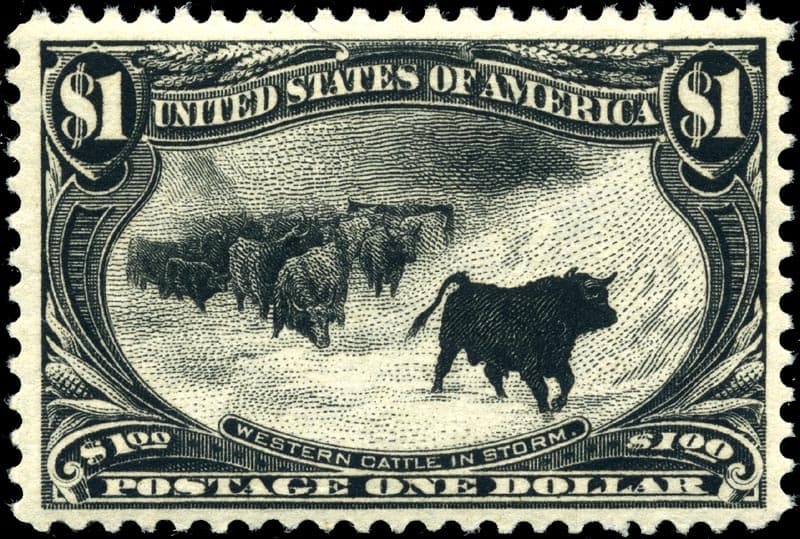
US 1898 Trans-Mississippi $1 'Western Cattle in Storm'
Billed as a scene of the American West, the stamp collectors keep voting the most beautiful in U.S. history actually shows Highland cattle in a Scottish blizzard, copied from a painting without its owner's permission and printed in black only because a war got in the way.
- Year
- 1898
- Maker
- United States (USPOD)
- By price in stamps
- 80 of 100
Create a free account to see every recorded price and every grade.
Create a free account- Catalog number
- Scott 292, $1 black, Trans-Mississippi Exposition Issue
- Issued
- June 17, 1898, for the Trans-Mississippi and International Exposition in Omaha, Nebraska
- Printer
- Bureau of Engraving and Printing, Washington
- Designer
- Raymond Ostrander Smith, the Bureau's staff designer
- Engravers
- Marcus W. Baldwin (vignette and frame); Douglas S. Ronaldson (lettering and numerals)
- Source image
- The Vanguard, a painting of cattle in a Scottish Highland storm by John A. MacWhirter
- Quantity
- 56,900 delivered to post offices; unsold stock was later destroyed
- Paper and format
- Double-line USPS watermarked paper, flat plate, sheets of 100
- Nickname
- The Black Bull
- Highest single sale found
- $60,000 at auction, November 2012, for a never-hinged copy graded Superb 98
A newspaperman's idea
By 1898 the West was filling up. Wagon trains had crossed the plains, railroads linked the coasts, and new states had joined the Union. To celebrate that growth, Omaha staged the Trans-Mississippi and International Exposition from June 1 to November 1, 1898.
The stamps were the work of a promoter. Edward Rosewater, publisher of the Omaha Daily Bee and the exposition's director of publicity, was something of a stamp expert and had led the U.S. delegation to the 1897 Universal Postal Union congress. On December 13, 1897, he proposed special stamps for the fair, and ten days later Postmaster General James A. Gary agreed. Besides the 1893 Columbians, these were the only commemorative stamps the United States issued in the nineteenth century.
Accounts differ on how the high values came about. One history says Gary first promised five denominations from one cent to one dollar and later added four more, including a $2, raising the face value of the set to $3.80; a dealer account says the 50-cent, $1 and $2 were added after the original series was planned. Either way, collectors objected. Many were still smarting from the cost of the Columbians, whose dollar values were in fact still on sale at the Washington, D.C., post office. Gary was unmoved: "No one is compelled to buy the high values unless he wishes to do so."
Scottish cattle in an American storm
The Bureau of Engraving and Printing wanted a set of unquestioned artistic distinction, partly because its only previous stamps, the 1894 definitives, had been a utilitarian reworking of the old private-company designs. Raymond Ostrander Smith designed all nine stamps around a shared frame with ears of wheat and corn in the corners, and each vignette carries a title. The $1 was labeled "Western Cattle in Storm."
The picture was not western at all. It came from The Vanguard, an 1878 painting by the Scottish artist John MacWhirter (the National Postal Museum gives his name as John A. MacWhirter) showing Highland cattle heading for shelter in a winter storm. An engraving of the painting by C. O. Murray had been published in England, and an American cattle company had copied it, without permission, for its calendar. That print reached the Bureau. Sources differ on the painting's owner: one names Lord Blythswood, another says only that it had been sold to an Englishman. A full apology was later made to the owner.
Marcus W. Baldwin engraved both the cattle and the frame, and Douglas S. Ronaldson cut the numerals and lettering. The result, a bull leading a herd through driving snow, is dense with fine engraved line, and that detail is a large part of the stamp's appeal.
Black, by accident of war
The Trans-Mississippi stamps were meant to be printed in two colors, with black vignettes inside colored frames. The Bureau prepared bicolor essays for all nine values; the National Postal Museum holds a $1 essay with a dull violet frame around the black cattle. Then the United States entered the Spanish-American War on April 25, 1898. Congress imposed new taxes to pay for it, the Bureau was flooded with orders for revenue stamps, and two-color printing was abandoned to save time and labor.
The $1 was first announced, on May 16, in light brown. Only on May 26, four days before printing began, did the public learn it would be black. The entire printing ran over three days, June 1 to 3, 1898, from plates of 100 on double-line watermarked paper. The museum gives the quantity as 56,900; another account gives 57,000 printed with 56,900 shipped to post offices.
The earliest known delivery of Trans-Mississippi stamps to postmasters was June 15, and the official first day was June 17, more than two weeks after the fair opened, because dies designed for two colors had to be reworked. Early sales were brisk and then faded. Sales to postmasters stopped on December 31, 1898, and the unsold stamps were returned and destroyed in an unknown quantity. Before this stamp, only two other $1 U.S. stamp designs had ever been released to the public: the $1 Columbian and the $1 Perry.
From "poorly conceived" to most beautiful
The stamp was not loved at first. In 1902 John Luff, one of the most influential philatelic writers of his day, wrote that the Trans-Mississippi stamps were "poorly conceived and executed, overloaded with ornaments, heavy in color and blurred in printing."
Opinion turned. By 1933 the author Ralph Kimble called the series perhaps the most attractive set of commemoratives the country had issued. In 1934 Stamps magazine asked readers to vote for the most beautiful stamp in the world; Canada's 1928 50-cent Bluenose won, and Western Cattle in Storm finished second. The National Postal Museum says collectors have repeatedly voted it the most beautiful stamp in the history of U.S. stamp production, and an auction catalog in 2012 called it widely regarded as the most beautiful U.S. commemorative ever issued.
It has a nickname to match: the Black Bull. And its first life had a long tail. In 1998, a century after the originals, the U.S. Postal Service issued all nine designs in two colors as first intended, on a souvenir sheet, along with a separate sheet of nine $1 stamps. For the 1998 $1, the frame was printed in red rather than the violet-brown of the original color scheme.
Collecting the Black Bull
A genuine 1898 $1 is printed in black on paper watermarked with double-line USPS letters, in the same wide format as the rest of the set. Its title runs along the bottom of the vignette: "Western Cattle in Storm." The 1998 reissue is easy to tell apart: it is two-colored and carries a small "1998" in the lower left corner.
Most surviving copies are hinged or used, and many have faults. In August 2015, sound hinged copies sold at auction for about $550 to $1,400, used copies for roughly $275 to $500, and reperforated or regummed copies for less than sound ones. Certificates are common for better copies.
Never-hinged, superbly centered examples are scarce. In November 2012 a never-hinged copy graded Superb 98, described as the highest grade awarded to a never-hinged example with only one other sharing it, sold for $60,000. Multiples cost proportionally more: in 2026 a dealer was asking $3,500 for an unused pair and $6,900 for an unused block of four, both with small flaws.
The numbers
- Issue date
- June 17, 1898 (earliest known delivery to postmasters June 15)
- Quantity
- 56,900 delivered to post offices (one account: 57,000 printed)
- Print run
- June 1-3, 1898
- Paper
- Double-line USPS watermark
- Format
- Flat plate, sheets of 100 subjects
- Color
- Black (light brown was announced first)
- On sale
- June 17 to December 31, 1898
Timeline
John MacWhirter paints The Vanguard, cattle in a Highland storm in Scotland.
Edward Rosewater proposes commemorative stamps for the Omaha exposition.
Postmaster General James A. Gary agrees to issue them.
The United States enters the Spanish-American War; the Bureau's revenue-stamp workload forces single-color printing.
The Post Office announces the $1 in light brown.
The color of the $1 is changed to black.
The Trans-Mississippi Exposition opens in Omaha; printing of the $1 begins.
The three-day print run of the $1 ends.
Earliest known delivery of Trans-Mississippi stamps to postmasters.
Official first day of issue.
The exposition closes.
Sales to postmasters end; unsold stamps are later destroyed.
John Luff dismisses the set as poorly conceived and heavy in color.
Readers of Stamps magazine vote it the second most beautiful stamp in the world, behind Canada's Bluenose.
The U.S. Postal Service reissues the set in two colors for its centennial, with a separate sheet of nine $1 stamps.
A never-hinged copy graded Superb 98 sells at auction for $60,000.
The world in 1898
Emile Zola's open letter J'Accuse...! is published in Paris over the Dreyfus affair.
The USS Maine explodes and sinks in Havana Harbor, killing 266 men.
The United States declares war on Spain.
Commodore Dewey's fleet destroys the Spanish squadron at the Battle of Manila Bay.
U.S. troops, including Theodore Roosevelt's Rough Riders, take San Juan Hill near Santiago de Cuba.
President McKinley signs the resolution annexing Hawaii.
The Treaty of Paris ends the Spanish-American War.
Marie and Pierre Curie announce the discovery of radium.
Price record
| Date | Price | Kind |
|---|---|---|
| Nov 2012 | $60,000 | Sold at auctionNever hinged, graded Superb 98; described as the highest grade awarded to a never-hinged copy, shared by one other. |
| Aug 2015 | $1,380 | Sold at auctionVery lightly hinged, almost Very Fine, with certificate. |
| Aug 2015 | $1,300 | Sold at auctionOriginal gum, hinged, Very Fine, with certificate. |
| Aug 2015 | $1,000 | Sold at auctionOriginal gum, lightly hinged, Very Fine, with certificate. |
| Aug 2015 | $920 | Sold at auctionVery lightly hinged, reperforated at right. |
| Aug 2015 | $850 | Sold at auctionRegummed, large and well centered, slight corner bend. |
| Aug 2015 | $690 | Sold at auctionLightly hinged, sharp impression, Fine to Very Fine. |
| Aug 2015 | $633 | Sold at auctionVery lightly hinged, reperforated at right, light corner crease. |
| Aug 2015 | $546 | Sold at auctionVery lightly hinged, Fine. |
| Aug 2015 | $489 | Sold at auctionUsed, Very Fine, with certificate. |
| Aug 2015 | $489 | Sold at auctionUsed, large margins, Extremely Fine. |
| Aug 2015 | $460 | Sold at auctionUsed, Very Fine, with certificate. |
| Aug 2015 | $431 | Sold at auctionRegummed, Fine. |
| Aug 2015 | $350 | Sold at auctionOriginal gum, hinge remnants, tiny thin and perf tear. |
| Aug 2015 | $276 | Sold at auctionUsed, Fine to Very Fine. |
| Aug 2015 | $276 | Sold at auctionUsed, reperforated at right. |
| Oct 1, 2026 | $2,200 | Asking price, not a saleDealer asking price for a mint copy. |
| Oct 1, 2026 | $2,730 | Asking price, not a saleDealer asking price for a mint copy described as Fine centering. |
| Oct 1, 2026 | $1,500 | Asking price, not a saleDealer asking price for an unused copy with small flaws. |
| Oct 1, 2026 | $995 | Asking price, not a saleDealer asking price for a used single. |
| Oct 1, 2026 | $1,730 | Asking price, not a saleDealer asking price for a used single described as Very Fine. |
| Oct 1, 2026 | $2,395 | Asking price, not a saleDealer asking price for a used single described as Extra Fine. |
A realized auction price is what a buyer actually paid on the date shown, including the buyer's premium where the sale reported it. It is the strongest kind of reference price, and it is a record of one sale of one object on one day, not a promise of what the next example will bring.
By reference price, US 1898 Trans-Mississippi $1 'Western Cattle in Storm' is number 80 of 100 in the stamps entries of the FLOAT 100. 82 of those 100 rest on a realized sale; the rest carry an asking price or a guide value, and each page says which. Rank within the FLOAT 100 itself (38 here) is editorial: how much an object defines its field, not price alone.
Did you know
- The cattle on "Western Cattle in Storm" are Scottish Highland cattle, painted near Callander in Scotland.
- The image reached the Bureau through an American cattle company's calendar, which had copied an English engraving of the painting without permission.
- The stamp was announced in light brown and switched to black only four days before printing began.
- It was supposed to be two-colored, but the Spanish-American War swamped the Bureau with revenue-stamp orders.
- In a 1934 magazine poll for the world's most beautiful stamp, it lost only to Canada's Bluenose.
- When it appeared, the 1893 Columbian dollar values were still on sale at the Washington, D.C., post office.
- Collectors call it the Black Bull.
How this page is made
- The figure
- One reference price, shown with its own kind. FLOAT does not average it with anything or adjust it for time.
- Realized or not
- A realized price is a completed sale. An asking price, an estimate and a price-guide value are not sales, and are labeled as such wherever they appear.
- The story
- Researched from published records and checked fact by fact. Updated Oct 1, 2026.
- Archive
- Oct 5, 2026